

What if the shipping method you chose for its "hands-off" convenience is actually the biggest threat to your business's standing with US Customs? Most small business owners choose Delivered Duty Paid (DDP) because it feels like a relief to let the supplier handle the paperwork. You want to focus on growing your brand, not wrestling with harmonized codes or surprise tax bills. However, with the strict Importer of Record (IOR) regulations that went into effect on March 20, 2026, that convenience now carries significant risks of DDP shipping for importers that could lead to seized cargo or even being blacklisted by CBP.
We understand that international trade can feel like an intimidating maze; we've spent over 35 years helping families and entrepreneurs find their way through it. In this article, you'll discover the hidden legal and financial pitfalls of DDP shipping and learn how to protect your business from common customs compliance traps. We'll walk you through the new 2026 rules, explain why your profit margins might be taking an invisible hit, and provide a clear roadmap for when you should move away from DDP to ensure your operations stay safe and predictable.
Key Takeaways
- Understand why the "all-inclusive" appeal of DDP often hides the legal risks of DDP shipping for importers, especially under the strict 2026 US Customs regulations.
- Learn how the new Importer of Record requirements eliminate "gray-zone" logistics and why you remain legally liable for your supplier’s documentation errors.
- Compare DDP against DAP and FOB to identify which shipping term provides the best balance of cost transparency and legal protection for your business.
- Discover why Amazon FBA sellers are at unique risk when using DDP and how to ensure your status as the Importer of Record is properly established.
- Recognize the value of a professional customs audit to safeguard your shipments from unexpected seizures, delays, and federal blacklisting.
What is DDP Shipping? The All-Inclusive Illusion
Have you ever wished that international trade was as simple as buying a product from a local shop? This desire for simplicity is exactly why Delivered Duty Paid (DDP) exists. Under the standard Incoterms rules, DDP represents the maximum level of obligation for a seller. They take on the responsibility for the entire journey, from the factory floor in a distant country to your specific delivery address. For many entrepreneurs, it feels like a "magic button" that removes the stress of logistics, making it a very popular choice in import logistics for startups where resources are often stretched thin.
The appeal is understandable. You pay one price, and the supplier handles the rest. You don't have to worry about finding a carrier, calculating duties, or filing paperwork. However, this convenience creates a fundamental conflict between ease of use and regulatory control. When you choose DDP, you're essentially handing over the keys to your legal compliance to a foreign entity that might not prioritize US law as much as you do. This lack of visibility is where the risks of DDP shipping for importers begin to take root. You trade oversight for an easy life, but that trade can become very expensive if things go wrong at the border.
The 2026 Landscape for DDP Importers
Why are we seeing so many DDP quotes lately? As global trade tensions persist in 2026, many overseas suppliers use "all-in" pricing to make their products look more attractive despite rising tariffs. While these quotes look clean on a spreadsheet, they often trigger increased scrutiny from US Customs and Border Protection (CBP). The March 20, 2026, rule change regarding verifiable Importer of Record (IOR) identities has made the old "gray-zone" DDP models obsolete. CBP now requires every shipment to be linked to a real, verifiable entity. If your supplier uses a shared or "virtual" IOR to save money, your cargo could be seized before it ever reaches your warehouse.
What the Seller Actually Pays For
To understand why DDP can be a trap, you need to know what the seller is supposedly covering in that single price. A standard DDP agreement typically includes:
- Export Logistics: Packaging, export licenses, and local transport in the country of origin.
- International Freight: The cost of air or ocean transit to a US port.
- Customs and Duties: All import duties, taxes, and terminal handling fees.
- Final Mile Delivery: Transport from the US port to your warehouse or an Amazon FBA center.
It sounds comprehensive, doesn't it? The danger lies in how the seller calculates these costs. If they underestimate the duty or misclassify the product to lower the price, the risks of DDP shipping for importers fall squarely on you. You're the one who will face the delays and penalties when the paperwork doesn't match the reality of the cargo.
The Hidden Compliance Risks of DDP Shipping
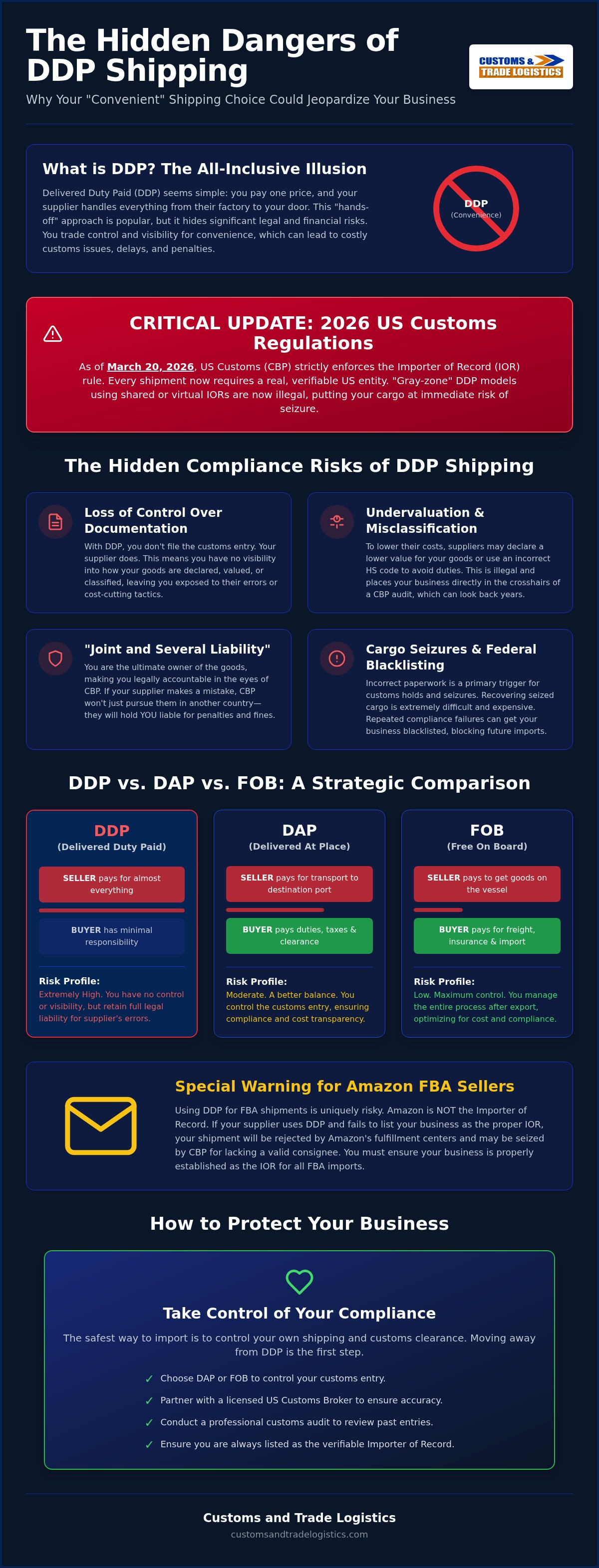
Many importers assume that because the seller pays the duties, the seller also carries the legal burden. This is a dangerous misunderstanding of official Incoterms definitions. In the eyes of US Customs and Border Protection (CBP), the ultimate owner of the goods is often held accountable for the accuracy of the entry. This concept, known as "Joint and Several Liability," means that if your supplier makes a mistake, CBP doesn't just go after them in another country; they come to you. You are part of the transaction, and that makes you part of the liability.
One of the most significant risks of DDP shipping for importers is the total loss of control over the declaration process. When you aren't the one filing the paperwork, you don't see what is being told to the government. Suppliers might under-declare the value of your goods to save on their own costs, or they might use incorrect HS codes to avoid anti-dumping duties. If CBP flags these discrepancies, your shipment won't just be delayed; it could be seized entirely. Recovering seized cargo is an expensive, uphill battle that can tarnish your business's reputation with federal agencies for years.
Undervaluation and Misclassification Hazards
Have you checked if your supplier is labeling your high-value electronics as "plastic samples"? This is a common tactic used to bypass duties, but it places your business in the crosshairs of a long-term audit. CBP has the authority to look back at years of previous entries. If they find a pattern of misclassification, you could be hit with massive back-duty bills and interest. We've seen small businesses crippled by these unexpected costs, which is why having a professional logistics partner to audit your entries is so vital for long-term security.
The "Ghost" Importer Problem
The March 20, 2026, IOR rule change was specifically designed to stop the "Ghost Importer" model. Historically, some DDP providers used fraudulent or borrowed identities to clear goods. Today, if your shipment arrives with a verifiable IOR that doesn't match the actual transaction, it is a red flag for fraud. Even if your company isn't listed as the IOR, having your name on the shipping label as the "Ultimate Consignee" links you to the investigation. The emotional toll of seeing your inventory stuck at the port while you're powerless to intervene is a stress no business owner should have to face.
DDP vs. DAP vs. FOB: A Strategic Comparison
Choosing the right shipping term is like picking the right insurance policy; you don't realize its value until something goes wrong. While we've discussed how the risks of DDP shipping for importers often center on legal liability, comparing DDP to other terms like DAP and FOB reveals a strategic path for growth. Most startups begin with DDP because it's simple. As your volume increases, however, that simplicity starts to cost you more than just money. You lose the ability to see exactly where your dollars are going.
DAP (Delivered at Place) serves as an excellent middle ground for businesses that want more control without managing every ocean vessel. Under DAP, your supplier gets the goods to your door, but you remain responsible for the customs clearance. This allows you to use your own trusted broker while still enjoying the convenience of door-to-door delivery. It effectively removes the hidden risks of unpaid tariffs that often lurk beneath a "too good to be true" DDP quote. If the supplier isn't paying the duties, they have no incentive to misdeclare the value.
Experienced entrepreneurs eventually realize that import from China logistics is most efficient when you have total visibility. This leads them to FOB (Free on Board). With FOB, you take control the moment the goods are loaded onto the ship at the origin port. You choose the carrier, you negotiate the freight rates, and you ensure the paperwork is perfect before the ship even leaves the dock. This level of oversight is the best defense against the long-term risks of DDP shipping for importers.
When to Choose DDP (and When to Run)
DDP is often appropriate for very low-volume, low-risk startup shipments. If you're importing a few cartons to test a new market, the administrative ease might be worth the small risk. But when should you run? Look for red flags in your supplier's quote. If they refuse to provide a breakdown of the duty and tax portion of the price, it's a sign they might be using a "gray-market" logistics route. When the administrative savings of DDP no longer outweigh the potential for a $10,000 customs penalty, it's time to switch to a more transparent term.
FOB: The Path to Transparency
Moving to FOB is a major milestone for a growing business. It allows you to gain full oversight of your custom brokerage service fees, ensuring you aren't paying hidden markups to a foreign middleman. By working with a US-based broker, you can verify that every HTS code is accurate. This doesn't just protect you from audits; it often uncovers duty-saving opportunities that a foreign supplier would never bother to find. You'll likely find that negotiating your own freight rates saves you more in the long run than any "all-in" DDP package ever could.
DDP Risks for Amazon FBA Sellers
If you sell on Amazon, you've likely had a supplier offer you an "FBA DDP" package. It sounds like the perfect solution: they handle the manufacturing, the shipping, and the customs, and your inventory simply appears at the warehouse. However, this is where many sellers face their most expensive lesson. Amazon has a very strict, non-negotiable policy: they will never act as the Importer of Record (IOR) for your shipments. If your supplier lists Amazon as the IOR on your customs paperwork, your goods will be rejected at the warehouse door or seized by US Customs before they even get that far.
This creates a complex legal situation. To get your goods into an Amazon warehouse, you must be the one responsible for the entry. Many sellers inadvertently fall into a trap where they are listed only as the "Ultimate Consignee" while a third-party entity hired by the supplier acts as the IOR. This is one of the most dangerous risks of DDP shipping for importers in the e-commerce space. If that third-party IOR is found to be non-compliant or fraudulent, your business is the one that loses its inventory and its reputation with CBP. You are the party receiving the economic benefit of the goods, which means you can't simply claim ignorance if the paperwork is wrong.
The FBA "Door-to-Door" Delusion
Suppliers often promise a seamless journey, but they frequently fail to handle the "final mile" requirements of the Amazon ecosystem. Amazon FBA has specific rules for palletizing, labeling, and scheduling deliveries. If your DDP provider doesn't understand these nuances, your shipment could sit at a port for weeks, racking up storage fees. Worse yet, if the duties haven't been fully settled before the truck arrives at an Amazon fulfillment center, the shipment will be turned away. Coordinating FBA freight forwarding services requires a partner who understands both US Customs law and Amazon’s internal logistics requirements.
Protecting Your Brand Reputation
For an Amazon seller, an "out of stock" notification is a disaster for your search rankings. A customs seizure caused by a DDP miscalculation can keep your products off the shelf for months. Amazon also monitors the legal compliance of its sellers; if your shipments are repeatedly flagged for customs issues, your entire seller account could be at risk of suspension. Don't leave your livelihood in the hands of a supplier who doesn't face the same consequences you do. To ensure your shipments are handled with the care they deserve, consult with our experts to audit your current FBA import strategy and secure your supply chain.
Protecting Your Business with a Customs Expert
By now, it's clear that the "all-inclusive" price of DDP often comes with hidden strings attached. Even if you choose to continue with this method for its administrative ease, you cannot afford to leave your compliance entirely in the hands of an overseas supplier. The risks of DDP shipping for importers are simply too high to ignore. This is where a professional audit of your customs clearance services us paperwork becomes your strongest defense. Having an expert eye review your entries ensures that your HTS codes are accurate and your valuations are honest before US Customs finds a reason to flag them.
We pride ourselves on acting as a "safe pair of hands" for family-owned and small businesses. Our role is to bridge the gap between your foreign factory and the strict requirements of US trade law. We don't just wait for problems to happen at the port; we work with you to verify your supplier's documentation before the ship ever leaves the dock. Once your goods clear the port, we can also manage the delivery and redistribution of your inventory, ensuring a smooth transition from the container to your customer's doorstep. This end-to-end oversight replaces anxiety with a sense of security.
The Customs and Trade Logistics Advantage
With over 35 years of experience, we've navigated every major US Customs port and seen how regulations have evolved. We understand that for a small business, a single seized shipment isn't just a line item, it's a threat to your growth. Our family-oriented approach means we take the time to demystify complex trade rules, explaining the "why" behind the paperwork. We act as your advocate, protecting you from the risks of DDP shipping for importers by ensuring your supply chain is built on a foundation of total compliance and transparency.
Your Next Steps to Secure Importing
Are you ready to take back control of your logistics? Your first step is to ask your supplier for a full breakdown of their DDP pricing. If they won't show you exactly what you're paying for duties and taxes, it's a sign you need a second opinion. We recommend setting up a consultation to review your current shipping terms and entry history. We can help you identify red flags and create a plan to transition to a safer, more transparent model like DAP or FOB. Protecting your business starts with having the right information, and we're here to guide you through every step of that journey.
Secure Your Supply Chain for 2026 and Beyond
Choosing the right shipping terms is one of the most important decisions you'll make for your business's longevity. While DDP offers a tempting shortcut, the legal and financial risks of DDP shipping for importers in 2026 are too significant to overlook. You've seen how the new Importer of Record rules have ended the era of "gray-zone" logistics and why Amazon sellers face unique hazards when they don't control their own customs entries. Moving toward more transparent terms like DAP or FOB isn't just about saving money; it's about building a business that US Customs respects and protects.
You don't have to navigate these complex waters alone. With 35+ years of US Customs expertise and a deep specialization in China-to-US logistics, our family-owned team acts as the mentor you need to stay compliant. We provide national support that turns administrative burdens into a streamlined, secure operation. Are you ready to stop guessing and start growing? Get a Professional Compliance Review for Your Shipments today. We're here to be your "safe pair of hands" in global trade.
Frequently Asked Questions
Is DDP shipping the best option for new Amazon sellers?
While DDP seems easy, it's rarely the best long-term option for Amazon sellers. Amazon strictly refuses to act as the Importer of Record, and relying on a supplier's "all-in" service can lead to rejected shipments or account suspensions. New sellers are better off using DAP or FOB terms to ensure they have full control over their compliance and IOR status from day one.
Who is legally responsible if a DDP shipment has incorrect paperwork?
You are legally responsible for the accuracy of the paperwork, even if your supplier handled the filing. Under the principle of "Joint and Several Liability," US Customs holds the buyer accountable for the validity of the entry. This is one of the primary risks of DDP shipping for importers, as you inherit the consequences of any mistakes or misdeclarations made by your foreign supplier.
Can US Customs seize my goods if the supplier paid the duties?
Yes, US Customs can and will seize goods regardless of who paid the duties if the declaration is fraudulent or incorrect. Payment of duties doesn't grant immunity from compliance rules. If the goods are undervalued or misclassified to save the supplier money, CBP will flag the shipment. Seizures often lead to total loss of inventory and potential federal investigations into your business.
What is the difference between DDP and 'Door-to-Door' shipping?
DDP is a legal Incoterm that defines who pays for duties and taxes, while "Door-to-Door" is simply a logistics service level. You can have a "Door-to-Door" shipment under DAP or FOB terms where you still maintain control over the customs clearance. Don't let a supplier use these terms interchangeably to hide the fact that they are taking over your legal compliance.
Why do some freight forwarders advise against DDP for China imports?
Many forwarders advise against it because DDP often hides the true cost of shipping and creates massive compliance gaps. For China imports, suppliers might use "gray-market" channels that bypass official regulations to keep quotes low. Experienced forwarders prefer transparent models where the importer has direct visibility into the duties paid and the HTS codes used for the entry.
Do I still need a customs broker if I use DDP shipping?
You absolutely should have a US-based customs broker to audit your DDP entries. Even though the supplier's broker might handle the initial filing, they don't represent your interests. A professional audit helps you identify the risks of DDP shipping for importers before they trigger a CBP investigation. It's about having a "safe pair of hands" to verify that your business isn't being exposed to unnecessary liability.
How can I tell if my supplier is misdeclaring the value of my DDP shipment?
You can tell if there's a problem by requesting the CBP Form 7501, also known as the Entry Summary, from your supplier. This document shows exactly what value and HTS code were declared to the government. If the supplier refuses to provide this form or if the numbers don't match your commercial invoice, they are likely misdeclaring your goods to avoid higher tax rates.
Does DDP shipping include the cost of unloading at my warehouse?
No, DDP typically does not include the cost of unloading the cargo at your warehouse. While the seller is responsible for bringing the goods to your named place of delivery, the buyer is generally responsible for the actual unloading process. You should ensure your warehouse team or 3PL is prepared to receive the goods once the truck arrives to avoid additional detention fees.


