
Did you know that since the de minimis threshold was eliminated in May 2025, even the smallest sample shipments now require formal customs entry? For many US business owners, managing import from China logistics in 2026 feels like trying to solve a puzzle where the pieces keep changing shape. You might feel a lingering anxiety about $5,000 ISF penalties or the confusion of choosing between FOB and DDP while port congestion looms. It is a heavy burden to carry alone, but you don't have to navigate these waters without a steady hand at the helm.
We understand that your business's success depends on predictable timelines and total compliance. You deserve a logistics partner who treats your cargo with the same care you do. This guide promises to demystify the entire process, providing you with a step-by-step roadmap to master shipping from China to the US. We will walk through everything from navigating the latest Section 301 tariffs to securing final delivery, giving you the peace of mind that comes with a truly professional plan.
What you'll master in this guide:
- A clear view of the 2026 trade landscape and why managing data is just as vital as moving your physical cargo.
- How to handle your legal duties as an Importer of Record and use HTS codes to accurately predict your duty rates.
- The best way to choose between air and ocean freight to balance your delivery speed with your shipping budget.
- A reliable, step-by-step import from China logistics workflow that covers everything from pre-shipment permits to the 10+2 ISF.
- Why 35 years of consulting expertise acts as a protective shield for your business growth and customs compliance.
Understanding the China-to-US Logistics Landscape in 2026
China continues to be the primary manufacturing engine for US brands because its industrial infrastructure is simply unmatched. Even as global markets shift, the efficiency and scale found in Chinese hubs—where businesses like Logotrade source their professional branded gifts—remain the gold standard. However, successful import from China logistics in 2026 requires more than just booking space on a vessel. It requires a mastery of the "invisible" side of trade: the data and documentation that must move faster than the physical cargo itself.
Many new importers fall into the trap of "hoping for the best," only to find their goods stuck at the port. This happens because modern logistics is built on strict global trade principles where every digit on a form matters. With the elimination of the $800 duty-free threshold in May 2025, every commercial shipment now faces intense scrutiny. A centralized strategy isn't a luxury for small businesses anymore; it's a survival requirement to avoid unexpected costs and delays.
The Logistics Chain: From Factory Floor to US Warehouse
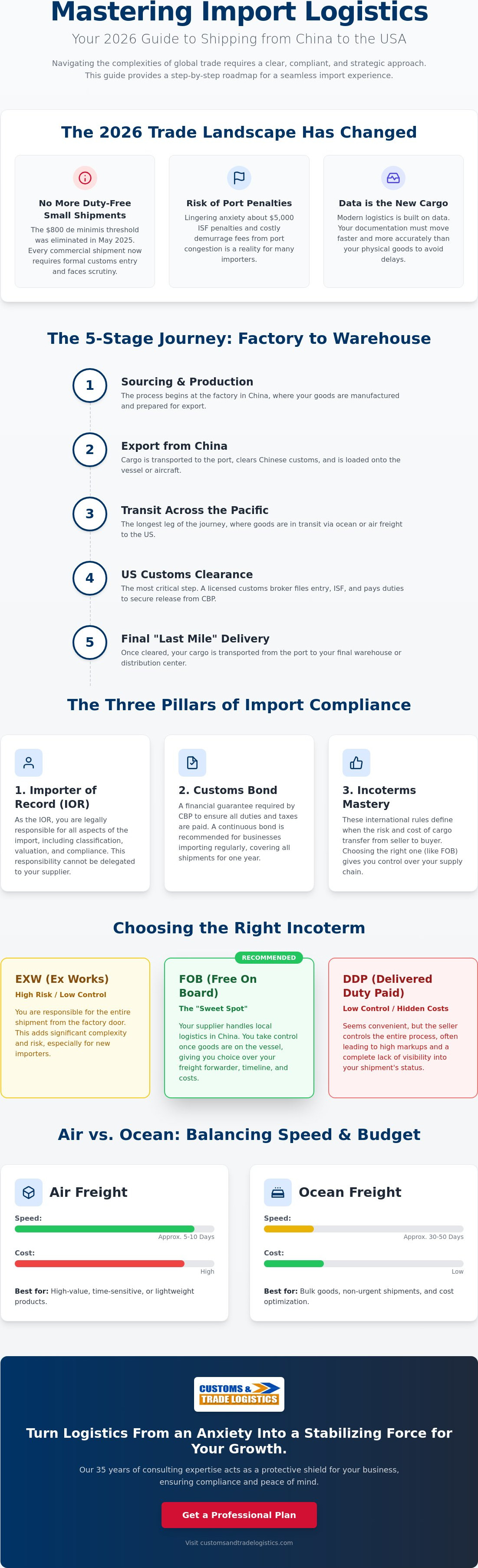
Think of your shipment's journey in five distinct stages. It begins with sourcing and production, followed by export from China, the transit leg across the Pacific, customs clearance at the US border, and finally, redistribution. While the ocean transit is the longest part of the journey, the "last mile" delivery in the US is often where the most complexity hides. You'll need to coordinate with several key players, including your supplier, the freight forwarder, and a licensed customs broker, to ensure the handoff between these stages is seamless and secure.
Why Small Businesses Need a Professional Logistics Partner
The cost of a "do-it-yourself" mistake can be devastating. When a shipment is delayed because of a paperwork error, you aren't just losing time. You're paying for demurrage and detention fees that can quickly eclipse the value of your goods. Digital "click-and-ship" platforms might look easy, but they often lack the protective care of a seasoned mentor who understands your specific business needs. They won't call you to explain why a specific HTS code might trigger a manual audit.
In 2026, we've moved into a compliance-first environment. Working with a family-oriented consultancy provides a "safe pair of hands" that digital algorithms can't replicate. A professional partner doesn't just file papers; they act as a knowledgeable bridge, helping you navigate new regulations like the Uyghur Forced Labor Prevention Act (UFLPA) and ensuring your business stays on the right side of US Customs. This partnership turns logistics from a source of anxiety into a stabilizing force for your growth.
While this guide focuses on the US, the need for localized expertise is universal. If you are also exploring opportunities in South America, you can check out Lotus Lane Trading for specialized support with the Brazilian import market.
The Three Pillars of Import Compliance and Strategy
When you begin moving goods across the Pacific, it's easy to focus solely on the ship or the plane. In reality, successful import from China logistics is built on a foundation of legal compliance and strategic paperwork. You don't want to find out your documentation is flawed when your container is already sitting at the Port of Los Angeles. Understanding your role as the Importer of Record (IOR) is the first step toward a stress-free experience. As the IOR, you are legally responsible for ensuring your goods comply with all U.S. Customs and Border Protection (CBP) guidelines, regardless of what your supplier tells you.
One of the most frequent mistakes we see is relying on a supplier's "suggested" classification. If they provide an incorrect code, you are the one who faces the penalties and audits. This is why professional import consulting is so valuable. It transforms a guessing game into a precise science, preventing classification errors that can cost your business thousands in back-payments. You also need a customs bond to act as a financial guarantee to the government that all duties will be paid. While a single-entry bond works for one-off shipments, most of our growing clients prefer a continuous bond, which covers all imports for an entire year and simplifies the clearance process.
Mastering Incoterms: FOB, EXW, and DDP Explained
Incoterms are the international rules that determine exactly when the risk and cost of the cargo shift from the seller to you. While many suppliers offer Ex Works (EXW), this leaves you responsible for everything from the factory door onwards, which is often too much for small businesses to manage. On the other end, Delivered Duty Paid (DDP) might seem convenient, but it can hide high markups and leave you with zero control over the shipping timeline. We often recommend Free on Board (FOB) as the "sweet spot." Under FOB, your supplier handles the local Chinese logistics, and you take over once the goods are on the vessel, allowing you to choose your own trusted freight partner.
Classification and Valuation: Getting the Math Right
HTS codes are the 10-digit classification system used by US Customs to determine duty. Getting this number right is critical because it dictates your total landed cost. In 2026, Section 301 tariffs on Chinese goods remain a major factor, with rates typically ranging between 7.5% and 25% for most products. You must also be diligent about valuation. Trying to "undervalue" a shipment on a commercial invoice to save on taxes is a major red flag for CBP and can lead to seizures. If these terms feel overwhelming, our Import From China Consulting can help you build a compliant strategy from day one, ensuring your business stays protected and profitable.
Choosing the Right Shipping Method: Air vs. Ocean Logistics
How do you decide between the slow boat and the fast plane? This choice is the heartbeat of your import from China logistics strategy. For most businesses, ocean freight remains the backbone of their operations because of its cost-efficiency for high volumes. If you're moving large quantities of goods, a Full Container Load (FCL) offers the best security and the lowest per-unit cost. However, we often work with growing brands that don't yet have enough inventory to fill a whole 20 foot or 40 foot container. In those cases, Less than Container Load (LCL) is a fantastic tool. It lets you share container space with other importers, making global trade accessible without needing a massive warehouse.
Lead time planning is where many businesses get tripped up. You have to look beyond the time the ship spends on the water. We call this the Total Transit Time. It includes factory release, trucking to the port in China, customs clearance at both ends, and final delivery to your door. In 2026, sea freight from China to the US West Coast typically takes 18 to 25 days, while the East Coast requires 30 to 40 days. If your schedule reliability is a concern, which currently sits at about 61.9 percent for ocean carriers, you might consider multimodal solutions. These combine sea and air legs to balance cost and speed for an optimized journey.
Ocean Freight Deep Dive: FCL and LCL Strategies
Choosing between FCL and LCL depends on your volume and how much you value exclusive use of the container. FCL is generally faster because your goods don't need to be consolidated or deconsolidated at a warehouse. If you're shipping to the West Coast, a 40 foot container from Shanghai to Los Angeles currently ranges between $3,200 and $5,500. For smaller shipments, LCL rates are approximately $45 to $90 per cubic meter. Once your ship docks, port selection becomes critical. Choosing a port closer to your final destination reduces expensive inland transport costs, often referred to as drayage, and keeps your timeline predictable.
Air Freight: Speed and Security for Premium Goods
When speed justifies the higher price, air freight is your best ally. It's ideal for high-value electronics, seasonal fashion, or premium goods where security is paramount. Companies like LC Rings demonstrate how specialized businesses must prioritize secure and rapid transit for their most valuable inventory. Air freight from China to the US takes roughly 5 to 10 days and costs about $5.30 per kilogram. You'll need to understand chargeable weight, which is based on either the actual weight or the space the box takes up in the plane. Using air logistics allows you to maintain lean inventory levels, reducing the capital tied up in stock. It acts as a vital safety valve when you need to avoid stockouts during peak seasons or when import from China logistics face ocean port congestion.
Step-by-Step: The Import From China Workflow for 2026
Think of your shipment's journey as a relay race where the baton is a mountain of digital data. If the handoff fails at any stage, the entire process grinds to a halt. Managing import from China logistics requires a methodical approach that begins long before your goods reach the water. Are you prepared for the specific milestones required by US Customs? Following a structured workflow ensures you don't face the $5,000 penalties associated with late filings or the frustration of avoidable inspections.
Your journey begins with a pre-shipment compliance check. You must verify your HTS codes and check for any required permits, such as those from the FDA or EPA, before the factory finishes production. Once your goods are ready, the second step is booking freight and filing the 10+2 Importer Security Filing (ISF). This filing is non-negotiable; it must reach US Customs at least 24 hours before the vessel is even loaded in China. After the ship departs, you'll manage the Bill of Lading and Commercial Invoice, which act as your title of ownership. As the vessel nears the US, the fourth step involves the formal Customs Entry and the payment of duties and taxes. Finally, once cleared, your cargo moves to the last stage: final delivery and redistribution to your warehouse or fulfillment center.
Documentation Mastery: The Paperwork That Powers Trade
The Commercial Invoice is the most critical document in your folder. Vague descriptions like "plastic parts" are an open invitation for a manual inspection; you need to be specific to ensure smooth passage. Your Packing List must also be a perfect mirror of your physical cargo, detailing the weight, dimensions, and carton counts for every SKU. Finally, the Bill of Lading (BOL) serves as your official contract of carriage. It's the document that proves you own the goods, and without a properly endorsed BOL, you cannot take possession of your shipment at the port.
Amazon FBA Logistics: From Factory to Fulfillment Center
If you're an e-commerce seller, your workflow has an extra layer of complexity. Amazon has strict requirements for labeling and palletization that must be met before your goods leave China. A "door-to-door" logistics chain for FBA means your partner must coordinate the ocean leg with a specialized trucking service that understands Amazon's scheduling system. Many successful sellers find that Customs Clearance Services in the US are the missing link that integrates these factory-to-fulfillment workflows seamlessly. If you want to ensure your inventory arrives ready for sale without hidden fees, our International Freight Logistics team can manage every step of this journey for you.
Why Expert Logistics Consulting is Your Competitive Advantage
Many businesses view a customs broker as a simple "paperwork filer," someone who just hits the submit button on the documents you provide. However, in the high-stakes world of import from China logistics, there is a world of difference between a filer and a trade consultant. A consultant doesn't just process your data; they challenge it. They look for inconsistencies in your commercial invoices and suggest more accurate HTS codes that might lower your duty rates. With over 35 years of experience, we've seen how this proactive approach translates into faster clearance times and significantly lower risk for our clients.
Choosing a family-owned partner means you're getting more than just a service provider; you're gaining a mentor. We offer the kind of personalized oversight that large, digital-only platforms simply can't match. When a port strike looms or a regulation changes overnight, you don't want to wait in a support queue. You want a "safe pair of hands" that already knows your supply chain inside and out. This level of dedication helps you build a scalable logistics infrastructure, allowing your business to grow without being held back by administrative bottlenecks.
Reducing Risk Through Proactive Oversight
Expert consultants are trained to identify "red flags" long before US Customs does. This might mean spotting an issue with a country-of-origin marking or catching a valuation error that could trigger a manual audit. By moving from a transactional mindset to a strategic one, you stop reacting to logistics problems and start preventing them. This strategic shift gives you the peace of mind to focus on marketing and sales, knowing your inventory is moving safely through the global marketplace.
Getting Started: Your First Shipment with Professional Support
If you're ready to professionalize your supply chain, your first consultation is the perfect place to start. You should have your supplier's contact information, product descriptions, and any existing HTS codes ready for review. We'll help you set up your Importer of Record (IOR) profile and secure a continuous bond, which is a vital step for any business planning more than two shipments per year. "In international trade, a reliable logistics partner is not an expense, but a safeguard against the volatility of global markets." By investing in Import From China Consulting, you're not just moving boxes; you're protecting your bottom line and ensuring your brand's long-term success in the US market.
Securing Your Supply Chain for 2026 and Beyond
Managing your supply chain shouldn't feel like a gamble. By mastering HTS classifications and choosing the right transit methods, you turn a complex obstacle into a clear competitive advantage. It's vital to remember that successful import from China logistics depends on the accuracy of your digital data long before the first container is ever loaded. You have worked hard to build your brand, and you shouldn't have to carry the heavy administrative burden of customs compliance alone. Whether you're a growing small business or a high-volume Amazon seller, you deserve a partner who values personal connection as much as technical precision.
We offer expertise across all US Customs ports and provide the dedicated oversight that only a family-owned consultancy can deliver. Let our 35 years of expertise secure your next China import—contact Customs and Trade Logistics today. We're ready to act as your knowledgeable bridge to the global marketplace, ensuring your goods arrive safely and your business continues to thrive. You've got a bright future ahead, and we're honored to help you reach it with total peace of mind.
Frequently Asked Questions
What is the most cost-effective way to import from China?
Ocean freight remains the most cost-effective method for managing your import from China logistics. Full Container Loads (FCL) offer the best value for large volumes, while Less than Container Load (LCL) allows you to pay only for the space you use. While air freight is faster, sea freight significantly reduces your per-unit cost, which is essential for maintaining healthy profit margins in a competitive market.
How long does it typically take for a shipment from China to clear US Customs?
Most shipments clear US Customs within 24 to 72 hours if the documentation is perfect. This timeline depends on filing your entry electronically before the vessel arrives. However, if your cargo is flagged for a manual review or a physical inspection, the process can extend by several days or even weeks. Having a proactive broker helps you prepare for these possibilities and minimize the impact on your schedule.
Do I need a special license to import goods from China into the US?
You don't need a specific "import license" for most general consumer goods entering the US. Instead, you must have a Customs Bond and a valid tax ID or Social Security number to act as the Importer of Record. Some specific products, such as those regulated by the FDA or EPA, might require additional permits or certifications. It's always best to check these requirements during your initial consulting phase.
What is an ISF filing and why is it mandatory for ocean freight?
The Importer Security Filing (ISF), also known as "10+2," is a mandatory digital declaration for all ocean freight entering the US. It requires you to provide ten data points about your cargo and two from the carrier at least 24 hours before the ship leaves China. This rule helps US Customs identify high-risk shipments. Failing to file accurately or on time can lead to a $5,000 penalty per violation.
How are customs duties and taxes calculated for China imports?
Duties and taxes are calculated using your product's HTS code, its total commercial value, and its country of origin. In 2026, most Chinese imports face a combination of standard rates plus Section 301 and Section 122 tariffs. You should also account for the Merchandise Processing Fee (MPF) and, for ocean freight, the Harbor Maintenance Fee (HMF). Expect your total landed cost to be roughly 30 to 45 percent above your factory price.
Can a customs broker help me find the correct HS code for my product?
Yes, a professional customs broker is your best resource for navigating the 10-digit HTS classification system. They use their expertise to find the code that accurately describes your goods while ensuring you pay the correct duty rate. While your supplier might suggest a code, you are legally responsible for its accuracy. A broker acts as a protective shield, helping you avoid the audits that come from improper classification.
What happens if my shipment is selected for a US Customs inspection?
If your shipment is selected for inspection, it will be moved to a Centralized Examination Station (CES) for review. US Customs has the right to inspect any cargo, and the importer is responsible for the costs of transporting and storing the goods during this time. These exams can range from a simple X-ray to a full physical devanning. While inspections are a normal part of trade, having organized paperwork can help the process move as quickly as possible.
Is it better to use a digital freight forwarder or a traditional customs broker?
Digital forwarders are often great for basic tracking, but a traditional customs broker provides the strategic mentorship that many businesses need. When you face a complex regulatory hurdle or a customs delay, a "safe pair of hands" with decades of experience is invaluable. We focus on building a personal connection with our clients, moving beyond simple transactions to provide the total management and protective care your business deserves.


