

Would you hand over a few hundred dollars today if it guaranteed you wouldn't lose $15,000 tomorrow? For many small business owners, the question of whether are customs broker fees worth it for small importers comes down to a simple choice between short-term savings and long-term survival. You've worked hard to source your products, so it's natural to feel protective of your margins when faced with line items like formal entry fees or ISF filings. We understand that every cent matters when you're growing a brand.
We've spent over 35 years helping importers move goods from factory to front door, and we know the anxiety that comes with HTS code confusion or the fear of a CBP audit. In this 2026 ROI guide, you'll discover how to calculate the true cost of DIY importing versus professional oversight. We'll break down the latest 2026 Merchandise Processing Fee (MPF) thresholds, which currently sit at a 0.3464 percent rate, and provide a clear framework to help you decide if a broker is an unnecessary expense or your most valuable partner. You'll gain the peace of mind needed to ensure your shipments clear the port without the sting of unexpected penalties.
Key Takeaways
- Understand why are customs broker fees worth it for small importers by comparing a modest service fee to the catastrophic risk of a $15,000 non-compliance penalty.
- Identify the hidden ROI found in broker-led speed, which helps your business avoid daily demurrage and port storage charges that quickly erode profit margins.
- Master the 2026 regulatory landscape, including the latest Merchandise Processing Fee (MPF) thresholds and mandatory ISF filing requirements.
- Discover how to vet a brokerage partner based on their specific China-to-US expertise and their commitment to human-led, personalized support.
The DIY Temptation: Why Small Importers Question Broker Fees
When you're building a new brand, every dollar in your budget is precious. It's natural to look at a shipping quote and ask: are customs broker fees worth it for small importers? Many startups fall for the "self-clearance" myth, believing that filing a few digital forms with U.S. Customs and Border Protection (CBP) is a task they can handle on their own. This mindset often stems from a hobbyist approach where the goal is simply to get a box from point A to point B. However, as your business grows, the complexity of international trade grows with it.
Understanding What is a Customs Broker? is the first step in realizing these professionals aren't just data entry clerks; they're licensed experts in federal law. In 2026, the reality of trade involves heightened scrutiny and a shifting tariff landscape that can catch even seasoned importers off guard. Moving from a DIY approach to a professional partnership is a psychological shift that marks the transition from a casual side-hustle to a serious, compliant business operation.
Is it Legally Required to Hire a Customs Broker?
Strictly speaking, the law doesn't force you to hire a broker. You have the legal right to file your own entries. However, CBP holds you to the exact same standard of "informed compliance" as a Fortune 500 corporation. If you misclassify a product or miss a filing deadline, "I didn't know" isn't a valid legal defense. This "Expertise Gap" is where most DIY importers run into trouble, as the government expects total accuracy regardless of your company's size. A Power of Attorney (POA) is the legal document that authorizes a licensed broker to act as your agent and conduct customs business in your name.
The Hidden Complexity of 2026 Trade Regulations
Trade in 2026 is defined by volatility. Section 301 tariffs on Chinese goods and other trade remedies continue to impact small business margins, making correct HTS classification a high-stakes game. Many products that seem "simple" actually fall under the jurisdiction of Partner Government Agencies (PGAs) like the FDA or EPA. Whether you are importing specialized materials for lobster rope doormats or moving consumer electronics, you're likely dealing with multiple layers of federal oversight. A broker acts as a protective buffer between your business and federal audits, ensuring that every agency's requirements are met before your cargo arrives at the port. This foresight is what prevents the "informal entry" mistakes that lead to seized shipments and long-term delays.
Breaking Down the 2026 Customs Broker Fee Structure
When you look at a quote from a logistics provider, the numbers can feel like a confusing alphabet soup of acronyms. To decide if are customs broker fees worth it for small importers, you first need to understand what you're actually buying. A standard entry fee covers the basic process of notifying the government that your goods have arrived. However, trade is rarely "basic." Depending on your shipment's complexity, you may see variable costs for things like Importer Security Filing (ISF), additional line items if you have a diverse product mix, or Partner Government Agency (PGA) processing if the FDA or EPA needs to weigh in on your cargo.
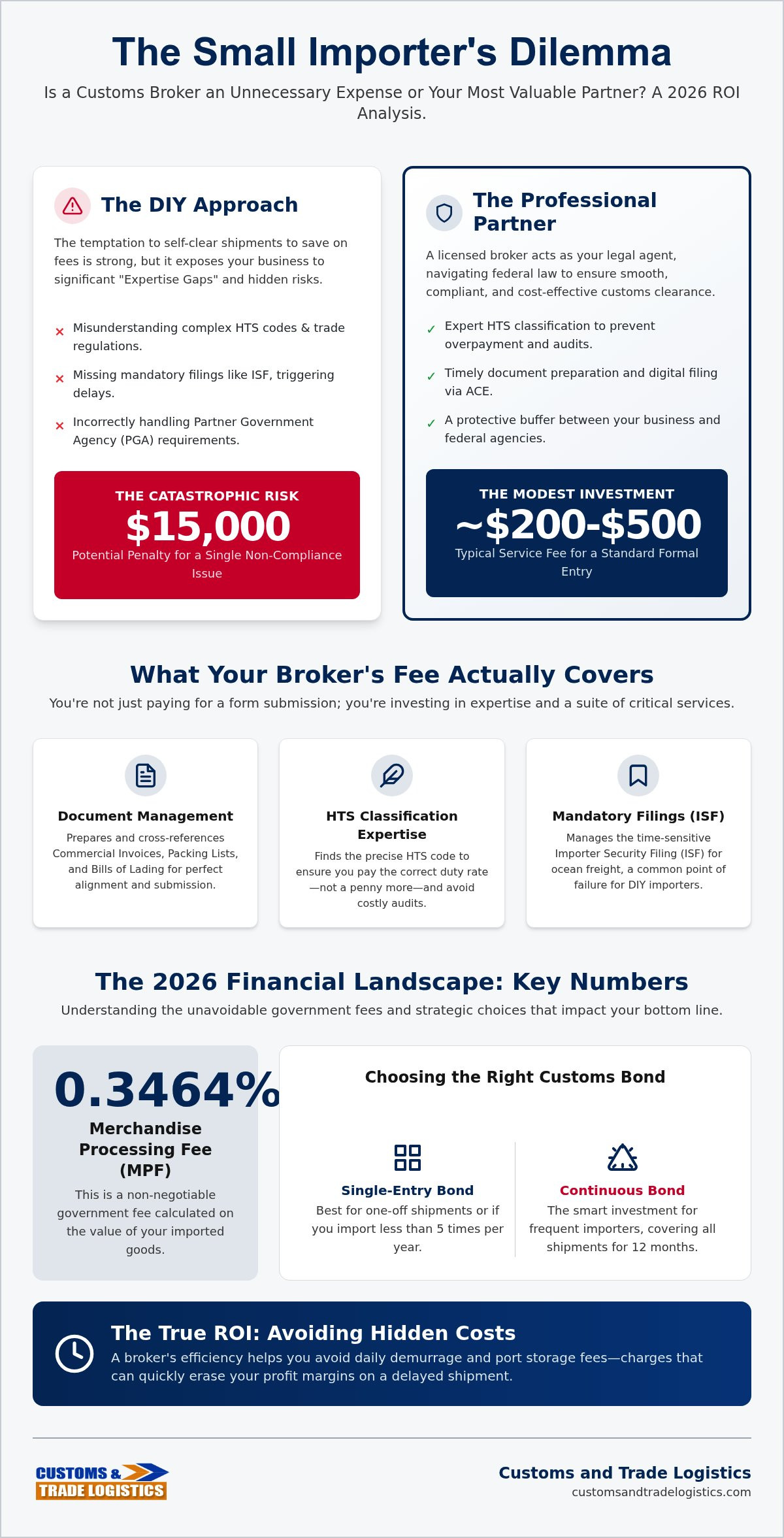
One of the most critical decisions you'll make involves your customs bond. This is essentially a specialized insurance policy that guarantees the government will receive its duties. For a one-off shipment, a single-entry bond might seem cheaper. But if you plan to import more than five times a year, a continuous bond is almost always the better investment. It covers all your entries for 12 months and often simplifies the clearance process. If you find these choices overwhelming, our team provides Customs Clearance Services that help you navigate these financial decisions with clarity.
What Exactly is Included in a Broker's Service Fee?
You aren't just paying for someone to hit "send" on a digital form. A large portion of a broker's value lies in classification expertise. Finding the precise HTS code is an art form; the wrong choice can lead to overpaying duties or, worse, triggering an audit. Your broker also manages the heavy lifting of document preparation, ensuring the Commercial Invoice, Packing List, and Bill of Lading all align perfectly. These documents are then filed through the Automated Commercial Environment (ACE), a sophisticated system governed by U.S. Customs and Border Protection regulations, which requires specialized software and training to operate.
Government Fees You Cannot Avoid
It's important to distinguish between what your broker earns and what they simply collect on behalf of the government. These are "pass-through" costs. For 2026, the Merchandise Processing Fee (MPF) is set at a rate of 0.3464 percent. For formal entries, you'll encounter a minimum fee of $33.68 and a maximum of $651.50. If you're bringing goods in by sea, you'll also pay the Harbor Maintenance Fee (HMF), which is 0.125 percent of the cargo's value. These fees go directly to the Treasury, not into your broker's pocket, but having a professional handle the calculation ensures you don't underpay and face future penalties.
Broker Fees vs. Customs Penalties: The Real ROI Calculation
Calculating the return on investment for your logistics spend requires looking at more than just the upfront cost. To answer if are customs broker fees worth it for small importers, you have to weigh a service fee against the catastrophic expense of a single mistake. For example, failing to file your Importer Security Filing (ISF) correctly or on time can result in a liquidated damages penalty of $5,000 per violation. When you compare that to a broker's modest filing fee, the service pays for itself many times over by preventing a single administrative error.
Beyond direct fines, a broker protects you from the cascading costs of port delays. If your paperwork is incomplete, your container stays at the terminal, racking up demurrage fees that typically range from $150 to $350 per day. These charges can wipe out your entire profit margin in less than a week. An expert broker ensures your cargo moves through the port with speed, effectively acting as a shield against these hidden storage costs. Outsourcing this work also saves you dozens of hours each month, allowing you to focus on selling your products rather than deciphering federal regulations.
The True Cost of a Customs Hold
What happens when CBP flags your DIY entry for an intensive exam? These inspections aren't just stressful; they are expensive. You are responsible for the costs of trucking the container to a Centralized Examination Station (CES) and the labor fees for the inspection itself, which can easily exceed $1,000. A 14-day delay at the port doesn't just stall your inventory; it strangles your cash flow and leaves your customers waiting. Partnering with a reliable import logistics partner ensures your documentation is bulletproof, which significantly reduces the likelihood of being flagged for random, time-consuming inspections.
Long-Term ROI: Building a Compliance History
CBP maintains a record of every importer's filing history. A clean record over several years builds trust with the agency, often leading to faster clearances and fewer manual reviews. Understanding the role of customs brokers in trade logistics helps you see that you aren't just buying a transaction; you're buying a reputation. While digital-only algorithms might offer a low price, they lack the nuance of a 35-year veteran who can spot a classification error before it becomes a legal problem. For a deeper dive into scaling your operations, see our guide on Import Logistics for Startups: A Strategic Guide to Global Trade in 2026. This long-term compliance strategy is what allows small businesses to eventually compete on a global scale.
Evaluating a Partner: How to Choose a Broker for Your Small Business
Choosing a brokerage partner is one of the most critical decisions you'll make for your supply chain. It's not just about finding the lowest quote; it's about finding a "safe pair of hands" that understands your specific trade lane. If you're sourcing from overseas, specialization is your best defense against the volatility of 2026 trade remedies. A broker who specializes in China-to-US logistics will be intimately familiar with Section 301 tariffs and shifting port conditions, providing a level of oversight that a generalist simply can't match. This targeted expertise is a primary reason why are customs broker fees worth it for small importers who want to avoid costly classification errors.
While technology has improved the industry, you shouldn't rely on a chatbot when your cargo is stuck at a terminal. Small importers need a blend of digital visibility and personal consulting. Be wary of suspiciously low fees that hide "extra" administrative charges for things like document storage or basic communication. A transparent partner will provide a clear, line-by-line fee schedule so you can justify every dollar against your bottom line.
Specific Needs for Amazon FBA Sellers
Amazon sellers face a unique set of hurdles, especially regarding "Importer of Record" (IOR) status. If you're a foreign-owned entity, you need a broker who can manage these legal requirements while coordinating seamless delivery to FBA warehouses. This requires a partner who understands both federal law and Amazon's strict receiving guidelines. For a deeper look at navigating these requirements, read our Amazon Seller Import Help: The 2026 Guide to FBA Freight Forwarding Services. Managing this end-to-end flow is essential for maintaining your seller rating and avoiding inventory stockouts.
Vetting Your Broker's Credentials
Before signing a Power of Attorney, verify that the firm holds a valid CBP license and permit. Don't be afraid to ask about their experience with your specific product category, whether it's complex electronics or regulated textiles. A family-owned firm often offers a level of personal investment in your growth that larger, corporate entities lack. We've spent 35 years acting as a seasoned mentor for new importers, ensuring they have the confidence to scale. If you're ready to secure your 2026 supply chain, contact our team for expert customs clearance services and let us handle the heavy lifting for you.
Protecting Your Margins with Customs and Trade Logistics
At Customs and Trade Logistics, we believe a broker should be more than just a line item on your balance sheet; we act as a stabilizing force for your business. The global market in 2026 is full of variables, from port congestion to shifting trade policies. Our family-owned firm brings over 35 years of experience to the table, providing a legacy of reliability that demystifies the often-intimidating world of international trade. When you ask if are customs broker fees worth it for small importers, the answer lies in the security of having a seasoned mentor who treats your cargo with the same care as their own.
We provide total oversight from the factory floor to your front door. By managing the entire international shipping chain, we remove the friction points that typically cause delays for unrepresented importers. This end-to-end management means you aren't just buying a customs entry; you're investing in a partnership that values personal connection as much as technical compliance. Similar to how TBM Property Management provides reliable oversight for property investors, we take the administrative burden off your shoulders, acting as a "safe pair of hands" in a complex regulatory environment.
Customized Solutions for Growing Importers
Your logistics needs will change as your business evolves. We specialize in scaling our services to match your growth, whether you are starting with Less than Container Load (LCL) shipments or moving into Full Container Loads (FCL). Our team provides expert consulting for China-to-US imports, helping you navigate high Section 301 tariffs and find legal ways to protect your margins. For a detailed breakdown of how to plan your shipping costs, see our article on Understanding Custom Brokerage Service Fees: A 2026 Guide to Import Budgeting. This proactive planning ensures that are customs broker fees worth it for small importers looking to build a sustainable, long-term trade operation.
Ready to Secure Your Supply Chain?
Securing your 2026 supply chain doesn't have to be a complicated process. Getting started with a professional broker is a simple step that immediately lowers your risk profile with CBP. Once we have your Power of Attorney and product details, we handle the filings, the bonds, and the coordination with carriers. This allows you to stop worrying about HTS codes and start focusing on what you do best: selling your products and growing your brand. If you're ready to experience the relief of a fully managed import process, contact us today for a personalized review of your import needs. Let our family help your business navigate the global marketplace with confidence.
Securing Your 2026 Import Success
The journey from a foreign factory to a U.S. warehouse is filled with regulatory hurdles that can easily trip up an unrepresented business. When you evaluate if are customs broker fees worth it for small importers, remember that you aren't just paying for a digital filing. You're investing in a shield against five thousand dollar ISF penalties and the daily drain of port demurrage fees. By choosing a partner with 35+ years of industry experience, you replace the anxiety of a potential audit with the confidence of a seasoned mentor who understands your specific trade lanes.
We take pride in being a family-owned firm that specializes in the nuances of China-to-US logistics and Amazon FBA requirements. Our goal is to demystify the complex parts of trade so you can focus on building your brand. Don't let paperwork be the bottleneck that stops your growth. You deserve a partner who values your bottom line as much as you do. Get a Personalized Customs Brokerage Quote for Your Small Business and let us handle the complexities while you scale your operations with total peace of mind.
Frequently Asked Questions
Is it worth hiring a customs broker for a single small shipment?
Yes, hiring a professional is almost always a smart move even for a single shipment. When you ask if are customs broker fees worth it for small importers, you have to look at the liability you take on by filing yourself. CBP expects 100 percent accuracy on every form. A single error on your ISF filing can lead to a $5,000 fine, which is significantly more expensive than a broker's entry fee.
How much should a small business expect to pay in customs broker fees in 2026?
For 2026, standard industry fees for formal entries generally range between $150 and $400 per entry. Complex shipments that require clearance from agencies like the FDA or USDA often fall into the $250 to $400 range. You should also account for the Merchandise Processing Fee (MPF), which has a 2026 minimum of $33.68. Requesting a line-by-line fee schedule from your partner is the best way to avoid surprises.
Can a customs broker help me reduce the amount of duty I pay?
Brokers reduce your costs by identifying the precise Harmonized Tariff Schedule (HTS) code for your products. Many importers accidentally use codes with higher duty rates or miss out on trade agreements that could lower their tax burden. A seasoned mentor uses their expertise to ensure you pay exactly what you owe and not a penny more. This strategic classification protects your profit margins from being eroded by overpaid tariffs.
What happens if I don't use a customs broker and my paperwork is wrong?
Incorrect paperwork can lead to shipment seizures, expensive port delays, and civil penalties that average $15,000 per incident. If your documentation is wrong, CBP may move your cargo to a Centralized Examination Station for an intensive exam, which can cost you over $1,000 in labor and trucking fees. Beyond the immediate costs, a poor filing history makes your business a target for frequent, time-consuming inspections in the future.
Do Amazon sellers need a customs broker for FBA imports?
Amazon sellers generally need a broker because Amazon refuses to act as the Importer of Record for FBA shipments. You are responsible for ensuring all duties and taxes are paid before the goods reach an FBA warehouse. A broker who understands Amazon's specific requirements can manage your IOR status and coordinate the final delivery. This partnership ensures your inventory isn't rejected at the warehouse door due to compliance failures.
What is the difference between a freight forwarder and a customs broker?
A freight forwarder acts as the travel agent for your cargo, while a customs broker acts as the legal representative to the government. The forwarder manages the logistics of ships, planes, and trucks to move the goods. The broker focuses on the complex laws and regulations required to clear those goods through the port. Many small businesses find that using a firm that handles both services creates a much smoother journey.
How long does the customs clearance process take with a broker?
The clearance process often takes less than 48 hours when a broker files your entry electronically before the cargo arrives. Brokers use the Automated Commercial Environment (ACE) system to submit data directly to CBP. This early filing allows for "wheels up" or "vessel arrival" clearances, meaning your goods can move toward their final destination immediately. Without a broker's digital tools, you might face days of manual processing at the port.
Is a continuous customs bond better than a single-entry bond for small importers?
A continuous bond is the better choice if you plan to import five or more times in a single year. While a single-entry bond might seem cheaper for one-off shipments, a continuous bond covers all your imports for 12 months. It also simplifies the ISF filing process and is often required for certain types of high-value or regulated cargo. Deciding between bond types is a key part of determining if are customs broker fees worth it for small importers.


