

A low freight quote can become an expensive surprise if no one has clearly taken responsibility for the shipment’s next handoff. If you’re asking how to find a reliable freight forwarding partner, look beyond the rate. Find out who coordinates each step, from transport and customs clearance to final delivery, and what happens if the plan changes.
A suitable partner should explain what’s included, how you’ll receive updates, and which responsibilities belong to other providers. These details can be difficult to compare when providers use different terms or rely on separate companies for parts of the journey.
This practical 2026 guide explains how to assess a provider’s experience, service scope, communication, and costs before entrusting them with an international shipment. You’ll learn how to compare quotes using the same shipment details, clarify who manages customs and delivery handoffs, and check whether a provider’s capabilities fit your needs. Customs and Trade Logistics has more than 35 years of industry experience and supports small and medium-sized businesses managing imports.
Key Takeaways
- To learn how to find a reliable freight forwarding partner, assess how well a provider’s experience and responsibilities match your specific shipment needs.
- Ask which shipment tasks the provider handles directly and which depend on outside parties, so handoffs are clear before you commit.
- Compare written quotes using the same shipment details, and clarify what’s included, excluded, or subject to change.
- Use a consistent vetting process to ask focused questions, check relevant experience, and compare communication practices.
- Prepare a shipment brief with cargo, origin, destination, timing, documents, and delivery needs to help set up the first shipment clearly.
How to Find a Reliable Freight Forwarding Partner for Your Business
A reliable partner provides clear ownership and communication, not just a low quote. You should know who coordinates each stage, what updates to expect, and whom to contact if a handoff or schedule changes. Getting those details before booking can help you identify gaps while there’s still time to address them.
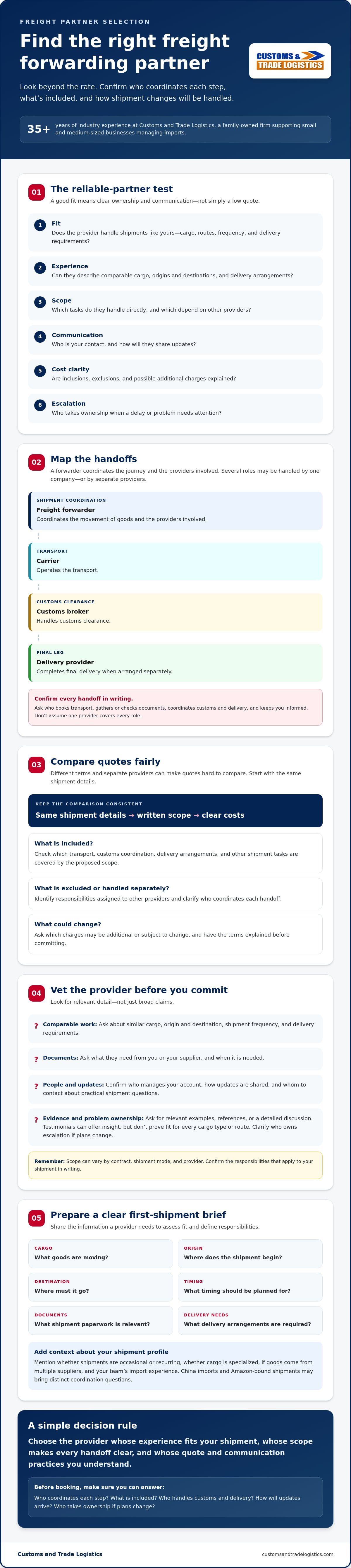
A freight forwarder coordinates the movement of goods and the providers involved in that journey. For a neutral overview of what a freight forwarder is, it helps to distinguish coordination from the work itself: a carrier operates the transport, a customs broker handles customs clearance, and a delivery provider completes the final leg when that’s arranged separately. One company may cover more than one role, but don’t assume it does. Confirm responsibilities in the agreed scope.
Use this first-pass checklist to focus your questions:
- Fit: Does the provider handle shipments like yours?
- Experience: Can they describe relevant cargo, routes, and delivery arrangements?
- Scope: Which tasks are performed directly, and which rely on other providers?
- Communication: Who is your contact, and how will they share updates?
- Cost clarity: Are inclusions, exclusions, and possible additional charges explained?
- Escalation: Who takes ownership when a delay or problem needs attention?
What should a reliable freight forwarding partner take responsibility for?
Ask how the provider coordinates the shipment from supplier pickup or the first origin handoff through the delivery milestones you’ve agreed on. Who arranges bookings? Who gathers or checks shipment documents? Who coordinates customs clearance, transport, and delivery arrangements? Several parties may be involved, but you should be able to identify who owns each handoff and how updates will reach you. Because scope varies by contract, shipment mode, and provider, get responsibilities in writing.
Why does the right partner depend on your shipment profile?
An occasional shipment may need a different level of coordination than recurring volume, specialized cargo, or goods collected from multiple suppliers. When discussing fit, share the origin, destination, cargo details, delivery requirements, and your team’s import experience. China imports and Amazon-bound shipments can raise distinct coordination questions, such as how supplier handoffs or delivery requirements will be managed. Customs and Trade Logistics is a family-owned firm with more than 35 years of industry experience, including particular expertise in imports from China. Treat relevant experience as a reason to ask focused questions, not as a substitute for confirming the scope of your shipment.
Check Freight Forwarder Experience, Service Scope, and Accountability
Experience matters most when it matches the shipment you’re planning. A provider may know one trade lane or cargo type well but have limited experience with another. As you assess how to find a reliable freight forwarding partner, ask about work comparable to yours in cargo, origin and destination, shipment frequency, and delivery requirements. Look for a specific explanation of how the provider would coordinate your shipment, rather than relying on broad claims of expertise.
Which experience and capability questions should you ask?
Ask how the provider has handled shipments with similar characteristics and what handoffs were involved. Can they explain which documents they’ll need from you or your supplier, and when those documents are needed? Ask who will manage your account and whether that contact can answer practical questions about your cargo and delivery plan. FIATA offers a place to explore industry best practices. Consider general guidance alongside shipment-specific questions when evaluating a prospective provider.
Relevant experience should be supported by clear examples, references, or a detailed discussion of comparable work. Testimonials can offer insight into a customer’s experience, but they don’t show that a provider can manage every cargo type, route, or service requirement.
How can you clarify customs and transport responsibilities?
Ask whether customs clearance is included in the proposed scope or arranged separately, and who coordinates with the customs broker. Confirm who communicates with carriers, suppliers, customs representatives, and delivery providers. If several companies are involved, establish which provider is responsible for passing information between them and updating you if a handoff is delayed.
Request a written scope before agreeing to proceed. It should identify the services covered, key shipment milestones, the party responsible at each stage, and the contact for resolving questions or problems. Check that it reflects your shipment mode and delivery needs, and ask for clarification wherever responsibility is vague. For more detail on brokerage responsibilities, see this U.S. customs clearance services guide.
Customs and Trade Logistics combines customs clearance services with international freight logistics and import consulting. If your shipment needs both transport coordination and customs support, explore customs and logistics support as you assess which responsibilities your provider should cover.
Compare Freight Forwarding Quotes, Communication, and Shipment Visibility
A headline quote tells you little if providers priced different services or made different assumptions. Give each provider the same shipment specification: cargo description, origin, destination, shipment mode, timing, and delivery requirements. Then compare the written scope, not just the total. This is a practical step in how to find a reliable freight forwarding partner because it helps reveal differences in responsibilities and costs.
How do you compare freight forwarding quotes fairly?
Ask each provider to separate its service charges from third-party charges and identify what’s included, excluded, estimated, or dependent on final shipment details. Clarify assumptions about cargo information, shipment dimensions, delivery arrangements, or other details that could change the quote. For customs-cost planning, see this custom brokerage service fees guide.
Use a simple comparison sheet so every provider answers the same questions:
Scope: Provider A: ______ | Provider B: ______
Charges and assumptions: Provider A: ______ | Provider B: ______
Communication and updates: Provider A: ______ | Provider B: ______
Handoffs and responsible parties: Provider A: ______ | Provider B: ______
Exclusions or possible adjustments: Provider A: ______ | Provider B: ______
Blank answers are a reason to ask follow-up questions. Request written clarification before choosing.
What communication and visibility should you expect?
Agree on how updates will arrive, how often you can expect them, and which contact is accountable for responding. Ask what shipment milestones can be confirmed and what tracking information is available. Some updates may depend on carriers or other providers, so clarify who gathers that information and passes it along.
Communication matters most when the plan changes. Ask how the provider will raise a delay, missing document, or schedule change, who will explain the impact, and what next steps they’ll coordinate. A realistic description of visibility is more useful than a broad promise. Confirm what you’ll see, when you’ll receive it, and whom to contact if an update is unclear.
Vet a Freight Forwarding Partner Before You Sign
A consistent review process can turn a promising conversation into a clear working agreement. If you’re deciding how to find a reliable freight forwarding partner, use these steps before authorizing a shipment:
- 1. Define your shipment needs. Write down the cargo, route, timing, required services, and delivery arrangements.
- 2. Shortlist providers. Focus on businesses with experience relevant to your shipment and the responsibilities you need covered.
- 3. Ask focused questions. Request examples of comparable shipments and ask how handoffs, documents, and exceptions are managed.
- 4. Verify the details. Check references or comparable experience where appropriate. Confirm any applicable credentials with the relevant authority, and make sure they fit the provider’s role and transport mode. Don’t assume one credential covers every activity.
- 5. Compare the written terms. Review scope, quote assumptions, service boundaries, liability language, insurance details, and cancellation conditions.
- 6. Confirm before proceeding. Make sure the agreed responsibilities, contacts, and next steps are documented before the shipment is arranged.
What documents and answers should you request?
Ask for a written service scope, a sample quote structure, the applicable terms, and a defined process for raising urgent shipment issues. Confirm how commercial invoices, packing information, and transport documents are reviewed, who shares them with relevant parties, and how questions or corrections are handled. If you’re sourcing from China, this China import logistics guide can help you prepare for the coordination questions involved.
Read the agreement closely. Check what the provider accepts responsibility for, what falls outside the scope, and how liability and insurance are described. If any wording is unclear, ask for an explanation in writing before you sign. For legal interpretation of contract language, consult a qualified professional.
Which warning signs deserve a closer look?
Vague exclusions, inconsistent answers, and promises that don’t appear in the written terms call for follow-up. If a quote leaves out a service your shipment needs, ask whether it’s excluded, arranged separately, or still to be confirmed. A single low quote or missed reply isn’t proof of poor service, but repeated gaps or reluctance to clarify responsibilities should factor into your decision.
For imports from China that require customs clearance or freight coordination, explore China import consulting and logistics support as you assess your options.
Choose the Right Freight Forwarding Partner and Set Up the First Shipment
The right partner is the one whose experience, communication, and agreed service scope fit your shipment, not simply the provider with the lowest quote. Once you’ve chosen, treat onboarding as the first practical test of how well responsibilities are understood. A clear handover helps your supplier, logistics provider, customs representative, and delivery provider work from the same shipment details.
Start with a concise shipment brief that covers:
- Cargo: Description, quantity, dimensions, and other details requested for planning.
- Route: Origin, destination, and supplier contact information.
- Timing: Your target shipment and delivery dates, plus any important decision deadlines.
- Documents: What’s available, who will provide each item, and who will review or share it.
- Delivery needs: Destination requirements and any arrangements that need to be coordinated.
Before cargo moves, confirm your working contact, approval points, expected updates, and who will take ownership of exceptions. Keep the agreed scope, quote assumptions, communication channels, and document responsibilities in writing. If the supplier changes cargo details or timing, ask how the change should be approved and who needs to be informed.
How do you make onboarding smoother for your first shipment?
Share accurate cargo and supplier information early, then confirm who is responsible for each required document and handoff. Agree on shipment milestones, decision deadlines, and how changes will be approved before they arise. A short written recap after the initial planning conversation can help everyone work from the same instructions and make unresolved questions visible before they affect the shipment.
When should you speak with a logistics and customs partner?
Consider getting guidance if supplier coordination, customs paperwork, or delivery planning feels unclear, particularly when your business is handling international imports for the first time or managing growing shipment needs. Customs and Trade Logistics is a family-owned firm with more than 35 years of industry experience, supporting small and medium-sized businesses with customs clearance, international freight logistics, import consulting, and delivery redistribution.
For help discussing your shipment’s import logistics and customs coordination, discuss your import logistics needs.
Move Forward With a Partner That Fits Your Shipments
Choosing a freight forwarding partner is less about finding the lowest quote and more about knowing who owns each handoff. Match the provider’s experience and service scope to your shipment, compare written terms using the same details, and agree on communication and escalation before cargo moves. These steps make it easier to decide how to find a reliable freight forwarding partner with confidence.
A clear shipment brief gives your chosen provider a practical starting point. Share accurate cargo, supplier, route, document, timing, and delivery information, then confirm who will handle each responsibility. If customs clearance and freight coordination both matter, make sure the provider can explain how those services fit together and where its scope ends.
Customs and Trade Logistics is a family-owned firm with more than 35 years of industry experience, supporting small and medium-sized importers with customs clearance and international freight logistics. If you’d like to discuss an upcoming import, discuss your import logistics needs. With clear expectations and the right support, you can move your shipment forward one well-defined step at a time.
Frequently Asked Questions
How do I know if a freight forwarder is reliable?
Assess reliability against your shipment’s needs, not a general promise. Look for relevant experience, documented responsibilities, transparent quote assumptions, and a defined communication process. Ask who coordinates each handoff and how the provider handles delays or other exceptions. Verify credentials that apply to the specific services and transport modes involved. Compare providers’ written answers rather than relying on a sales conversation alone, and clarify anything uncertain before proceeding.
What questions should I ask a freight forwarding partner?
Ask what services are included, who is responsible for each handoff, and how customs clearance is coordinated. Confirm which charges or assumptions may change, who your main contact is, how updates will be shared, and how delays are escalated. Request written terms and a clear description of the service scope. Tailor your questions to your cargo, route, shipment frequency, and delivery requirements so you can compare providers using the same criteria.
How do I compare freight forwarding quotes?
Give every provider the same cargo description, route, shipment timing, and delivery requirements. Then compare the proposed service scope, included and excluded charges, assumptions, possible adjustments, and communication commitments. A lower headline quote may cover less work than another proposal, while an estimate may change if shipment details are unconfirmed. Ask providers to explain differences in writing before choosing, and make sure you understand what each quote covers.
Should a freight forwarder also handle customs clearance?
Not necessarily. Freight forwarding coordinates shipment movement and related logistics, while customs brokerage handles customs clearance activities. One provider may offer both, or you may work with separate specialists. Confirm who coordinates with the customs broker, what information each party needs, and whether brokerage is included in the proposed scope or arranged separately. Put the handoff in writing so it’s clear who is responsible for communicating and sharing shipment information.
Can a small business use a freight forwarding partner?
Yes. Small businesses can choose a provider whose services and communication fit their shipment volume, experience, and delivery needs. Ask whether the provider can accommodate your shipment pattern, what information your team must supply, and how charges are presented. A large global network isn’t the only measure of fit. Clear responsibilities and practical communication may matter more for your business. Customs and Trade Logistics supports small and medium-sized importers.
What documents should I prepare before contacting a freight forwarder?
Prepare the cargo description, supplier and destination details, expected timing, packaging information, and delivery requirements you already know. Commercial invoice and packing details may also be relevant, depending on the goods and shipment. Ask the provider which documents are needed, who will review them, and who will share or submit them. Documentation needs can vary, so confirm the requirements for your specific shipment rather than relying on a generic checklist.
Is the cheapest freight forwarding quote the best choice?
Not automatically. Quotes can differ in service scope, assumptions, included charges, communication, and responsibility for shipment handoffs. Compare proposals using identical shipment details, then ask providers to explain exclusions or uncertain items in writing. A higher quote isn’t automatically better, either. The aim is to understand what each provider will coordinate and choose the option that fits your shipment requirements and tolerance for uncertainty, not simply the lowest headline figure.


