

The right drayage partner is defined by the route it can serve, not just the truck it sends. A drayage carrier moves containerized freight short distances between facilities, often between ports or intermodal terminals and the next point in the journey. Finding a reliable drayage company starts with matching its safety practices, communication, experience, and geographic coverage to your freight’s needs.
Choosing a carrier can feel complex when a shipment depends on several handoffs and facilities. You’re right to look beyond a quote: a provider’s service network needs to fit the specific ports, terminals, and delivery routes your freight will use. This guide explains how to assess safety records and driver credentials, judge communication, review relevant experience and customer feedback, and evaluate coverage. With those checks in mind, you can make a more informed decision and keep your shipment moving with clearer expectations.
Key Takeaways
- Assess safety practices, driver credentials, and equipment fit to understand how a carrier protects your freight.
- Look for clear shipment updates and a dependable point of contact who can help address changes or delays.
- Use relevant experience and customer feedback to judge whether a provider can handle your type of cargo and shipment needs.
- Map the carrier’s service network against your ports, terminals, and delivery routes before choosing a partner.
1. Drayage provider safety records and driver credentials
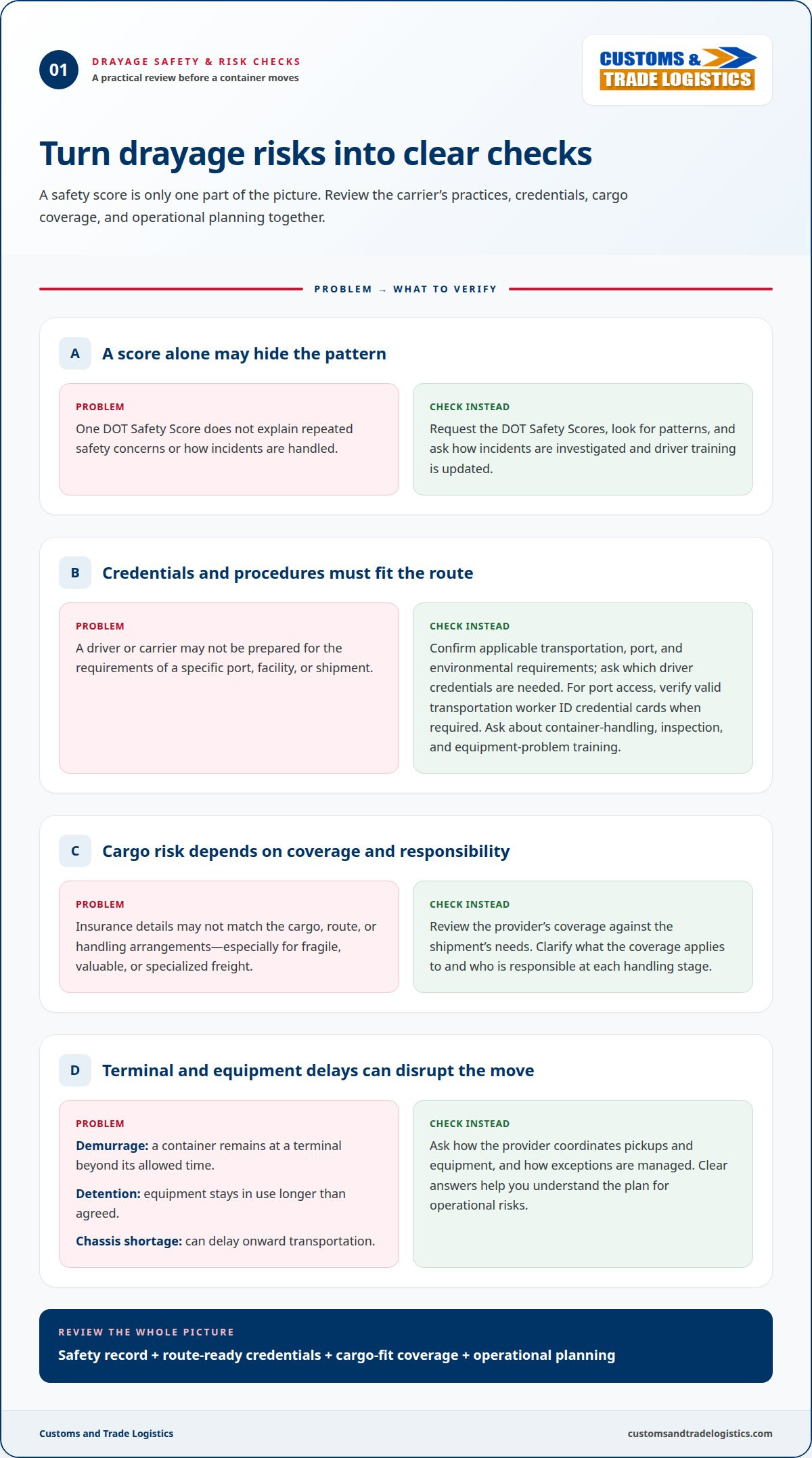
Review the carrier’s safety record, driver practices, and equipment. Ask for its DOT Safety Scores and look for patterns that could affect your shipments, such as repeated safety concerns. A score is only one part of the picture, so also ask how the company investigates incidents and updates driver training when procedures need attention.
Ask how the provider handles applicable transportation, port, and environmental requirements. Find out which driver credentials are needed for your route and facilities. For port access, confirm that drivers hold valid transportation worker ID credential cards when required. Ask about training in safe container handling, inspections, and responding to equipment problems. These checks help you assess whether safety practices fit the work.
Insurance matters alongside safety. Review the provider’s coverage and how it applies to your cargo, route, and handling arrangements. Compare those details with your shipment’s needs, especially if cargo is fragile, valuable, or requires specialized equipment. Clear answers about coverage and responsibility help you understand where risks sit before a container moves.
To check a drayage company’s safety record and customer references, request its DOT Safety Scores, ask for references relevant to your freight, and look for reviews or case studies involving similar cargo and routes. Ask how the provider handles incidents, driver training, and shipment issues rather than relying on general reputation alone.
Plan for operational risks, too. Demurrage can arise when a container remains at a terminal beyond its allowed time. Detention may result when equipment stays in use longer than agreed, while a chassis shortage can delay onward transportation. Ask how the provider coordinates pickups, equipment, and exceptions. These details help you make an informed choice and reduce avoidable disruptions.
2. Customer service and communication
Clear communication gives everyone in the supply chain a useful next step. A dependable drayage contact should explain shipment planning, pickup, delivery, and additional handling. Establish who shares updates and how changes are reported. A missed port appointment, for example, can affect a receiving schedule, so prompt notice helps the next party adjust distribution or storage plans.
Ask how drayage companies coordinate port appointments, container status, and delays. They should coordinate appointment details with the relevant parties, share status information, and communicate changes affecting pickup or delivery. Find out what updates you’ll receive, such as receipt confirmation, proof of delivery, or arrival alerts, and how delays caused by traffic, weather, or equipment issues are reported.
A consistent point of contact makes updates easier to act on. That person can connect dispatch, the driver, and your receiving team when a route or delivery window changes. Clarify how to reach the team, what shipment information to provide, and how status updates follow a reported issue. A tracking platform can support visibility, but it doesn’t replace clear explanations from a responsive contact.
Give billing the same attention. Request a transparent breakdown of quoted charges and ask how additional fees or surcharges are communicated. If a cost changes, the provider should explain why and issue an invoice that matches the agreed shipment details. Clear records help you reconcile transportation costs and avoid surprises during logistics planning.
Before a shipment moves, align on the update process, appointment coordination, exception notices, and billing communication. For businesses managing imports alongside inland transportation, freight logistics coordination can help bring the moving parts into a clearer plan.
3. Company experience and customer reviews
Years in trucking can show familiarity, but relevant results matter more. Look for experience handling shipments like yours and review delivery performance. Ask how the provider measures on-time, in-full deliveries and manages exceptions. A carrier familiar with port-to-warehouse moves may suit that route better than one focused on different operations.
Customer reviews and case studies can show how a company works beyond its service description. Focus on comments about specific routes, cargo types, communication, and problem resolution. A detailed example involving a terminal delay or changed delivery plan offers more context than general praise. When speaking with a reference, ask about the shipment’s outcome and the provider’s customer service when plans changed.
Match freight experience to the cargo you move. A standard container shipment has different handling needs from overweight freight or cargo requiring specialized equipment. For an intermodal move, ask about experience coordinating transfers between transportation modes and hubs. Relevant examples can help show whether the carrier understands unusual dimensions or handling requirements.
Look for evidence that the provider knows the facilities and terminals on your route. Familiarity with a particular port or rail terminal can help a team plan pickups and coordinate handoffs. A carrier serving several hubs, for example, may understand their different operating processes. Assess that experience against your origin, destination, and cargo requirements.
When finding a reliable drayage company, consider the evidence together: relevant delivery results, customer feedback, freight experience, and route familiarity. A strong reputation should be supported by examples resembling your shipment, not just broad claims. Check whether reviews describe consistent service across different loads and whether case studies explain what the provider handled directly. This gives you a clearer basis for choosing a partner whose experience fits your operations.
4. Geographic coverage and service network
A carrier’s coverage must match every leg your container will travel. Map the origin port or rail terminal, transfer points, and final delivery location before comparing service networks. Drayage commonly connects ports or rail yards with nearby facilities, and some routes fall within a 250-mile radius. The key is whether the provider serves your actual terminals and destination, not simply whether it operates in the same state.
For freight moving through California, relevant gateways can include the Ports of Los Angeles, Long Beach, and Oakland. A provider serving one gateway may not cover the others or the inland facilities your route requires. Match each shipment’s origin and destination to the network, then account for transfers between terminals, warehouses, or distribution centers. A clear route map helps identify handoffs that could affect timing and efficiency.
Ask how the carrier coordinates across its network. If a container arrives at a port and continues by rail, for example, the plan needs to identify the transfer location and the parties responsible at each stage. Confirm how the provider manages route changes, facility requirements, and communication between locations. This matters when a shipment involves multiple hubs or final delivery outside the port area.
Geographic fit also depends on cargo and service needs. A network may cover the route but lack the equipment or coordination required for an oversized load, transloading, or onward distribution. Consider whether the plan includes every transportation step your shipment needs and how the provider will respond to traffic or operational delays. Regulations and facility procedures can vary by location, so familiarity with the relevant terminals matters.
For a practical comparison, list each shipment’s port, terminal, destination, and required handoffs. Then match those points to the provider’s service network before choosing. If you’re planning an import route, map your freight’s route with the coverage and delivery steps in view.
Customs and Trade Logistics
Customs and Trade Logistics helps coordinate import logistics when freight involves more than the port-to-destination move. For shipments entering the United States, Customs Clearance Services and International Freight Logistics can support the import process alongside your transportation plan. Delivery and Redistribution Services can also help move goods onward after arrival.
This support can help align customs clearance, freight movement, and final delivery rather than manage each step in isolation. Share your shipment’s origin, destination, cargo details, and delivery needs to begin a practical discussion about the logistics involved.
Contact Customs and Trade Logistics to discuss your import shipment and transportation needs.
Move forward with a clear import plan
Choosing a drayage partner is one part of preparing an import shipment. Connect the port move with the broader journey, from customs clearance through onward delivery. A clear plan keeps responsibilities visible as freight passes between providers and facilities.
Customs and Trade Logistics supports importers with Customs Clearance Services, International Freight Logistics, and Import From China Consulting. These services can help when you’re coordinating an import and need support beyond the local container move. As you continue finding a reliable drayage company, consider how your transportation plan fits into the rest of your import process.
Share your shipment details and goals to discuss the support that fits your needs. Contact Customs and Trade Logistics to talk through your import logistics and take the next step with greater clarity.
Frequently Asked Questions
What Is a Drayage Carrier or Drayage Trucking Company?
A drayage carrier moves containerized freight over a short leg of its journey. It may, for example, transport a container from a port to a nearby distribution facility, connecting ocean or rail transportation with the next stage. The carrier handles the truck movement, while other parties may coordinate customs, longer-haul transportation, or final delivery.
What is Drayage?
Drayage is the short-distance transportation of containerized freight between connected points in a supply chain. It often links an ocean port or rail terminal with a warehouse, distribution center, or another transportation mode. Think of it as the local transfer that moves a container from its arrival point toward its next destination, not the entire international or long-haul journey.
How do you verify a drayage company's FMCSA registration, authority, and insurance?
Request the carrier’s legal business name and registration or authority details, then compare them with its records in the Federal Motor Carrier Safety Administration’s official carrier database. Ask for current insurance documentation and review the named business, coverage, and effective dates. If a policy detail is unclear, confirm it with the issuing insurer or agent before relying on it for your shipment.
What experience and equipment should a reliable drayage carrier have for your freight?
Look for experience that matches your shipment’s cargo, route, and handling needs. A standard container move differs from overweight or oversized freight, which may require specialized equipment. For recurring programs involving hundreds of loads, assess whether the carrier can handle the expected volume consistently. The closer its practical experience matches your freight profile, the easier it is to plan the movement accurately.
What are typical drayage rates and accessorial fees in the United States?
There is no single rate that applies to every U.S. drayage shipment. A quote depends on the route, shipment details, and included services. Ask for the base transportation charge and a clear breakdown of additional fees or surcharges. Review what each charge covers and which shipment circumstances could trigger it, so you can compare proposals on the same scope.
How do drayage rates vary by port, rail ramp, distance, and market?
Rates can differ because each move has its own origin, destination, distance, and terminal requirements. A port-to-warehouse move and a rail-ramp transfer may involve different routes and coordination. To compare quotes, provide each carrier with the same pickup and delivery points, container details, and service scope. This makes differences easier to understand without treating one market’s quote as a nationwide benchmark.