

For 2027, Chinese New Year falls on February 6. If your shipment plan relies on a supplier’s usual schedule, factory closures and freight disruptions could leave less time than expected to get inventory ready. If you’re navigating Chinese New Year shipping delays, you’re not alone. Holiday-related changes can turn a steady supply chain into a difficult mix of production slowdowns, port congestion, and shifting freight schedules.
International trade doesn’t have to feel like a gamble. A realistic plan accounts for supplier closures, post-holiday backlogs, and the handoffs between production, freight, customs, and final delivery. This guide explains which milestones to confirm, how to build a shipment timeline, and how to prepare for schedule changes that could affect your inventory.
Key Takeaways
- Ask each supplier to confirm its last production day, cargo-ready date, and reopening date so your timeline reflects actual factory schedules.
- Build a shared milestone tracker that names the responsible contact and marks each date as confirmed or estimated.
- Early freight booking can help, but it can’t make goods ready sooner or guarantee a departure. Assess routing, shipping mode, and inventory needs together.
- When navigating Chinese New Year shipping delays, plan for post-holiday production and delivery updates, not just the factory shutdown period.
- Keep freight coordination, paperwork, customs clearance, and final delivery on the same plan. Customs processing follows a separate timeline from factory and carrier schedules.
Why Chinese New Year Shipping Delays Affect More Than Factory Production
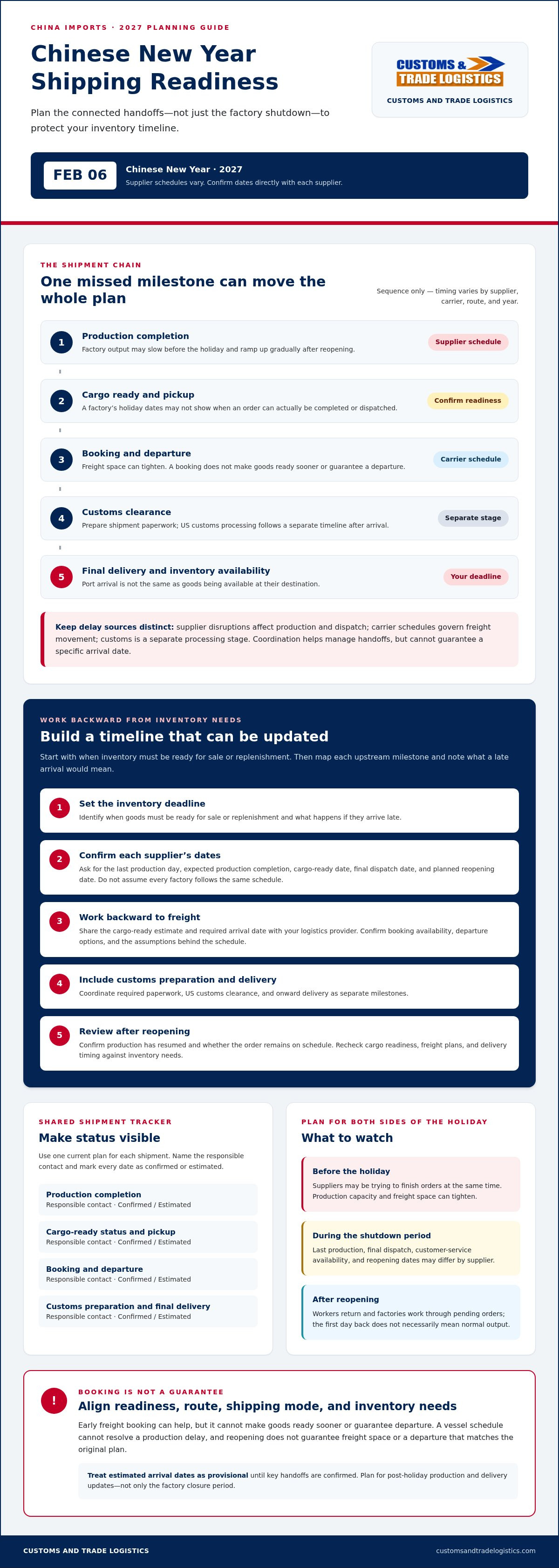
If a production pause could push your shipment past its sales window, it’s worth looking beyond the factory’s final workday. Goods still need to become cargo-ready, move to a port, secure space, depart, clear customs, and reach their destination. Chinese New Year shipping delays can affect several connected handoffs, not just the days when a factory is closed.
A concise definition: Chinese New Year shipping delays are timing disruptions caused by holiday-related changes in production, freight movement, and shipment handoffs before and after the holiday.
What tends to pause before and after the holiday?
Suppliers may set different dates for their last production day, final dispatch, customer-service availability, and reopening. Workers traveling home for the holiday contribute to a gradual slowdown and return, a pattern associated with Chunyun, the Spring Festival travel rush. A factory’s stated holiday dates may not tell the whole story about when your order can be completed or when you can get answers to questions.
Before the holiday, suppliers may be trying to finish orders at the same time. Production capacity and freight space can tighten, so a booking alone doesn’t mean the goods will be ready in time to use it. After reopening, production may ramp up gradually as workers return and factories work through pending orders. The first day back doesn’t necessarily mean normal output has resumed.
There’s no universal closure calendar. Dates and operating patterns vary by supplier, carrier, route, and year. Confirm each supplier’s schedule rather than assuming all factories pause or reopen together.
Why can one missed milestone affect the whole shipment?
Each stage depends on the one before it. If production finishes later than planned, cargo readiness may slip. That can affect pickup, the booked departure, and ultimately the delivery date. A vessel schedule can’t resolve a production delay, and a factory reopening doesn’t guarantee that freight space or the next departure will match your original plan.
Keep the different sources of delay clear. Supplier-side disruptions affect production and dispatch. Carrier schedules govern freight movement and may change independently. US customs processing is a separate stage after arrival, not an extension of a factory closure or carrier delay. Preparation and coordination can help manage the handoffs, but they can’t guarantee a specific arrival date.
When navigating Chinese New Year shipping delays, confirm each milestone with the party responsible: production completion, cargo-ready status, pickup, booking, departure, customs preparation, and final delivery. Treat an estimated arrival date as provisional until the key handoffs are confirmed. A shared, current shipment plan is more useful than relying on one date that doesn’t show where a delay occurred.
How to Build a Chinese New Year Shipping Timeline That Holds Up
Start with the date your inventory needs to be available, then work backward through production, freight, customs preparation, and final delivery. A useful timeline doesn’t rely on a single estimated arrival date. Track confirmed milestones and identify assumptions, because every handoff depends on the stage before it.
Use this sequence to build a plan you can update as schedules become clearer:
- Set your inventory deadline. Identify when the goods must be ready for sale or replenishment. Note what happens if they arrive late.
- Confirm supplier dates directly. Ask each supplier for its last production day, expected production completion, cargo-ready date, final dispatch date, and planned reopening date. Get dates for each supplier instead of applying one factory’s schedule to all your orders.
- Work backward to freight milestones. Share the cargo-ready estimate and required arrival date with your logistics provider. Confirm booking availability, expected departure options, and the assumptions behind the proposed schedule. A booking date is useful only if it aligns with when the goods can actually be collected.
- Include customs preparation and delivery. Coordinate the required shipment paperwork and plan for US customs clearance and onward delivery. These are separate milestones, so don’t treat port arrival as the same thing as inventory being available at its destination.
- Review after reopening. Ask the supplier to confirm when production has resumed and whether the order remains on schedule. Compare the updated cargo-ready date with freight plans, then review delivery timing against your inventory needs.
Which dates and milestones should importers confirm?
Use one shared tracker for every shipment. Record each milestone, its date, the person responsible for the next update, and when that update is due. Mark every date as confirmed or estimated. This distinction helps you spot assumptions and follow up before they affect the next handoff.
How much buffer should a shipment plan include?
There’s no single buffer that suits every shipment. Set contingency time according to supplier reliability, transport mode, route, and how urgently you need the inventory. If a missed arrival would disrupt a sales commitment, allow less flexibility than you would for stock with a wider replenishment window. Recheck schedules as the holiday approaches, then confirm them again after suppliers resume. Regular review helps you navigate Chinese New Year shipping delays without mistaking an early estimate for a firm delivery plan.
If you’d like help coordinating shipment dates and handoffs, discuss your China import timeline with Customs and Trade Logistics.
Is Booking Early Enough to Prevent Chinese New Year Delays?
Booking early can improve your options, but it can’t guarantee that a supplier will finish production on time or that a carrier will depart as planned. The booking depends on the goods being ready for the agreed handoff, and schedules may change as the holiday approaches. Advance coordination gives you more time to identify constraints, compare alternatives, and address paperwork gaps.
Early planning can reduce avoidable risk, but it can’t control factory output, carrier changes, or customs processing. After making an initial booking, reconfirm the cargo-ready date and departure details. Treat schedule availability and transit estimates as provider-confirmed information, not fixed promises.
What can early freight planning solve, and what can it not?
Discuss the shipment with your logistics provider while there’s still time to review booking availability, routing options, and paperwork needed for the planned movement. If a supplier’s production estimate shifts, tell the provider promptly and ask whether the original booking remains workable. A booking can reserve a planned option, but it can’t restart production or guarantee a sailing.
When should importers compare ocean and air freight?
Compare options based on when the inventory is needed, the cargo’s characteristics, and what can be arranged for the shipment. Neither mode eliminates holiday disruption. Ask your logistics provider to confirm current availability and transit estimates for the specific shipment and route.
| Planning option | What it may help with | Trade-off or dependency |
|---|---|---|
| Book freight early | Surfaces space constraints and paperwork gaps sooner. | Depends on production finishing and cargo being ready as planned. Confirm departure details with the provider. |
| Compare routing or mode | Gives you alternatives to assess if the original plan becomes difficult. | Availability and provider-confirmed transit estimates vary. Check cargo suitability and operational feasibility. |
| Plan inventory coverage | Helps you assess how much schedule movement your business can absorb. | Requires a realistic view of sales commitments, available stock, and replenishment needs. |
Ocean and air freight have different capacity, timing, and cargo considerations. Compare them against your actual deadline rather than assuming one is always preferable. If only part of an order is urgent, ask whether splitting it is operationally practical and what additional coordination it would require. A split shipment may offer flexibility, but it doesn’t remove the need to confirm production readiness and transport schedules.
For importers navigating Chinese New Year shipping delays, early booking is one part of a sound plan, not a substitute for checking each handoff. Connect inventory planning to supplier updates and provider-confirmed freight details, then revisit your choices if either changes.
A Step-by-Step Contingency Plan for China Imports Around the Holiday
A contingency plan gives everyone a clear next step when a date changes. Track supplier updates, freight plans, paperwork readiness, and arrival expectations in one shared place. For each milestone, record the responsible contact, the latest date, whether it’s confirmed or estimated, and when the next update is due.
- 1. Get supplier dates in writing. Confirm closure and reopening expectations, the last production day, expected production completion, cargo-ready date, and dispatch estimate. Ask the supplier to flag changes promptly and identify who will send updates.
- 2. Check the freight plan. Ask your logistics provider to confirm booking status, route assumptions, current schedule information, and how updates will be communicated. Share the supplier’s latest cargo-ready estimate and agree who will contact whom if it shifts.
- 3. Review paperwork readiness. Keep shipment information accurate and share requested documents or details with your customs broker promptly. Customs preparation is its own workstream. Complete paperwork does not restart production, secure a carrier departure, or guarantee customs release.
- 4. Plan for arrival and delivery. Map expected arrival and onward delivery stages against inventory needs. Identify which teams depend on the stock and who should receive revised estimates.
- 5. Reassess when dates move. Check the tracker against supplier and provider updates. Review inventory priorities and ask about feasible transport or delivery alternatives before changing the shipment plan.
What should importers ask suppliers and logistics providers?
Be specific. Ask suppliers to confirm their holiday closure, production completion, cargo-ready, dispatch, and reopening expectations. Ask the logistics provider which booking and route assumptions the plan depends on, what schedule information is provider-confirmed, and when the next update is due. Clarify who will report a change and what details they need to assess its impact.
How should a business respond when the schedule shifts?
First, update the tracker and distinguish a revised estimate from a confirmed date. Then assess which products or commitments are most time-sensitive. Notify inventory, sales, and fulfillment teams as soon as a change could affect their plans, rather than waiting for a final arrival date that may still move. Review transport or delivery alternatives with the relevant providers before making changes, and share any requested shipment information with your customs broker promptly.
This shared process makes navigating Chinese New Year shipping delays more manageable by clarifying what changed, who owns the next update, and which decisions need attention. For help coordinating freight, customs preparation, and delivery planning, discuss your China import logistics with Customs and Trade Logistics.
Coordinate China Shipping, US Customs, and Delivery With the Right Support
A shipment doesn’t become inventory the moment it leaves a Chinese factory. Freight coordination, accurate paperwork, US customs clearance, and delivery planning all affect what happens next. Each stage has its own requirements and timing. Keeping the handoffs connected makes it easier to spot missing information or a date that needs attention.
Customs processing is separate from factory closures and carrier schedules. A factory delay can postpone cargo readiness, while a carrier schedule affects freight movement. Customs clearance is a distinct part of the import process. A logistics partner can help coordinate freight, paperwork, clearance, and delivery planning, but professional support isn’t a promise of faster customs release or a specific arrival date.
What does an import logistics partner coordinate?
The right support can help you understand which shipment milestones need attention, what paperwork is needed for the services involved, and how delivery arrangements fit into the plan. A clear contact and update process also helps suppliers, freight providers, customs support, and your team work from the same current information. Confirm who is responsible for each handoff and how changes will be shared.
Customs and Trade Logistics is a family-owned US customs brokerage and logistics consulting firm with more than 35 years of industry experience. The firm supports businesses importing from China, provides customs clearance services at US ports, and coordinates freight and delivery redistribution. Its role is to help manage logistics and paperwork handoffs, not to control factory output, carrier schedules, or customs decisions.
What information should you have ready before asking for help?
A few details make it easier to discuss your shipment and identify which services may fit. Prepare:
- Supplier and cargo information: Supplier contact details, a clear cargo description, and the latest production and cargo-ready estimates.
- Shipment timing: Any booking or route details already confirmed, plus the dates that remain estimates.
- Paperwork status: The documents or shipment information you have gathered, and what is still outstanding.
- Business needs: Your inventory deadline, delivery destination requirements, and how much flexibility you have if dates change.
Ask what information is needed to assess your shipment and which services apply. This gives both sides a practical starting point for discussing next steps, without assuming every part of the shipment follows the same schedule. For businesses navigating Chinese New Year shipping delays, experienced coordination can help clarify responsibilities and keep important updates connected.
If you’d like to discuss your shipment and import support options, talk with our import logistics team.
Make Your Holiday Import Plan More Resilient
Chinese New Year planning works best when you manage the full shipment, not just the factory shutdown. Confirm supplier production and reopening dates, connect each milestone to freight, customs, and delivery plans, and keep inventory teams informed when estimates change. Early booking can help you prepare, but it can’t guarantee production or a departure date.
That’s the practical approach to navigating Chinese New Year shipping delays: know what’s confirmed, identify what could shift, and decide in advance how your business will respond. With the right coordination, you can make informed choices and keep uncertainty from catching your team off guard.
Customs and Trade Logistics is family-owned and operated, with more than 35 years of industry experience supporting China imports and customs clearance across US ports. For help coordinating the moving parts of your shipment, talk with our import logistics team.
Start the conversation early to give your next import a clearer path from supplier to delivery.
Frequently Asked Questions
When does Chinese New Year affect shipping from China?
Disruptions can begin before the holiday and continue afterward as factories reduce production, workers travel, and freight schedules come under pressure. In 2027, Chinese New Year falls on February 6, but individual suppliers may stop production or dispatch on different dates. Ask each supplier for its last production day, cargo-ready expectations, and reopening date instead of assuming one holiday calendar applies to every order.
How long do Chinese New Year shipping delays usually last?
The impact can extend well beyond the official holiday. For 2027, the wider supply chain disruption is expected to span roughly six to eight weeks, from mid-January to mid-March. That describes a broader period of potential disruption, not a guaranteed delay for every shipment. Timing depends on supplier readiness, freight availability, route, and post-holiday production recovery, so track confirmed milestones rather than relying on a general estimate.
Is freight booking enough to avoid Chinese New Year delays?
No. Booking early may help you identify space constraints and coordinate the shipment, but it can’t ensure the goods will be ready or that the carrier will depart as scheduled. When navigating Chinese New Year shipping delays, confirm production completion and cargo readiness with the supplier, then reconfirm booking and departure details with your logistics provider. Keep estimates separate from confirmed dates, and update your inventory plan if a milestone changes.
Can I ship goods from China during Chinese New Year?
Possibly, but it depends on whether your goods are ready, the carrier and route schedule, and the availability of services needed to move the cargo. A factory may be closed even if transport options remain available, so a booking can’t make unfinished goods ship. Ask your supplier and logistics provider to confirm cargo readiness, pickup arrangements, and departure status for your specific shipment before treating a planned movement as settled.
What happens if my supplier closes before my order is ready?
Contact the supplier promptly to confirm what is complete, what remains, and the revised production and cargo-ready estimates. Ask when the factory expects to reopen and when it can provide its next status update. Then tell your logistics provider, check whether the booking still fits the new schedule, and notify inventory or sales teams if the arrival estimate may affect commitments. Don’t assume production will resume at full pace immediately after reopening.
Should I use air freight instead of ocean freight before Chinese New Year?
Not automatically. Air and ocean freight differ in timing, capacity, cargo suitability, and operational requirements. Compare provider-confirmed availability and transit estimates against your inventory deadline, shipment characteristics, and flexibility. Air freight may be worth assessing for urgent goods, but it doesn’t remove production delays or guarantee movement during a busy period. If only part of an order is urgent, ask whether splitting it is practical before changing the plan.
Do Chinese New Year delays affect US customs clearance?
Factory closures and carrier schedule changes are separate from US customs processing, though a shipment delayed before departure will also arrive later for clearance. Customs preparation can proceed as shipment information becomes available, but complete paperwork doesn’t guarantee release by a particular date. Keep documents accurate, respond promptly to requests from your customs broker, and coordinate clearance and onward delivery timing around the latest arrival information.


