

When surcharges can swallow up to 28% of your total shipping invoice, the lowest upfront quote is rarely the one that protects your profit margins. If you're currently wondering whether air cargo is worth the premium or if you should shift to ocean transit to safeguard your cash flow, a comprehensive sea freight vs air freight cost analysis 2026 is essential to guide your next move.
We understand it's exhausting to handle fluctuating fuel surcharges, unpredictable port congestion, and hidden customs fees that suddenly blow your budget. You deserve clarity instead of guesswork. This guide provides a clear, data-driven framework to help you choose between sea and air freight based on current 2026 market rates, transit times, and total landed costs. You will discover the exact economic break-even points for your cargo volume, giving you total confidence in your shipping strategy.
Key Takeaways
- Navigate 2026 rate volatility by understanding how new environmental regulations and fuel surcharges impact your bottom line.
- Identify high-value or perishable product categories where the speed of air cargo provides a better return on investment than slower ocean routes.
- Determine the precise volume break-even point to switch from air to ocean using our sea freight vs air freight cost analysis 2026.
- Protect your budget by accounting for hidden landed costs, including HTS code duties and customs brokerage fees that aren't in a standard freight quote.
- Implement a hybrid logistics strategy that uses a 5-point decision checklist to maintain inventory levels while maximizing your cash flow.
The 2026 Global Shipping Landscape: Current Rate Trends and Market Drivers
Are you finding it harder to predict your shipping expenses this year? You aren't alone. The 2026 freight market is a study in contradictions. While global container volumes grew steadily through 2025, importers now face a landscape defined by regional price spikes and geopolitical rerouting. A thorough sea freight vs air freight cost analysis 2026 shows that the traditional price gap between these two modes is shifting. As ocean carriers continue rerouting around the Red Sea, voyage lengths and fuel consumption have climbed, pushing sea rates higher than historical averages. For a high-level look at these modes, this freight transport overview provides helpful context on how global networks operate.
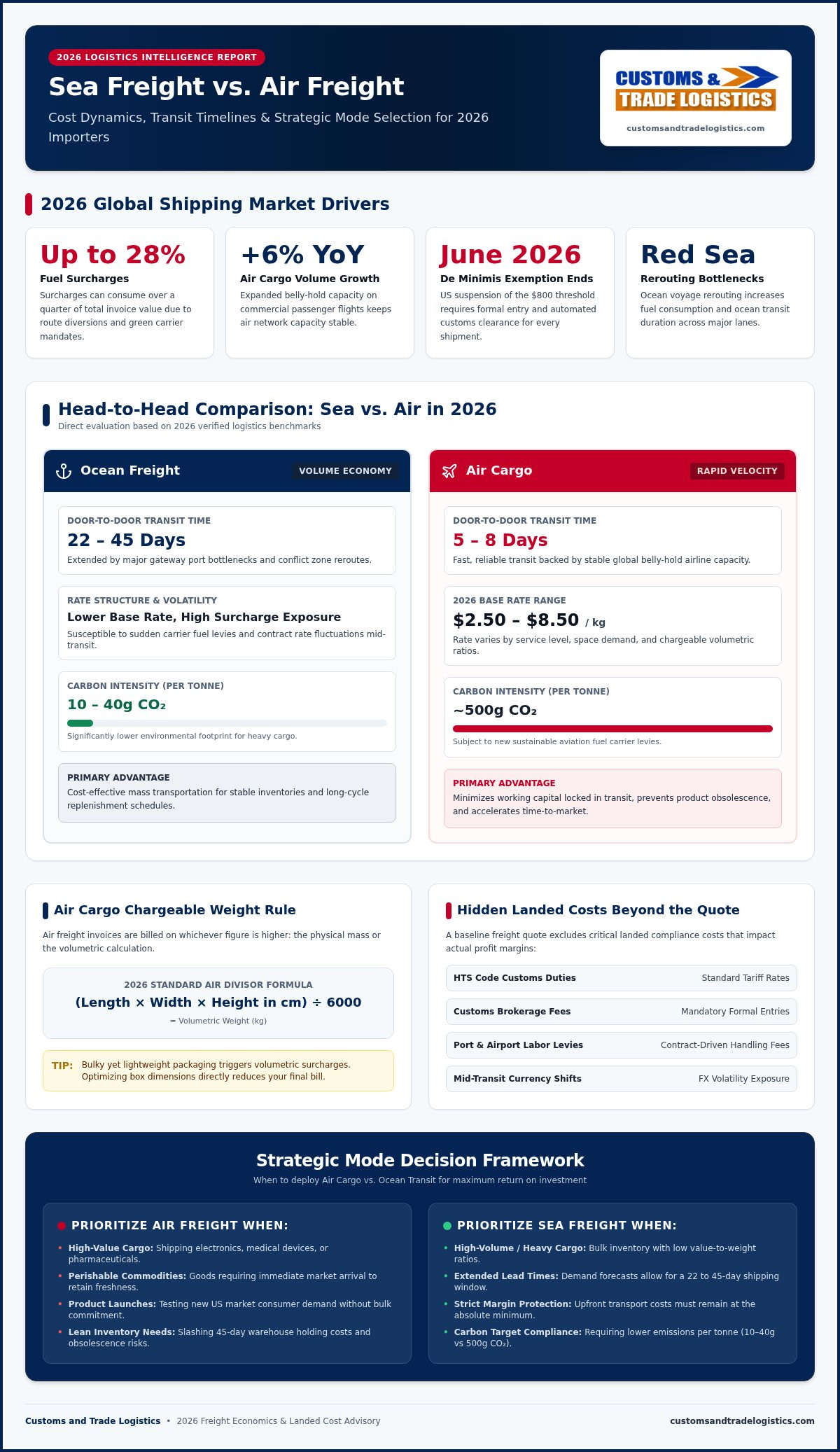
Does the current volatility feel like a moving target? We've seen fuel surcharges account for up to 28% of a total shipping invoice in recent months. This shift stems from new environmental mandates and the ongoing need for carriers to reroute around conflict zones. Technology now plays a vital role in managing these costs. With the United States suspending the $800 de minimis exemption in June 2026, every shipment now requires formal entry. Automated customs clearance systems are no longer a luxury; they're a necessity to avoid costly delays at the border.
Key Economic Factors Influencing 2026 Freight Costs
Labor markets are tightening, which directly impacts the handling fees you see at ports and airports. When port workers negotiate new contracts, those costs eventually trickle down to your invoice. Additionally, the rise of sustainable fuels has introduced new carrier levies. While these fuels reduce the carbon footprint, which is approximately 500g of CO2 per tonne for air versus 10 to 40g for sea, they add a layer of expense that importers must account for in their annual budgets. Currency fluctuations also remain a factor, as they can suddenly change the value of your international shipping contracts mid-transit.
Infrastructure and Port Congestion Forecast
We anticipate continued bottlenecks at major US gateway ports throughout the remainder of 2026. These delays extend sea transit times, which currently range from 22 to 45 days. In contrast, air cargo capacity has remained relatively stable, helped by a 6% year-over-year increase in global volumes and better belly-hold availability on passenger flights. If you're comparing sea freight vs air freight cost analysis 2026, remember that air freight typically delivers in 5 to 8 days. Infrastructure projects are underway to expand vessel capacity, but until they're complete, strategic carrier behavior will keep ocean rates volatile and transit times unpredictable.
Air Freight Cost Dynamics: When Does Speed Justify the Premium?
Air freight isn't just a faster way to move goods; it's a strategic tool for managing your business's cash flow. When you look at a sea freight vs air freight cost analysis 2026, the upfront price of air transport, which currently ranges from $2.50 to $8.50 per kilogram depending on the service level, can seem steep. However, the true value lies in the 5 to 8 day door-to-door transit time. For high-value electronics, medical supplies, or perishable items, this speed justifies the premium by getting products to market weeks ahead of ocean vessels.
The challenge often lies in measuring international transport costs accurately across different modes. You must look beyond the base rate to the "opportunity cost" of slow transit. Inventory tied up on a ship for 45 days is capital you can't reinvest. By choosing air, you reduce the need for expensive warehousing and shift toward a leaner inventory model. This approach minimizes the risk of your stock becoming obsolete before it even reaches your customers.
Understanding Chargeable Weight in 2026
A common trap for new importers is the difference between actual weight and volumetric weight. Chargeable weight is the greater value between a shipment's actual physical weight and its calculated volumetric weight, determining the final freight invoice amount. In 2026, the industry standard typically uses a divisor of 6000 for standard air cargo. If your packaging is bulky but light, you'll pay for the space it occupies, not its mass. Optimizing your boxes to remove empty space is one of the fastest ways to slash your air freight bill and protect your margins.
Strategic Use of Air Freight for Product Launches
Are you launching a new product in the US market? Air freight allows you to test consumer demand without committing to a massive ocean shipment. If a product sells out faster than expected during peak seasons, air cargo acts as a tactical bridge to prevent stock-outs while your main inventory travels by sea. Many successful SMBs now use a hybrid model: they ship the first 20% by air to capture immediate sales and the remaining 80% by sea to protect their long-term profitability. This balanced approach ensures you stay competitive without overextending your budget. If you need help designing a split-shipment strategy, our team provides expert international freight logistics to keep your supply chain moving smoothly.
Sea Freight Economics: Calculating the Volume Threshold for LCL and FCL
Are you ready to scale beyond small air shipments? While air freight is excellent for speed, your margins depend on moving to the ocean as your volume grows. The economic break-even point in a sea freight vs air freight cost analysis 2026 usually occurs once your shipment exceeds 100 kilograms. Beyond this point, the per-kilogram cost of sea freight, which currently ranges from $0.15 to $0.80, becomes significantly more attractive than air cargo's higher rates. It's a relief to know that even with rising fuel costs, ocean transit remains the most cost-effective method for bulk inventory.
Reliability in 2026 depends heavily on container availability. While vessel capacity has expanded, strategic carrier behavior and rerouting still cause regional volatility. If you're managing large-scale orders, conducting a sea freight vs air freight cost analysis 2026 is the only way to ensure your landed costs stay within budget. For those moving high volumes, our import from China logistics guide provides deeper insights into coordinating these complex movements from foreign suppliers to your door.
LCL Shipping: The Small Business Workhorse
LCL (Less than Container Load) is the small business workhorse. It allows you to pay only for the space you use by sharing a container with other importers. It's ideal for shipments under 10 to 12 cubic meters (CBM). However, LCL carries hidden risks. Because your goods are consolidated with others, they face extra handling at the port, which can lead to damage or potential delays if another importer's paperwork isn't in order. To save costs, ensure your pallets are clearly labeled and professionally shrink-wrapped to prevent shifting during transit.
FCL Shipping: Economies of Scale for Growing Brands
When your shipments grow to the 12 to 15 CBM threshold, it's time to consider FCL (Full Container Load). By renting the entire 20ft or 40ft container, you gain exclusive use, which improves security and speeds up the process since there's no need for consolidation. For 2026 budgets, remember that a 40ft container offers nearly double the volume of a 20ft unit for a relatively small price increase, providing massive economies of scale. Don't forget to plan for "last mile" drayage and potential demurrage fees, which can run from $100 to $350 per day if your cargo isn't picked up promptly from the port. Partnering with a dedicated container transport specialist—such as Jagelo Haulage for routes serving major UK ports—ensures boxes are collected swiftly to avoid costly terminal delays.
Did you know that your initial freight quote typically represents only 60% to 70% of your total expense? If you're only budgeting for the transit itself, you're in for a shock when the final bill arrives. A complete sea freight vs air freight cost analysis 2026 must account for duties, taxes, and handling fees that occur after the cargo leaves the supplier. The HTS code you assign to your products is the most critical factor here, as it determines your 2026 duty rates. Even a small error in classification can lead to a 12.5% forced-labor duty or other penalties that erase your profit margins.
Navigating these requirements is why many importers rely on professional customs clearance services us. For example, customs bonds are a non-negotiable cost for any shipment entering the U.S. valued over $2,500. Whether you choose a single-entry bond or a continuous bond, this expense is a prerequisite for legal entry. Without it, your goods will sit at the port, accruing daily fees that quickly spiral out of control.
The Anatomy of Landed Cost in 2026
Terminal handling charges (THC) and port security fees are often omitted from basic quotes but are mandatory at every major gateway. You also need to consider how insurance rates fluctuate; while air freight is more expensive to ship, its shorter transit time often results in lower insurance premiums compared to the 45-day exposure of sea freight. Finally, don't forget the costs of domestic trucking and redistribution once your goods clear customs. Understanding these custom brokerage service fees helps you build a realistic budget that supports long-term growth.
Regulatory Compliance: Avoiding the "Delay Tax"
In 2026, even simple documentation errors can trigger intensive customs exams. These exams aren't just a nuisance; they're a "delay tax" that costs you time and money. Storage and demurrage fees at the port can run from $100 to $350 per day, which is enough to sink a small shipment's profitability. Our expert brokers act as protective mentors for SMBs, guiding you through the paperwork to ensure a smooth, compliant journey for every pallet. If you're tired of hidden fees blowing your budget, request a transparent landed cost estimate today.
Strategic Selection: Building a 2026 Logistics Plan for Your Business Growth
How do you turn this sea freight vs air freight cost analysis 2026 into a practical roadmap? Choosing the right mode isn't just a math problem; it's about protecting your business's growth in a volatile market. To build a resilient strategy, we recommend a 5-point checklist: evaluate product value relative to chargeable weight, assess current port congestion forecasts, check inventory lead times, factor in total landed costs including HTS duties, and align your shipping mode with seasonal demand peaks. By following this framework, you move from reactive shipping to proactive supply chain management.
A hybrid logistics model is often the most effective way to maximize cash flow. Instead of choosing one mode exclusively, many successful brands split their inventory. They use air freight for initial product launches or urgent restocks and sea freight for the bulk of their replenishment. This approach ensures you never miss a sales opportunity due to stock-outs while keeping your average shipping cost per unit as low as possible. If you're just starting out, our guide on import logistics for startups offers a step-by-step path for first-time importers to enter the global market with confidence.
Tailored Advice for Amazon FBA Sellers
Amazon FBA sellers face unique pressure in 2026. With major carriers like UPS and FedEx announcing a 5.9% general rate increase, managing your inbound shipping costs is vital to staying competitive. You can't afford to miss delivery windows, but overspending on air freight for every SKU will quickly erode your margins. Utilizing specialized FBA freight forwarding services for China imports helps you consolidate goods and choose the most efficient route to Amazon's fulfillment centers. Smarter shipping choices, such as optimizing packaging at the source, also reduce prep-center costs and improve your inventory performance index.
Partnering for Long-Term Success
In a digital-first world, the value of a family-owned logistics partner is significant. While automated platforms handle the data, it's our 35+ years of industry experience that manages the exceptions. When geopolitical disruptions occur or new regulations change the rules for formal entry, you need a "safe pair of hands" to lift the administrative burden from your shoulders. We act as your advocate, acting as a knowledgeable bridge between your small-scale operations and the global marketplace. Let Customs and Trade Logistics simplify your 2026 shipping strategy so you can focus on building your brand while we handle the complexities of the journey.
Mastering Your 2026 Import Strategy
Mastering your 2026 import strategy requires looking past the base freight quote to the total landed cost. We've explored how speed justifies the premium for high-value goods and where sea freight offers the best economies of scale for bulk orders. By integrating a sea freight vs air freight cost analysis 2026 into your planning, you can navigate fuel surcharges and regulatory shifts with total confidence. Understanding these dynamics is the key to protecting your profit margins in a changing global market.
At Customs and Trade Logistics, we bring 35+ years of family-owned expertise to every shipment. Whether you're an Amazon FBA seller or a growing SMB, our team provides national coverage across all US ports of entry to act as your "safe pair of hands." We take the administrative burden off your shoulders so you can focus on scaling your business. Ready to optimize your margins? Get a Professional 2026 Freight and Customs Consultation today. You don't have to navigate the complexities of international trade alone. We're here to help you build a resilient, profitable future.
Frequently Asked Questions
Is air freight or sea freight cheaper for small businesses in 2026?
Sea freight is typically the more affordable choice for small businesses moving shipments larger than 100 kilograms. While air freight rates range from $2.50 to $8.50 per kilogram, ocean rates remain significantly lower, often between $0.15 and $0.80 per kilogram. A detailed sea freight vs air freight cost analysis 2026 helps you identify the specific weight threshold where ocean transit protects your profit margins without sacrificing your business's cash flow.
How long does sea freight take from China to the US in 2026?
You should expect sea freight from China to the United States to take between 22 and 45 days door-to-door in 2026. This timeline is heavily influenced by port congestion and strategic carrier rerouting around the Red Sea. In contrast, air freight offers a much tighter window of 5 to 8 days. Planning for these longer ocean transit times is essential for maintaining consistent inventory levels and avoiding expensive emergency air shipments.
What is the break-even point for switching from air to sea freight?
The economic break-even point for switching from air to sea freight is generally found at the 100-kilogram mark. Below this weight, the speed and lower handling fees of air cargo often outweigh the costs of ocean consolidation. If you're comparing LCL and FCL ocean options, the break-even point typically shifts between 12 and 15 cubic meters. Analyzing these thresholds ensures you aren't overspending on premium air space for bulky, low-value inventory.
Can an Amazon seller use sea freight for FBA shipments?
Yes, Amazon sellers can and should use sea freight for FBA shipments to maximize their profitability on bulk inventory. While air is great for testing new SKUs, ocean transit allows you to move larger volumes at a fraction of the cost. You'll need specialized freight forwarding to ensure your goods meet Amazon's strict delivery windows and labeling requirements. We act as a knowledgeable bridge to help you manage this end-to-end process smoothly.
What are the hidden costs of international shipping I should budget for?
You must budget for several expenses beyond the initial freight quote, including fuel surcharges, customs bonds, and HTS duties. Terminal handling charges, port security fees, and customs brokerage fees are also standard requirements. Additionally, be prepared for potential demurrage or storage fees, which can run from $100 to $350 per day if your cargo isn't cleared promptly. Accounting for these landed costs prevents budget blowouts and protects your bottom line.
How do fuel surcharges affect my 2026 shipping costs?
Fuel surcharges are a major driver of volatility, often accounting for 15% to 28% of your total shipping invoice in 2026. These fees fluctuate based on global oil prices and the increased fuel consumption required for longer rerouted voyages. Conducting a regular sea freight vs air freight cost analysis 2026 allows you to see how these surcharges impact each mode differently. Staying informed on these trends helps you adjust your pricing and shipping schedules accordingly.
Do I need a customs broker for both air and sea freight?
You absolutely need a customs broker for both air and sea freight shipments, especially those valued over $2,500. A broker ensures your paperwork is compliant with current regulations, such as the June 2026 suspension of the $800 de minimis exemption. We act as a safe pair of hands, handling the complex formal entry procedures and HTS classifications. This professional oversight is your best defense against costly penalties and unnecessary delays at the border.
What happens if my shipment is delayed at a US port in 2026?
If your shipment is delayed at a US port, you'll likely face demurrage or detention fees that range from $100 to $350 per day. These costs accrue quickly and can easily exceed the value of the freight if left unmanaged. Proactive communication with your logistics partner is vital to resolving documentation errors or congestion issues. Our 35+ years of experience allows us to navigate these bottlenecks, acting as a dedicated advocate for your business's growth.


