

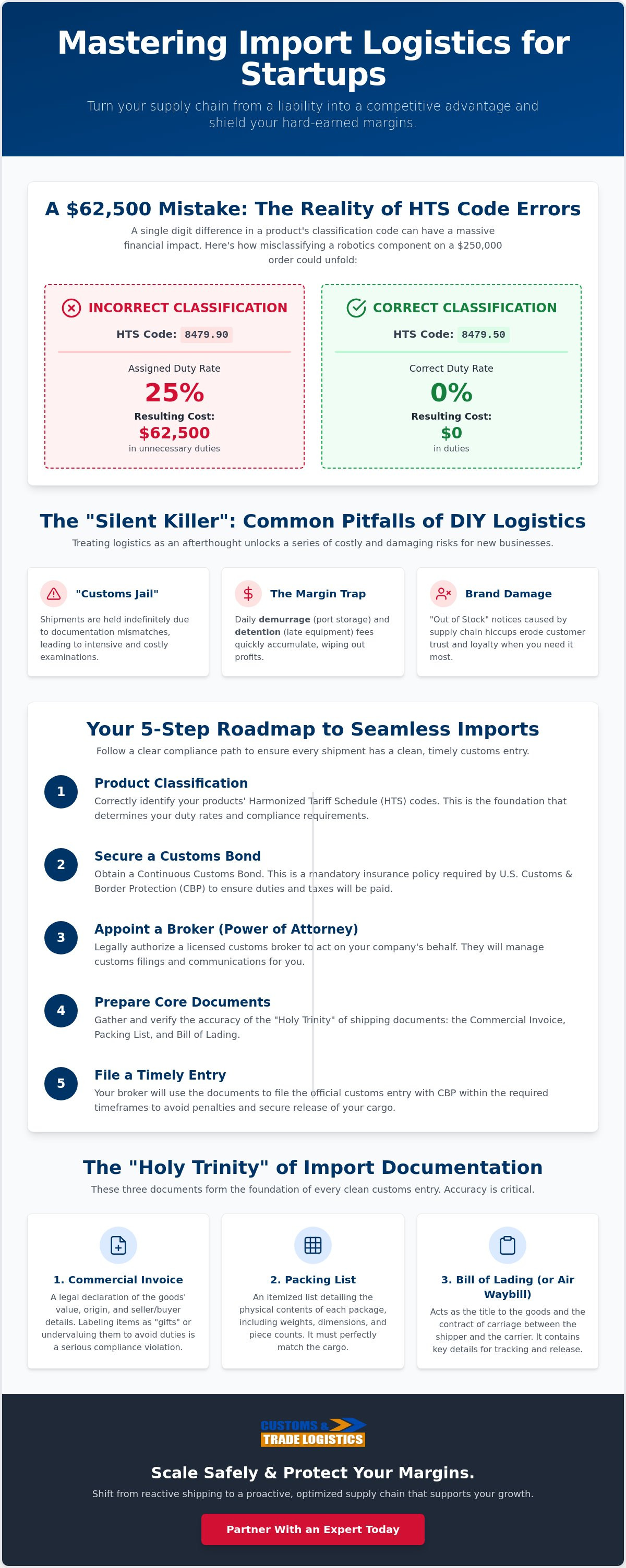
Did you know that misclassifying a single robotics component under HTS code 8479.90 instead of 8479.50 could cost your business $62,500 in unnecessary duties on a $250,000 order? For many founders, the leap into international trade feels like stepping into a minefield of shifting regulations and dense paperwork. It's completely normal to feel a sense of anxiety when you're staring down new Section 301 investigations or trying to figure out if your recent shipments qualify for refunds through the CAPE tool after the latest Supreme Court rulings.
We understand that you want to focus on building your brand, not decoding federal registers. This guide will show you how to master import logistics for startups so you can protect your hard-earned margins and turn your supply chain into a competitive advantage rather than a source of stress. You'll learn how to handle the complexities of international shipping and US Customs with the confidence of a seasoned veteran. We'll walk through the specific 2026 tariff updates, provide a clear compliance checklist, and help you identify the right partners to handle the administrative burden for you.
Key Takeaways
- Recognize how strategic logistics planning acts as a shield for your startup’s margins by preventing costly shipment delays.
- Demystify complex jargon and HTS codes to ensure your paperwork is accurate and your duty rates are minimized.
- Identify why the "DIY" approach to import logistics for startups often leads to legal risks and how a professional partner provides a safer path.
- Follow a clear, five-step roadmap to compliance that covers everything from Customs Bonds to establishing a Power of Attorney.
- Learn how to shift from reactive shipping to a proactive, optimized supply chain that supports your long-term growth.
Why Import Logistics is the Silent Killer of New Startups
Many founders launch their businesses with a laser focus on product design and digital marketing, treating the physical movement of goods as an afterthought. This is a dangerous oversight. Effective import logistics for startups involves far more than simply moving boxes from point A to point B. It's a complex orchestration of legal compliance, financial management, and timing. When you treat shipping as a mere chore to be dealt with later, you're essentially leaving the front door of your business unlocked.
The "Margin Trap" is a very real threat for early-stage companies. If your shipment is held at a US port for just 10 days due to a paperwork error, the resulting daily storage fees can quickly spiral. These costs don't just nibble at your budget; they can wipe out an entire quarter’s profit before you've even sold a single unit. A "wait and see" approach doesn't work in global trade. By the time you realize there's a problem, the financial damage is often already done.
The High Cost of Amateur Logistics
When you handle your own imports without expert guidance, you risk encountering "Customs Jail." This occurs when your documentation doesn't perfectly match your cargo, leading to intensive examinations and indefinite holds. Beyond the legal headache, you'll face demurrage and detention fees. Demurrage is charged for every day your container sits on the dock past its free time, while detention applies to the late return of the equipment itself. These daily penalties accumulate rapidly. Perhaps worse is the damage to your brand. Early adopters are often your biggest advocates, but their loyalty fades quickly when "out of stock" notices become the norm due to avoidable supply chain hiccups.
Logistics as a Strategic Foundation
Success requires a psychological shift. You must view logistics not as a burden, but as a strategic shield. A well-organized approach to import logistics for startups makes your business far more attractive to investors. They want to see that you have total visibility over your capital and that your goods aren't stuck in a legal limbo. Understanding The Anatomy of a Startup Import Shipment allows you to build a scalable model from day one. Whether you're bringing in your first pallet or your hundredth container, having a "safe pair of hands" to manage the administrative weight ensures you can scale safely without the fear of unexpected fines or terminal delays.
The Anatomy of a Startup Import Shipment: Breaking Down the Jargon
Walking into the world of global trade without knowing the lingo is like trying to read a map in a language you don't speak. For a founder, the terminology can feel like a barrier to entry, but these terms are simply the rules of the road. Mastering import logistics for startups begins with understanding the specific documents and codes that tell U.S. Customs and Border Protection (CBP) exactly what you're bringing into the country. If these details are wrong, your shipment doesn't move. It's that simple.
You'll also need to decide on your Incoterms, which define who is responsible for the goods at each stage of the journey. Many new founders gravitate toward "DDP" (Delivered Duty Paid) because it sounds easy; the supplier handles everything until it reaches your door. However, DDP often hides inflated shipping costs and leaves you with zero oversight of the customs entry filed in your name. Taking control of your own logistics early on provides the transparency you need to protect your margins.
Essential Documentation for Every Shipment
There are three core documents, often called the "Holy Trinity," that form the foundation of every entry. First is the Commercial Invoice. This isn't just a bill; it's a legal declaration of value. Labeling items as "samples" or "gifts" to avoid duties is a major red flag for CBP and can trigger audits. Second is the Packing List, which must accurately reflect the physical count and weight of your cargo. Finally, the Bill of Lading acts as your title to the goods and the contract of carriage. You can find more details on these requirements in CBP's guide to importing.
Understanding HTS Codes and Duties
The Harmonized Tariff Schedule (HTS) is how the government classifies every single item that crosses the border. HTS codes are the DNA of your import declaration. A single digit difference can be the gap between a 0% duty rate and a 25% penalty. For example, in 2026, misclassifying a robotics component under HTS code 8479.90 could result in a 23% duty, while the correct classification under 8479.50 might carry a 0% rate. On a $250,000 order, that's a $62,500 mistake. Because regulations change frequently, you should consult on HTS classification before your factory even begins production.
Every importer is also required to have a Customs Bond. Think of this as a mandatory insurance policy that guarantees the US government will receive its duties and taxes. Without a valid bond on file, your goods won't even be allowed to leave the port. If you're feeling overwhelmed by these requirements, reaching out to a trusted logistics advisor can help you secure your bond and verify your codes before you commit your capital.
Building Your Supply Chain: Choosing the Right Logistics Model
Why do so many founders attempt to manage their own customs entries? Usually, it's a well-intentioned effort to save money. However, the "DIY" approach to import logistics for startups is often a legal liability in disguise. When you sign a customs entry, you're legally responsible for the accuracy of every HTS code and valuation. If the government finds an error, they don't go after your supplier or your software provider. They come to you. Managing these complexities yourself can quickly turn into a full-time job that pulls you away from your actual business goals.
Choosing a partner requires looking past the lowest freight quote. You must evaluate the "Total Landed Cost." This includes the shipping rate, but also customs duties, bond fees, and potential storage costs. A cheap quote from a digital forwarder might look great on a spreadsheet, but if their automated system misclassifies your goods, you'll pay far more in the long run. Traditional brokers often provide a level of advocacy and expertise that algorithms simply can't match. They act as a stabilizing force, protecting you from the volatility of the global market.
The Hidden Risks of Supplier-Managed Shipping
Many startups fall into the trap of letting their factory handle the shipping. While it feels convenient, it often leads to "hidden fees" once the goods arrive at the US port. Because the factory’s forwarder has no relationship with you, they may prioritize their own margins over your delivery timeline. You also lose total control. Who do you call when your shipment is delayed in the mid-Atlantic? Transitioning to a buyer-controlled model allows you to choose your own partners and ensures you have a "safe pair of hands" managing your interests from the moment the goods leave the factory floor.
Selecting a Logistics Partner for the Long Haul
As you evaluate potential partners, look for more than just a service provider. You need a mentor-style relationship. Ask specific questions:
- Do you have experience with my specific product category?
- Can you provide national coverage across all US ports as we expand?
- How do you handle sudden tariff changes or customs audits?
If you're sourcing primarily from overseas, generalized advice isn't enough. Startups importing from Asia specifically need a specialized China to US import consultant who understands the unique regulatory landscape of that trade lane. A partner with 35+ years of experience can help you move from survival mode to true optimization. This level of oversight ensures that as your business grows from its first pallet to its hundredth container, your logistics remains a foundation for success rather than a source of anxiety.
The Startup Compliance Roadmap: 5 Steps to a Clean Customs Entry
Executing a successful shipment requires a methodical approach. You've already learned why amateur mistakes are so costly, so let's look at the actual sequence of events that ensures your cargo clears without a hitch. This roadmap for import logistics for startups provides a clear path through the regulatory fog, moving you from preparation to final delivery.
- Step 1: Secure a Continuous Customs Bond. Don't wait until your goods are on the water. This is your entry ticket into the US market.
- Step 2: Establish a Power of Attorney (POA) with a licensed US Customs Broker. This legal document allows your partner to act on your behalf, filing entries and communicating directly with CBP.
- Step 3: Conduct a pre-shipment document audit. Review your Commercial Invoice and Packing List against your HTS classifications before the factory seals the container.
- Step 4: File your Importer Security Filing (ISF). Known as the "10+2" rule, this must be filed at least 24 hours before your cargo is loaded onto a vessel. Failing to file this on time can result in a $5,000 fine, a cost that underscores the importance of proactive import logistics for startups.
- Step 5: Monitor the entry and manage the final mile delivery. Stay in close contact with your broker as the ship nears the US to ensure drayage and trucking are scheduled for your warehouse or FBA center.
The Power of the Continuous Bond
While you can purchase a bond for a single entry, it's rarely the right choice for a growing business. A Continuous Bond covers all your imports for a full year at any US port. It acts as a financial guarantee to the US government that all duties and taxes will be paid. For startups, this model saves significant time and administrative overhead, as you won't need to secure new paperwork for every individual pallet or container you bring in. It's the most efficient way to maintain a steady flow of inventory while keeping your compliance record clean.
Navigating the Final Mile and Redistribution
The journey doesn't end when the ship docks. You still need to manage drayage, the short-distance trucking that moves your container from the terminal to a warehouse. Seasonal port congestion in 2026 can lead to unexpected delays, so your redistribution plan must be flexible. This is especially critical for e-commerce brands that require Amazon FBA freight forwarding help to meet strict delivery windows. If you want to ensure your first shipment is handled with expert care, request a customs clearance consultation today to get your paperwork started.
Scale Safely: How Expert Logistics Consulting Empowers Your Growth
Most founders start their journey in "survival mode," where the only goal is getting the first shipment to the door without a total disaster. As your business matures, your needs change. Transitioning from small LCL (Less than Container Load) shipments to FCL (Full Container Load) orders is a major milestone that requires a higher level of coordination; you can discover Warenous to find the right 3PL partners to manage this increased volume. Mastering import logistics for startups means moving past simple survival and into a phase of true optimization. This is where your supply chain stops being a cost center and starts being a strategic asset.
A dedicated logistics partner provides the stabilizing force you need to scale. With 35+ years of industry experience, a seasoned broker doesn't just file paperwork; they anticipate the hurdles before you even hit them. This deep expertise translates into faster clearances and lower duty costs because they know how to navigate the nuances of a shifting regulatory environment. You're no longer just a number in a call center queue. You gain direct access to decision-makers who understand your specific business goals and care about your long-term success.
As your business reaches these milestones of efficiency and scale, you may begin looking toward the next chapter of your corporate journey. To explore how to maximize your company's value during a potential merger or sale, visit Bravo Kilo Advisors for specialized business brokerage and M&A advisory services.
Beyond Clearance: Strategic Trade Consulting
True growth requires looking at the bigger picture of global trade. Strategic consulting helps you identify duty drawback opportunities, which allow you to recover duties paid on goods that are eventually re-exported or returned. In a volatile market, staying ahead of changing regulations is vital. For instance, the U.S. Trade Representative initiated 60 new Section 301 investigations on June 2, 2026, which could impact your margins if you aren't prepared for new tariffs. A mentor-style partner treats your business like their own, providing the oversight needed to navigate these complex legal shifts with total peace of mind.
Ready to Import? Take the First Step with Confidence
Don't make the mistake of waiting until your goods are already on the water to find a broker. By then, your options are limited and your risk of unexpected fees is high. A proactive discovery call allows you to map out your 2026 strategy and verify your HTS codes before you commit your capital. This early planning is the foundation of a scalable, resilient supply chain that can grow from your first pallet to your hundredth container. When you're ready to move forward, let Customs and Trade Logistics be your "safe pair of hands" for your first shipment.
Secure Your Competitive Edge in Global Trade
Success in the international marketplace requires more than a great product; it demands a resilient and compliant supply chain. You've seen how moving away from the "DIY" trap and mastering the fundamentals of documentation can protect your business from the silent killers of trade. Mastering import logistics for startups isn't just about checking boxes for CBP; it's about building a foundation for sustainable growth that allows you to scale from your first pallet to full containers with confidence.
You don't have to carry this administrative weight alone. With over 35 years of industry experience and deep expertise across all US Customs ports, our family-owned team is here to act as your "safe pair of hands." We provide the personalized service and professional assurance you need to navigate 2026's complex regulatory landscape. Ready to protect your margins and streamline your operations? Get Expert Import Logistics Help for Your Startup today. Your journey into the global marketplace is a major milestone, and we're here to ensure you reach it with total peace of mind.
Frequently Asked Questions
Do I really need a customs broker for my startup’s first small shipment?
You aren't legally required to hire a broker, but it's highly recommended because you remain personally liable for every declaration made to the government. Even for a small first shipment, a broker ensures your import logistics for startups strategy starts on solid ground. They catch errors in valuation or description that often trigger audits, saving you from the stress of unexpected fines during your critical launch phase.
What is an HTS code and how do I find the right one for my product?
An HTS code is a 10-digit number from the Harmonized Tariff Schedule that tells the government exactly what you're importing. You can search the official HTS database, but many descriptions are overlapping and confusing to the untrained eye. It's best to have a professional verify your code before production starts. One wrong digit can change your duty rate from 0% to a significant penalty, so accuracy is your best defense.
How much does it cost to hire a customs broker for a startup?
Customs brokers typically charge a flat fee per entry, along with costs for additional services like filing a Customs Bond or an ISF. While it's tempting to look for the lowest price, you should consider the value of the expertise and protection you receive. A seasoned broker acts as a mentor, helping you avoid the "silent killers" of trade that often cost far more than the service fee itself.
What is the difference between a freight forwarder and a customs broker?
A freight forwarder organizes the physical transportation of your goods, while a customs broker manages the legal process of entering those goods into the country. Think of the forwarder as the travel agent for your cargo and the broker as the legal advocate who handles the taxes and compliance. Many companies offer both, but they're distinct roles requiring different licenses and specialized skill sets to manage effectively.
How long does it typically take for a shipment to clear US Customs in 2026?
Most air shipments clear within 24 hours, while ocean freight typically takes 48 to 72 hours once the entry is filed. In 2026, AI-powered systems have made the process faster for compliant importers, but any discrepancy in your paperwork will trigger a manual review. If your shipment is flagged for an intensive exam, you should expect a delay of several days or even weeks depending on port congestion.
What happens if my startup’s shipment is flagged for a customs exam?
If your shipment is flagged for an exam, it'll be moved to a Centralized Examination Station (CES) for inspection by CBP officers. You're responsible for the costs of transporting the container to the station and the labor fees for the inspection itself. This is why having a proactive partner is vital; they can help ensure your paperwork is so clean that you aren't perceived as a high-risk importer by the authorities.
Can I import goods from China to my home address as a startup?
You can import goods to a residential address, but it often presents practical challenges for import logistics for startups. Many freight carriers use large trucks that can't navigate residential streets, and you may face additional fees if you don't have a loading dock. It's often more efficient to use a commercial warehouse or a redistribution center that is equipped to handle heavy cargo and frequent deliveries.
What is an ISF filing and why is it critical for ocean freight?
The Importer Security Filing, or ISF, is a mandatory set of data that must be sent to US Customs at least 24 hours before your ocean cargo is loaded onto a ship. It's often called the "10+2" rule because it requires ten data elements from the importer and two from the carrier. Failing to file this on time can result in a $5,000 fine per violation and a hold on your cargo.


