

Would you risk a $5,000 fine just to save a few hundred dollars on a paperwork filing? For many importers, the fear of a simple clerical error turning into a financial nightmare is a constant source of stress. You've likely felt the frustration of watching your profit margins shrink because of unexpected charges or confusing government acronyms like MPF and HMF. Understanding the average cost of a customs broker 2026 is about more than just finding a line item for your spreadsheet; it's about securing your supply chain against expensive delays at the port.
We believe that international trade shouldn't feel like a gamble. You deserve a predictable budget and the peace of mind that comes with total compliance. This guide provides a transparent look at the service fees, bonds, and government charges you'll face this year. We'll walk you through the latest 2026 Federal Register updates, including the new MPF caps, and explain how to avoid the hidden costs that often catch growing businesses off guard. You're about to get a clear roadmap for a seamless, secure import process from the factory floor to your final delivery.
Key Takeaways
- Learn to distinguish between professional service fees and mandatory government disbursements to build a truly transparent 2026 import budget.
- Discover why the average cost of a customs broker 2026 often depends on your bond choice and how to calculate the break-even point for a continuous bond.
- Gain a clear understanding of the 2026 Merchandise Processing Fee rates and the specific regulatory shifts affecting entry preparation.
- Identify the hidden costs of international trade, like demurrage and detention fees, and learn proactive strategies to keep your cargo moving.
- Find out how personal oversight from a seasoned partner protects your business from the $5,000 penalties associated with common filing errors.
Understanding the 2026 Customs Brokerage Fee Structure
Do you know where every dollar of your logistics budget actually goes? When you look at a shipping quote, it's easy to feel overwhelmed by the wall of numbers and acronyms. In 2026, the landscape of international trade is shifting, making it vital to understand how these costs are built. A customs broker acts as your licensed advocate, standing between your business and the complexities of U.S. Customs and Border Protection (CBP). But What is a Customs Broker? Beyond just filing paperwork, they ensure your goods comply with every regulation to prevent costly hold-ups. They're the "safe pair of hands" that keeps your supply chain moving.
The average cost of a customs broker 2026 reflects a two-part structure: the professional service fee you pay for their expertise and the mandatory government disbursements they handle on your behalf. Regulatory shifts this year mean brokers must provide even more detailed entry preparation than in previous years. If you see a flat-rate quote that seems suspiciously low, be careful. Complex shipments with multiple line items or different product classifications require more time and precision. Relying on "one size fits all" pricing is often a risky gamble for your profit margins, as it may not account for the granular oversight required for modern compliance.
Service Fees vs. Government Duties
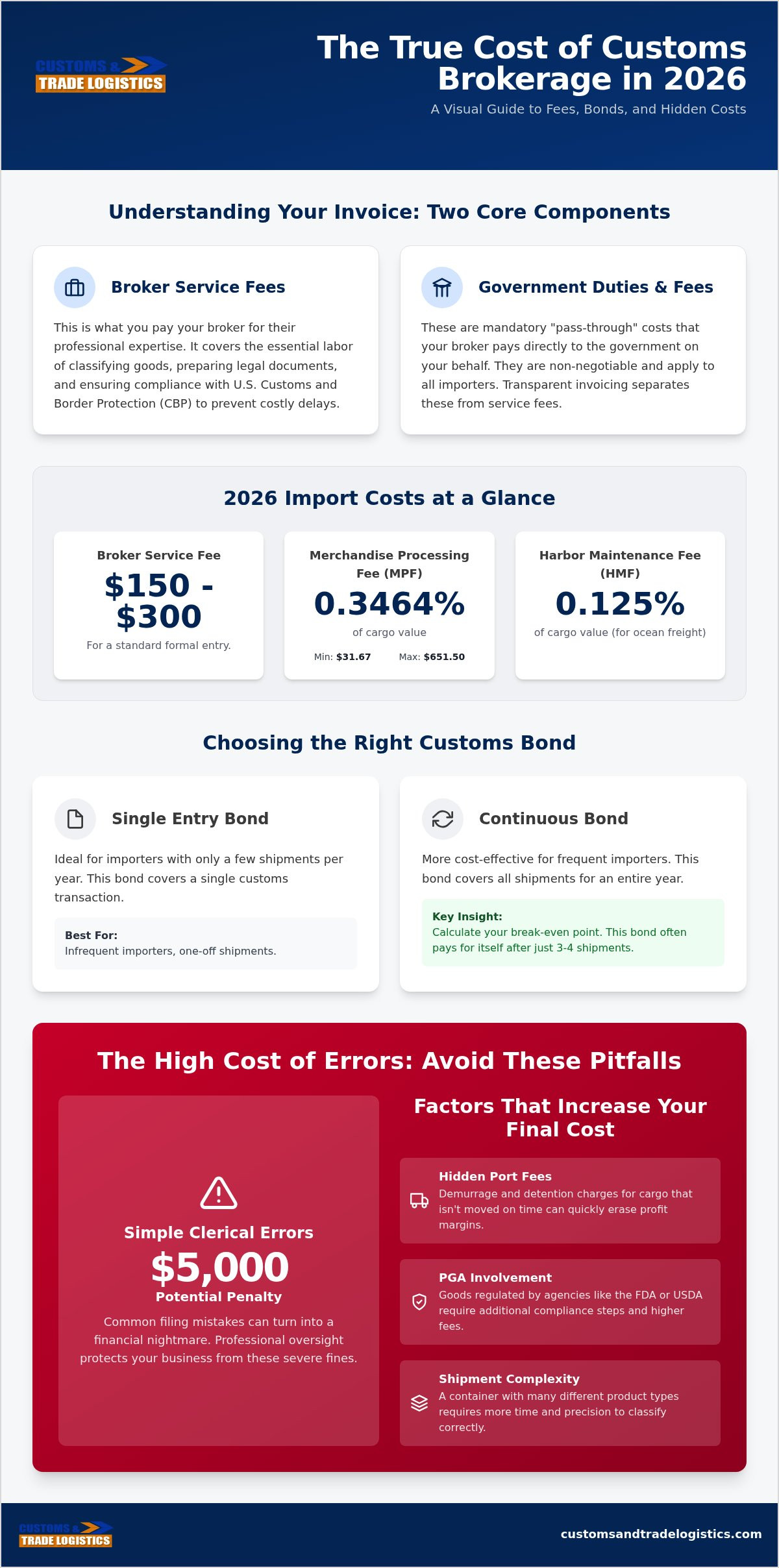
Think of the brokerage entry fee as the cost of professional oversight. This fee covers the labor required to classify your goods under the correct tariff codes, prepare legal documents, and communicate directly with CBP. However, duties and taxes are entirely separate. These are "pass-through" costs that go directly to the government. For example, the Merchandise Processing Fee (MPF) is currently 0.3464% of your cargo value, with a maximum cap that has risen to $651.50 in 2026. We prioritize transparent invoicing so you can see exactly what part of your payment is for our service and what part is heading to the federal treasury. This clarity helps you avoid the "hidden fee" trap that many importers face.
Factors Influencing Your 2026 Quote
Why do quotes vary so much from one shipment to the next? Several variables determine your final bill:
- Mode of Transport: Ocean freight involves different filing requirements, like the Importer Security Filing (ISF), compared to air freight.
- PGA Involvement: If your goods fall under the watch of Participating Government Agencies like the FDA, USDA, or EPA, expect additional compliance steps and higher fees.
- Shipment Complexity: A container with 50 different types of electronics takes significantly more work to clear than one filled with a single type of raw material.
High-frequency importers who move more than 10 entries per month can often find relief through volume discounts. If your business is growing, it's worth asking about a rate structure that rewards your consistency. Understanding the average cost of a customs broker 2026 helps you identify when a quote is fair and when it's missing the critical protection your business needs.
Average Service Fees and Government Charges in 2026
What should you realistically expect to pay for professional clearance this year? For a standard formal entry, most brokers set their base service fees between $150 and $300. This covers the essential work of reviewing your commercial invoice, classifying your goods, and submitting the digital entry to U.S. Customs and Border Protection. While these rates are a core part of the average cost of a customs broker 2026, they're only one piece of the puzzle. You also need to account for the mandatory government fees that every importer must pay, regardless of which broker they choose.
The 2026 MPF and HMF Breakdown
Government fees are often where budgets get derailed if you haven't planned ahead. The Merchandise Processing Fee (MPF) for 2026 is calculated at 0.3464% of the cargo value. For smaller shipments, there is a minimum charge of $31.67. If you're importing high-value goods, the maximum MPF cap has risen to $651.50 this year. It's a non-negotiable cost for formal entries arriving by air, land, or sea. If your goods arrive via ocean container, you'll also see the Harbor Maintenance Fee (HMF) on your invoice. This is set at 0.125% of the cargo's value. These percentages might seem small, but they add up quickly on large orders. Resources from the International Trade Administration can help you understand how these trade policies impact global commerce and your bottom line.
If you're shipping by sea, the Importer Security Filing (ISF), often called "10+2," is your most critical defensive tool. Filing this document typically costs between $35 and $80. While it's an extra charge, it's your primary shield against the $5,000 "no-file" or "late-file" penalties that customs officials strictly enforce. We often suggest that new importers look at their total landing cost rather than just the base fee. Our team at Customs and Trade Logistics helps you map out these expenses in advance so there are no surprises when your ship reaches the port.
Additional Service Charges to Anticipate
Complexity always influences the final price. If your shipment contains more than five different types of products, brokers usually apply "extra line" fees. Each product requires its own Harmonized System (HS) code and individual classification. Similarly, if your goods are regulated by Participating Government Agencies (PGA) like the FDA or EPA, expect to pay for the additional data entry and compliance verification required. Even in our digital-first era, you might still encounter document handling or messenger fees for specific port requirements. By accounting for these variables now, you can build a resilient budget that protects your profit margins through 2026 and beyond.
Customs Bonds: Single Entry vs. Continuous Bond ROI
Every formal entry into the United States requires a customs bond. Think of it as a security deposit or a performance guarantee that ensures U.S. Customs and Border Protection (CBP) gets paid their duties and taxes. Without this bond, your cargo stays stuck at the port, and you'll face mounting storage fees. While the official customs broker permit fees are costs paid by the professional to maintain their license, the bond is a cost you must budget for directly. In 2026, understanding how these bonds impact the average cost of a customs broker 2026 is the key to preventing "budget creep" in your logistics plan. It's one of those granular details that separates a smooth import experience from a stressful one.
When to Choose a Single Entry Bond
If you're only planning to import once or twice a year, a Single Entry Bond (SEB) is often the most logical starting point. These typically cost between $75 and $200, though the price depends on the total value of your duties and taxes. It's a low upfront investment for trial shipments or one-off equipment orders. However, there's a catch for ocean freight. If you're shipping by sea, CBP also requires an ISF bond. When using an SEB, you'll often pay an additional fee for this separate coverage. This "hidden" layer can quickly turn a cheap entry into an expensive one. For low-volume importers, this remains a manageable expense, but it's important to see the full picture before your goods depart the factory.
The Advantages of a Continuous Bond
As your business grows, the math shifts in favor of a Continuous Bond. This 12-month solution covers all your entries at every U.S. port for a full year. It significantly streamlines the customs clearance services us importers rely on, as you don't have to secure a new bond for every individual shipment. Most continuous bonds cost between $400 and $1,200 annually. When you consider that a continuous bond also covers your ISF requirements without extra per-shipment bond fees, the break-even point is usually around 5 to 6 shipments per year. Calculating the average cost of a customs broker 2026 requires looking at these annual savings versus the per-entry hassle of single bonds. In 2026, with increased bond sufficiency requirements, having this "safe pair of hands" in place ensures you won't face delays if your import volume suddenly spikes.
Avoiding the Hidden Costs of International Trade
The price on your initial quote is rarely the final number you pay if your logistics chain isn't managed with care. While the average cost of a customs broker 2026 covers the standard filing, the real financial danger lies in what happens when things go wrong. Unexpected delays or clerical errors can trigger fees that dwarf the original brokerage service cost. For instance, if your container is flagged for a CBP exam, you are responsible for the transportation and labor costs associated with that inspection. These exams are random, but having a "safe pair of hands" ensures your documentation is so precise that it doesn't raise unnecessary red flags.
One of the most expensive mistakes we see involves import from China logistics. Missing a single filing deadline can lead to "Liquidated Damages," which is government-speak for a very large bill. Specifically, an ISF filing must be submitted 24 hours before vessel loading to avoid a $5,000 fine. When you multiply that by several shipments, a simple oversight can destroy a small business's yearly profit. Proactive management isn't just a luxury; it's a financial necessity in the 2026 trade environment.
Storage and Demurrage Protection
Do you know what happens when your container sits too long at the pier? It costs you. Demurrage and detention fees typically range from $150 to $350 per day, per container. These charges kick in the moment your "free time" at the port expires. In 2026, port congestion remains a volatile factor in logistics budgeting. A diligent broker coordinates closely with your trucking partners to ensure immediate pickup the moment your cargo clears. We act as your eyes and ears at the port, pushing for movement so you don't get stuck paying for a container to just sit there.
Compliance as a Cost-Saving Strategy
Accuracy is your best defense against long-term costs. Incorrect HTS codes might save you a few dollars in duties today, but they lead to massive fines and audits tomorrow. We recommend a regular custom brokerage service fees audit to ensure you aren't overpaying or, worse, under-complying. By investing in expert oversight now, you avoid the sting of retroactive penalties that can surface years after a shipment has cleared. If you want to protect your margins from these hidden traps, get a transparent fee breakdown from our team to see how we prioritize your bottom line.
Why a Family-Owned Partner Saves You More in 2026
Do you want to be treated like a ticket number or a business partner? In an era where massive logistics corporations rely on automated digital algorithms to process entries, the value of a personal touch has never been higher. While the average cost of a customs broker 2026 might look similar on a spreadsheet across different providers, the real savings come from the "invisible" costs that a seasoned partner helps you avoid. We've spent over 35 years acting as a "safe pair of hands" for our clients, ensuring that every shipment is treated with the care it deserves. Our veteran expertise allows us to spot potential issues before they become expensive delays at the port.
The Value of Veteran Expertise
Navigating the shifting sands of China-to-US tariffs and ongoing trade disputes requires more than just software. It takes a mentor who understands the nuances of the law. When you work with a family-owned consultancy, you get direct access to experts who know your business by name. We don't just file your paperwork; we provide active oversight of your entire supply chain. This level of dedication is especially vital when dealing with complex classifications or sudden regulatory changes. By catching errors early, we reduce the likelihood of inspections and storage fees, effectively lowering your total cost of doing business even as global trade becomes more complex.
Comprehensive Logistics for SMBs
For growing e-commerce brands, customs clearance is just one part of the journey. We specialize in providing Amazon seller import help, moving your goods from foreign suppliers through the clearance process and directly into redistribution. This end-to-end approach is a game-changer for small and medium-sized businesses that don't have the resources to manage multiple vendors. We also provide strategic import logistics for startups, helping new entrepreneurs scale safely without falling into common compliance traps.
Our goal is to demystify the industry and replace your anxiety with a sense of security. Whether you're importing a single pallet or managing high-volume container shipments, you deserve a predictable budget. When you're ready to secure your 2026 supply chain, requesting a transparent, all-in quote is the first step toward true peace of mind. We're here to bridge the gap between your local operations and the global marketplace, ensuring your goods move smoothly from the factory floor to your customer's door.
Securing Your 2026 Import Strategy
Do you feel more confident about your upcoming logistics budget? Understanding the average cost of a customs broker 2026 is the first step toward a more predictable and profitable year. By separating professional service fees from mandatory government charges like the MPF and HMF, you can avoid the sticker shock that often plagues unprepared importers. Whether you choose a single entry bond for a trial run or a continuous bond for long-term growth, your goal is always the same: seamless clearance and zero penalties.
We've spent over 35 years acting as a "safe pair of hands" for businesses just like yours. As a family-owned and operated firm, we provide national coverage for all US ports, ensuring your cargo moves quickly and compliantly from coast to coast. You don't have to navigate these complex regulations alone. It's time to replace logistical anxiety with a sense of security and partnership. Your growth is our priority, and we're here to bridge the gap between your local operations and the global marketplace.
Get a Transparent 2026 Customs Brokerage Quote Today and let us help you scale your business with confidence. We're ready to guide you through every step of the journey.
Frequently Asked Questions
How much does a customs broker cost per entry in 2026?
A standard formal entry typically costs between $150 and $400 in professional fees, though complex shipments requiring additional agency oversight can exceed $500. For smaller shipments valued under $2,500, you might pay an informal entry fee of $50 to $100. The average cost of a customs broker 2026 depends heavily on your shipment's complexity and the number of distinct product classifications involved.
Is the Merchandise Processing Fee (MPF) mandatory for all imports?
Yes, the Merchandise Processing Fee is mandatory for almost all formal entries entering the United States. It is calculated as 0.3464% of the cargo's value, with a minimum charge of $31.67 and a maximum that has risen to $651.50 for the 2026 fiscal year. While some specific free trade agreements might offer exemptions, most commercial importers should always include this non-negotiable charge in their landing cost budget.
What is the difference between a customs broker and a freight forwarder?
A customs broker focuses on legal compliance and communication with U.S. Customs, while a freight forwarder manages the physical movement of your goods. Think of the broker as your legal advocate who ensures your paperwork is perfect to avoid fines. The forwarder is the architect of the journey, booking space on ships or planes and coordinating the actual transportation from the factory to your warehouse.
Can I clear customs myself without a broker?
You are legally permitted to clear your own customs entries as an Importer of Record, but it is rarely recommended for commercial businesses. The process requires a deep understanding of the Harmonized Tariff Schedule and specific digital filing systems. Without a broker's expertise, you risk $5,000 fines for simple paperwork errors or significant delays that lead to expensive storage fees at the port.
How do I calculate the total landed cost of my import?
To find your total landed cost, you must add the factory product price to the costs of international shipping, insurance, and all duties or taxes. You also need to include the average cost of a customs broker 2026 and mandatory government fees like the MPF. Calculating this total before your goods leave the supplier ensures that your final retail price point remains profitable after all expenses are paid.
What happens if my ISF filing is late in 2026?
If your Importer Security Filing is late or missing in 2026, U.S. Customs can issue a fine of $5,000 per violation. This filing must be submitted at least 24 hours before your goods are loaded onto a vessel at the foreign port. Beyond the financial penalty, a late filing often triggers a "Do Not Load" order or an intensive examination upon arrival, causing weeks of delays.
How much does a continuous customs bond cost?
A continuous customs bond generally costs between $400 and $1,200 per year, depending on the total value of duties and taxes you pay annually. This bond is valid for 12 months and covers all your shipments at every U.S. port of entry. For most businesses importing more than five times a year, it is the most cost-effective way to satisfy security requirements without paying per-shipment bond fees.
Are there extra fees for importing from China to the US?
Importing from China often involves additional costs, specifically Section 301 tariffs which can add 7.5% to 25% or more to your duty bill. You may also face higher brokerage fees if your shipments require specialized consulting to navigate complex trade disputes or anti-dumping regulations. Because China imports are under increased scrutiny, investing in thorough documentation is the best way to prevent expensive inspections and port delays.


