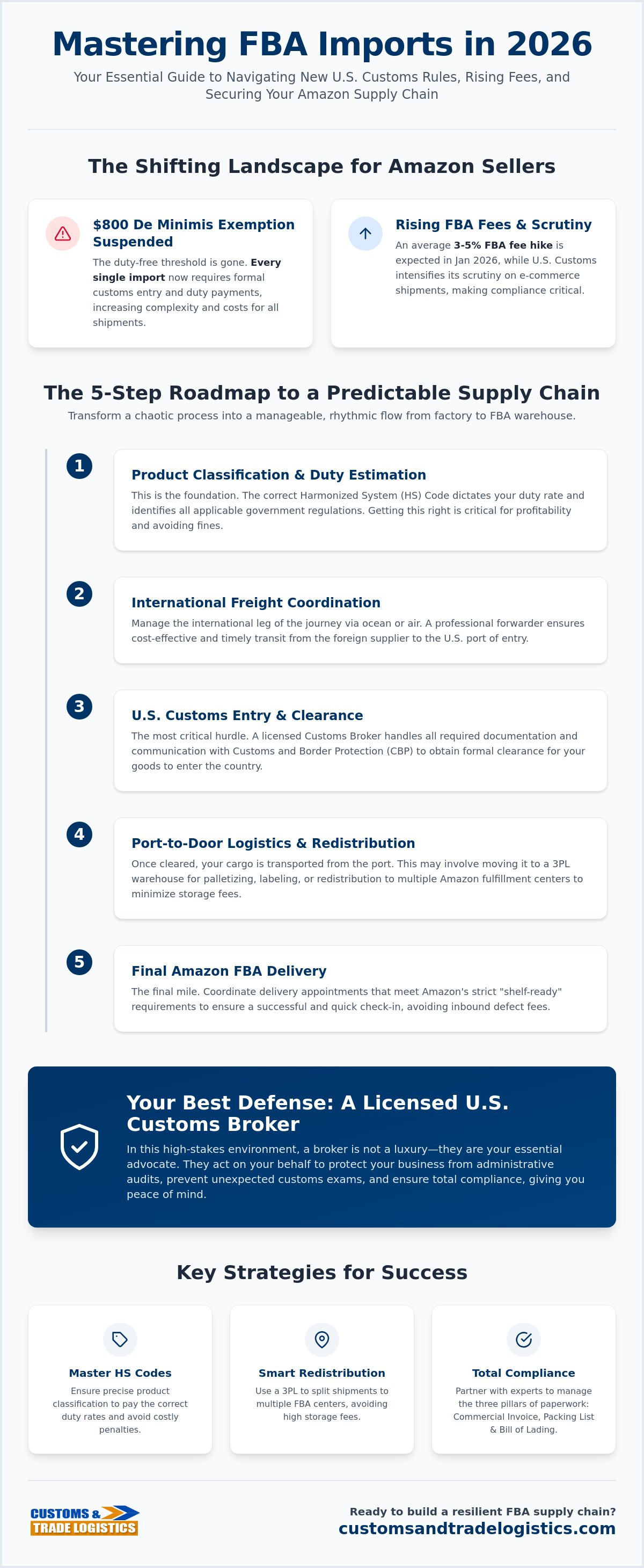
Did you know that every single import into the U.S. now requires formal duty payments since the $800 de minimis exemption was indefinitely suspended? For many sellers, this regulatory shift, combined with the average 3% to 5% FBA fee hike seen in January 2026, has turned a profitable venture into a logistical puzzle. You likely feel the weight of these changes every time you coordinate a shipment, worrying if a minor HS code error will lead to a costly customs hold or an unexpected penalty. It's a lot to manage when you're trying to focus on scaling your brand.
We believe you deserve a partner who treats your inventory with the same care you do. This guide is designed to help you master these international complexities by utilizing professional FBA freight forwarding services to secure your supply chain. We'll provide a clear, step by step framework for maintaining total compliance with U.S. Customs and avoiding those rising inbound defect fees. You're about to learn how to move products from the factory to the warehouse with total predictability, giving you the peace of mind that comes from having an expert handle the heavy lifting.
Key Takeaways
- Understand how the 2026 suspension of the de minimis exemption changes your import strategy, requiring formal customs entry for every shipment regardless of value.
- Discover how professional FBA freight forwarding services manage the entire journey from your foreign supplier to the Amazon warehouse, keeping your supply chain predictable.
- Learn why a licensed US Customs Broker acts as your essential advocate, protecting your business from administrative audits and unexpected customs exams.
- Master the art of product classification to ensure you're using the correct HS codes and paying the right duty rates every time.
- Explore how smart redistribution and delivery strategies can help you avoid high storage fees and meet Amazon's strict "shelf-ready" requirements.
Why Amazon Sellers Need Dedicated FBA Freight Forwarding Services in 2026
Success on Amazon has always required a great product and savvy marketing, but the logistics of 2026 have added a new layer of difficulty. At its core, FBA freight forwarding services act as the vital link between your foreign supplier and the Amazon fulfillment network. This isn't just about moving boxes; it's about managing a high-stakes journey through international ports, customs checkpoints, and final-mile delivery. A professional freight forwarder serves as your architect, ensuring that every step of this journey is compliant and cost-effective.
Why is this so critical now? The regulatory landscape has shifted significantly. With the indefinite suspension of the $800 de minimis duty-free exemption, every single shipment now requires formal documentation and duty payments. Small businesses can't fly under the radar with low-value imports anymore. If your paperwork isn't perfect, your goods won't just be delayed; they could be seized. This is where the difference between a generic, self-service shipping platform and a consultative customs partner becomes clear. While a digital platform might give you a label, a dedicated partner provides the oversight needed to catch incorrect valuations or missing permits before they become expensive nightmares.
The Complexity of Modern E-commerce Trade
Have you noticed that US Customs scrutiny has intensified lately? In the current trade climate, e-commerce shipments are under a microscope. Proactive compliance is no longer optional if you want to protect your Amazon seller health rating. A single customs hold can lead to out-of-stock notices, which tank your search rankings and revenue. The old "set it and forget it" approach to logistics simply doesn't work when you're scaling a brand. You need a strategy that anticipates shifts in trade policy and keeps your inventory moving without friction.
Beyond the Shipping Label: The Paperwork Reality
Many first-time importers assume that a shipping label is the only document that matters. In reality, your shipment's success depends on the accuracy of three pillars: the Commercial Invoice, the Packing List, and the Bill of Lading. Digital-only platforms often miss the subtle nuances of specific product categories or complex tariff classifications. Does your product require an FDA prior notice? Does it fall under a specific anti-dumping duty? A "safe pair of hands" in the form of an experienced logistics partner ensures these questions are answered long before your cargo reaches the port, preventing administrative errors that could stall your growth.
The 5-Step Roadmap: From Foreign Factory to Amazon Fulfillment Center
Moving inventory across the globe can feel like a series of hurdles, but it becomes a manageable, rhythmic process when you break it down into a logical sequence. While many sellers think the journey begins when the goods leave the factory, the most successful brands start their preparation weeks in advance. By utilizing comprehensive FBA freight forwarding services, you can transform a chaotic shipping schedule into a predictable supply chain that works for you, not against you.
The roadmap to a successful FBA check-in involves five distinct stages:
- Step 1: Product classification and duty estimation (HS Codes).
- Step 2: Coordinating the international freight leg via ocean or air.
- Step 3: Navigating US Customs entry and obtaining formal clearance.
- Step 4: Port-to-door logistics, including redistribution to multiple warehouses.
- Step 5: Final delivery and successful Amazon FBA check-in.
Phase 1: Classification and Compliance Check
Determining the correct Harmonized System (HS) code is the foundation of your entire import strategy. This ten digit code dictates the duty rate you'll pay and identifies which government regulations apply to your product. If you choose a code that's too broad, you might overpay on duties; if it's too specific and incorrect, you risk audits and fines. Precise duty estimation is the single most critical variable in determining whether your product will actually be profitable after all landed costs are accounted for. Our team provides import from China consulting to help you identify if your goods require oversight from agencies like the FDA or EPA, ensuring you have the right permits before the cargo ever leaves the factory floor.
Phase 2: International Freight and Customs Entry
For high volume Amazon sellers, the choice between ocean and air freight is a balance of speed and cost. Ocean freight remains the gold standard for maintaining healthy margins on bulky items, while air freight offers the agility needed to prevent "out of stock" disasters. A seasoned partner manages the international leg by filing your Importer Security Filing (ISF) at least 24 hours before the ship departs. Missing this window can result in an automated $5,000 fine from US Customs. To save precious transit time, a professional broker often files your entry before the ship even docks. This proactive approach ensures your goods aren't sitting idle at the port. By integrating FBA freight forwarding services early in the process, you ensure that every document is verified and every filing is punctual, moving your inventory one step closer to the "shelf-ready" status Amazon demands.
Navigating US Customs: Why a Licensed Broker is Your Best Defense
Many sellers use the terms "freight forwarder" and "customs broker" interchangeably, but understanding the difference is vital for your business's legal safety. While your FBA freight forwarding services manage the physical movement of goods across the ocean, a licensed US Customs Broker acts as your legal representative before the government. They are the only professionals authorized to file entries and communicate directly with US Customs and Border Protection (CBP) on your behalf. This distinction matters most when your shipment is flagged for a random exam or an administrative audit.
With over 35 years of experience navigating complex port regulations, we've seen how quickly a minor documentation error can spiral into a major financial loss. A broker doesn't just push paper; they act as a proactive shield. For instance, if you're importing a high volume of goods, you'll need a Continuous Customs Bond. This bond allows for "continuous entry" over a 12 month period, saving you from the hassle and higher costs of filing single entry bonds for every individual shipment. It's a foundational piece of a predictable supply chain that keeps your inventory moving without constant administrative friction.
The Advocate Advantage: Human Expertise vs. Automated Platforms
Large digital aggregators often promote automation as the ultimate solution for modern imports. However, software cannot argue a case with a Customs officer. Imagine a scenario where a port official notices a discrepancy between your Commercial Invoice and the physical Packing List. An automated platform might simply send you a generic notification that your container is on hold. In contrast, a family owned consultancy picks up the phone. We resolve these discrepancies by providing immediate context or corrected documentation, often preventing a costly full container exam before it's even scheduled. This level of protective care is what separates a simple service provider from a true partner who is invested in your success.
Mitigating Financial Risks: Bonds, Duties, and Audits
The financial stakes of importing go far beyond the initial freight quote. If your goods are stuck at a terminal due to clearance delays, you'll quickly face Demurrage and Detention fees. These daily penalties can easily eat through your entire profit margin in a matter of days. Beyond the immediate arrival, ensuring accurate duty payments is your best defense against future audits. US Customs has the authority to review your records years after a sale is finalized. Investing in professional customs clearance services us ensures that your business remains stable and compliant, protecting you from back-dated duty bills or IRS inquiries that could threaten your long term growth.
FBA Logistics Strategy: Delivery, Redistribution, and Door-to-Door Care
Is it faster to ship directly from your supplier to an Amazon warehouse? While it sounds efficient, this shortcut often leads to expensive complications for new sellers. When you ship directly from a foreign factory, you lose the ability to inspect your goods before they reach Amazon's strict receiving docks. If a pallet is damaged or a label is unreadable, Amazon may reject the entire shipment or hit you with inbound defect fees. In 2026, these penalties have climbed as high as $8.25 for bulky items, making a "direct to FBA" strategy a risky gamble for your margins.
By utilizing comprehensive FBA freight forwarding services, you gain a critical buffer between the factory floor and the fulfillment center. This stage of the journey is where your logistics strategy either saves or costs you money. Instead of sending a massive, slow-moving container to a single warehouse, a professional partner helps you break down that inventory. This ensures your products are distributed across the network exactly where they are needed, keeping your stock levels healthy and your shipping times short.
The Strategic Value of Redistribution Centers
Implementing import delivery and redistribution is one of the most effective ways to lower your overhead. Amazon's storage fees are increasingly aggressive; in 2026, the threshold for aged inventory surcharges was reduced from 271 days to just 181 days. By holding a portion of your inventory in a redistribution center and "dripping" it into FBA as needed, you avoid these heavy surcharges. This approach also protects your Buy Box status by ensuring you never trigger low inventory level surcharges, keeping your supply chain lean and responsive to sudden sales spikes.
Mastering the Last Mile: Meeting Amazon’s Strict Requirements
What does door to door import logistics actually look like for a scaling brand? It means having a single point of contact who manages everything from the initial factory pickup to the final FBA check-in. This is especially vital now that Amazon has ended its internal prep and labeling services. Your logistics partner must ensure every unit is "shelf-ready" with perfect FNSKU labeling and palletization. Whether you are shipping a Full Container Load (FCL) or a smaller Less than Container Load (LCL), we manage the specific appointment scheduling and carrier requirements that Amazon demands.
If you are ready to streamline your supply chain and avoid the pitfalls of direct factory shipping, we are here to help. Explore our international freight logistics services to find a tailored solution for your growing brand.
Choosing the Right Partner for Your Amazon Import Journey
Selecting a provider for your FBA freight forwarding services is one of the most consequential decisions you'll make as a seller. You aren't just hiring a company to move boxes; you're choosing a partner who will hold your business's reputation in their hands. In an industry where regulations change overnight, the difference between a successful peak season and a logistical disaster often comes down to the expertise of your logistics provider. You need a partner who offers more than just a digital dashboard; you need a seasoned mentor who understands the high stakes of the Amazon marketplace.
At Customs and Trade Logistics, we've spent 35 years as a family-owned consultancy, acting as a bridge between small businesses and the global market. We believe that a consultative approach beats a purely digital self-service model every time. Why? Because software can't provide the "safe pair of hands" that a veteran broker offers when a complex customs issue arises. We take the time to understand your specific growth goals, treating your inventory with the same diligence we'd use for our own family business.
Moving from Vendor to Strategic Partner
When you evaluate a potential partner, look beyond the initial price quote. Ask specific questions about their experience with import from China logistics. Do they understand the nuances of different US ports, or do they only operate out of one? Transparency in service fees is also non-negotiable. You deserve to know exactly what you're paying for without hidden surcharges appearing mid-transit. A true strategic partner acts as your advocate, ensuring that every link in your supply chain is visible and optimized for your success.
Your Next Steps to a Secure Supply Chain
Ready to move forward? Getting started is a straightforward process when you have the right information prepared. For your first consultation, try to have the following data points ready:
- Detailed product specifications and materials for accurate HS code classification.
- Your supplier's contact information and the specific factory location.
- Estimated shipment volumes and your desired timeline for FBA check-in.
- Any previous customs entry documents if you've imported before.
A professional review of your current process can often uncover hidden costs or compliance gaps you didn't even know existed. You don't have to face the complexities of the global marketplace alone. With the right support, you can replace the anxiety of importing with the confidence of a predictable, compliant supply chain.
Securing Your Supply Chain for 2026 and Beyond
The landscape for Amazon sellers has changed, but these new complexities don't have to stall your growth. Success in 2026 is built on a foundation of precise compliance and a proactive logistics strategy. By mastering product classification and utilizing strategic redistribution, you can navigate rising fees and strict warehouse requirements with confidence. Relying on professional FBA freight forwarding services ensures that your inventory moves seamlessly from the factory floor to the Amazon shelf without the stress of unexpected customs holds.
With 35+ years of industry experience and deep expertise in China-to-US trade lanes, our team provides the human oversight that automated platforms simply can't match. We offer comprehensive support across all US Customs ports, acting as a dedicated advocate for your brand's stability and expansion. Let our family-owned team manage your Amazon FBA imports today. You've worked hard to build your business; let us provide the safe pair of hands you need to protect it. We look forward to helping you reach your next milestone.
Frequently Asked Questions
Do I need a customs broker to sell on Amazon FBA?
You need a licensed customs broker for almost any formal entry into the United States. While it is technically possible to file yourself, the legal risks and complexity of customs regulations make it impractical for most businesses. A broker acts as your authorized representative to US Customs, ensuring all duties are paid and regulations are met. This is especially vital now that the $800 duty-free exemption has been suspended, making nearly every shipment a formal entry.
What is the most common mistake Amazon sellers make when importing from China?
The most frequent error is neglecting to verify product compliance and landed costs before the goods leave the factory. Many sellers assume their supplier has handled the paperwork correctly, only to find missing permits or incorrect HS codes at the port. This leads to unexpected duties and storage fees that can quickly turn a profitable product into a loss. Inspection at a redistribution center before final delivery is your best defense.
How much do FBA freight forwarding services cost?
The cost depends on several variables, including your shipment's total weight, volume, and whether you choose air or ocean transport. Because these rates fluctuate based on global demand and current fuel surcharges, we provide tailored quotes based on your specific needs. Investing in professional FBA freight forwarding services helps you avoid hidden costs like demurrage or penalties that often arise from amateur logistics management.
Can I ship directly from my manufacturer in China to an Amazon warehouse?
You can ship directly, but it is a risky strategy for most sellers. Amazon has extremely rigid requirements for palletization and labeling that manufacturers often struggle to meet perfectly. If your manufacturer makes a small error, Amazon may reject the entire shipment or charge heavy inbound defect fees. Using a buffer stop allows you to inspect your goods and ensure they are "shelf-ready" before they reach the fulfillment center.
What is an ISF filing and why does it matter for FBA sellers?
An ISF, or Importer Security Filing, is a mandatory document that must be filed with US Customs at least 24 hours before your ocean cargo leaves a foreign port. It provides authorities with essential data about the goods and the parties involved in the transaction. If you fail to file this on time, you face an automated $5,000 fine. Your logistics partner manages this filing to keep your supply chain moving without penalties.
How long does the customs clearance process typically take for FBA goods?
Customs clearance usually takes between 24 and 48 hours if your broker pre-files the entry before the vessel arrives. However, this timeline can stretch to several days or even weeks if your cargo is selected for a random exam. Having all your documentation, such as the Commercial Invoice and Packing List, perfectly prepared in advance is the best way to ensure a smooth and speedy release from the port.
What happens if my shipment is held by US Customs?
If your shipment is held, it will undergo one of several types of examinations, ranging from a simple X-ray to a physical inspection. You will be responsible for the costs associated with moving the container and the exam itself. During this time, your broker acts as your advocate, communicating with port officials to resolve any questions and secure the release of your inventory as quickly as possible.
How do I find the correct HS code for my Amazon products?
Finding the correct code requires matching your product's material and primary function to the Harmonized Tariff Schedule of the United States (HTSUS). You can search the official database yourself, but the language is often technical and easy to misinterpret. We recommend a professional classification review to ensure you aren't overpaying duties or using a code that might trigger an audit by US Customs later in your business journey.


