
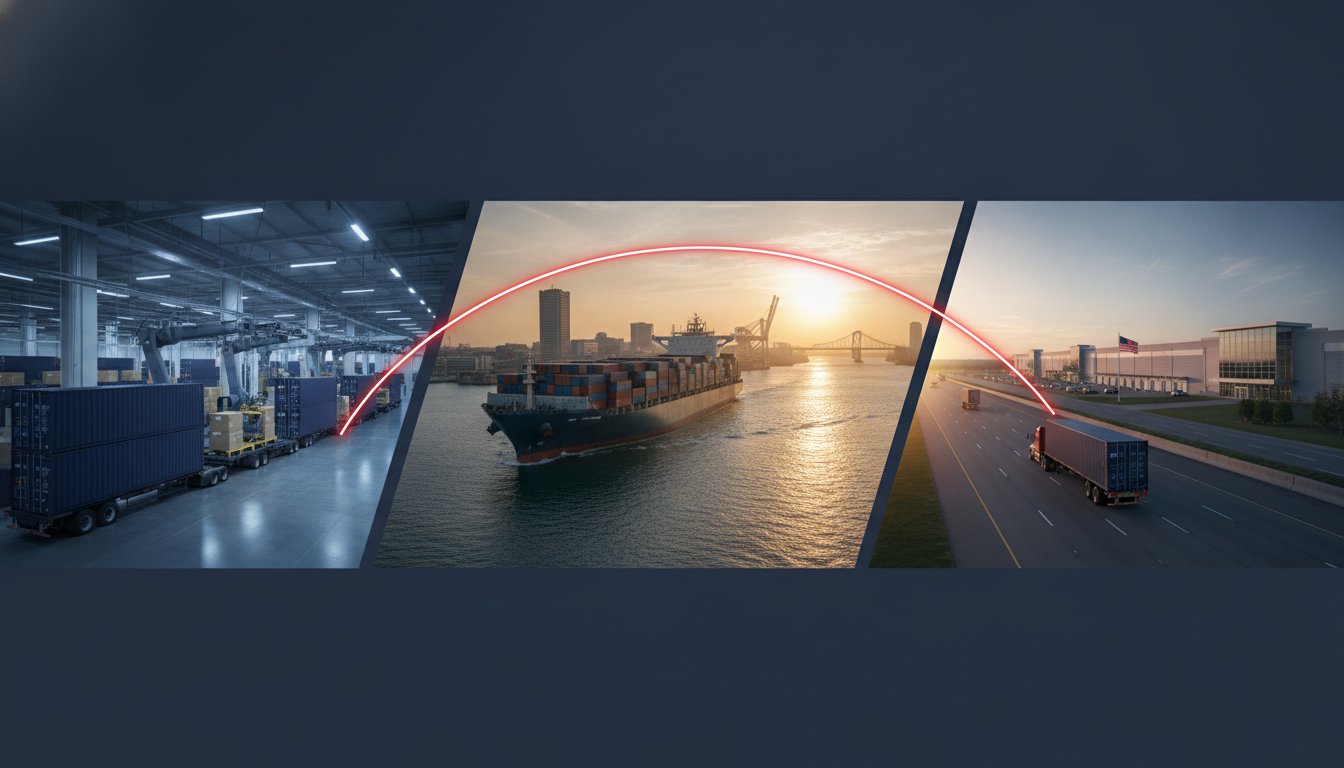
What if you could stop tracking five different vendors and finally eliminate the anxiety of a surprise 10% Section 122 tariff bill hitting your desk? We know that for many US businesses, the 2026 shipping landscape feels more like a minefield than a marketplace. Between the global suspension of the $800 de minimis threshold and the complexities of calculating the 0.3464% Merchandise Processing Fee, it's easy to feel overwhelmed. You want to focus on growing your company, yet you're stuck decoding HTS codes or worrying about hidden port fees. Utilizing door to door import logistics is the most effective way to reclaim your time and ensure your goods move from the factory floor directly to your warehouse with total compliance.
You likely agree that the administrative burden of international trade has become a heavy weight to carry. We promise to help you master the end-to-end import process so you can trade with confidence and security. This guide provides a clear roadmap through the logistics chain, explaining how to bypass common delays and maintain visibility over your inventory. We'll preview the essential steps to streamline your operations, reduce your overhead, and navigate the latest US Customs regulations without the usual stress.
Key Takeaways
- Understand how a single point of contact manages every phase from origin pickup to final-mile delivery, removing the burden of coordinating multiple vendors.
- Learn to calculate your true "total landed cost" and see how door to door import logistics reduces administrative overhead compared to managing separate contracts.
- Master the "Paperwork Fortress" by identifying the essential trio of documents and the mandatory filing rules required to clear US Customs without costly delays.
- Discover the critical criteria for selecting a logistics partner, including the necessity of in-house customs brokerage and specific lane expertise.
What is Door to Door Import Logistics?
Imagine your cargo moving from a factory in Shenzhen to your warehouse in Chicago without you ever having to call a trucking company or a customs broker. This is the reality of door to door import logistics. Instead of buying a piecemeal service where you manage every handoff, you partner with a single provider who oversees the entire journey. This model integrates international freight, the foundational elements of What is Door-to-Door Shipping, and the intricate details of US Customs entry into one streamlined package. Essentially, door-to-door logistics is a unified chain of custody that reduces touchpoints and risk.
The core components of this service include three main pillars: international freight forwarding, customs brokerage, and final-mile delivery. In a traditional port-to-port model, the provider's responsibility ends the moment the ship docks. You're then left to manage the "no man's land" between the pier and your warehouse. Door-to-door logistics removes this gap. Your provider isn't just a carrier; they're a manager of the entire supply chain, ensuring that the transition from sea or air to the local delivery truck happens without your intervention, though you can learn more about DityTruck to see how domestic transport and rental options are compared.
The "Concierge" vs. "DIY" Approach
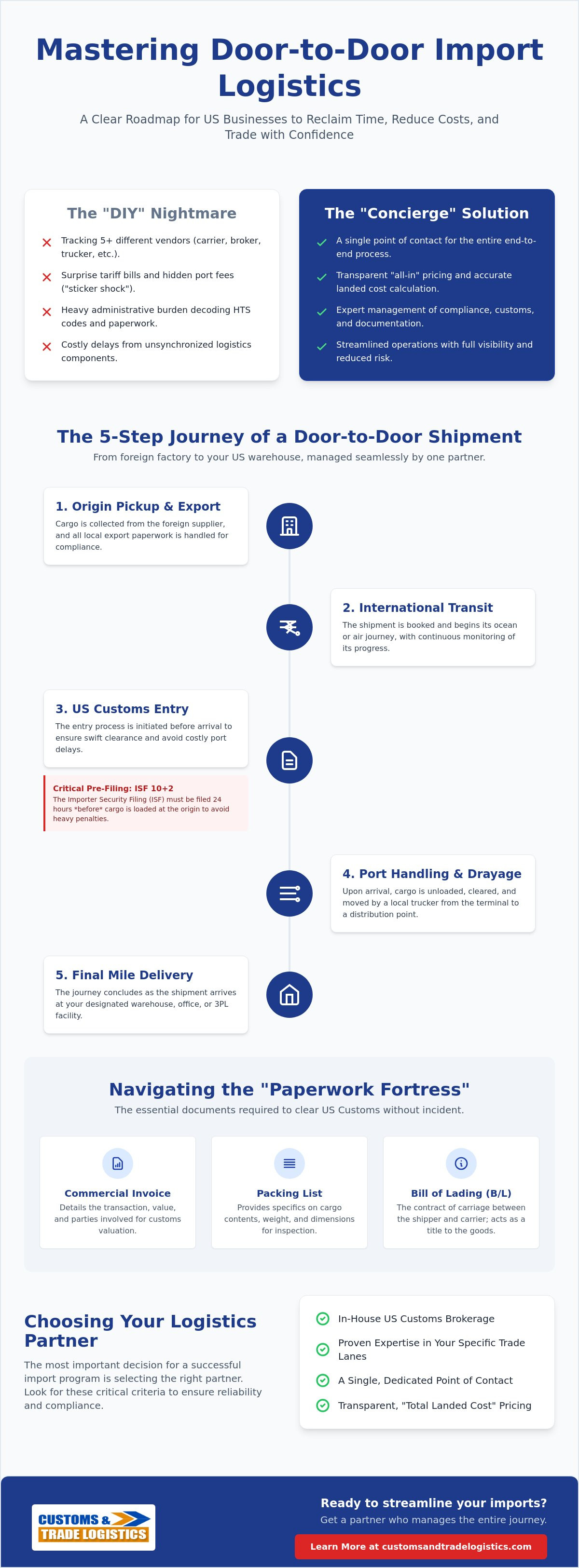
Traditional shipping is often a "DIY" nightmare for growing businesses. You might secure a great rate for the ocean leg, but then you're left scrambling to find a trucker at the port and a broker to handle the entry. This fragmentation often leads to logistics chaos, where a delay at the terminal snowballs into massive storage fees because your components aren't synchronized. By contrast, the "concierge" approach provides professional oversight from start to finish. It shifts the burden of coordination from your shoulders to a dedicated partner. SMBs and e-commerce brands benefit most from this because it provides the infrastructure of a global corporation without the need for an in-house logistics department.
This concierge-style oversight is a hallmark of quality in any transport sector; for example, Southern Elite Van Lines applies this same level of end-to-end management to long-distance relocations, ensuring that complex moves are handled with precision and care.
Key Terminology for Modern Importers
To master this model, you'll need to grasp how it interacts with Incoterms, specifically DDP (Delivered Duty Paid) and DAP (Delivered at Place). While DDP suggests the seller handles everything, many US importers prefer DAP to maintain control over their Customs compliance while still enjoying door delivery. Regardless of the term used, you remain the Importer of Record (IOR). This is a critical distinction. Being the IOR means you're legally responsible for the accuracy of your filings. A true door to door import logistics partner acts as your advocate here, ensuring compliance while providing "all-in" pricing. This transparency protects you from the "sticker shock" of hidden port charges or unexpected handling fees that often plague traditional shipping methods.
The 5-Step Journey of a Door to Door Shipment
The process of door to door import logistics isn't a single event. It's a carefully choreographed sequence of five distinct stages that require precise timing. To move goods successfully from a foreign factory to a US warehouse, your provider must manage these steps:
- Step 1: Origin Pickup and Export Documentation. Your provider coordinates with the foreign supplier to collect the cargo and ensure all export paperwork is compliant with local laws; having an on-the-ground partner like Buying Office Asia can further streamline this initial stage of procurement and quality control.
- Step 2: International Transit. The shipment begins its ocean or air journey. During this phase, your provider monitors the vessel's progress and manages the booking.
- Step 3: US Customs Entry. This is the most critical phase. Your broker starts the entry process well before the ship docks to avoid delays.
- Step 4: Port Handling and Drayage. Once the cargo arrives at the US terminal, it's unloaded and moved by a local trucker to a distribution point.
- Step 5: Final Mile Delivery. The journey ends with the "last door" arrival at your warehouse, office, or a 3PL facility such as boost3pl.com.
By integrating these steps, you eliminate the "no man's land" that often exists between the port and your front door. This unified approach prevents the common "paperwork stall" that ruins many shipments before they even reach the US. Instead of you calling five different companies to find out where your container is, you have one point of contact managing the entire flow. Additionally, for businesses in Southern California managing the physical aftermath of large incoming shipments, you can check out LA Dumpster Bins to handle warehouse waste and debris removal.
Customs Clearance: The Invisible Middle Step
Do you know what happens 24 hours before your ocean cargo is even loaded at the origin port? Your provider must file the Importer Security Filing (ISF), often called the 10+2 rule. Proactive filing is the only way to avoid heavy port penalties and "no-load" orders. A professional broker ensures your goods are classified correctly under the Harmonized Tariff Schedule (HTS), which dictates your duty rates. You can find more details on these requirements in our guide to Customs Clearance Services in the US: The Complete Importer’s Guide for 2026. Understanding these Basic Importing and Exporting Requirements is essential for any business acting as the Importer of Record.
Special Considerations for Amazon FBA Sellers
Selling on Amazon adds another layer of complexity to door to door import logistics. The "Factory to FBA" workflow requires strict adherence to Amazon's delivery appointments and pallet requirements. If your shipment isn't compliant, Amazon might reject it at the gate, leaving you with a massive bill and no inventory. A door-to-door provider manages this redistribution by ensuring your cargo is properly prepped and scheduled for its specific FBA destination. For a deeper look at managing these complex deliveries, check out our Import Delivery and Redistribution: A Strategic Guide for US Importers in 2026. If you need help navigating these requirements, our team offers specialized International Freight Logistics to keep your supply chain moving smoothly.
Door-to-Door vs. Port-to-Port: A Commercial Comparison
Have you ever been lured by a shipping quote that seemed too good to be true? Many importers choose port-to-port shipping because the initial "sticker price" is lower than a full-service quote. However, focusing only on the ocean freight cost is a dangerous game. To understand the true impact on your bottom line, you must calculate the total landed cost. This includes every expense from the moment your goods leave the factory until they're safely on your shelves. While port-to-port might save you money on the initial invoice, it often costs you much more in administrative time and unexpected fees.
Think about the effort required to manage five different contracts simultaneously. You have the factory, the origin forwarder, the ocean carrier, the customs broker, and the domestic trucker. If one link in this chain breaks, you're the one stuck on the phone trying to coordinate a fix. Door to door import logistics consolidates these relationships into a single contract. This streamlined approach isn't just about convenience; it's about accountability. When a delay happens at the terminal, you don't have to play detective to figure out who's at fault. Your provider is responsible for the entire journey, acting as a dedicated advocate for your inventory.
The Reality of Hidden Port Fees
The most common trap in port-to-port shipping is the sudden arrival of demurrage and detention charges. These fees kick in when your container sits too long at the port or when the empty equipment isn't returned on time. Because port-to-port providers stop their service at the pier, they often lack the incentive to rush the final delivery. A door-to-door provider bakes these logistics into a single managed fee. They coordinate the drayage and delivery before the container even hits the dock, providing the predictable lead times you need for accurate inventory planning. This oversight protects you from the budget-killing surprises that often hide in the fine print of "cheap" freight quotes.
Beyond transit costs, managing the disposal of packaging materials is a critical part of warehouse logistics; you can read more about how Book Your Dumpster USA supports commercial facilities with reliable roll-off rentals.
When is Port-to-Port Actually Better?
Is port-to-port ever the right choice? For high-volume enterprise importers with massive, in-house logistics departments, fragmented control can sometimes offer a slight cost advantage. These large corporations have the internal capacity to Navigate Shipping and Logistics, managing complex paperwork and negotiating individual contracts with every carrier. But for 90% of SMBs, these "cost savings" are an illusion. If you don't have a full-time staff to manage the "Paperwork Fortress" we discussed earlier, the administrative burden will quickly outweigh any minor discount. For growing Amazon sellers who need to scale quickly without adding headcount, door to door import logistics is the only logical path forward.
Navigating the "Paperwork Fortress" of Import Logistics
Why do some shipments clear the port in hours while others languish in a warehouse for weeks? The answer usually isn't the speed of the boat; it's the accuracy of the paper. Successful door to door import logistics depends entirely on the quality of the data behind the shipment. To US Customs and Border Protection (CBP), your cargo is only as legitimate as the documents supporting it. Accurate documentation is the "passport" that prevents your goods from being detained by US Customs. Without it, you're not just risking a delay; you're risking expensive storage fees and potential seizure.
Every shipment requires an essential trio of documents: the Commercial Invoice, the Packing List, and the Bill of Lading. The Commercial Invoice is the most scrutinized, as it declares the transaction value and the country of origin. If this doesn't match the Packing List, which details the physical count and weight, you've handed CBP a reason to audit your business. For ocean freight, the ISF (10+2) filing is equally critical. This must be filed at least 24 hours before the cargo is loaded at the origin port. Missing this window is a non-negotiable error that often results in a $5,000 fine per violation.
Classification is the final hurdle. The Harmonized Tariff Schedule (HTS) code you choose determines your duty rate. It's the #1 area where importers overpay. A single digit difference can move your product from a 0% duty category to one with a 25% trade remedy surcharge. Relying on your supplier to pick the code is a common mistake; they don't always understand the nuances of US trade law. You need a partner who can verify these codes before the entry is filed.
Avoiding Common Compliance Pitfalls
Vague descriptions are a magnet for inspections. Writing "parts" or "accessories" on an invoice is no longer acceptable in 2026. CBP requires specific, plain-language descriptions of what the item is and what it's made of. Similarly, incorrect valuation is a major red flag. If you're using a "sample" value for a commercial shipment to save on duties, you're inviting a formal audit. A customs consultant acts as a shield here, reviewing supplier paperwork to catch these inconsistencies before they reach a government official's desk.
The Family-Owned Advantage in Compliance
In an age of automated freight platforms, there's a significant risk in letting an algorithm handle your compliance. While a computer might flag a missing field, it won't notice that your supplier used an outdated HTS code that carries an unnecessary surcharge. We believe a "safe pair of hands" is better than an automated algorithm for complex entries. Our team applies 35+ years of experience to every document review, acting as a dedicated advocate who knows your specific product line. If you're feeling overwhelmed by the paperwork, our Customs Clearance Services provide the expert oversight you need to stay compliant and keep your goods moving.
Choosing Your Door to Door Logistics Partner
How do you find a partner you can actually trust with your business? Selecting the right provider for door to door import logistics is the difference between a thriving operation and one paralyzed by supply chain delays. You need more than just a company that moves boxes; you need a strategic advocate who understands the legal weight of your role as the Importer of Record. To make an informed choice, you should evaluate potential partners against four critical benchmarks.
- Licensed Customs Brokerage: This is non-negotiable. Never trust a forwarder who doesn't have in-house brokerage. When a provider outsources this task, you lose the direct line of accountability that prevents the classification errors we discussed in the "Paperwork Fortress" section.
- Specific Trade Lane Experience: Global trade isn't one-size-fits-all. A partner with deep experience in the China-to-US lane understands the specific local regulations and carrier nuances that keep goods moving.
- Transparent Communication: In a crisis, you don't want a chatbot or an automated ticket system. You need a person you can call directly who can provide real-time updates.
- National Port Coverage: Your business shouldn't be limited by geography. Your partner must have the ability to clear cargo at any US port of entry, ensuring flexibility if you need to reroute shipments to avoid coastal congestion.
By focusing on these criteria, you ensure that your logistics provider is a "safe pair of hands" rather than just another vendor in a crowded marketplace. For businesses requiring specialized support like same-day or express delivery for urgent cargo, SpeedLink Transport Limited offers the flexible logistics solutions needed to maintain a high-performance supply chain.
The Value of a Stabilizing Partner
Customs and Trade Logistics acts as a knowledgeable bridge between your local operation and the global market. We don't believe in hiding behind industry jargon or complex acronyms. Instead, we work to demystify the process, replacing your anxiety with a sense of security and partnership. As a family-owned firm, we offer a level of personal dedication that large aggregators simply cannot match. You aren't just a shipment number to us; you're a partner whose growth is tied to our own. This protective, diligent approach ensures that every detail of your supply chain is managed with the care it deserves.
Next Steps: From Quote to Delivery
Are you ready to move from logistics chaos to professional oversight? Preparing for your first consultation is simple. Gather your recent commercial invoices and a list of your most frequent suppliers. During our talk, we'll identify the bottlenecks in your current process and show you how a managed solution can lift the administrative burden from your shoulders. You'll feel the relief of knowing that your compliance and transport are in expert hands. If you're ready to streamline your supply chain, contact Customs and Trade Logistics for a tailored import solution today. We'll help you navigate the complexities of 2026 and beyond with confidence.
Secure Your Supply Chain for the Future
Navigating the global marketplace doesn't have to be a source of constant anxiety. By choosing door to door import logistics, you're not just moving freight; you're building a resilient, compliant supply chain that protects your business from the volatility of 2026. You've learned how a single point of contact eliminates the "no man's land" between ports and warehouses, ensuring that your total landed costs remain predictable and your paperwork stays bulletproof. This strategic approach replaces logistics chaos with professional oversight.
Success in international trade requires a partner who acts as a dedicated advocate. With 35+ years of industry expertise and Licensed Customs Brokers at all US Ports, we specialize in China-to-US SMB logistics. We're here to lift the administrative burden from your shoulders so you can focus on what you do best: growing your company. Simplify your imports with a family-owned logistics partner today. Your journey from factory floor to front door is in safe hands, and we're ready to help you every step of the way.
Frequently Asked Questions
Is door-to-door shipping more expensive than other methods?
Door-to-door shipping is often more cost-effective when you evaluate the total landed cost rather than just the initial freight quote. Port-to-port prices usually exclude terminal handling fees, drayage, and the administrative cost of your time spent managing multiple vendors. By consolidating these into a single managed fee, you avoid surprise surcharges and the hidden expenses of coordinating a fragmented supply chain. It's an investment in predictability and security.
Who is responsible for customs duties in a door-to-door shipment?
You are typically responsible for customs duties as the Importer of Record, unless your contract specifically uses DDP (Delivered Duty Paid) terms. Even within a comprehensive door to door import logistics model, the legal liability for accurate valuation and duty payment rests with your business. Your logistics partner facilitates the filing and payment process, but the actual funds for duties and taxes are billed to your account to ensure compliance.
Can door-to-door logistics handle Amazon FBA deliveries?
Yes, door-to-door services are specifically designed to navigate the strict delivery requirements of Amazon fulfillment centers. This includes coordinating with your factory for proper labeling, managing the international transit, and scheduling the final delivery appointment through Amazon’s Carrier Central. A professional partner ensures your goods don't just reach the United States; they arrive at the correct FBA warehouse in total compliance with Amazon's rigorous packaging and scheduling standards. For brands looking to elevate their presentation with high-quality custom packaging or commercial printing, Micro Printing offers tailored solutions that ensure your products stand out upon arrival.
What documents do I need to provide for a door-to-door import?
You must provide three primary documents: the Commercial Invoice, the Packing List, and the Bill of Lading. These files act as the passport for your cargo and are scrutinized by US Customs to determine duty rates and verify the shipment's contents. You'll also need to sign a Power of Attorney (POA) to allow your broker to file entries on your behalf. Accuracy here is vital to avoid inspections and delays.
How long does a typical door-to-door shipment from China take?
A typical sea freight journey from China to a US warehouse takes between 30 and 45 days, depending on the specific port of entry. Air freight is significantly faster, usually arriving within 5 to 10 days. These timelines include the origin pickup, international transit, customs clearance, and final-mile delivery. Given the peak season demand in 2026, we recommend planning for these durations to ensure your inventory levels remain stable without interruption.
What happens if my shipment is delayed at the port?
Your logistics partner acts as your primary advocate to resolve the issue with the terminal or US Customs as quickly as possible. Delays often stem from paperwork inconsistencies or random government inspections. Because a door-to-door provider manages both the brokerage and the drayage, they can pivot quickly to minimize expensive demurrage and detention fees. They handle the communication with the port so you don't have to play detective yourself.
Do I need a customs bond for door-to-door shipping?
Yes, you must have a customs bond for any commercial shipment valued over $2,500 entering the United States. This bond acts as a financial guarantee to the government that all duties, taxes, and fees will be paid in full. Most businesses choose a continuous bond, which covers all their imports for a rolling twelve-month period. Your door to door import logistics provider can help you secure this bond during your initial consultation.


