

What if a single container of goods arrived at the port only to be met with a tax bill that costs more than the products themselves? For many US importers, the question of what are anti-dumping duties isn't just a matter of curiosity; it's a critical survival tactic for their bottom line. These aren't your standard tariffs. They are aggressive trade enforcement tools designed to protect domestic industries, and they can catch even experienced businesses off guard. If you've ever felt a sense of dread while looking at complex HTS codes or worried about a sudden retroactive duty increase, you're certainly not alone.
We understand that international trade often feels like a moving target, especially when dealing with high-stakes imports from China. Our goal is to replace that anxiety with a sense of security and partnership. In this 2026 guide, you'll learn exactly how anti-dumping duties work, why they're triggered, and how to protect your business from unexpected import costs. We will walk through the specifics of scope rulings and explain the steps you can take to ensure your shipments remain compliant and profitable. By the end of this article, you'll have a clear roadmap to manage these regulations with the confidence of a seasoned pro.
Key Takeaways
- Understand exactly what are anti-dumping duties and how they function as trade enforcement tools to penalize products sold below fair market value.
- Learn why the cash deposit requirement means paying estimated duties upfront and how to manage the risk of retroactive rate increases years later.
- Identify the specific HTSUS codes and online search tools used to determine if your products are subject to these high-cost penalties before you order.
- Master the timeline of an investigation so you know exactly when Customs and Border Protection begins enforcing new rates at the port of entry.
- Discover how pre-import consulting with a seasoned broker acts as a stabilizing force to protect your business and your profit margins.
Defining Anti-Dumping Duties (ADD) and Their Role in Trade
Have you ever found a supplier offering prices that seem almost impossible to match? While a low price point is great for your margins, it often raises red flags for federal regulators. Understanding what are anti-dumping duties is the first step in protecting your business from a financial shock at the border. Essentially, these are protectionist tariffs placed on foreign goods that the US government believes are being sold at less than fair value.
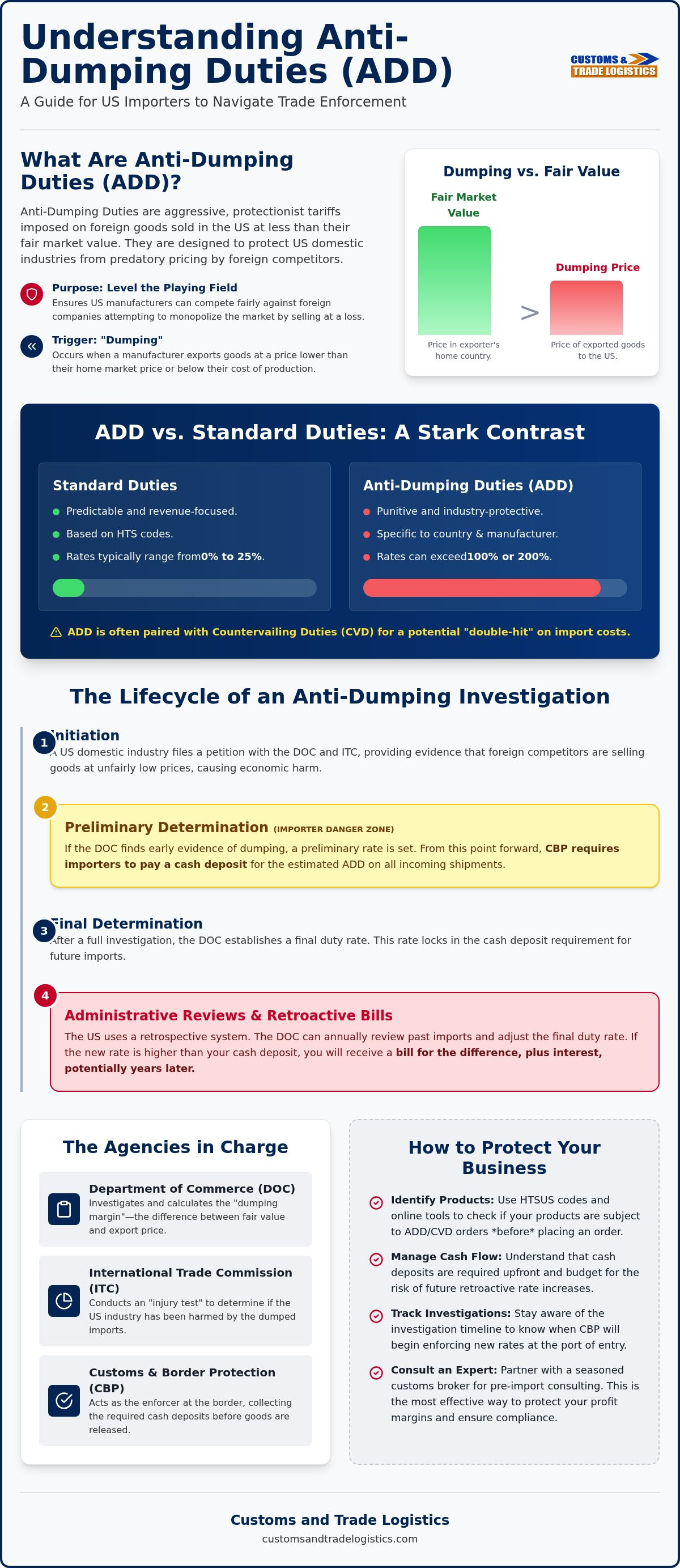
The term "dumping" describes a specific trade practice where a manufacturer exports goods at a price lower than what they charge in their home country, or even below the actual cost of production. Why would a company do this? The goal is usually to flood the market, crush domestic competition, and secure a monopoly. Anti-dumping duties act as a corrective weight. They're designed to level the playing field so that US-based manufacturers can compete fairly against foreign entities that might be selling at a loss to gain a foothold.
Importers often encounter these alongside Countervailing Duties (CVD). While ADD focuses on the pricing behavior of the company, CVD addresses unfair subsidies provided by foreign governments. This "double-hit" can turn a profitable shipment into a massive liability overnight if you haven't done your homework.
The Difference Between Standard Duties and Anti-Dumping Duties
Standard duties are generally predictable. They're based on the Harmonized Tariff Schedule (HTS) and exist mainly to generate revenue for the government. Anti-dumping duties, however, are purely punitive. They don't follow the standard 0% to 25% ranges you might be used to seeing. In many cases, ADD rates exceed 100% or 200% of the value of the goods. These rates are also highly specific. They can be applied to an entire country, but more often, they're tailored to individual manufacturers or exporters based on their specific history of trade practices. This means two suppliers in the same region could have vastly different duty requirements.
The Agencies in Charge: DOC and ITC
Two separate federal bodies must cooperate to finalize these duties. The Department of Commerce (DOC) handles the technical calculations. They investigate the foreign manufacturers to determine the "dumping margin," which is the difference between the fair value and the export price. Simultaneously, the International Trade Commission (ITC) conducts an "injury test." They decide if the US industry has been genuinely hurt or threatened by these imports. Once both agencies finish their work, US Customs and Border Protection (CBP) steps in as the enforcer. They're the ones who stop your shipment and demand the cash deposit before your goods can leave the port.
The Lifecycle of an Anti-Dumping Investigation
Understanding what are anti-dumping duties requires looking past the final tax bill and examining the process that creates it. These investigations don't happen in a vacuum. They follow a rigid, multi-stage timeline that can last over a year before a final decision is reached. For an importer, the most dangerous part of this lifecycle is the uncertainty during the middle stages. If you aren't tracking these developments, you might find your cargo stuck at the port with a surprise bill.
The process moves through several critical phases:
- Initiation: It starts when a group of US manufacturers files a petition with the Department of Commerce (DOC) and the International Trade Commission (ITC). They must prove that foreign competitors are selling goods at unfairly low prices.
- Preliminary Determination: This is the "danger zone" for importers. If the DOC finds early evidence of dumping, they set a preliminary rate. From this day forward, US Customs and Border Protection (CBP) begins requiring cash deposits for every entry.
- Final Determination: After a deep dive into the foreign manufacturer's books, the DOC sets a final rate. This locks in the duty for the time being, but it's rarely the end of the story.
- Administrative Reviews: The US uses a retrospective system. Every year, the DOC can review the previous year's imports. If they decide the dumping margin was actually higher than the deposit you paid, they will send you a bill for the difference, plus interest.
From Petition to Implementation
The transition from a domestic complaint to a border tax happens in three main steps. First, the domestic industry files a formal complaint alleging economic harm. Second, the DOC and ITC launch parallel investigations. The DOC looks at the pricing, while the ITC determines if the US industry is actually being hurt. Third, preliminary rates are announced. This often catches many importers off guard because the duty requirement begins immediately upon the announcement, even before the investigation is officially finished.
The 'Scope' of an Investigation
A common mistake is assuming your product is safe because of its name. Scope rulings focus on physical characteristics like dimensions, chemical composition, or specific use cases rather than commercial labels. For example, a "wooden cabinet" might be exempt, but a "wooden vanity" could be subject to massive duties depending on how the scope is written. If you're unsure if your cargo fits a specific ruling, our Import From China Consulting can help you analyze the technical details before you commit to a supplier.
You must also remember that scope is often country-specific. A product made in Vietnam might have a 0% duty, while the exact same product from China could face a 200% rate. Reading a scope ruling carefully is the only way to know for sure if your specific goods are in the crosshairs of federal regulators.
The Financial Reality: Cash Deposits and Retroactive Rates
The most jarring part of learning what are anti-dumping duties is realizing how they drain your liquid capital. Unlike standard tariffs that you might pay through a periodic monthly statement, ADD usually requires a "Cash Deposit." This means you must pay the estimated duty amount in cash at the time of entry. If your product carries a 100% ADD rate, you're essentially paying double for your inventory before it ever reaches your warehouse. This immediate hit to your cash flow can be a shock for businesses used to more predictable costs.
This isn't a "one and done" payment. The US operates on a retrospective system, meaning your entry stays "unliquidated," or open, for years. If a later administrative review determines the duty should have been higher than what you paid at the port, you'll receive a bill for the difference. This retroactive billing often arrives two or three years after you've already sold the product and moved on. To make matters worse, the government charges interest on these underpayments. It's a heavy administrative burden that can sink a small business if they haven't set aside a contingency fund.
How ADD Impacts Your Bottom Line
When you calculate your landed cost, you must look at the total stack of fees. Your final bill includes the standard duty, ADD, Countervailing Duties (CVD), the Merchandise Processing Fee (MPF), and the Harbor Maintenance Fee (HMF). For Amazon sellers and small retailers operating on thin margins, these layers can quickly turn a potential profit into a significant loss. Investing in professional customs brokerage service fees is a vital step here. A seasoned broker helps you budget for these costs accurately so you don't get blindsided by a retroactive bill you simply can't afford to pay.
Bonding and Security Requirements
Your financial obligations don't stop at cash deposits. Most importers use a Continuous Bond to cover their annual entries. However, shipments subject to anti-dumping duties are considered high-risk by surety companies. If you start importing ADD-subject goods, your bond limit might need a significant increase to cover the potential liability. Securing these bonds for high-risk commodities like steel, aluminum, or certain chemicals is notoriously difficult. A knowledgeable broker acts as your advocate, coordinating with surety providers to ensure your bond is sufficient and your cargo keeps moving without unnecessary delays at the port.
How to Identify if Your Product is Subject to Anti-Dumping
How can you tell if your specific shipment is in the crosshairs? Identifying the risk before you pay your supplier is the only way to protect your profit margins. Your first stop should always be the Harmonized Tariff Schedule of the United States (HTSUS). While most importers look at the general duty rates in Column 1, you need to scan the "Special" sub-column for indicators like "AD" or "CVD." If those letters appear next to your HTS code, it means a trade case is either active or pending. Understanding what are anti-dumping duties in a practical sense means knowing how to spot these markers before you sign a purchase order.
Beyond the tariff schedule, the International Trade Administration (ITA) and CBP provide an online ADD/CVD search tool. This database is the most reliable way to find specific case numbers and current cash deposit rates. You'll also need to be extremely careful about the "Country of Origin." Some suppliers might suggest shipping goods through a third country to avoid duties, a practice known as transshipment. This is highly illegal and can lead to seized cargo and massive fines. If your product falls into a "gray area" where the technical description is vague, you may need to request a formal Scope Ruling. This is a legal determination from the DOC that confirms once and for all whether your specific item is subject to the duty.
Red Flag Commodities for 2026
Certain industries are under constant surveillance. For 2026, steel, aluminum, chemicals, and solar panels remain at the top of the list for enforcement. However, consumer goods are increasingly targeted. We've seen a surge in cases involving wooden bedroom furniture, mattresses, and specific synthetic textiles. Because of these high stakes, managing import from China logistics requires a level of scrutiny that goes far beyond standard freight forwarding. You must verify the HTS code against the most recent scope rulings before the goods ever leave the factory floor.
Vetting Your Suppliers
Is your manufacturer being honest about their duty status? You need to ask direct questions. Find out if they have their own specific "entity rate" or if they are subject to the much higher "country-wide" rate. The difference can be staggering. A factory that cooperated with the Department of Commerce might have a 10% rate, while their neighbor is hit with a 200% "all-others" penalty. If a supplier offers a price that seems too good to be true, it's often because they're evading these duties. Don't wait for your goods to arrive at the port to find out you've made a six-figure mistake. If you need help verifying a supplier's compliance history, our customs clearance services provide the oversight you need to import with total peace of mind.
Managing Compliance with a Seasoned Customs Broker
Dealing with global trade regulations alone is a recipe for unnecessary stress. When you're trying to figure out what are anti-dumping duties and how they apply to your specific goods, having a seasoned partner makes all the difference. A customs broker doesn't just push paper. They act as a stabilizing force that protects your cash flow from the volatile nature of trade enforcement. We help you identify potential risks before you ever send a wire transfer to a supplier. This proactive approach is especially vital for import logistics for startups, where a single compliance error could end the business before it even scales. By analyzing the technical specs of your product early, we ensure that your landed cost calculations are grounded in reality rather than guesswork.
The Broker as Your Advocate
The administrative burden of ADD/CVD is immense. From managing specific case numbers to ensuring the correct cash deposit is paid at the port, the room for error is nearly zero. We take that weight off your shoulders. By choosing a partner with over 35 years of industry experience, you ensure that your customs clearance services us are handled with the precision required to avoid costly seizures or unexpected audits. We act as a knowledgeable bridge between your operation and the strict requirements of CBP. We translate complex legal scope rulings into clear business decisions, allowing you to focus on selling while we focus on compliance. It's about replacing anxiety with a sense of security and partnership.
Next Steps for Your Next Shipment
Are you ready to move forward with confidence? Don't wait until your goods are on the water to check for compliance. The best time to vet a shipment is during the planning phase. Start by gathering your commercial invoice and packing list for a preliminary review. We can help you confirm your HTS codes and check for any active ADD cases that might apply to your specific manufacturer. If you're still confused about what are anti-dumping duties and how they might impact your specific niche, reach out to our team. As a family-owned consultancy, we value your growth as much as you do. We are here to provide the safe pair of hands your business deserves so you can navigate the global marketplace without fear.
Secure Your Supply Chain for 2026
Managing international trade shouldn't feel like a gamble. We've explored the complex lifecycle of investigations and the significant cash flow impact of retroactive billing. Success in the global marketplace depends on your ability to identify risks before your goods leave the factory floor. Understanding what are anti-dumping duties is a vital first step, but having a dedicated mentor to navigate technical scope rulings is what truly protects your profit margins.
As a family-owned business with over 35 years of experience, we specialize in helping SMBs and Amazon sellers master complex China-to-US import compliance. We act as your safe pair of hands, ensuring every entry is filed accurately to prevent seizures and audits. Let our 35 years of expertise protect your imports; contact Customs and Trade Logistics today. You've worked hard to grow your business, and we're here to help you keep it moving forward with total peace of mind.
Frequently Asked Questions
What happens if I don't pay anti-dumping duties?
Failure to pay leads to immediate cargo seizure and heavy financial penalties. CBP can also revoke your ability to import altogether, which effectively ends your business operations. Since the government treats unpaid duties as a debt to the U.S. Treasury, they can use aggressive collection tactics against your company assets. Don't risk your livelihood by ignoring these requirements; it's always better to address compliance issues before your goods reach the port.
Can anti-dumping duties be refunded later?
You can receive a refund if the final duty rate determined during an administrative review is lower than the cash deposit you paid at entry. The U.S. government will return the difference plus interest. However, this process often takes years to complete. It's important to keep meticulous records of your entries during this time. While refunds are possible, they are never guaranteed and depend entirely on the Department of Commerce findings.
How do I find the anti-dumping rate for a specific product?
You can find these rates by searching the ADD/CVD Search Tool on the International Trade Administration website or checking the "Special" column of the HTSUS. Each case has a specific number associated with the country and commodity. Since rates vary by manufacturer, you must identify your supplier's specific entity rate. If you're still confused about what are anti-dumping duties for your specific item, a professional broker can verify the correct rate for you.
Is there a difference between anti-dumping and countervailing duties?
Yes, they target different unfair trade practices. Anti-dumping duties address companies selling products below market value, while countervailing duties target foreign government subsidies that give exporters an unfair advantage. While they have different origins, they are often applied to the same shipments from countries like China. Both require cash deposits and are enforced by CBP with equal strictness to protect domestic industries from unfair competition and market manipulation.
Can I avoid anti-dumping duties by shipping through a third country?
Shipping through a third country to hide the true origin of goods is called transshipment, and it is a serious federal offense. CBP uses sophisticated data tracking to identify these schemes. If you are caught, your goods will be seized, and you could face criminal prosecution. Proper compliance means declaring the actual country where the product was manufactured, regardless of which ports the container visited during its journey to the United States.
Are Amazon sellers personally liable for unpaid anti-dumping duties?
As the Importer of Record, you are legally responsible for all duties, taxes, and fees. CBP doesn't distinguish between a large corporation and a small Amazon seller; the liability remains the same. If your business is an LLC, the entity is usually liable, but the government can pierce the corporate veil in cases of intentional fraud. It's vital to have a seasoned partner managing your filings to avoid these significant personal and professional risks.
How often do anti-dumping duty rates change?
Rates typically change every year during the administrative review period. Additionally, every five years, the DOC and ITC conduct a Sunset Review to decide if the duty should continue or be revoked. This means the rate you pay today might not be the rate you owe two years from now. Staying informed about what are anti-dumping duties and their specific review cycles is the only way to avoid being blindsided by retroactive bills.


