
The era of "cheap parcel" importing is officially over; every commercial shipment entering the country now requires a formal entry regardless of its value. If you've felt overwhelmed by the suspension of the de minimis threshold or the sudden scrutiny of AI-powered supply chain mapping, you aren't alone. It's natural to worry about paperwork errors causing expensive port storage charges or "hidden" fees appearing on your final invoice. You want your goods to move from the factory to your warehouse without a hitch, but the 2026 regulatory environment makes that feel like a moving target.
We understand that behind every shipment is a promise you've made to your customers. This guide is designed to help you master the complexities of modern regulations and discover how professional customs clearance services us importers rely on can protect your bottom line. We'll walk you through the updated 2026 Merchandise Processing Fees, clarify the latest HTS code revisions, and show you how a "safe pair of hands" can ensure your import process stays predictable and compliant. Let's take the guesswork out of your logistics and get your supply chain moving with confidence.
Key Takeaways
- Learn how to verify HTS codes and Partner Government Agency (PGA) requirements early to accurately estimate your total landed costs.
- Understand the mandatory ISF filing deadlines and the differences between single-entry and continuous bonds for your business.
- Discover why professional customs clearance services us businesses rely on provide a "safe pair of hands" for managing complex 2026 regulations.
- Gain strategies for coordinating with foreign suppliers to ensure all documentation is compliant before your cargo leaves the port.
- See how personalized logistics consulting can identify hidden bottlenecks in your supply chain and accelerate your growth.
What are Customs Clearance Services and Why Do Importers Need Them?
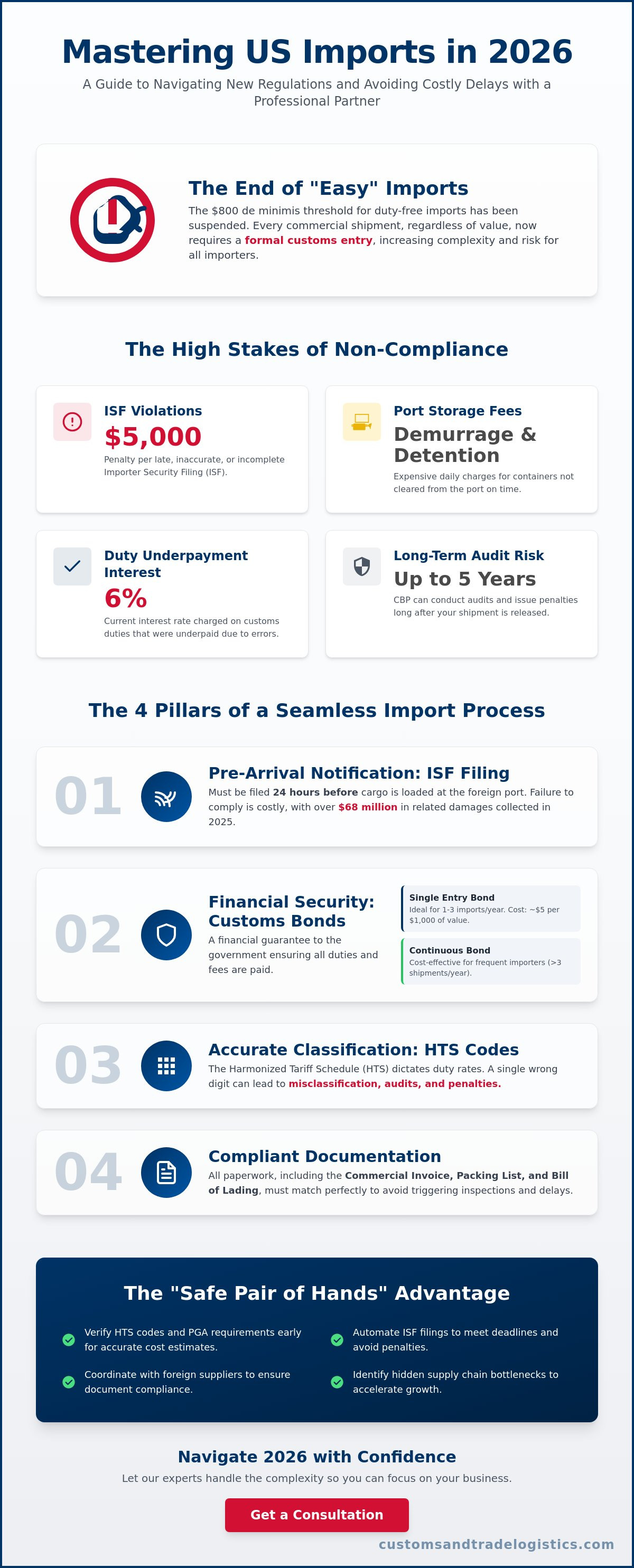
Think of customs clearance as the official "green light" from the government for your goods to enter the country. It isn't just a simple stamp at the border; it's a rigorous verification process where U.S. Customs and Border Protection (CBP) ensures your shipment complies with all federal laws. Since the suspension of the $800 de minimis threshold in August 2025, the landscape has changed for everyone. Now, even small commercial shipments face formal entry requirements. Utilizing professional customs clearance services us ensures that your cargo doesn't just sit at the port collecting dust while you scramble to figure out the paperwork.
Without professional oversight, you risk being hit with demurrage and detention fees. These are essentially expensive "parking tickets" for your cargo. Demurrage kicks in when your container stays at the terminal past its "free time," while detention occurs when you keep the equipment outside the port longer than allowed. A seasoned partner manages the logistics timeline so these surprise costs don't eat your profits. They act as a stabilizing force, ensuring that the transition from the ship to the truck is as smooth as possible.
There's a massive difference between clearing a small parcel and a full commercial container. While a parcel might seem less intimidating, the regulations surrounding Customs duties in the United States apply to both. A full container involves significantly more documentation, including packing lists and commercial invoices that must match the bill of lading perfectly. Any discrepancy can trigger an inspection, leading to delays that ripple through your entire supply chain.
The Legal Role of a Customs Broker in the US
A licensed broker acts as your essential liaison with the CBP. The first step in this partnership is signing a Power of Attorney (POA). This legal document allows the broker to act on your behalf, filing entries and ensuring that all customs clearance services us are handled with precision. They carry the heavy responsibility of calculating accurate duty and tax payments. Because they stay current on the latest 2026 HTS revisions, they help you avoid the 6% interest rates currently charged on underpayments of customs duties.
Why 'Self-Clearing' is a Risk for Small Businesses
Why is doing it yourself so risky? The Harmonized Tariff Schedule (HTS) is a massive, shifting library of codes. One wrong digit can lead to misclassification, which triggers audits or long-term penalties. CBP can conduct audits for up to five years after a shipment has been released. Having a "safe pair of hands" means you have a partner who understands the nuances of the law and protects you from the 24/7 pressures of global trade. They provide the relief you need to focus on growing your business instead of worrying about administrative burdens.
The Essential Components of a Seamless US Import Process
Building a reliable supply chain requires more than just finding a factory. You need a structured approach to satisfy federal requirements before your cargo even touches the water. The process relies on four critical pillars: pre-arrival notification, financial security, accurate classification, and final accounting. When these elements align, your goods move through the port without the stress of unexpected holds or fines.
Understanding ISF Filing and the '24-Hour Rule'
For ocean freight, the Importer Security Filing (ISF), often called "10+2," is your first major hurdle. You must file this at least 24 hours before your goods are loaded onto a vessel at the foreign port of departure. Missing this window isn't just a minor oversight; U.S. Customs and Border Protection collected over $68 million in liquidated damages related to ISF violations in 2025. The standard penalty for a late, inaccurate, or incomplete filing is $5,000 per violation. Our customs clearance services us team automates this workflow, ensuring every data point is transmitted to the government long before the crane moves your container.
Customs Bonds: Protecting Your Imports
A customs bond isn't insurance for your goods. Instead, it's a financial guarantee to the U.S. government that all duties, taxes, and fees will be paid. If you're a first-time importer, you might start with a Single Entry Bond, which typically costs about $5 per $1,000 of merchandise value. However, growing businesses usually find that a Continuous Bond is a cost-saving tool for businesses importing more than three times a year. It covers all your entries at all U.S. ports for a full 12 months, providing the relief of knowing your bond is always ready for the next shipment.
The Precision of HTS Classification
Getting your Harmonized Tariff Schedule (HTS) code right is the difference between a profitable quarter and a surprise bill. The 2026 Basic Edition of the HTS is now in effect, and "close enough" simply won't cut it for federal auditors. Using the wrong code could mean paying unnecessary Section 301 tariffs on Chinese goods or, worse, being flagged for underpayment and facing a 6% interest rate on the balance. A seasoned consultant looks beyond the surface to find the most favorable legal classification for your products. For more detailed guidance on staying compliant, you can review the official Tips for New Importers provided by CBP.
Finally, the Entry Summary (Form 7501) serves as the ultimate accounting of your shipment. It's the document that officially closes the loop with the government, detailing the final value and duty paid. If you feel unsure about managing these technical moving parts, exploring Import From China Consulting can help you build a more resilient and predictable strategy from the very beginning.
Navigating the Logistics Chain from China to US Ports
Moving goods from a factory in Shenzhen or Ningbo to a warehouse in the United States is a high-stakes relay race. The first leg begins long before the ship leaves the dock. You must ensure your Chinese suppliers provide documentation that is "US-ready." This means your Commercial Invoice and Packing List must align perfectly with the Bill of Lading. Discrepancies at this stage often lead to customs holds that can delay your entire supply chain for weeks. Our customs clearance services us team acts as a stabilizing force here, verifying these documents before your cargo even departs.
Choosing between ocean and air freight is your next big decision. With U.S. import prices rising by 4.2% as of April 2026, balancing speed and cost-efficiency has never been more critical. Air freight offers rapid transit for high-value or time-sensitive electronics, but ocean freight remains the backbone for bulk inventory. Regardless of the mode, the arrival of your goods triggers a vital document: the Arrival Notice. This is the signal for your broker to finalize the entry process and secure the official "Customs Release."
Factory-to-Port Coordination in China
The hand-off from your factory's local forwarder to your US-based broker is where many small businesses stumble. A logistics consultant bridges this communication gap, ensuring that the "clean" Bill of Lading is transmitted correctly. We help you manage this transition, providing the oversight needed to prevent your goods from being misrouted or stalled at the origin port. This proactive care ensures that the data used for your ISF filing matches the physical reality of the cargo on the ship.
Delivery and Redistribution Services
What happens once the government grants that coveted "Customs Release"? For many importers, the journey is only half over. This is where Delivery and Redistribution Services become essential. Once the container is cleared, you must coordinate drayage, the short-haul trucking that moves your container from the port to a distribution center. Port congestion can lead to expensive delays, so having a partner who manages this "last mile" is a major competitive advantage.
E-commerce sellers often face the challenge of split shipments. If you're sending inventory to multiple Amazon FBA centers or regional warehouses, a redistribution strategy is vital. We don't just clear your goods; we help you navigate the movement of those products to their final destinations. This end-to-end management provides the relief of knowing your inventory is moving steadily toward your customers, rather than sitting idle in a crowded port terminal.
Avoiding Costly Delays: A Compliance Checklist for Importers
Compliance isn't a one-time event that happens at the border; it's a proactive strategy that begins months before your cargo leaves the factory. Waiting until your ship arrives to check regulations is a recipe for disaster. By following a structured checklist, you can eliminate the anxiety of surprise fees and keep your supply chain moving. Start by verifying your HTS codes before you place an order. With Revision 10 of the 2026 HTS published as recently as June 8, 2026, using an outdated code could lead to significant duty underpayments and a 6% interest rate on the balance.
A thorough audit of your commercial invoices is equally vital. You must ensure that every item has a clear country of origin marking, such as "Made in China," and that the valuation is transparent. Finally, establish a clear communication timeline with your provider of customs clearance services us. Knowing exactly who is responsible for each document at every stage of the journey provides the peace of mind you need to focus on your customers rather than administrative red tape.
The #1 Mistake: Incorrect Valuation
CBP is increasingly relying on data analytics to target importers for audits. Your declared value must represent the total price paid or payable for the goods. If you provided the factory with molds, tools, or materials to help produce your items, these are considered "assists" and must be included in the declared value. Accuracy is critical because CBP uses automated systems to flag undervalued shipments for manual inspection. If you're unsure about how to calculate your total landed costs, reaching out for professional Customs Clearance Services can help you avoid these costly valuation traps.
Managing PGA (Partner Government Agency) Requirements
Does your product contain a battery? Is it a medical device, a children’s toy, or a piece of radio-frequency equipment? If so, you'll need more than just CBP approval. Agencies like the FDA, FCC, or CPSC have their own stringent rules. Missing a single certification can lead to a "refusal of admission," where your goods are either destroyed or shipped back at your expense. An experienced broker flags these requirements during the consulting phase, acting as the "safe pair of hands" that ensures all necessary certifications are in place long before the goods arrive at a US port.
Why a Dedicated Customs Partner is Your Best Growth Strategy
Scaling a business in the 2026 trade environment requires more than just a digital interface or a sleek mobile app. While technology has its place, it often fails when you're facing a complex regulatory dispute or a sudden port delay. A dedicated partner provides the personalized logistics consulting needed to identify hidden bottlenecks in your supply chain before they cost you money. We treat your cargo as our own, offering the security and diligence that only a family-owned business can provide. This level of protective care ensures that as you move from your first shipment to high-volume operations, you're never just a number in a database.
A veteran consultant acts as a stabilizing force, replacing the anxiety of "what if" with the confidence of "what's next." We don't just file paperwork; we advocate for your business. By understanding your specific growth goals, we can tailor customs clearance services us to fit your unique needs. This partnership transforms a complex administrative hurdle into a strategic advantage that helps you outpace competitors who are still struggling with the basics of compliance.
The Value of 35+ Years of Industry Experience
There's no substitute for time spent in the trenches. With 35 years of experience, we've seen every major shift in U.S. trade policy and navigated the specific nuances of every major port. These long-standing relationships with carriers and terminal officials often mean the difference between a shipment that gets stuck and one that moves through smoothly. We operate with a "safe pair of hands" philosophy, managing the heavy administrative burden so you can focus on your brand's vision. Our expertise allows us to anticipate problems before they happen, providing the relief that comes from working with a seasoned mentor who knows the ropes.
Support for Amazon Sellers and E-commerce Brands
E-commerce brands face unique challenges, especially when shipping directly to Amazon FBA centers. The documentation requirements are strict, and the margin for error is slim. We've developed specialized workflows that ensure your customs clearance services us are handled with the precision Amazon demands. Whether you're redistribution inventory across multiple regional hubs or managing your very first container from China, we're here to guide you. We'll handle the technical compliance and the "last mile" logistics so your products reach the shelf on time and without surprise fees.
Don't let the complexity of international trade hold your business back. Ready to demystify your import process? Contact Customs and Trade Logistics for a personalized consultation and let us help you build a more resilient, predictable supply chain today.
Secure Your Supply Chain for 2026 and Beyond
Importing in 2026 demands more than just basic paperwork; it requires a proactive approach to ever-changing regulations. You've learned how accurate HTS classification and timely ISF filings are the foundation of a compliant journey. By managing these technical details early, you protect your business from the hidden costs of port delays and manual inspections. Reliable customs clearance services us importers trust act as the bridge between your overseas factory and your final customer, turning a complex administrative hurdle into a predictable, manageable process.
We provide the relief you need through over 35 years of industry-leading experience and a family-owned dedication that treats your cargo with the care it deserves. With national coverage across all US ports of entry, we're ready to act as your "safe pair of hands" in the global marketplace. Streamline your US imports with a veteran customs partner and let's get your products moving. Your business is ready for growth, and we're here to help you reach that next level with confidence.
Frequently Asked Questions
What is the average cost of customs clearance services in the US?
Professional fees for these services are typically structured as flat rates per entry, with additional charges for ISF filings or complex entries involving other government agencies. These costs are separate from the actual duties, taxes, and bonds you owe to the government. Most businesses find that the cost of hiring a broker is much lower than the storage fees or penalties that result from a single paperwork mistake.
How long does it typically take for goods to clear US Customs?
Most shipments clear within 24 to 48 hours after the vessel arrives, provided your documents were submitted correctly in advance. If your broker files for pre-clearance, your goods might even be released before the ship docks at the port. However, if your cargo is selected for a random exam or a government hold, the process can extend by several days or even weeks.
Do I need a customs broker for every shipment I import?
While you aren't legally required to hire a broker, the 2025 suspension of the $800 de minimis threshold makes it a practical necessity for almost all commercial shipments. Every commercial entry now requires formal documentation that is difficult to manage without specialized software. A licensed professional ensures you don't miss these complex filings, protecting your business from being flagged for future audits or penalties.
What is the difference between a customs broker and a freight forwarder?
A freight forwarder manages the physical movement of your goods across borders, while a customs broker acts as your legal liaison with the government. Think of the forwarder as the logistics manager for your cargo and the broker as the compliance expert. Many modern firms provide both customs clearance services us and freight logistics to offer a seamless, end-to-end experience for their clients.
What happens if my shipment is flagged for a customs exam?
If your container is flagged, it will be moved to a Centralized Examination Station (CES) for a physical or X-ray inspection. You'll be responsible for the costs of transporting the container to the station and the labor fees for the exam itself. While your broker will handle the coordination and keep you informed, they can't speed up the government's review process once an exam is triggered.
Can I import goods from China without a continuous customs bond?
Yes, you can use a Single Entry Bond, but it isn't always the most cost-effective choice for frequent shippers. For imports from China, a bond is mandatory to guarantee that all duties and taxes will be paid to the government. If you plan to import more than three times a year, a Continuous Bond is a better tool for saving money and simplifying your clearance process.
How do I find the correct HTS code for my product?
You can search the official U.S. International Trade Commission (USITC) database, but classifying products correctly is a specialized skill that requires technical training. The Harmonized Tariff Schedule is incredibly dense, and a single digit error can lead to duty underpayments and interest charges. It's safer to have a consultant review your product specifications to find the most accurate and legally defensible code for your items.
What documents are required for US customs clearance?
Every shipment requires a Commercial Invoice, a Packing List, and a Bill of Lading at a minimum. Depending on your product, you might also need specific forms for Partner Government Agencies, such as FDA or FCC certifications. Ensuring these documents are verified and "US-ready" before your cargo leaves the factory is the best way to prevent expensive delays when your goods arrive at the port.


