

Did you know that as of August 2026, the $800 duty-free "de minimis" threshold is officially a thing of the past for all commercial imports? This permanent shift means every shipment, no matter how small, now requires a formal entry and a payment to U.S. Customs. If you're wondering how are customs duties calculated for imports under these new rules, you aren't alone. Many importers feel a sense of dread when they log into the ACE portal; they fear a single misclick could lead to double payments or costly late penalties.
We understand that managing international trade can feel like a heavy burden. You want to stay compliant without getting lost in technical jargon or confusing interfaces. This guide promises to demystify the digital payment landscape, giving you a clear, step-by-step workflow for secure and efficient transactions. We'll explore the differences between direct and broker-managed payments, ensuring you have a safe pair of hands to maintain total oversight. By the end, you'll have the peace of mind that your 2026 imports are fully compliant and your bottom line is protected.
Key Takeaways
- Master the strict 10-day payment window to protect your business from late fees and ensure your goods move through the port without delay.
- Gain clarity on how are customs duties calculated for imports under the 2026 regulations to avoid unexpected spikes from Anti-Dumping or Countervailing duties.
- Evaluate the differences between ACH Debit and ACH Credit to choose the digital payment route that best aligns with your team's accounting workflow.
- Learn to navigate the ACE portal interface with confidence by following a methodical verification process before authorizing any fund transfers.
- Discover how a seasoned customs broker acts as a stabilizing force, lifting the administrative burden of financial compliance from your shoulders.
Understanding the Timeline and Requirements for Paying Customs Duties Online
At its core, a customs duty is a mandatory federal tax levied on goods as they cross international borders. To understand the broader economic context, you might ask: What is a tariff? Effectively, it's a tool used by the government to protect domestic industries and generate revenue. By 2026, the landscape has shifted. The permanent suspension of the $800 de minimis threshold means nearly all commercial shipments now require formal entry and duty payment. This transition makes 100% digital payment a necessity for modern compliance. We view this shift as an opportunity to gain better oversight of your finances, lifting the administrative burden that paper-based systems used to create.
Your primary document for this process is the Entry Summary, also known as CBP Form 7501. This document acts as the final record of your shipment's value, classification, and the total amount owed to the government. It’s the essential "bill" you'll be paying through the online portal, and ensuring its accuracy is the first step toward a secure transaction.
When Exactly Are Duties Due?
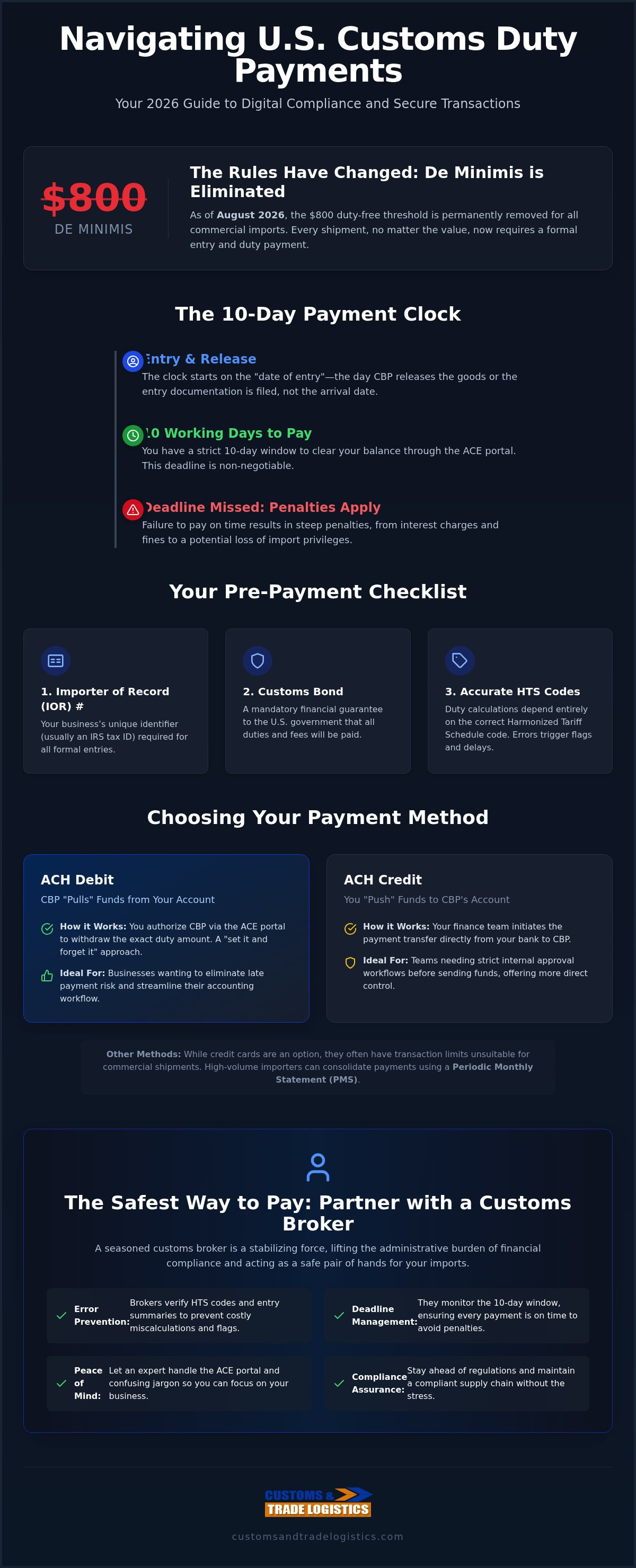
There's often confusion between the date of arrival and the date of entry. The clock doesn't start ticking the moment your cargo hits the pier. Instead, the 10-day payment window begins on the "date of entry," which is the day CBP officially releases the goods or the day the entry documentation is filed. You have exactly 10 working days from this point to clear your balance. If you miss this deadline, the penalties can be steep; they range from interest charges to a loss of import privileges. Many businesses rely on customs clearance services us to monitor these timelines, ensuring no deadline slips through the cracks.
Prerequisites for Online Payment
Before you can authorize a transfer, you must have several administrative pieces in place. First, you need an Importer of Record (IOR) number. This is usually your business’s IRS tax identification number or a Social Security number for individuals. Second, a Customs Bond is mandatory for all formal entries. This bond acts as a financial guarantee to the U.S. government that all duties and fees will be paid, acting as a "safe pair of hands" for your shipment’s legal standing.
Finally, your data must be accurate. A central part of this is understanding how are customs duties calculated for imports. This calculation depends entirely on your product's Harmonized Tariff Schedule (HTS) code. In 2026, with HTS Revision 15 in effect, using the correct code is vital. If your classification is off, your duty amount will be incorrect, which can trigger an automated flag in the ACE portal. Making sure your HTS codes are verified before you reach the payment stage provides a sense of security and keeps your supply chain moving without unexpected financial hurdles.
Choosing the Best Method for Paying Customs Duties Online
Deciding which payment channel to use is just as important for your cash flow as understanding how are customs duties calculated for imports based on HTS codes. You have three primary digital avenues to consider: ACH Debit, ACH Credit, and credit cards. While credit cards might seem convenient, they often come with strict transaction limits that don't suit commercial shipments. Most businesses find that Automated Clearing House (ACH) options provide the stability and oversight needed for regular trade. You can find full details on CBP's acceptable electronic payment methods to see which fits your current bank setup.
For many accounting teams, the choice between ACH Debit and ACH Credit comes down to control. With ACH Debit, you authorize CBP to withdraw the exact duty amount from your account. It's a "set it and forget it" style that virtually eliminates the risk of late fees. ACH Credit, however, puts your bank in the driver's seat. Your team initiates the transfer, which offers more internal security but requires a rigorous schedule to ensure funds clear within that 10-day window. If you're a high-volume seller, you might also look into the Periodic Monthly Statement (PMS). This allows you to consolidate all your duties into one monthly payment rather than paying for every single shipment as it arrives.
Direct Payment via the ACE Portal
The Automated Commercial Environment (ACE) portal is the primary system for US trade processing. Managing your own ACE account gives you direct visibility into every entry summary filed under your ID. However, it's a technical platform built for professionals, and the learning curve can be steep. Small businesses often find the administrative burden of navigating the portal's interface to be a significant distraction from their daily operations. If you choose this route, you'll need a dedicated staff member to monitor the portal daily to authorize payments and track compliance.
The Broker-Managed Approach
Most importers prefer a broker-managed approach because it acts as a stabilizing force for their logistics. Instead of you logging into the government portal, your broker facilitates the payment on your behalf. This often results in consolidated billing, where you receive one clear invoice that includes both the government duties and the custom brokerage service fees. This method significantly reduces the risk of transaction errors or double-paying duties. If you want to simplify your financial trade journey, our team at Customs and Trade Logistics can manage these complex digital hurdles for you, providing a safe pair of hands for every dollar transferred.
Step-by-Step Guide: Paying Customs Duties Online via ACH
Moving from the theory of trade to the actual transfer of funds requires a methodical approach. While you likely already know how are customs duties calculated for imports based on your HTS codes, the actual movement of money requires a formal enrollment in the Automated Clearing House (ACH) system. This digital handshake between your bank and U.S. Customs and Border Protection (CBP) ensures that your payments are secure, traceable, and compliant. Using CBP-approved electronic payment methods is the most reliable way to maintain your standing as a trusted importer.
Setting Up Your ACH Debit Account
To begin, you'll need to complete CBP Form 4801, which is the official ACH Debit Enrollment form. This document links your business bank account directly to your Importer of Record (IOR) number. Don't wait until your cargo is at the port to start this process. The verification period between CBP and your financial institution typically takes about 15 days. If you set this up at least two weeks before your shipment arrives, you'll have a safe pair of hands ready to catch the transaction the moment it's due. Once enrolled, CBP will send a pre-notification to your bank to confirm the account is active and ready for duty withdrawals.
Authorizing and Tracking the Transaction
After your entry is filed, CBP issues a "Statement of Duties." This document serves as your official bill, detailing the exact amount owed for each shipment. When you log into the ACE portal, you'll see these statements listed by their date of entry. You must review the entry summaries and duty amounts for accuracy before you click the authorization button. If you spot a discrepancy in how are customs duties calculated for imports on your statement, you must address it before authorizing the transfer.
Executing the payment is a straightforward click-by-click process within the portal's "Financial" tab. You select the open statements, verify the total, and authorize the withdrawal. If a payment fails, it’s usually due to insufficient funds or an incorrect IOR number. Most failed transactions trigger an automated notice, giving you a small window to rectify the issue before late fees apply. Once the payment clears, usually within 24 to 48 hours, you'll receive a digital receipt. You must download and maintain these records for a mandatory period of five years. This diligent record-keeping is your best defense during a future customs audit, providing a clear paper trail of your total financial compliance.
Common Pitfalls and How to Avoid Payment Delays
Even after you've mastered the ACH setup, the road to a cleared shipment has potential traps. One of the most common issues arises when there's a misunderstanding of how are customs duties calculated for imports before the goods even ship. If your initial estimate is off, your authorized payment won't match the government's requirement, leading to immediate delays at the port. These errors often stem from ignoring "Anti-Dumping" (AD) and "Countervailing" (CV) duties. These trade remedies target goods sold at less than fair value or those benefiting from foreign subsidies. They can trigger unexpected payment spikes that double or even triple your expected costs.
Timing is another frequent hurdle. The 10-day payment window is strictly enforced, but it only counts working days. Federal holidays and bank weekends can significantly shorten your actual response time. If your funds aren't available when CBP attempts a withdrawal, you may find your import privileges suspended. This is particularly dangerous for those seeking Amazon seller import help. A single payment failure can lead to FBA inventory blocks, causing your listings to go dark and halting your revenue stream during peak seasons.
Dealing with Unexpected Duty Increases
What happens if CBP challenges your valuation after you've already paid? This scenario often creates panic, but there's a methodical way to resolve it. You may need to file a "Post Summary Correction" (PSC) if you discover an error after the entry summary is filed but before it's liquidated. Because these corrections are technically demanding, expert import logistics for startups focuses heavily on pre-calculation. Getting the numbers right the first time is much simpler than trying to fix a financial record once it's in the government's system.
Security and Fraud Prevention
As digital transactions become the standard in 2026, security is paramount. Always verify that your payment portal is an official .gov site. Phishing attempts targeting new importers are on the rise; these often look like urgent "duty due" notices from fake agencies. Using an established customs broker provides a "safe pair of hands" for all financial transfers. We act as a protective barrier, verifying every statement before a single dollar leaves your account. If you are concerned about maintaining compliance while scaling your business, let our family-owned brokerage manage your customs payments to ensure your funds and your reputation remain secure.
Why Partnering with a Customs Broker is the Safest Way to Pay
Managing the financial side of international trade doesn't have to be a source of constant anxiety. While understanding how are customs duties calculated for imports is a great first step, the actual execution of those payments in the ACE portal often feels like a full-time job. By partnering with a professional brokerage, you're not just hiring a service; you're gaining a mentor with over 35 years of industry experience. We act as a stabilizing force, ensuring that every dollar you send to the government is accurate and on time. This partnership allows you to replace the fear of late penalties with the relief of knowing your compliance is in a safe pair of hands.
When you consolidate your shipping, customs clearance, and duty payments through a single point of contact, you remove a massive administrative burden. Instead of juggling different logins and tracking several deadlines, you receive clear, comprehensive oversight. This efficiency is what allows small businesses and Amazon sellers to stop worrying about paperwork and start focusing on scaling their operations. We handle the granular procedural details so that your journey from port to warehouse remains methodical and steady.
The Family-Owned Advantage
Unlike digital-only platforms that treat your business like a ticket number, our family-owned approach offers personalized oversight that automated systems simply cannot match. We understand the specific nuances of China-to-US trade, from the latest HTS updates to the complexities of AD/CVD duties. This level of expertise is vital when your sensitive financial data is on the line. We pride ourselves on being accessible; you can speak directly to experts who care about your growth as much as you do. It's a supportive partnership designed to bridge the gap between small-scale operations and the global marketplace.
Next Steps: Streamlining Your 2026 Import Strategy
Transitioning from DIY payments to a professional brokerage solution is a strategic move for any growing importer. The long-term ROI of this shift is significant. When you avoid the interest charges and penalties that come with miscalculating how are customs duties calculated for imports, you protect your profit margins. Our goal is to provide a seamless experience that concludes with total resolution and peace of mind. Are you ready to lift the weight of customs compliance off your shoulders? Consult with Customs and Trade Logistics today for a stress-free import process and let us handle the digital hurdles for you.
Secure Your Import Future with Confident Digital Payments
The 2026 trade landscape requires more than just logistical speed; it demands financial precision. You've learned that mastering the 10-day payment window and navigating the ACE portal are critical steps for any modern importer. By understanding exactly how are customs duties calculated for imports, you can eliminate the anxiety of unexpected spikes and keep your supply chain moving steadily. Whether you choose to manage payments directly or utilize a Periodic Monthly Statement, the goal remains the same: total compliance and financial oversight.
You don't have to carry this administrative burden alone. With over 35 years of brokerage experience, our family-owned team acts as a dedicated mentor for SMBs and Amazon sellers. We provide the personalized care and expert oversight needed to protect your business from costly errors and FBA blocks. Let our experts manage your customs payments and compliance so you can focus on what you do best: growing your brand. Your international trade journey is a marathon, and we're here to ensure every step is on solid ground.
Frequently Asked Questions
Can I pay my customs duties with a credit card online?
Yes, you can use a credit card for payments up to $24,999.99 through the Pay.gov system. However, most commercial importers find this limit restrictive for larger shipments. For consistent business operations, setting up an ACH account is a much more reliable long-term solution. It provides the stability you need to manage your cash flow without worrying about daily transaction caps or merchant processing hurdles. For businesses looking to simplify the other side of their finances, using a tool like Hunt Cover can streamline how you receive payments from your own customers.
How long does it take for CBP to process an online ACH payment?
Online ACH payments typically process within 24 to 48 hours. While the system marks your obligation as paid the moment you authorize the transfer, the actual movement of funds between your bank and CBP takes a day or two. This is why we recommend initiating the transfer well before the final deadline. It ensures your shipment's status is cleared in the system without any last-minute technical friction.
What happens if I miss the 10-day deadline for paying duties?
If you miss the 10-day window, CBP will assess interest charges on the unpaid balance immediately. Beyond the financial cost, repeated delays can lead to a sanctioned status. This means CBP may refuse to release your future shipments until all duties are paid in advance. Having a mentor-like partner to track these dates helps you avoid these penalties and keeps your reputation with Customs in good standing.
Do I need a separate ACE account if my broker is paying the duties?
You don't strictly need your own ACE account if your broker is handling the payments on your behalf. We manage the interface and authorization for you, which lifts a significant administrative burden. However, many of our clients still choose to maintain view-only ACE portal access. This allows you to see how are customs duties calculated for imports on every entry summary for your own internal financial audits.
How can I verify that my customs duties have been paid to the government?
You can verify your payment by checking the Statement section in your ACE portal or by reviewing the final entry summary provided by your broker. This document shows how are customs duties calculated for imports and confirms the total paid. A liquidated status on your entry is the ultimate confirmation. If we manage your payments, we provide clear, consolidated receipts so you have a safe pair of hands documenting every transaction.
Are there additional fees for paying customs duties online?
There are no additional convenience fees charged by U.S. Customs for paying duties online via ACH. The amount you see on your entry summary is exactly what you pay. While your specific bank might charge a small fee for outgoing ACH transfers, the digital process is generally the most cost-effective method. It's far cheaper than the administrative costs and potential interest associated with paper checks or late payments.
Can I schedule my duty payments in advance?
Yes, you can schedule payments in advance if you use the ACH Debit method within the ACE portal. This feature is particularly helpful for managing your accounting calendar around bank holidays or weekends. By authorizing the payment early, you ensure the funds are ready to be pulled on the exact due date. This proactive approach gives you total peace of mind that your compliance is maintained without constant manual monitoring.


