
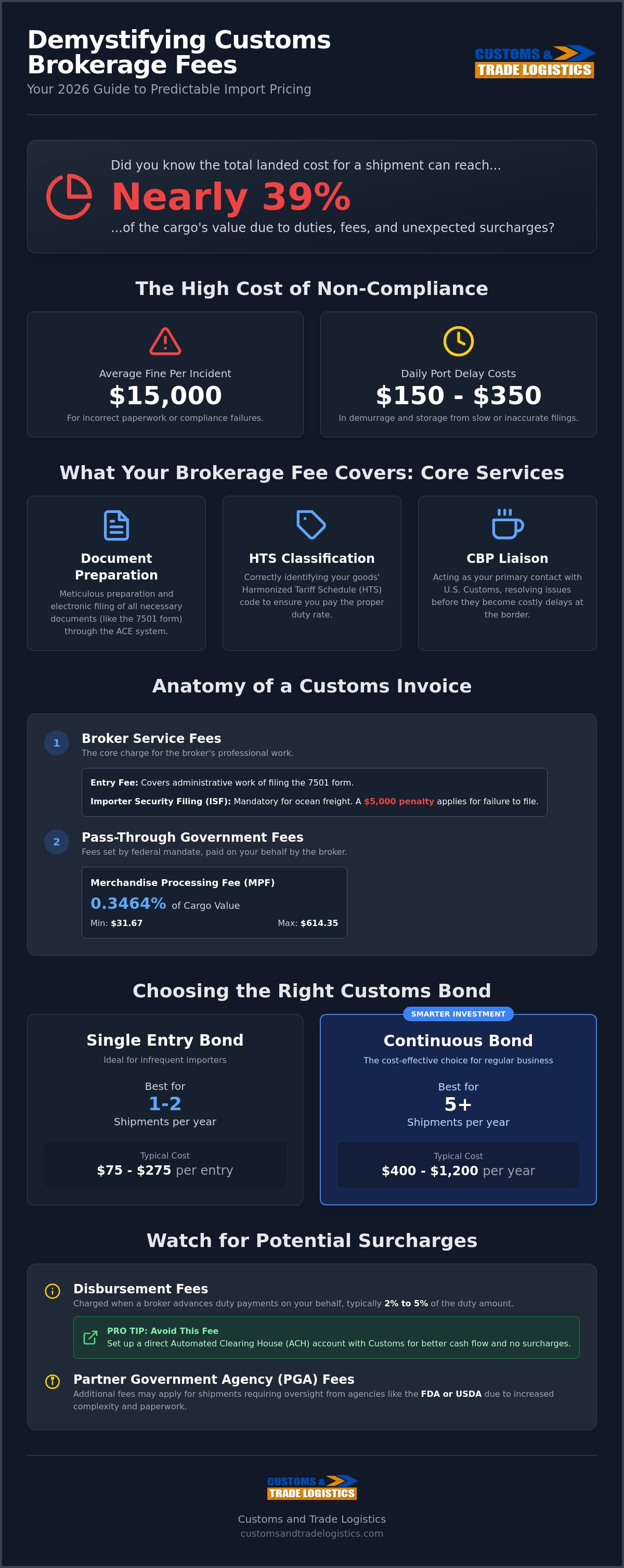
Did you know that the total landed cost for a shipment of electronics from China can reach nearly 39% of the cargo's value once all duties and fees are tallied? It's a staggering figure that often catches importers off guard, especially when the invoice arrives with unexpected surcharges. We understand how frustrating it feels to look at a line item for custom brokerage service fees and wonder exactly what you're paying for. You want a partner who treats your business like their own, not a corporate giant that hides costs behind complex jargon.
Mastering the nuances of customs pricing is the only way to protect your profit margins and keep your supply chain moving without friction. In this guide, we'll demystify the 2026 pricing landscape so you can build a predictable budget for every shipment. You'll learn the difference between mandatory government charges like the Merchandise Processing Fee and the service fees that ensure your compliance. We're going to break down exactly how to eliminate surprise invoices and find a partner who explains the "why" behind every cost.
Key Takeaways
- Understand how custom brokerage service fees act as your first line of defense against costly non-compliance and liquidated damages.
- Learn to break down standard fee schedules, including the difference between single-entry and continuous bonds for better long-term budgeting.
- Identify common "hidden" surcharges associated with complex invoices and Partner Government Agency oversight from the FDA or USDA.
- Discover how to choose a partner who prioritizes transparency over bundled "mystery" fees, ensuring you always know exactly what you are paying for.
What Are Custom Brokerage Service Fees?
Have you ever wondered why your import invoice includes a specific charge for professional oversight? At its core, custom brokerage service fees are the professional charges paid to a licensed expert who manages the legal entry of your goods into the United States. Think of it as hiring a specialized guide to lead you through a dense forest of federal regulations. A Customs broker acts as your advocate and bridge to the global marketplace, ensuring that every box and pallet meets strict government standards before it ever touches a delivery truck.
These fees are essential because the alternative is incredibly expensive. U.S. Customs and Border Protection (CBP) holds importers to a standard of "informed compliance." This means that if your paperwork is wrong, you don't just get a polite correction. You face liquidated damages and heavy fines that can average $15,000 per incident. By 2026, the industry has shifted toward more transparent fee structures. Most modern brokers now offer a flat fee per entry, which makes your budgeting much easier to predict. Others might use a percentage-based structure for exceptionally high-value shipments. Regardless of the model, these fees must be a primary part of your total landed cost calculation to ensure your business remains profitable.
The Scope of Professional Customs Services
A broker does far more than just "pushing paper." Their work involves meticulous document preparation and electronic filing through the Automated Commercial Environment (ACE) system. They carefully analyze your goods to determine the correct classification using the Harmonized Tariff Schedule (HTS). This is a critical step; the HTS code determines the duty rate you pay. Finally, they act as your primary liaison with CBP, answering technical questions and resolving issues before they turn into costly delays at the border.
Why "Cheap" Brokerage Fees Can Be Expensive
It’s tempting to shop for the lowest possible price, but "cheap" service often carries hidden costs that surface later. If a broker rushes through your filing and misclassifies your products, you could be hit with massive penalties. Beyond fines, slow or inaccurate filing leads to demurrage and storage costs at the port. These port delays can run between $150 and $350 per day, quickly erasing any savings from a lower service fee. This is why having a reliable import logistics partner is so valuable. They act as a safe pair of hands, catching errors early and protecting your bottom line from the "cheap" mistakes that derail many international operations.
Breaking Down the Standard Fee Schedule
How do you separate the professional service from the government's cut? When you look at an invoice, the core of your custom brokerage service fees is typically the Entry Fee. This charge covers the administrative work of filing the 7501 form, which is the official document that tells U.S. Customs exactly what you're bringing into the country. Beyond this base charge, you'll encounter mandatory security filings like the Importer Security Filing (ISF), also known as 10+2. For ocean freight, this must be filed at least 24 hours before the vessel is loaded. Failing to do so can result in a $5,000 penalty, making the broker's filing fee a small but vital insurance policy for your shipment.
It's also helpful to understand that some costs are pass-through expenses. Your broker often pays government user fees on your behalf and then bills you for reimbursement. These official customs broker fees and government adjustments, such as the Merchandise Processing Fee (MPF), are set by federal mandate. In 2026, the MPF is 0.3464% of your cargo's value, with a minimum of $31.67 and a maximum of $614.35. If you're unsure which bond fits your volume, our team at Customs and Trade Logistics can help you run the numbers to find the most cost-effective path.
Continuous vs. Single Entry Bonds
Every importer must have a customs bond to guarantee that duties and taxes will be paid. If you only ship once or twice a year, a Single Entry Bond (costing between $75 and $275) might seem cheaper. However, for businesses importing five or more times annually, a Continuous Bond is the smarter investment. At a cost of $400 to $1,200 per year, it covers all your entries for 12 months. We often act as the bridge for small businesses, helping them secure bond underwriting even when their volume is just beginning to scale.
Disbursement and Merchant Fees
Brokers frequently advance duty payments to the government to keep your cargo moving. Because this uses the broker’s own credit line and carries financial risk, most charge a disbursement fee, usually between 2% and 5% of the duty amount. You can avoid this surcharge by setting up a direct Automated Clearing House (ACH) account with Customs. We highly recommend this for better cash flow management. If you need more tailored advice, exploring customs duty and tax help can provide strategies to navigate these costs without straining your operational budget.
Secondary Fees and "Hidden" Surcharges
Why do some invoices look longer than others? It often comes down to the complexity of your shipment. If you're importing a single product type, your custom brokerage service fees will be straightforward. However, if your invoice contains dozens of different items, each requiring a separate Harmonized Tariff Schedule (HTS) code, you'll see "additional line fees." Most brokers include the first few lines in the base price but charge a small fee for every line thereafter to account for the extra classification work required for complex manifests.
Partner Government Agency (PGA) Processing
Many products fall under the jurisdiction of agencies beyond just Customs. If you import food, medical devices, or wood products, agencies like the FDA, USDA, or the Lacey Act require specific data sets. This triggers PGA processing fees. These aren't just "extra charges" for the sake of it. They cover the labor required to verify compliance and transmit specialized data through the ACE system. You can often lower these costs by providing your broker with complete data sheets and ingredient lists well before the shipment arrives. For healthcare providers looking to optimize their entire operational cycle, you can discover Tausch Medical to help manage the complex billing side of your business.
The Cost of Customs Inspections
What happens if CBP flags your container? This is one of the most stressful parts of importing. While the government doesn't charge for the inspection itself, you are responsible for the "exam coordination fees." Your broker must arrange for the container to be moved to a Centralized Examination Station (CES). A VACIS exam, which is essentially a giant X-ray, is faster and cheaper. In contrast, an intensive physical exam can cost between $300 and over $1,000, excluding trucking and storage fees. A family-owned broker provides a significant advantage here because they offer closer oversight, ensuring your cargo isn't sitting idle at a CES longer than necessary.
These secondary costs reflect the growing operational costs and fee pressures that brokers face in a highly regulated environment. Even in our digital age, you might still see small "messenger" or "courier" fees on an invoice. While most filing is electronic, certain original documents, like a physical Bill of Lading or specific permits, still require hand-delivery to port authorities or government offices. Understanding these line items helps you build a more resilient budget and eliminates the "sticker shock" that often comes with complex international trade.
How to Evaluate a Broker’s Value in 2026
How do you distinguish a truly valuable partner from a simple service provider? In 2026, the lowest custom brokerage service fees aren't always the best deal for your bottom line. You need to look at the total cost of ownership. A broker who saves you fifty dollars on an entry but fails to answer the phone when your container is stuck at the terminal is costing you money. Value is found in the balance of transparency, responsiveness, and the ability to scale alongside your business as you grow from one pallet to ten containers. If you are tired of opaque pricing, you can request a transparent fee breakdown to see exactly where your money goes.
The debate between a digital freight forwarder vs traditional broker is more relevant than ever. Digital platforms offer sleek interfaces and automated filing, which works well for simple, repetitive shipments. However, these platforms often lack the seasoned expertise needed when a shipment from China faces enhanced scrutiny or a complex tariff dispute. A traditional broker acts as a mentor and advocate. They provide the human oversight that catches errors before they become permanent records in the ACE system. When you pay custom brokerage service fees, you're paying for that "safe pair of hands" to manage your regulatory risk.
Auditing Your Customs Invoices
You should never accept a "bundled" mystery fee on your invoice. Red flags include unexplained "miscellaneous" charges or sudden rate hikes that weren't discussed during your initial onboarding. To compare quotes effectively, ask three different brokers for a line-item disclosure of their service fees versus pass-through government costs. Ensure you have a signed Power of Attorney (POA) on file that clearly outlines the fee disclosure requirements. This document is the foundation of your legal relationship and ensures your broker is held to the highest standard of professional conduct.
Specialized Support for Amazon and China Imports
Importing for Amazon FBA requires a specific set of skills, particularly in delivery and redistribution. Your broker must understand the strict labeling and appointment requirements of Amazon fulfillment centers to avoid costly rejected shipments. Similarly, managing imports from China in 2026 requires deep knowledge of Section 301 tariffs and evolving trade restrictions. Specialized consulting provides the technical defense necessary to navigate high-stakes audits and complex tariff environments, making the slightly higher service fee a proactive investment in your company's long-term financial health.
Why Customs and Trade Logistics is the Right Investment
Do you feel like just another number in a corporate database? In an industry dominated by massive logistics conglomerates, the personal touch often gets lost in the shuffle. At Customs and Trade Logistics, we've spent over 35 years building a national consultancy that stays true to its family-owned roots. We don't just process paperwork; we act as a stabilizing force for your business. Our team manages the entire journey from your foreign supplier to the final delivery point. This ensures that your custom brokerage service fees are always tied to tangible, expert oversight that protects your bottom line.
We've designed our service model specifically for small to medium-sized businesses that need more than just an entry filer. You need a mentor who understands the "why" behind every regulation. Our end-to-end management approach means we oversee everything from initial Import From China Consulting to the final stages of delivery and redistribution. By acting as a "safe pair of hands," we demystify the global trade process and replace your administrative anxiety with a sense of total security. We believe that professional assurance shouldn't come with a hidden price tag, which is why our fee structures remain transparent and predictable.
Personalized Service in a Corporate World
When a shipment is delayed at the port, you don't want to wait on hold for a generic call center. You need direct access to seasoned professionals who know your business by name. We prioritize proactive communication to prevent costly port delays before they happen. Our team provides custom solutions for complex logistics, including specialized shipping coordination that larger firms often overlook. Whether you're dealing with a difficult classification or need help with redistribution, we provide the specific expertise required to keep your cargo moving without friction.
Get a Transparent Quote Today
How do you start moving toward a more predictable import budget? The first step in our partnership is a comprehensive logistics audit. We'll look at your current processes and identify where you might be overpaying or facing unnecessary risks. This professional oversight reduces the stress of international trade and gives you the confidence to scale your operations. We're here to provide the reliable care your business deserves. If you're ready to eliminate the mystery from your landing costs, you can Request a clear breakdown of our custom brokerage service fees and start your journey toward a more profitable supply chain today.
Secure Your Supply Chain for 2026 and Beyond
Identifying the specific components of your import costs is the first step toward reclaiming control over your business growth. You now understand how to distinguish between mandatory government charges and the professional oversight that keeps your shipments compliant. By auditing your invoices and choosing a partner who prioritizes clarity, you eliminate the fear of hidden surcharges and late-stage port delays. This knowledge transforms a complex administrative burden into a predictable part of your budget.
At Customs and Trade Logistics, we bring over 35 years of industry experience to every shipment we manage. As a family-owned and operated consultancy, we provide national coverage across all US ports while maintaining the personalized service you won't find at a large corporate firm. We're here to ensure your custom brokerage service fees translate directly into peace of mind and stable profit margins. It's time to stop worrying about surprise costs and start focusing on your next big opportunity.
Ready to take the guesswork out of your logistics? Get a transparent quote for your next shipment today. We're excited to help you navigate the complexities of global trade with confidence and professional care.
Frequently Asked Questions
How much does a customs broker typically charge per entry in 2026?
Professional rates for entry preparation vary depending on the complexity of your shipment and whether it requires a formal or informal entry. Shipments with five or more line items or those requiring review by agencies like the FDA generally involve more labor and higher service fees. Most brokers provide a tailored quote based on the specific data entry and compliance work required for your manifest.
Is it possible to clear customs without a broker to avoid fees?
What is the difference between a brokerage fee and a customs duty?
A brokerage fee is a payment for the professional service of managing your entry, while a customs duty is a mandatory tax paid to the government. Your broker uses the Harmonized Tariff Schedule to calculate the duty based on your product's value and origin. You pay the duty to the government, and you pay the broker for their work in ensuring the filing is accurate and timely.
Why did my broker charge me a disbursement fee?
Brokers charge a disbursement fee when they use their own credit line or cash to pay duties and taxes to the government on your behalf. This fee, which is usually a small percentage of the total duty amount, covers the financial risk and administrative cost of advancing those funds. You can usually avoid this charge by setting up a direct ACH account with Customs to pay duties yourself.
How are ISF filing fees calculated for ocean shipments?
ISF filing fees are almost always charged as a flat rate per shipment for ocean freight. This fee covers the professional labor of transmitting the required "10+2" data elements to the government at least 24 hours before your vessel is loaded. It's a vital service because a missing or late filing can trigger a $5,000 penalty from Customs and Border Protection.
Do custom brokerage service fees include the cost of a customs bond?
Most custom brokerage service fees do not include the bond premium, which is billed as a separate line item. You need either a single-entry bond for a one-time shipment or a continuous bond if you plan to import multiple times throughout the year. Your broker can facilitate the purchase of these bonds from a surety company, but they are distinct from the fee for filing your entry.
What happens if my broker makes a mistake on the HTS classification?
You remain legally responsible for the accuracy of your entry as the importer of record, even if the error was made by your broker. Misclassifications can lead to audits, seized goods, and heavy financial penalties that impact your bottom line. This highlights the importance of choosing a diligent partner who prioritizes accuracy over the fastest or cheapest filing possible.
Are there extra fees for importing from China to the US?
Imports from China often face enhanced scrutiny and additional Section 301 tariffs, which can make the filing process more complex. This complexity might lead to higher custom brokerage service fees if your shipment requires extensive classification work or additional documentation to prove compliance. Working with a consultant who specializes in China imports can help you navigate these specific challenges and manage your total landed costs.


