
Did you know that the average effective U.S. tariff rate reached 13.7% in February 2026, the highest level recorded since 1972? If your business is struggling with the sudden elimination of the $800 de minimis threshold, you're certainly not alone. The fear of a CBP audit or a sudden "landed cost" spike can make international trade feel like a minefield. Securing expert customs duty and tax help is no longer just a convenience; it's a necessary shield for your bottom line in this high-stakes environment.
We know how exhausting it is to decode jargon like MPF, HMF, and Anti-Dumping duties while trying to maintain your margins. This guide provides the professional assurance you need to master these complexities with confidence. We'll explore the expiration of Section 122 tariffs, the new ad valorem rules for postal shipments, and the ongoing process for IEEPA duty refunds. You'll gain a clear path toward predictable costs and reduced administrative burdens, allowing you to focus on growing your business while we help handle the compliance details.
Key Takeaways
- Understand how the 2026 regulatory landscape affects your bottom line and the specific role CBP plays in managing import fees.
- Master the essentials of HTS classification and valuation to ensure you access the right customs duty and tax help for your specific products.
- Compare the risks of DIY filing against the security of professional customs clearance services to shield your business from unexpected audits.
- Identify common pitfalls like misclassification and valuation errors that can lead to significant delays and overpayments.
- Discover how a seasoned mentor can simplify your international freight logistics and turn a complex process into a predictable part of your operations.
Understanding US Customs Duties and Taxes in 2026
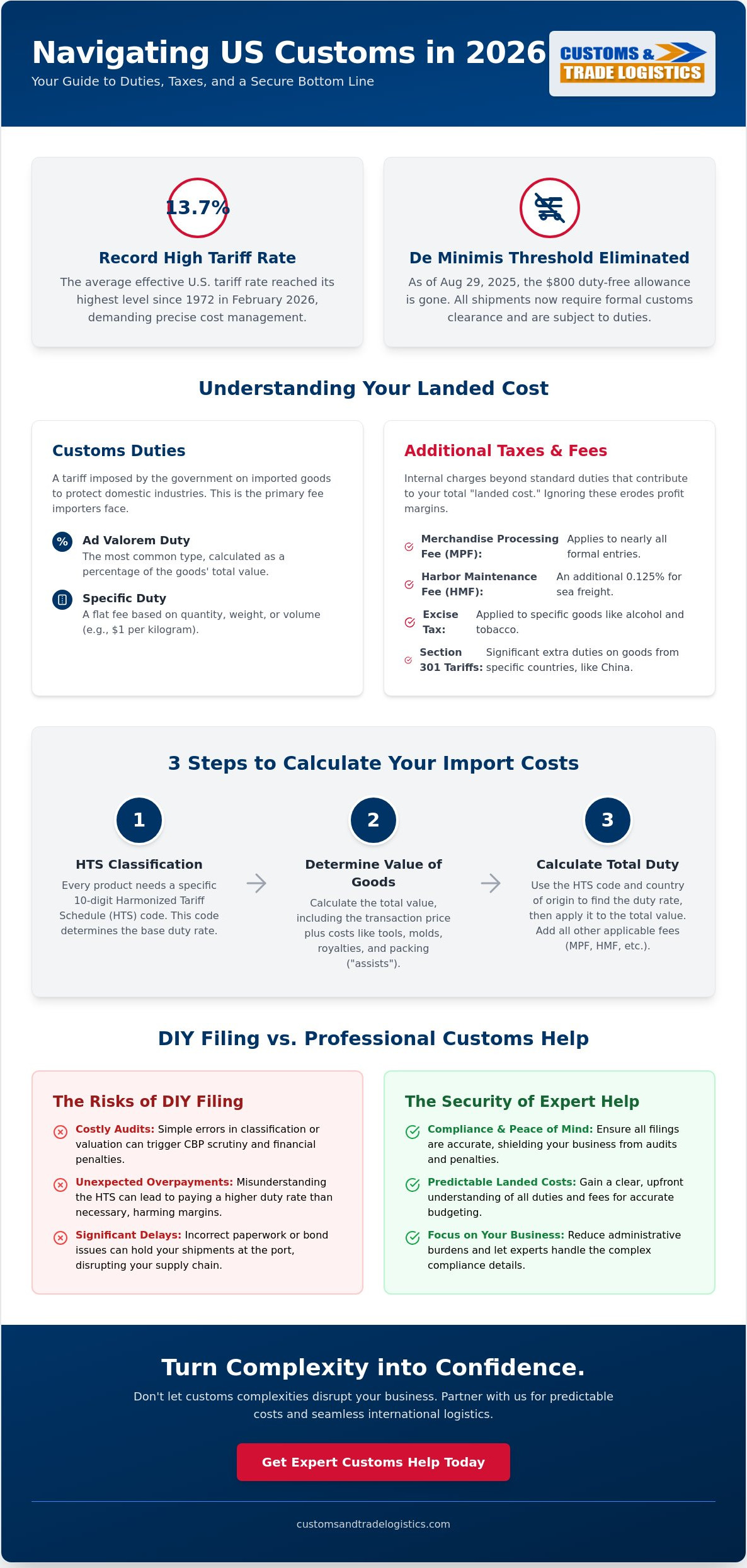
Customs duty is a specific type of tariff that the US government imposes on goods imported from international markets. Think of it as a mandatory fee paid to the state to protect domestic industries and regulate the flow of trade. U.S. Customs and Border Protection (CBP) acts as the primary enforcement agency, collecting these fees at every port of entry while ensuring that all shipments comply with federal laws. Because the average effective U.S. tariff rate reached 13.7% in early 2026, businesses now require more specialized customs duty and tax help than ever before to stay profitable.
Most importers encounter two primary ways of calculating these costs. Ad valorem duties are the most common, calculated as a percentage of the total value of the goods. Specific duties, on the other hand, are flat fees based on the quantity, weight, or volume of the items, such as a set dollar amount per kilogram. The Harmonized Tariff Schedule (HTS) serves as the mandatory legal foundation for every duty assessment performed on goods entering the United States.
For a deeper dive into the historical and legal framework of these regulations, Understanding US Customs Duties provides an excellent overview of how these policies have evolved into the current 2026 standards.
Duty vs. Tax: What is the Difference for Importers?
Are you confused about why you're seeing multiple charges on your entry summary? While duties are tariffs on foreign goods, taxes are additional internal revenue charges. For example, some products like alcohol or tobacco trigger an Excise tax. It's also vital to remember that the US doesn't have a national Value Added Tax (VAT), but you'll still face fees like the Merchandise Processing Fee (MPF). These combined costs create your "landed cost," which is the total price of getting a product from the factory to your warehouse. If you don't account for every tax and fee, your margins can vanish before the goods even arrive.
For businesses with international reach, these tax challenges often extend to other jurisdictions; for instance, Davis & Co LLP provides specialized tax planning and guidance on regional alerts like HMRC tax warnings to help maintain global compliance.
The Role of the De Minimis Threshold
For years, many businesses relied on the $800 de minimis threshold under Section 321 to bring in small shipments duty-free. However, as of August 29, 2025, this threshold was eliminated for all countries. Every shipment, regardless of its value, is now subject to duties and requires formal customs clearance. This shift has placed a massive administrative burden on e-commerce sellers who previously avoided these complexities. Because all postal shipments must now use the ad valorem method for duty calculation, you can't rely on the "specific duty" shortcuts of the past. This change makes proactive customs duty and tax help essential for managing high-volume, low-value inventory without facing constant delays.
How to Calculate and Manage Your Import Costs
Calculating your total spend isn't just about the price of the goods. It's a multi-step process that begins with the Harmonized Tariff Schedule. Every product entering the US requires a specific 10-digit code that determines its duty rate. If you choose the wrong code, you risk overpaying or triggering a costly audit. For those seeking reliable customs duty and tax help, the first priority is verifying that your HTS classification matches the physical characteristics of your shipment. It's a technical task, but getting it right from the start saves you from long-term headaches.
Once you have the code, you must determine the "Value of Goods." This is usually the transaction value, or the price actually paid. However, you must also include "assists," such as tools or molds provided to the manufacturer, and any royalties or packing costs. By cross-referencing your HTS code with the country of origin, you'll find the base duty rate. Don't forget that as of February 2026, the average tariff rate has reached 13.7%, making these calculations vital for your profit margins. You can find more details in the Official Customs Duty Information provided by CBP.
Common US Import Fees Beyond Basic Duty
Duties aren't the only costs you'll face at the border. The Merchandise Processing Fee (MPF) applies to almost all entries. For formal entries, this is an ad valorem fee with specific minimum and maximum caps. If you're importing via sea, the Harbor Maintenance Fee (HMF) adds another 0.125% to your cargo's value. We also have to consider Section 301 tariffs. These additional duties continue to impact goods from China, often adding a significant percentage on top of standard rates. Identifying these extra costs early ensures your "landed cost" stays predictable.
The Importance of a Customs Bond
Why do you need a customs bond? Think of it as a guarantee to the US government that all duties and fees will be paid. CBP requires a bond for all formal entries. You can choose a single entry bond for one-off shipments, but most frequent importers prefer a continuous bond. This covers all your entries for a full year and simplifies the process. Many professional customs clearance services us include bond management to ensure you're never caught without coverage. If you're looking for a partner to help streamline these steps, our customs clearance services provide the oversight you need to grow without the administrative burden.
Self-Service vs. Professional Customs Duty Help
How much is your time worth? For many small businesses, the lure of a DIY approach to importing is strong. You might think you're saving money by handling the entries yourself, but in the 2026 trade environment, one mistake can erase those savings instantly. With the average tariff rate hitting 13.7 percent, the margin for error has disappeared. Finding professional customs duty and tax help isn't just about outsourcing a task. It's about protecting your company from audits and penalties that stem from simple clerical errors. While CBP provides general guidelines for calculating import duties and fees, applying those rules to your specific product requires a nuanced touch that software often lacks.
Digital platforms offer sleek interfaces for simple shipments. They're useful for basic data entry, but they often fall short when CBP issues a Request for Information. That's where a traditional brokerage shines. A family-owned consultancy acts as a mentor, providing the "safe hands" needed to navigate a complex dispute. They don't just file papers; they advocate for your business. This level of oversight replaces anxiety with a sense of security, ensuring that you aren't just another number in a giant carrier's database. When your bottom line is on the line, having a partner who understands your growth goals makes all the difference.
When Should You Seek Expert Help?
Is your shipment value exceeding $2,500? If so, CBP requires a formal entry, which is a non-negotiable trigger for professional oversight. You should also seek expert customs duty and tax help if you're importing regulated goods. Items under the jurisdiction of the FDA, EPA, or FCC require extra layers of tax oversight and specialized documentation. Additionally, if you're sourcing from China, managing Section 301 exclusions is far too complex for a simple spreadsheet. Expert guidance ensures you don't overpay on these targeted tariffs.
Digital Freight Forwarder vs. Traditional Broker
Choosing between an automated system and a veteran consultant is a pivotal decision for your supply chain. Automated systems are great for speed, but they can't solve the "paperwork headache" when a shipment gets flagged at the port. We've detailed the specific pros and cons in our guide on digital freight forwarder vs traditional broker. A veteran partner understands the rhythm of the port and the specific needs of small-scale operations. They offer a level of diligence and personal connection that an algorithm simply can't provide.
Common Pitfalls and How to Avoid Duty Overpayment
Overpaying the government isn't just a mistake; it's a direct drain on your company's growth. Many importers unknowingly hand over extra cash because they lack the specialized customs duty and tax help needed to audit their internal processes. The most frequent culprit is misclassification. A single incorrect digit in a 10-digit HTS code can shift your product from a 0% duty rate to 25% or higher. These errors don't just affect your current shipment. They create a pattern that CBP may flag during a future audit, putting your entire supply chain at risk.
Valuation errors are equally dangerous and often occur when importers forget to include "assists." If you provided the factory with molds, tools, or even engineering designs for free or at a reduced cost, CBP requires you to add that value to the declared price of the goods. Forgetting to include these assists or relevant royalties means you've technically under-declared your value. On the flip side, many businesses fail to claim duty-free status for eligible countries under trade agreements like the USMCA. You shouldn't leave money on the table simply because the paperwork feels overwhelming.
Finally, we must address the "silent killers" of profit margins: Anti-Dumping (AD) and Countervailing Duties (CVD). These are extra fees imposed on goods sold at less than fair value or subsidized by foreign governments. Because AD/CVD rates can sometimes exceed 100%, they can turn a profitable shipment into a massive financial loss overnight. Staying ahead of these specific duties requires constant vigilance and a partner who monitors the latest federal registers for your product category.
The Hidden Costs of HTS Misclassification
CBP operates on a principle called "informed compliance." This means it's your legal responsibility as the importer to know the law and classify your goods correctly. If you get it wrong, the consequences are often retroactive. CBP can look back up to five years for duty recovery. This means you could receive a massive bill for unpaid duties plus interest for shipments you sold years ago. Don't wait for a "Request for Information" to fix your codes; proactive management is the only way to sleep soundly.
Strategies for Duty Drawback and Recovery
Did you know you can get your money back? Duty Drawback is a federal program that allows you to claim a refund of up to 99% of duties paid on imported goods that are later exported or destroyed. While the filing process is notoriously complex, it's a powerful tool for recovering capital. We encourage businesses to audit their past entries for potential savings. If you're worried about your current compliance level or suspect you've been overpaying, our customs clearance services can provide the thorough review you need to protect your margins.
Partnering with Customs and Trade Logistics for Peace of Mind
Why should you navigate these choppy waters alone? For over 35 years, we've acted as a dedicated mentor for small and medium businesses, helping them transform logistical anxiety into operational security. International trade is built on trust and technical precision. We don't just process paperwork; we provide a "safe pair of hands" that values your company's growth as much as you do. By offering personalized customs duty and tax help, we ensure that every HTS code is verified and every valuation is accurate before your goods ever reach the border.
Our family-owned approach means you get more than a service provider. You get an advocate. We take the time to learn your product line, which allows us to find legal duty-saving opportunities that automated systems often miss. From the moment your shipment leaves the factory to its final delivery at your warehouse, we provide end-to-end oversight. This total management approach removes the administrative weight from your shoulders, letting you focus on scaling your brand while we handle the regulatory heavy lifting.
We believe that every importer deserves a partner who is diligent, thorough, and deeply invested in their success. Whether you're dealing with the elimination of de minimis thresholds or the complexities of the new CAPE refund system, our team is here to provide a stabilizing force. We replace the fear of CBP audits with the confidence of full regulatory compliance.
Expertise in China to US Import Logistics
Importing from China presents unique challenges, especially with the shifting landscape of Section 301 tariffs and the expiration of Section 122 global tariffs. Our specialized import from China logistics consulting is designed to help you navigate these specific hurdles. Whether you're a traditional wholesaler or an Amazon seller, we ensure your goods maintain full FBA compliance through meticulous duty filing. We understand the rhythm of Chinese manufacturing and the strict requirements of US redistribution, making the journey seamless and predictable.
Your National Partner for Customs Clearance
Scale shouldn't come with a massive paperwork headache. We have the capability to clear your goods at every US port through a single, reliable point of contact. This national reach means you don't have to manage multiple brokers for different entry points. Instead, you work with a reliable import logistics partner who knows your brand's history and specific needs. Ready to secure your supply chain and protect your bottom line? Contact Customs and Trade Logistics for a consultation today and let us simplify your import journey.
Secure Your Import Strategy for 2026 and Beyond
Navigating the current trade landscape requires more than just a basic understanding of tariffs. You've seen how the elimination of the de minimis threshold and rising tariff rates have made accurate HTS classification a non-negotiable part of your success. By mastering your landed costs and avoiding the "silent killers" of profit like Anti-Dumping duties, you position your brand for sustainable growth. Securing professional customs duty and tax help is the most effective way to replace logistical anxiety with a sense of total security.
At Customs and Trade Logistics, we bring over 35 years of industry experience as a family-owned mentor to your side. We offer nationwide customs clearance at all US ports, acting as a dedicated advocate for your business compliance. Why let administrative burdens hold you back when you can have a seasoned partner managing the details? Get Expert Customs Duty Help Today and take the first step toward a more predictable, profitable future. Your global journey is just beginning, and we're ready to support you every step of the way.
Frequently Asked Questions
How much is the import tax from China to the US in 2026?
The total tax depends on your specific HTS code, but the average effective U.S. tariff rate reached 13.7% in February 2026. Most goods from China are also subject to Section 301 tariffs, which can add an additional 7.5% to 25% on top of the standard duty rate. It's vital to calculate these costs early, as the combination of base duties and targeted tariffs can significantly impact your landed cost.
Can I pay my customs duties and taxes online directly to CBP?
Yes, you can pay directly through the Automated Commercial Environment (ACE) portal or by using the eBond system. However, most businesses find it much simpler to have their customs broker handle these payments through a periodic monthly statement. This consolidated approach ensures that all fees are paid on time and matches your internal records perfectly, reducing the risk of missed deadlines and interest charges.
What happens if I classify my goods with the wrong HTS code?
Using the wrong HTS code can trigger retroactive duty bills, interest, and severe penalties from CBP. Because the government operates on "informed compliance," you are legally responsible for any errors, even if they were unintentional. CBP has the authority to look back up to five years into your import history to recover unpaid duties. Seeking professional customs duty and tax help is the best way to prevent these costly surprises.
Is there a way to reduce the amount of customs duty I owe?
You can often reduce your duty burden by utilizing free trade agreements or claiming Duty Drawback if your imported goods are eventually exported. Some importers also benefit from Section 301 exclusions or by using bonded warehouses to defer payments. Proper HTS classification is the most common way to save money, as many products have multiple possible codes with vastly different duty rates.
Who is responsible for paying import duties: the buyer or the seller?
The Importer of Record (IOR) is legally responsible for the payment of all duties, taxes, and fees. In most international sales, the US buyer acts as the IOR, though this is ultimately determined by the Incoterms used in your purchase agreement. If you buy goods under DDP (Delivered Duty Paid) terms, the seller is responsible for these costs, but the buyer still carries some compliance risk.
What is a Merchandise Processing Fee (MPF) and do I have to pay it?
The MPF is an administrative fee that CBP charges to cover the cost of processing your import entry. You must pay this fee on almost all formal entries entering the United States. The fee is calculated as a percentage of your shipment's value, with specific minimum and maximum caps that are adjusted annually. It's a standard part of your total import costs that must be factored into your budget.
How long do I have to pay my customs bill after my goods arrive?
Duties and taxes are generally due within 10 working days of the entry being filed and the goods being released. If you're set up with a periodic monthly statement through your broker, you can consolidate these payments into a single monthly transaction. Failing to pay within the required window can lead to the suspension of your immediate delivery privileges and the assessment of liquidated damages against your bond.
Do I need a customs broker if I am an Amazon FBA seller?
While you can technically file your own entries, a customs broker is essential for Amazon FBA sellers because Amazon will not act as the Importer of Record. If your HTS codes are incorrect or your paperwork is incomplete, your inventory will be held at the port, leading to expensive storage fees and lost sales. A broker acts as your mentor, ensuring your shipments clear quickly so they can reach the FBA warehouse without delay.


