
What if the $800 de minimis exemption you've relied on for years suddenly vanished, leaving every one of your imports buried in unexpected duties? It's a reality now. With the June 2026 suspension of this exemption and the rise in minimum Merchandise Processing Fees to $33.58, importing has become a high-stakes game. You've likely found yourself asking: what is a freight forwarder, and is it finally time to hire one?
It's completely normal to feel anxious about hidden costs or the dense jargon of international trade. You want your goods to arrive on time without a surprise bill from customs. We understand that you need more than just a middleman. You need a partner who treats your business like their own and keeps your shipments moving smoothly through a complex regulatory environment.
This guide explains how a freight forwarder acts as your logistical architect to streamline global trade and protect you from expensive shipping errors. You'll gain a clear understanding of the entire logistics chain. We'll show you how to find a safe pair of hands to ensure your shipping timelines remain predictable and your business stays protected from unnecessary delays.
Key Takeaways
- Understand exactly what is a freight forwarder and how they act as a logistical architect to manage your cargo's journey from factory to front door.
- Explore the operational pillars, from documentation to tracking, that safeguard your imports from the heavy administrative burden of global trade.
- Discover the differences between logistics management and legal compliance so you know when to call a forwarder versus a licensed customs broker.
- Uncover how a dedicated logistics partner levels the playing field for SMBs and Amazon sellers by providing expert mentorship and carrier leverage.
- Identify the essential qualities to look for in a shipping partner to ensure you find a reliable "safe pair of hands" with deep industry expertise.
Defining the Freight Forwarder: Your Logistical Advocate
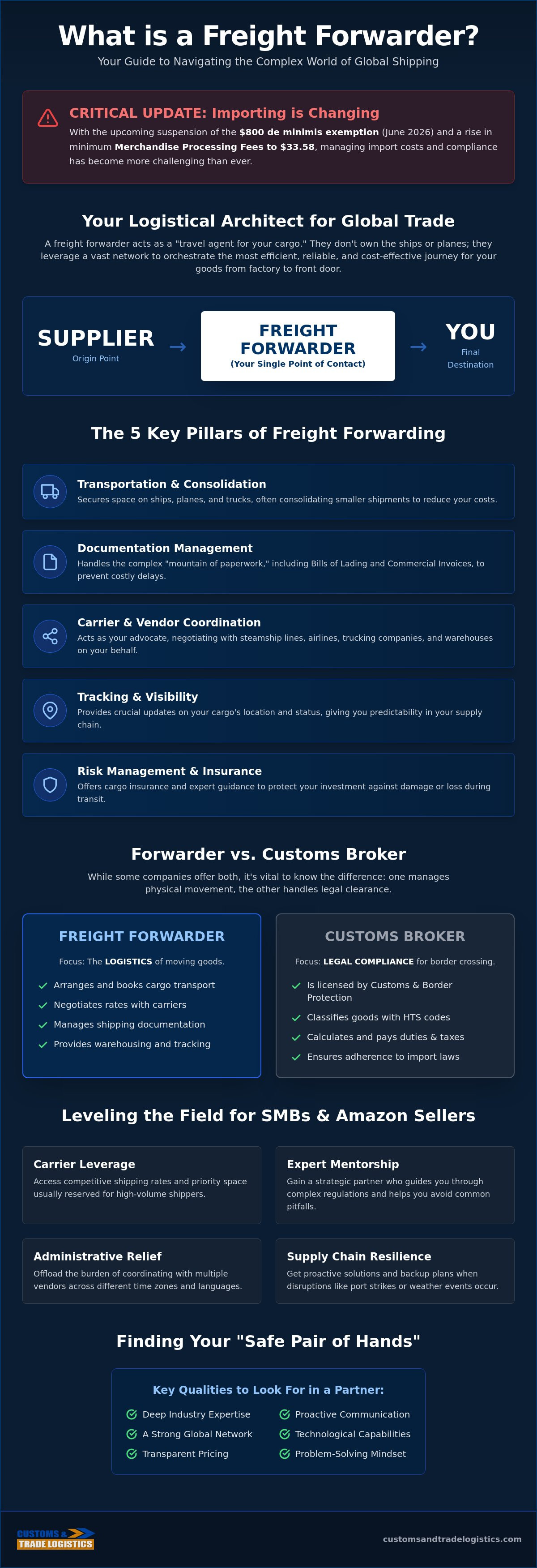
A freight forwarder is a specialist firm that orchestrates the movement of goods from a supplier to a final destination. They act as the primary point of contact for your business, consolidating multiple logistics services into one managed solution. Essentially, a freight forwarder serves as a strategic architect of the international supply chain, designing the most efficient path for your cargo to travel across borders. They don't own the ships or the planes. Instead, they own the expertise required to move your products through them.
Think of them as a "travel agent for cargo." Just as a travel agent coordinates flights, hotels, and transfers without owning the airline, a forwarder manages the entire journey of your goods. They select the best carriers and routes to fit your specific budget and timeline. When you're asking what is a freight forwarder, it's helpful to view them as the conductor of a very large, very complex orchestra. They ensure every player performs their part at exactly the right moment so the final result is a seamless arrival at your warehouse.
Just as a forwarder acts as a travel agent for your cargo, you may find yourself needing a real travel expert for personal milestones; for those planning a tropical wedding or a honeymoon escape, visit Sunlover Travel to see how they coordinate luxury vacations with the same level of precision.
The "Middleman" Myth vs. Strategic Reality
It's easy to dismiss this role as just another "middleman" taking a fee, but that's a significant oversimplification. In reality, a forwarder provides essential risk management and administrative relief. They shoulder the burden of coordinating between different time zones, languages, and legal requirements. This expertise is vital for import logistics for startups, where one small documentation error can lead to thousands of dollars in storage fees. By handling the carriers, warehouses, and paperwork, they allow you to focus on growing your business rather than chasing down a missing container.
Who Does a Freight Forwarder Work With?
To truly understand what is a freight forwarder, you have to look at the massive network they maintain on your behalf. They operate at the center of a web of providers, including:
- Steamship lines and international airlines
- Trucking companies and rail operators
- Port authorities and terminal operators
- Warehouses and distribution centers
Their daily work involves negotiating rates and securing space on routes that are often congested. They act as your advocate when things go wrong. If a port strike occurs or a storm delays a vessel, your forwarder is already working on a backup plan. Instead of you spending hours on hold with a global carrier's call center, your partner is rerouting your shipment. For a deeper look at the historical and legal foundations of this role, you can explore more about What is a Freight Forwarder? on Wikipedia. They are the "safe pair of hands" that keeps your supply chain resilient in an unpredictable world.
The 5 Key Pillars of Freight Forwarding Operations
When you look deeper into what is a freight forwarder, you see they are more than just a booking agent. They are the engine behind five critical pillars that keep your supply chain moving. Without these operational foundations, importing becomes a series of expensive guesses. A professional partner provides oversight from the moment your goods leave the factory floor until they reach your customer's door. They use their industry leverage to secure space on vessels that might otherwise be full, and they combine smaller shipments through freight consolidation to save you money. This level of International Freight Logistics support ensures you aren't overpaying for "dead space" in a container.
Beyond physical movement, a forwarder provides a vital safety net through cargo insurance. Oceans are unpredictable; containers can be lost or damaged in transit. Having a partner who manages these claims and provides protective care for your investment is the difference between a minor setback and a total loss. The International Trade Administration provides a clear overview of the services of a freight forwarder, which helps define their role in a modern, high-stakes trade environment.
Mastering International Trade Documentation
The "mountain of paperwork" is often the biggest source of anxiety for US importers. A single typo on a Bill of Lading, Commercial Invoice, or Packing List can trigger thousands of dollars in "demurrage" and "detention" fees at the port. With the 2026 suspension of the $800 de minimis exemption, every single low-value shipment now requires formal or informal entry procedures. Your forwarder manages these documents with precision, ensuring you remain compliant with US regulations and avoid the increased scrutiny of modern customs enforcement. They act as your administrative shield, catching errors before they become costly penalties.
Managing the Ocean and Inland Legs
Moving goods across the ocean is only half the battle. Once your container hits a US port, the "last-mile" coordination begins. Your forwarder manages the transition from the steamship line to trucking companies or rail operators. They handle the redistribution and delivery of your goods to their final destination, whether that's a warehouse or a retail shelf. This transition is a high-risk period where delays often occur. Integrating professional customs clearance services us during this phase ensures that your cargo doesn't sit idle while you wait for paperwork to clear. It's a seamless, end-to-end process that keeps your shipping timelines predictable and your mind at ease.
Freight Forwarder vs. Customs Broker: Understanding the Difference
Many new importers find themselves confused about the specific roles of their trade partners. Are they the same thing? Not quite. While understanding what is a freight forwarder helps you manage the physical movement of your goods, a customs broker ensures those goods are legally allowed to enter the country. A broker manages the "compliance" and legal entry of your cargo. In contrast, the forwarder manages the "logistics" and physical transit. To put it simply, the broker focuses on the "what" of your shipment, such as classification and duties. The forwarder focuses on the "how," including transportation methods and route planning.
Using a firm that offers both services provides a massive advantage. It ensures a seamless handoff at the port. When the team moving your container is the same team filing your entry, there's no room for "he said, she said" errors. To ensure you're working with qualified professionals, many top-tier firms maintain membership in the National Customs Brokers & Forwarders Association of America (NCBFAA). This organization represents the experts who handle over 97% of U.S. import entries, setting the standard for the industry.
When Do You Need a Licensed Customs Broker?
Do you need a broker for every shipment? Yes. Any commercial import into the U.S. requires a formal or informal entry filed with Customs. A licensed Customs Broker is specifically authorized by U.S. Customs and Border Protection to act on your behalf. They navigate the complex world of Harmonized Tariff Schedule (HTS) codes and duty calculations. If these codes are incorrect, you risk audits or heavy fines. We've spent over 35 years navigating these specific U.S. Customs ports, providing the seasoned mentorship you need to stay compliant.
The Synergy of Integrated Logistics
There is a distinct "safe pair of hands" feeling when one dedicated team manages both the ship and the paperwork. This integrated approach prevents the communication gaps that cause costly port delays. When a forwarder and broker work in the same office, they can resolve documentation issues in minutes rather than days. This synergy is particularly vital for import from China logistics. Because of the long distances and complex regulations involved, having one point of contact simplifies your entire operation and gives you total peace of mind.
The Strategic Value for Small Businesses and Amazon Sellers
Small businesses often face a steep uphill battle when entering the global market. Have you ever tried to book space directly with a major steamship line? For most small to medium businesses (SMBs), these giant carriers are nearly impossible to reach. They prioritize massive corporations that move thousands of containers every month. This is exactly what is a freight forwarder for an emerging brand: a powerful ally that pools your volume with others to give you the same rates and priority as the big players. They act as a bridge between your local operation and the vast global marketplace.
Beyond just saving money, a family-owned forwarder provides a mentorship role that you won't find at a generic call center. We understand the anxiety that comes with your first large purchase order. We walk you through the entire process, helping you scale from small Less than Container Load (LCL) shipments to Full Container Loads (FCL) as your sales grow. This "safe pair of hands" approach turns a complex logistical hurdle into a manageable part of your business plan. If you're ready to secure your supply chain, our International Freight Logistics experts are ready to help you grow.
FBA Freight Forwarding: From Factory to Amazon Warehouse
Amazon FBA sellers face a unique set of challenges that traditional retailers don't. Amazon’s receiving centers have incredibly strict policies regarding palletization, labeling, and delivery windows. One small error in how your factory packs your goods can lead to a total rejection of your cargo at the warehouse door, resulting in massive storage fees and lost sales. A specialized forwarder ensures every box meets these requirements before it ever reaches the US. They manage the factory-to-door delivery so you can focus on your marketing. You can learn more about these specific requirements in our guide to FBA freight forwarding services.
Navigating Imports from China
Sourcing from China presents its own hurdles, from language barriers to the 12-hour time difference. It's difficult to manage an overseas pickup when you're sleeping. A US-based partner acts as your advocate abroad, coordinating with your suppliers to ensure your cargo is ready and compliant. This level of oversight is a key part of what is a freight forwarder in the modern era. Our consultants help you verify suppliers and manage the entire journey. This direct coordination prevents the communication gaps that often lead to shipping delays or incorrect documentation, ensuring your inventory arrives exactly when you need it.
Selecting Your Freight Forwarding Partner: What to Look For
Choosing the right logistics partner is the most critical decision you'll make for your supply chain. Now that you understand what is a freight forwarder and the essential role they play, you need to know how to separate the veterans from the newcomers. You're looking for more than a vendor; you're looking for a "safe pair of hands" that values your business's growth as much as you do. In an industry where regulations can change overnight, a track record that spans decades is invaluable. Seasoned experts have seen every possible scenario, from port strikes to global capacity crunches, and they know exactly how to pivot.
Communication is the next pillar of a successful partnership. Does the firm offer a personal touch or a generic call center? If you're routed to an automated system every time you have a question, your shipment isn't getting the protective care it deserves. You want a partner who picks up the phone, knows your name, and understands your specific business needs. Transparency is equally vital. A reliable partner is clear about fees and potential "extra" costs, such as port exams, before they happen. In 2026, with stricter customs enforcement and the suspension of de minimis exemptions, you can't afford surprise invoices that eat into your margins.
Finally, look for versatility. As we explored in previous sections, the synergy between shipping and compliance is where the real value lies. Choosing a partner who handles both international freight logistics and customs brokerage ensures that your goods move through the port without the communication gaps that cause delays. This holistic approach is what is a freight forwarder at its best: a single managed solution for a complex global journey.
Questions to Ask Your Potential Forwarder
Before signing a contract, engage in a direct conversation to gauge their expertise. Ask these specific questions:
- "Do you have experience with my specific commodity?" Different goods, from electronics to textiles, have unique regulatory requirements.
- "How do you handle communication during a shipping delay?" You need to know if they'll be proactive or if you'll have to chase them for updates.
- "Are you a licensed customs broker in the US?" This confirms they can handle the legal entry of your goods without outsourcing to a third party.
The Value of a Family-Owned Consultancy
There's a stark contrast between "big box" logistics firms and the personalized care of a family business. Large firms often treat you like a number in a database, but a family-owned consultancy provides a dedicated advocate who is deeply invested in your growth. You often have one point of contact who knows your business history, which simplifies every conversation and builds long-term trust.
At Customs and Trade Logistics, we act as the seasoned mentor for your next shipment. We combine the authority of a veteran in the field with the accessibility of a local partner. We bridge the gap between your small-scale operations and the global marketplace, acting as a stabilizing force that lifts the administrative burden from your shoulders. When you work with us, you gain a partner who values personal connection as much as technical compliance, ensuring every shipment is handled with diligent care.
Secure Your Global Supply Chain Today
International trade doesn't have to be a source of constant anxiety. Now that you've explored what is a freight forwarder, you know they're the architectural force that keeps your business moving. From managing the 2026 suspension of de minimis exemptions to handling the strict labeling requirements of Amazon FBA, the right partner acts as your dedicated advocate. You've seen how the synergy between physical logistics and customs compliance protects you from costly port delays. By choosing a partner with deep expertise, you ensure your goods are always in a safe pair of hands.
With over 35 years of industry-leading experience and specialized knowledge in all US Customs ports, we're ready to help your business thrive. Let our family-owned team manage your next shipment. Contact Customs and Trade Logistics today. Your growth shouldn't be limited by complex paperwork or shipping jargon. We're here to lift that burden so you can focus on building your brand with total confidence.
Frequently Asked Questions
Is a freight forwarder the same as a shipping company?
No, they aren't the same. A shipping company, often called a carrier, owns the physical ships, planes, or trucks that move the cargo. In contrast, what is a freight forwarder is better described as a logistical architect. They don't own the vessels; instead, they coordinate with multiple carriers to design and manage the most efficient journey for your goods. Because these vessels require specialized technical care during their voyage, you can learn more about Panama Ship Service to see how operational support at the Panama Canal keeps the global maritime industry moving.
Do I legally need a freight forwarder to import into the US?
There's no legal requirement to hire one, but it's often a practical necessity for growing businesses. While you can try to manage carriers yourself, you still need a licensed Customs Broker to handle the legal entry of your goods. Most importers prefer having a single partner to manage both the physical movement and the complex compliance paperwork.
What are the most common fees charged by a freight forwarder?
You'll typically see charges for the actual ocean or air freight, fuel surcharges, and documentation handling fees. You also need to account for US Customs user fees, such as the Merchandise Processing Fee (MPF), which has a minimum of $33.58 for fiscal year 2026. A transparent partner will provide a clear breakdown so you aren't surprised by hidden costs at the port.
Can a freight forwarder help me with imports from China?
Yes, managing these complex trade lanes is a primary service they provide. A forwarder coordinates everything from the initial factory pickup in China to the final redistribution in the US. They act as your advocate on the ground, overcoming language barriers and time zone differences to ensure your suppliers meet all shipping requirements.
What happens if my shipment is delayed at the port?
Your forwarder steps in as your primary advocate to resolve the issue. They communicate directly with port authorities and carriers to identify the cause of the delay and get your cargo moving again. This oversight is vital for managing "demurrage" and "detention" fees, which can quickly become expensive if your container sits idle for too long.
Does a freight forwarder provide insurance for my cargo?
Most forwarders can arrange cargo insurance to act as a safety net for your investment. Since international carriers have very limited legal liability for lost or damaged goods, this extra layer of protection is essential. It ensures you're covered for the full value of your products if something goes wrong during an unpredictable ocean crossing.
What is a Shipper’s Letter of Instruction (SLI)?
An SLI is a legal document that provides your forwarder with the specific details of your shipment. It grants them the authority to act on your behalf and serves as a blueprint for the movement of your goods. This document ensures everyone is on the same page regarding where the cargo is going and how it should be handled.
How much does it cost to hire a freight forwarder?
The cost varies based on your cargo's volume, the shipping route, and the specific services your business needs. Because every shipment is unique, pricing is typically tailored to the individual journey rather than a flat rate. Understanding what is a freight forwarder helps you see that their value lies in preventing the costly shipping errors that often exceed the price of their services.


