

Did you know that demurrage and detention charges cost US importers over $5 billion annually? It's a staggering figure that highlights just how quickly a few days of "free time" can evaporate, leaving your profit margins vulnerable to carrier fees you didn't see coming. If you've ever felt overwhelmed by confusing terminology or a lack of transparency from carriers, you're certainly not alone. Most importers find these costs to be the most frustrating part of the logistics journey because they often feel unpredictable and unavoidable.
This guide is here to replace that anxiety with a sense of security. We'll show you exactly how to calculate demurrage and detention fees using clear, manual formulas updated for 2026. By mastering this math, you can move from reacting to invoices to proactively managing your bottom line. We'll also dive into the latest Ocean Shipping Reform Act (OSRA) protections and share the specific strategies our veteran brokers use to negotiate more free time. You'll walk away with a practical toolkit to predict, calculate, and mitigate these charges, giving you the peace of mind that your shipments are always in a safe pair of hands.
Key Takeaways
- Learn the vital distinction between terminal-based demurrage and equipment-based detention to pinpoint exactly where your logistics costs are coming from.
- Master the 2026 tiered-rate formula for how to calculate demurrage and detention fees so you can accurately forecast your total expenses before the invoice arrives.
- Identify the most common documentation errors that trigger administrative holds and learn how pre-clearance services keep your cargo moving.
- Understand the "daily burn rate" of a delayed container to better protect your cash flow and budget for unexpected supply chain volatility.
- Discover the negotiation strategies veteran brokers use to secure extended free time and resolve fee disputes with professional assurance.
Demurrage vs. Detention: Defining the 2026 Logistics Landscape
Understanding the difference between demurrage and detention is the first step toward protecting your profit margins. While these terms are often used interchangeably in casual conversation, they represent two distinct phases of a container's journey. Before you can master how to calculate demurrage and detention fees, you must understand the specific triggers for each charge. These daily costs, collectively known as "per diem" fees, act as a financial clock that starts ticking the moment your cargo arrives at its destination.
Demurrage refers to the fee charged when a loaded container remains inside the port terminal beyond the allotted free time. Think of it as a parking fee for the space your cargo occupies on the dock. Detention, on the other hand, applies to the equipment itself. This fee is triggered when you've moved the container outside the port but haven't returned the empty box to the carrier’s designated depot within the agreed timeframe. In this ecosystem, the ocean carrier owns the equipment, the terminal operator manages the physical space, and you, the Importer of Record, are responsible for the swift movement of both.
The "Free Time" Window: When the Clock Starts Ticking
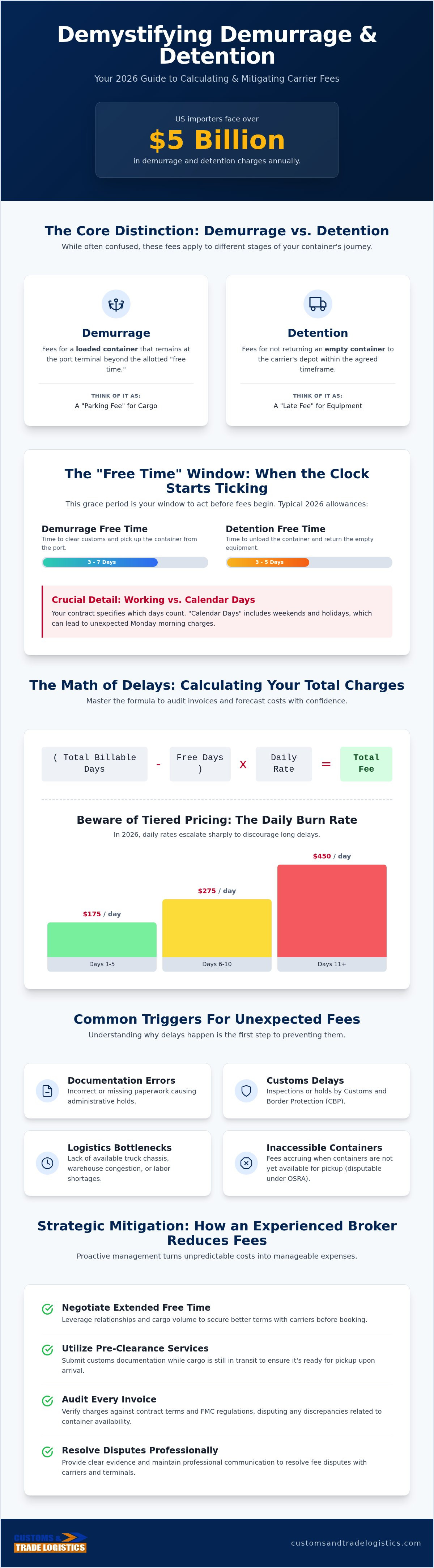
Every shipment comes with a grace period known as "free time." In 2026, most major US ports provide a window of 3 to 7 days for demurrage and roughly 3 to 5 days for detention. However, the fine print in your contract is what truly matters. Does your agreement specify "working days" or "calendar days"? This distinction is vital. If your contract uses calendar days, the clock continues to run through weekends and holidays, often leading to surprise charges on Monday morning. We've seen how import logistics for startups can quickly become complicated when these small details are overlooked during the initial booking phase.
Why Terminals and Carriers Charge These Fees
These fees aren't just arbitrary penalties; they're designed to maintain equipment velocity. In the high-pressure environment of 2026 global trade, carriers need their containers back as quickly as possible to fulfill the next booking. If a container sits idle, it's not earning revenue. Similarly, port terminals aren't designed for long-term warehousing. They're transit hubs that require constant flow to prevent bottlenecks. High fees serve as a powerful incentive for importers to clear their cargo and return equipment, ensuring the entire supply chain remains fluid. Distinguishing between carrier-imposed equipment fees and port-imposed storage charges will help you identify exactly which partner to contact when you need to dispute a bill or request an extension.
The Math of Delays: How to Calculate Your Total Charges
While automated tools are convenient, knowing how to calculate demurrage and detention fees manually is the only way to audit carrier invoices with confidence. The basic formula is straightforward: (Total Days - Free Days) x Daily Rate = Total Fee. However, the complexity lies in the variables. In 2026, many carriers have moved toward tiered pricing to discourage long-term container storage. This means your daily rate might double or triple after the first week of delays. You must also distinguish between the "Discharge Date," when the container hits the dock, and the "Available for Pickup" date. The Federal Maritime Commission emphasizes that fees should only accrue when containers are actually accessible, making this distinction a primary point for auditing your bills.
International billing adds another layer of complexity through currency fluctuations and the use of Special Drawing Rights (SDRs). These represent a basket of global currencies used to stabilize costs in cross-border trade. If your contract is quoted in SDRs, you'll need to check the current exchange rate on the day the invoice is issued to ensure the conversion is accurate. If this administrative load feels heavy, partnering with a reliable logistics expert can simplify the process and ensure you never overpay for carrier errors.
Step 1: Identifying Your Contracted Free Time
Your first task is locating the specific free time stipulations within your Bill of Lading or Service Contract. These aren't always prominently displayed; they're often buried in the fine print of the carrier's tariff. Understanding how custom brokerage service fees align with these terminal costs helps you build a more accurate total landed cost model. A common pitfall is miscalculating the Last Free Day (LFD). If you assume the clock starts when you pick up the container rather than when it was discharged, you'll be met with an expensive surprise at the gate.
Step 2: Applying the Tiered Rate Schedule
Carriers use escalating rate schedules where the daily penalty increases as the container remains unreturned. This tiered structure is designed to create a sense of urgency for the importer. For example, if you face a 10-day delay with a 4-day free window, you have 6 billable days. If the first 5 days of the penalty are $150 and the next tier is $300, your calculation looks like this: (5 days x $150) + (1 day x $300) = $1,050. In 2026, you must also account for weekend and holiday exceptions which vary by port. Some terminals include Saturday in their "working day" count while others don't, making it essential to verify the specific schedule of your arrival port.
Common Triggers: Why Demurrage and Detention Fees Accrue
Why do these costs spiral out of control even when you've planned your budget carefully? Once you understand how to calculate demurrage and detention fees, the next step is identifying the triggers that start the clock. Documentation errors remain the primary controllable cause of delays. When paperwork is missing or inaccurate, the terminal won't release the cargo, and the carrier won't stop the billing cycle. Utilizing professional customs clearance services us is often the most effective way to prevent these administrative holds before they become expensive liabilities.
Beyond paperwork, 2026 has introduced specific port-side challenges like drayage driver shortages and chronic chassis unavailability. If your driver arrives but can't find a chassis to mount the container, the box stays on the dock, and demurrage continues to accrue. There's also the "Customs Black Hole." This occurs when a container is flagged for a Contraband Enforcement Team (CET) or Manifest Examination Team (MET) inspection. These exams often take place at off-site facilities, and the time spent in line for an exam doesn't stop the terminal's demurrage clock. It's a frustrating reality where you're penalized for a mandatory government process.
The Impact of Incomplete Paperwork
A single missing Importer Security Filing (ISF) or an error on a Commercial Invoice can stop your cargo movement entirely. It's a common trap; a 48-hour delay in document submission can easily result in hundreds of dollars in fees before the first truck even arrives. This is especially true for import from China logistics, where Harmonized Tariff Schedule (HTS) accuracy is under intense scrutiny. If your classifications don't match the physical goods, U.S. Customs will issue a hold, and the terminal will keep charging you for every day the container sits idle.
Logistics Bottlenecks and External Factors
While we can control paperwork, external factors in 2026 remain volatile. Weather events, labor strikes, and sudden port congestion can all prevent you from returning equipment on time. You might encounter the "Chassis Split" problem, where you have a truck and a driver ready, but the wheels are at a different terminal entirely. Don't expect "force majeure" clauses to save you. In the shipping world, these clauses rarely apply to demurrage and detention waivers. Carriers generally view these delays as part of your operational risk, which is why having a proactive partner to monitor these bottlenecks is essential for your peace of mind.
The Financial Impact: Budgeting for Logistics Contingencies
How much does a single day of delay actually cost your business? In 2026, the "daily burn rate" for a delayed container can be devastating for a small business's cash flow. On the US West Coast, demurrage rates typically start between $100 and $200 for the first five days. After that initial window, fees often escalate sharply, sometimes exceeding $400 per day during periods of heavy port congestion. When you add detention fees, which average around $185 for a 20-foot container and $285 for a 40-foot container, a week-long delay can easily result in thousands of dollars in unbudgeted expenses. Mastering how to calculate demurrage and detention fees is only half the battle; you also need to build these variables into your financial forecasts to protect your bottom line.
It's vital to distinguish between port storage and demurrage. While both are triggered by cargo sitting at the terminal, port storage is paid to the terminal operator for the physical space, while demurrage is paid to the ocean carrier for the use of their equipment. Amazon FBA sellers are particularly vulnerable to these dual charges during the Q4 peak season. When Amazon's receiving warehouses are backed up, containers often sit at the port for weeks, triggering both carrier and terminal penalties simultaneously. If you're struggling to manage these spikes, our team can help you audit your current shipping strategy to identify hidden cost leaks.
Hidden Costs: Drayage and Pre-Pull Fees
When the demurrage clock is ticking and your warehouse isn't ready, a "pre-pull" strategy can be a financial lifesaver. A pre-pull involves a drayage driver picking up the container before free time expires and storing it at a private, off-site yard. While you'll pay a pre-pull fee and private storage costs, these are significantly lower than the $400-plus daily penalties at the terminal. Many FBA freight forwarding services use this maneuver to stop the demurrage clock while waiting for a delivery appointment. It's a proactive way to maintain control over your logistics spend rather than being at the mercy of carrier invoices.
Building a Logistics Safety Net
We recommend that importers set aside a "landed cost" variance buffer of at least 5% to 10% of their total cargo value. This safety net accounts for the supply chain volatility that defines the 2026 landscape. Use your historical delay data to identify patterns; if your shipments through certain ports consistently face three days of detention, build those costs into your product pricing. A well-maintained Customs Bond also plays a role here. It ensures that your cargo doesn't sit longer than necessary due to administrative holds, allowing for faster clearance and immediate movement. Research shows that proper management of these fees can lead to a 20% to 30% reduction in overall logistics costs, turning a "safe pair of hands" into a significant competitive advantage.
Strategic Mitigation: How an Experienced Broker Reduces Fees
While knowing how to calculate demurrage and detention fees is an essential skill for any importer, the ultimate goal is to avoid these charges altogether. Strategic mitigation isn't just about math; it's about foresight and proactive management. One of the most powerful tools in your arsenal is "Pre-Clearance." By resolving customs entries and filing paperwork before the vessel even docks, you ensure that the cargo is ready for pickup the moment it's available. This eliminates the administrative lag that often eats up your free time window before you can even secure a drayage driver.
Experienced brokers also negotiate extended free time during the initial booking phase. While standard windows in 2026 are often 3 to 7 days, a veteran partner can often secure additional time for high-volume or complex shipments. If you're hit with unfair charges due to port congestion or a lack of terminal appointments, we can file carrier-specific "Stop the Clock" requests. These disputes require precise documentation and a deep understanding of carrier tariffs, making Customs and Trade Logistics the "safe pair of hands" you need to navigate these challenges with confidence.
The Family-Owned Advantage in Fee Disputes
Personalized oversight beats an automated algorithm every time. While digital freight forwarders use software to track shipments, they often lack the human intuition needed to navigate a sudden port crisis or a complex documentation hold. With over 35 years of industry experience, our team relies on long-standing relationships with carriers and terminal operators across all national ports. We recently helped a client resolve a documentation hold that threatened to result in five days of demurrage. By personally intervening with the carrier and clarifying the HTS classification, we cleared the hold in 24 hours, saving the importer over $1,500 in potential penalties.
Proactive Compliance as a Cost-Saving Tool
The best way to manage delays is to prevent them through proactive compliance. We conduct "Pre-Import Audits" to ensure your shipments meet all 2026 regulatory requirements before they leave the origin port. For first-time importers and startups, we act as a mentor, demystifying the process and highlighting the specific pitfalls that lead to detention and demurrage. This protective care ensures your business growth isn't stunted by administrative burdens or unexpected financial leaks. It's about building a stable foundation for your international operations through partnership and expertise.
Contact us to audit your logistics chain and stop overpaying for delays.
Take Control of Your 2026 Logistics Strategy
Mastering the math behind your shipping delays is the first step toward reclaiming your profit margins. By understanding how to calculate demurrage and detention fees, you move from feeling overwhelmed by carrier invoices to being a confident auditor of your own supply chain. Accurate paperwork and proactive pre-clearance aren't just administrative tasks; they're your primary defense against the escalating tiered rates that define the current port landscape.
You don't have to carry this administrative burden alone. With 35+ years of expert brokerage experience and specialized support for Amazon FBA and small business imports, our team provides national US port coverage and rigorous compliance oversight. We act as your safe pair of hands, ensuring your cargo stays moving and your costs stay predictable. Let us help you navigate the complexities of international trade with the personal touch of a family-owned partner. Your growth is our priority, and we're ready to help you secure a more stable future for your imports.
Get a Professional Logistics Audit and Avoid Costly Fees
Frequently Asked Questions
What is the difference between demurrage and detention?
Demurrage is the fee for a loaded container staying inside the port terminal past the free time. Detention is the charge for equipment kept outside the port beyond the return window. Essentially, demurrage is about terminal space; detention is about the container box itself. Understanding this distinction is the foundation of mastering how to calculate demurrage and detention fees. It helps you identify whether the delay is at the dock or with your warehouse.
How many free days do I typically get for a container at a US port?
In 2026, standard free time for demurrage at major US ports typically ranges from 3 to 7 days after the vessel discharges. For detention, you usually have 3 to 5 days after gating out the container to return the empty box. These windows vary by carrier and terminal. Some ports offer up to 7 days, but congestion often shortens these windows. Always verify if your contract counts calendar days or working days.
Can demurrage fees be waived if the delay was caused by a customs exam?
Generally, carriers don't automatically waive demurrage fees for customs examinations like CET or MET holds. They view these as part of your operational risk. However, under 2026 Federal Maritime Commission rules, you can dispute charges if the container wasn't actually accessible for pickup. We often help clients file "Stop the Clock" requests when government-mandated delays make it impossible to move the cargo within the free time. This requires precise documentation and proactive communication.
Who is responsible for paying demurrage and detention fees?
The Importer of Record is primarily responsible for paying these fees to the ocean carrier or terminal operator. While your broker might pay the invoice upfront to secure cargo release, these costs are ultimately passed through to you. It's vital to have a clear agreement with your trucking company to ensure they return containers promptly. Their delays can trigger detention charges on your account, so oversight of your drayage partners is essential for your budget.
How do I calculate the "Last Free Day" for my shipment?
To find your Last Free Day, identify the date the container was discharged and made available for pickup. Add your contracted number of free days to this date. If your contract specifies calendar days, you must include weekends and holidays. If it says working days, you only count days the terminal is open. Correctly identifying this date is critical when learning how to calculate demurrage and detention fees for your financial records.
Does a customs hold stop the demurrage clock from ticking?
No, a customs hold does not stop the demurrage clock from ticking. The terminal continues to charge storage even if your paperwork is under review or your container is flagged for inspection. This is why pre-clearance and accurate documentation are so important. They ensure your cargo is cleared before the vessel arrives, giving you the full benefit of your free time window and preventing unnecessary financial penalties from accumulating while your goods sit idle.
What is a "Per Diem" charge in international shipping?
"Per Diem" is a Latin term meaning "per day." In shipping, it acts as an umbrella term for daily equipment usage fees. It specifically refers to the fixed daily rate you pay for keeping a container beyond the free time window. Carriers use these charges to encourage the fast return of their equipment. These fees are usually tiered, meaning the daily cost increases the longer you hold the container box past the initial grace period.
How can an Amazon FBA seller avoid detention fees when returning empty containers?
Amazon FBA sellers can avoid detention fees by using "pre-pull" strategies and coordinating with drayage partners. If an FBA warehouse is backed up, have your driver move the container to a private yard. This stops the detention clock on the carrier's equipment. Returning the empty container to the terminal immediately after unloading is the best way to prevent equipment penalties from eating into your Amazon business profit margins and disrupting your monthly cash flow.


