

Would you knowingly risk a $5,000 fine just because of a simple misunderstanding about paperwork? For many businesses, the confusion surrounding who is responsible for ISF filing leads to expensive liquidated damages and frustrating port delays. It's a heavy burden to carry, especially when you're already managing the complexities of international logistics and tight deadlines. You shouldn't have to guess whether your supplier, your carrier, or you personally are on the hook for the 10+2 requirements.
We understand how intimidating the 24-hour deadline feels when you're struggling to get accurate data from overseas suppliers. This guide is designed to replace that anxiety with total clarity. You'll learn exactly who holds the legal liability for filing and how to coordinate with your partners to ensure compliance. We'll provide a clear checklist of the data you need to collect and explain how a trusted customs broker acts as a safe pair of hands to manage the process. By the end, you'll have the peace of mind that your shipment will clear the port without a hitch.
Key Takeaways
- Identify why the Importer of Record is the legal party who is responsible for ISF filing and what that burden entails for your business.
- Learn the specific "10+2" data elements you must gather from your suppliers to ensure your filing is complete and accurate.
- Discover how to navigate the strict 24-hour filing deadline to avoid $5,000 in liquidated damages from U.S. Customs.
- Understand how a licensed customs broker acts as a "safe pair of hands" by managing the technical transmission of your ISF data.
- Get a clear roadmap for securing your supply chain and preventing costly delays at any U.S. port of entry.
What is ISF Filing and Why is it Required?
If you're new to importing, the acronyms can feel like a maze. ISF stands for Importer Security Filing, but most veterans in the industry simply call it the 10+2 rule. This is a mandatory U.S. Customs and Border Protection (CBP) requirement that applies strictly to ocean freight. It isn't just another piece of red tape. The primary purpose is to identify high-risk shipments long before they reach a busy U.S. port. This specific security measure was implemented as a direct result of the SAFE Port Act of 2006 to protect national borders. When businesses ask who is responsible for ISF filing, they're often looking for a way to manage this high-stakes task without making a costly mistake.
The 10+2 Rule Explained
The name "10+2" comes from the specific data points required for a successful submission. Ten of these elements come from the importer, while the remaining two are the responsibility of the ocean carrier. This shared data gives CBP a transparent look at the entire supply chain, from the manufacturer's floor to the final delivery destination. Currently, shipments arriving by air, rail, or truck are exempt from this specific filing. By receiving this information in advance, CBP can effectively streamline customs clearance services us. This early screening allows low-risk cargo to move through the ports with fewer interruptions. It's a system designed to keep the global marketplace moving while maintaining a high level of safety. Understanding the Importer Security Filing (ISF) is the first step toward a stress-free import experience.
The Critical 24-Hour Deadline
In the world of international shipping, the clock is your most demanding partner. Your ISF must be submitted and accepted by CBP at least 24 hours before your cargo is loaded onto the vessel at the origin port. It's a common mistake to think the deadline is based on the arrival date. If your goods are sitting on a dock in Shanghai, the filing must be finished before they're lifted onto the ship. You also need to distinguish between "filing" and "acceptance." CBP's system must process and approve the data for you to be in the clear. Adopting a "better late than never" attitude is a recipe for disaster in maritime logistics. A single late filing can lead to a $5,000 fine or even a "Do Not Load" order. Knowing who is responsible for ISF filing helps you delegate this time-sensitive task to experts who never miss a beat, giving you one less thing to worry about.
Who is Legally Responsible for ISF Filing?
When goods are crossing the ocean, the question of legal liability is never a gray area. According to U.S. Customs and Border Protection (CBP), the legal responsibility for a timely and accurate submission rests solely with the Importer of Record (IOR). This is the party causing the goods to enter the United States. In most cases, this is you, the buyer or owner of the merchandise. While you can delegate the paperwork to a professional, you can't delegate the legal consequences. If there's an error or a late filing, it's your business that will face the $5,000 fine, not your overseas supplier or the ocean carrier.
It's helpful to distinguish between ultimate responsibility and administrative delegation. You are the one legally on the hook, but you don't have to be the one physically typing the data into a customs portal. Most successful importers choose to have a licensed expert handle the transmission while they focus on their core business. If you're feeling overwhelmed by these requirements, our team of veterans can provide customs clearance services to ensure your filings are handled correctly every time.
The Importer of Record (IOR) Role
If you're a U.S.-based business purchasing products from overseas to sell domestically, you're almost certainly the IOR. This role requires you to have a valid Customs Bond in place. This bond acts as a financial guarantee to the government that all duties and penalties will be paid. Many entrepreneurs learning about import logistics for startups stumble on this first hurdle because they assume the shipping company handles everything. Without a bond and a clear understanding of your IOR status, your shipment won't even make it onto the vessel.
Can the Foreign Supplier be Responsible?
A common misconception is that the factory in China or Vietnam is the one who is responsible for ISF filing because they have all the data. While it's true that your supplier provides the manufacturer's name, address, and country of origin, they are rarely the legal "filer." Relying on a factory to handle U.S. compliance is a massive risk. They don't have a direct relationship with CBP and often don't understand the nuances of U.S. trade laws. Amazon sellers using Delivered Duty Paid (DDP) terms must be especially careful. Even if your supplier says they'll "handle everything," you remain the party CBP holds accountable. If they miss the 24-hour window, you're the one who gets the bill for liquidated damages.
Delegating the Duty: How a Customs Broker Helps
While the legal burden is clear regarding who is responsible for ISF filing, the actual work of submitting data to U.S. Customs and Border Protection is rarely done by the importer alone. Most businesses choose to delegate this technical transmission to a licensed US Customs Broker. To make this partnership official, you'll need to sign a Power of Attorney (POA). This document serves as the legal bridge that allows your broker to file on your behalf. It's a relationship built on trust, where your broker acts as a stabilizing force to keep your supply chain moving smoothly and securely.
Using a broker isn't just about outsourcing data entry; it's about comprehensive risk management. Expert brokers provide a layer of protection against "liquidated damages" by performing thorough data verification before the information ever reaches a government system. They don't just take your word for it; they cross-check your Commercial Invoice and Packing List against the strict requirements of 19 CFR Part 149. This oversight is where a family-owned brokerage shines. Unlike automated software that might overlook a subtle error in a manufacturer's address, a veteran broker provides a "safe pair of hands" to catch mistakes before they become expensive problems. They also help you navigate the complexities of custom brokerage service fees, ensuring you aren't surprised by hidden costs during your budgeting process.
The Broker as Your Compliance Advocate
Your broker acts as the primary point of contact between you, your supplier, and the freight forwarder. They ensure that the "10" data elements from your side and the "2" from the carrier align perfectly. This coordination is vital for preventing port delays that can eat into your profit margins. When you work with a seasoned partner, you're gaining a mentor who has seen every possible logistical hurdle over the last 35 years. They understand the pressure small businesses face and work diligently to ensure your paperwork is beyond reproach.
What Happens if Information is Missing?
It's common for factory data to arrive late, especially during peak shipping seasons. If you're still wondering who is responsible for ISF filing when a supplier goes silent, the answer remains the Importer of Record, but your broker is the one who solves the problem. If you're missing container stuffing locations or consolidator names as the 24-hour deadline approaches, your broker knows how to navigate the system to minimize penalty risks. They can file an initial ISF with the best available information and then perform an amendment while the ship is still at sea. This proactive strategy is a cornerstone of Amazon seller import help. Instead of panicking over a delayed email from a factory, you can rely on your broker to stay on top of the timeline and ensure your FBA inventory isn't held up at the port.
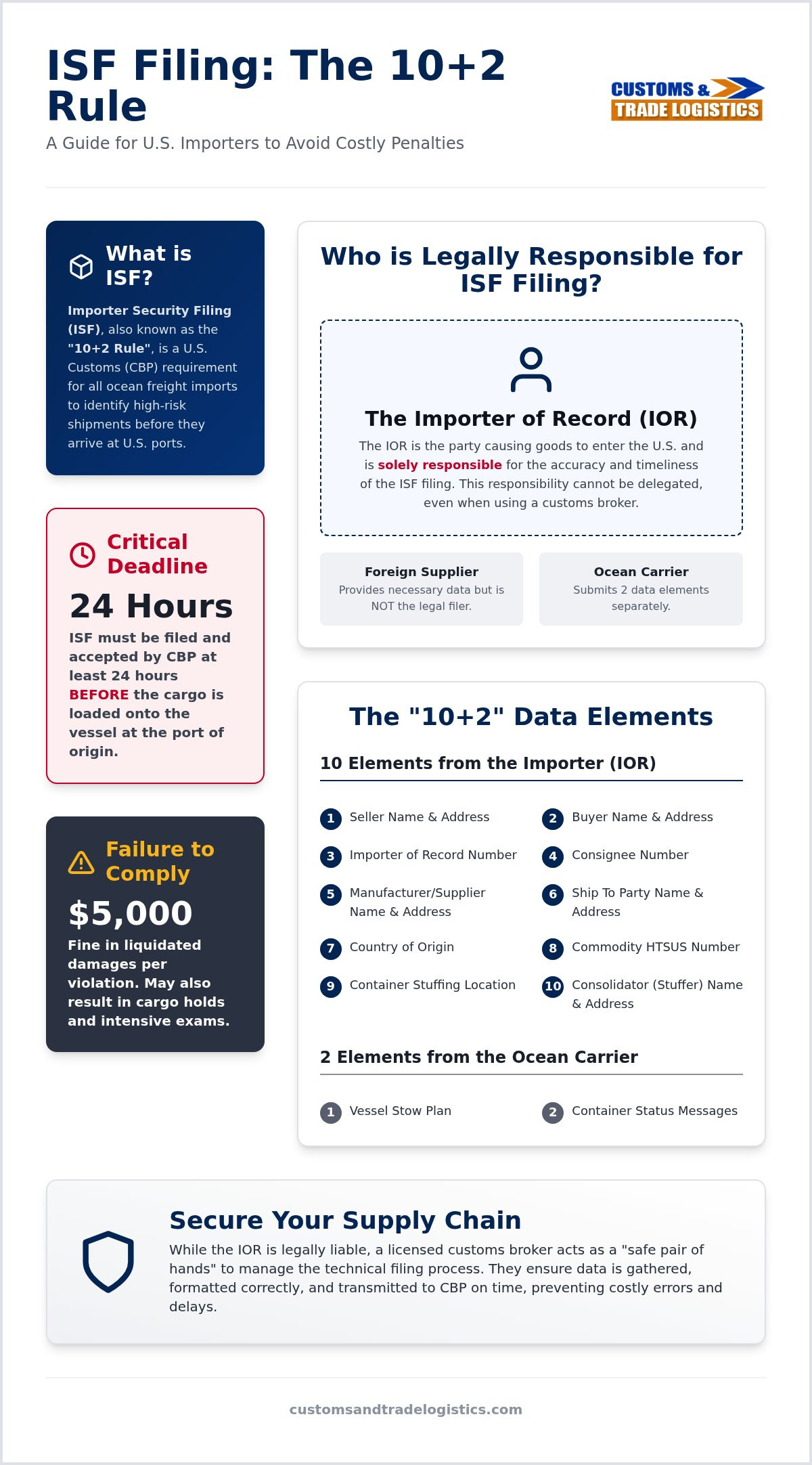
The 10 Data Elements You Must Provide
To successfully file your ISF, you need to gather ten specific pieces of information. While we've established that the Importer of Record is who is responsible for ISF filing, the quality of that filing depends on the accuracy of your commercial documents. Gathering this data shouldn't be a guessing game. Most of what you need is already sitting in your email inbox or on your desk. By organizing these details early, you ensure your broker has everything they need to meet that critical 24-hour deadline.
The ten elements you must provide include your Importer of Record Number (usually your EIN or SSN) and the Consignee Number for the party receiving the goods. You'll also need the full names and addresses for the Seller, Buyer, and the Manufacturer or Supplier. Additionally, you must identify the Ship-to party, which is the physical location where the goods are going after they leave the port. The list is rounded out by the Country of Origin, the Commodity HTSUS number, the Container Stuffing Location, and the Consolidator's name and address. If you're feeling a bit lost, our team provides the expert Customs Clearance Services you need to navigate these requirements with confidence.
Sourcing Data from Your Commercial Documents
Don't let the technical terms intimidate you. You can find the Manufacturer and Seller details directly on your Commercial Invoice. This document is the backbone of your shipment. It also usually lists the Country of Origin and the HTSUS (Harmonized Tariff Schedule) number. Getting these digits right at the factory level is essential for smooth import from China logistics. If your supplier provides a vague description instead of a specific HTSUS code, it can lead to misclassification and unwanted Customs scrutiny. Always double-check that the addresses on your Packing List match the ones on your ISF worksheet to avoid simple clerical errors that trigger fines.
The "+2" Elements Handled by the Carrier
The "10+2" rule isn't entirely on your shoulders. The final two pieces of the puzzle come from the ocean carrier. These are the Vessel Stow Plan and Container Status Messages. The stow plan tells CBP exactly where your container is located on the ship, while the status messages track the box's movement through various ports. You don't need to provide these. Your carrier transmits them directly to CBP. Your job is to focus on the first ten elements and ensure they reach your broker on time. Knowing who is responsible for ISF filing means knowing which parts of the process you control and which parts you can trust to your logistical partners.
Securing Your Supply Chain with Expert ISF Management
Managing international trade shouldn't feel like a solo mission. While the law clearly defines who is responsible for ISF filing, having a veteran mentor makes the difference between a smooth delivery and a $5,000 fine. At Customs and Trade Logistics, we've spent over 35 years demystifying the import process for small business owners and Amazon sellers. Our family-owned approach means we treat your cargo with the same protective care we'd give our own. We act as your "safe pair of hands," taking the administrative weight off your shoulders so you can focus on growing your brand.
Our end-to-end approach ensures oversight from the moment your goods leave the factory gate until they reach their final U.S. destination. We don't just file paperwork; we facilitate movement. By choosing a partner with decades of experience, you gain a dedicated advocate who understands the nuances of U.S. Customs regulations. You are never just a number in a database to us. We value personal connection and technical compliance in equal measure, ensuring your business has a reliable bridge to the global marketplace.
Comprehensive Import Support for Growing Brands
Whether you're shipping a single pallet or a dozen full containers, our team handles filings at every U.S. port nationwide. We specialize in the complex China-to-US shipping lanes, where accurate data is often hardest to secure. For Amazon FBA and e-commerce sellers, we serve as a stabilizing force. We understand the unique pressures of maintaining inventory levels and avoiding port delays. Our expertise ensures that your filings are accepted long before your vessel departs, keeping your supply chain predictable and secure.
Ready to Simplify Your Next Shipment?
True peace of mind comes from knowing that a professional is overseeing every detail of your compliance strategy. You don't have to navigate the 10+2 rule alone or worry about who is responsible for ISF filing when things go wrong. We are here to provide the clarity and confidence you need to scale your operations. If you're ready to leave the paperwork to the veterans, we're ready to help. Our team provides personalized oversight that software alone cannot match, ensuring your shipments move without friction.
Contact Customs and Trade Logistics for expert ISF filing assistance today and discover the relief of a seamless import experience.
Protect Your Shipments with Confidence
Mastering the 10+2 rule is a vital step in securing your business's future in the global market. The legal burden for compliance sits firmly with the Importer of Record. While the question of who is responsible for ISF filing has a clear legal answer, you don't have to carry that weight alone. Accuracy in your data and strict adherence to the 24-hour deadline are your best defenses against costly CBP penalties and port delays. By organizing your commercial documents early, you turn a complex administrative hurdle into a routine part of your success.
With over 35 years of industry experience, our family-owned team acts as a dedicated advocate for your growth. We specialize in supporting Amazon FBA sellers and small businesses at every U.S. port nationwide. You can partner with Customs and Trade Logistics for stress-free ISF compliance and enjoy the relief of professional oversight. Let our veterans handle the complex paperwork while you focus on scaling your brand. Your next successful shipment is just a conversation away.
Frequently Asked Questions
What is the penalty for failing to file an ISF on time?
The standard penalty for a late or inaccurate filing is $5,000 per violation. In some cases, a single shipment can incur multiple violations, leading to total penalties of up to $10,000. These are referred to as liquidated damages. CBP takes the 24-hour deadline before loading very seriously. Because the Importer of Record is the one who is responsible for ISF filing, these fines are issued directly to your business regardless of supplier errors.
Can I file the ISF myself without a customs broker?
Yes, you can technically file the ISF yourself, but it's rarely recommended for small businesses. Self-filing requires a valid customs bond and the technical capability to transmit data through CBP's Automated Commercial Environment (ACE) system. Most importers find the learning curve and software costs far outweigh the modest fees of a licensed broker. A professional ensures your data is formatted correctly, saving you from the stress of potential $5,000 fines.
Does ISF filing apply to air freight or international courier services?
No, ISF filing requirements apply only to cargo arriving in the United States by ocean vessel. If you're importing goods via air freight or international courier services like FedEx or DHL, you don't need to worry about the 10+2 rule. However, you'll still need to handle standard customs entries and duties. Always verify your shipping method early, as ocean freight involves much stricter security deadlines than air transport.
What is the "10+2" rule in simple terms?
The "10+2" rule is a security measure that requires ten data elements from the importer and two from the ocean carrier. This information allows CBP to screen for high-risk cargo before it's even loaded onto a ship at the origin port. It's a partnership between you and the carrier to provide transparency. This rule was established to protect U.S. borders while helping to facilitate a more efficient and predictable customs clearance process for legitimate trade.
How much time does it take for CBP to process an ISF filing?
CBP usually processes and provides a status message for an ISF filing within minutes of submission through the ACE system. However, the goal isn't just a fast response; it's getting an "accepted" status at least 24 hours before the vessel is loaded. If your filing is rejected due to errors, you'll need time to correct and resubmit it. Working with a veteran broker ensures your data is clean before the clock runs out.
What happens if my supplier provides incorrect information for the ISF?
If your supplier provides incorrect data, you are still legally liable for the error. CBP holds the importer accountable for all information submitted. If you discover a mistake after filing, your broker can often amend the ISF while the ship is still at sea. It's much better to catch and correct these errors proactively than to wait for Customs to flag them during a cargo examination at the port.
Do I need a new ISF filing for every single shipment?
Yes, a unique ISF filing is required for every individual ocean shipment entering the United States. Even if you're importing the exact same products from the same supplier every month, each new voyage requires its own 10+2 submission. This is because the shipping details, such as the vessel name and stuffing locations, change with every trip. Consistency in your reporting makes it easier for your broker to manage who is responsible for ISF filing for every new voyage.
Is an ISF filing required for personal household goods imports?
Yes, an ISF filing is mandatory for personal household goods if they're arriving as ocean freight. Many people moving to the U.S. from overseas are surprised to learn that their personal belongings are subject to the same security rules as commercial merchandise. If you're shipping furniture or household items in a container, you must ensure the 10+2 data is submitted on time to avoid delays and heavy fines at the port of arrival.


