

Importing from China is a documentation-first process where compliance is the only true shortcut to profitability. You've likely spent weeks perfecting your product, but the thought of dealing with US Customs probably brings a wave of anxiety. It's common to feel overwhelmed by industry jargon or fear that a single paperwork error could lead to your shipment being held at the port for weeks. You want to grow your brand, not spend your days deciphering complex shipping forms and worrying about hidden fees.
We understand these frustrations because we've spent over 35 years helping entrepreneurs just like you find their footing in global trade. This 2026 guide simplifies the China import process for small business by providing a clear, step-by-step roadmap for success. You'll learn how to master the import timeline, forecast your landing costs with precision, and identify the right logistics partners to handle the heavy administrative lifting. By the end of this article, you'll have the confidence to move your goods across the ocean without the stress of the unknown.
Key Takeaways
- Learn how to secure your supply chain by sourcing from verified, compliant manufacturers in the current trade environment.
- Discover why accurate documentation, like the Commercial Invoice, is the most critical factor in avoiding unexpected customs holds.
- Master the China import process for small business by following a step-by-step roadmap designed to protect your growth and minimize administrative stress.
- Use the Total Landed Cost formula to accurately forecast your expenses and choose the right freight strategy for your specific margins.
- Understand the unique benefits of partnering with a family-oriented customs broker who serves as a knowledgeable mentor for your international operations.
Navigating the China Import Landscape in 2026
The trade relationship between China and the United States remains the backbone of global e-commerce, but it's no longer as simple as clicking "buy" on a wholesale site. If you're looking to scale, you can't treat your shipment like a standard domestic package. The China import process for small business requires a compliance-first mindset. It's a journey that starts long before the goods reach the water, requiring a deep understanding of how to move cargo through a highly regulated environment.
Sourcing and Supplier Vetting Standards
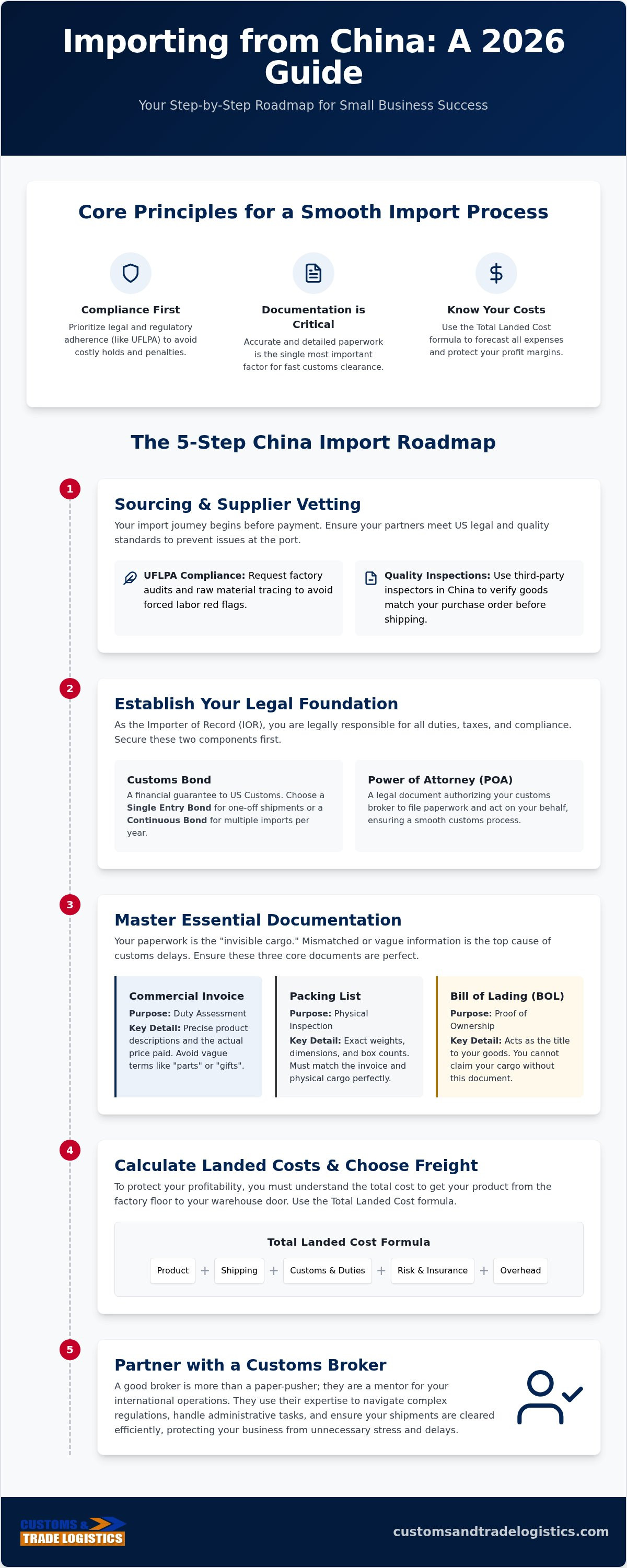
How do you know your supplier is legitimate? In 2026, vetting isn't just about product quality; it's about legal survival. You must ensure your partners don't trigger red flags with the Uyghur Forced Labor Prevention Act (UFLPA). This law assumes that goods from certain regions are made with forced labor unless you can prove otherwise. To stay compliant, we recommend requesting detailed factory audits and raw material tracing documents before you ever sign a contract.
Don't wait until the goods arrive at a US port to find a problem. Third-party quality inspections at the Chinese factory are your best defense against "held" shipments. These inspectors act as your eyes on the ground, verifying that the cargo matches your purchase order and meets US safety standards. This extra step prevents the heartbreak of paying for a container of goods that US Customs refuses to release.
The Legal Foundation: Your Importer of Record Status
Are you ready to take full legal responsibility for your goods? When you bring products into the US, you officially become the Importer of Record (IOR). This means you're the party liable for all duties, taxes, and regulatory compliance. It's a heavy title, but it's manageable when you have the right legal foundation in place. You aren't just a buyer; you're a participant in international trade law.
To function effectively as an IOR, you'll need to secure two critical components:
- A Customs Bond: This is a financial guarantee to US Customs that all duties and fees will be paid. Small businesses typically choose a "Single Entry Bond" for occasional shipments or a "Continuous Bond" if they plan to import multiple times throughout the year.
- Power of Attorney (POA): This document allows us to act as your advocate. It gives your customs broker the legal authority to file entries and handle the administrative paperwork that keeps your business moving.
Setting this foundation correctly ensures your growth isn't stalled by a simple oversight. We've spent 35 years acting as a safe pair of hands for small businesses, making sure these legal requirements are handled with care and precision so you can focus on your customers.
Mastering the Essential Import Documentation
Think of your paperwork as the "invisible cargo" that travels alongside your physical goods. While you focus on the quality of the products inside the container, US Customs focuses on the data on the page. If the data is wrong, the cargo doesn't move. Mastering this part of the China import process for small business is what separates successful brands from those facing costly delays and penalties.
The Core Documents: Invoice and Packing List
The Commercial Invoice is the primary document for duty assessment. It must include a precise description of the goods, the country of origin, and the actual price paid. Don't let your supplier use vague terms like "plastic parts" or "gift." Be specific. If you're importing ergonomic office chairs, say so clearly. Precise descriptions help avoid the "red flag" triggers that lead to administrative holds.
The Packing List is the invoice's twin, but it serves a different purpose. While the invoice focuses on value, the packing list focuses on physical dimensions, weight, and box counts. Customs officers use this to decide which pallets to pull for an exam. If your packing list says 50 boxes but the container holds 55, you can expect an intensive inspection. Ensuring these two documents match perfectly is the first step in a smooth entry.
Transport and Compliance Certificates
The Bill of Lading (BOL) acts as the official title to your goods. You'll likely see two types: a House BOL issued by a freight forwarder and a Master BOL issued by the shipping line. You cannot claim your cargo at the port without a properly endorsed BOL. It's the ultimate proof of ownership and the final key to unlocking your shipment.
As your shipment nears the coast, you'll receive an Arrival Notice. This document tells your broker exactly when the ship will dock, allowing them to finalize the customs clearance services needed to get your goods on the road. This is the moment where speed and accuracy matter most.
Depending on what you sell, you might need extra "hall passes" for specific agencies. Electronics often require EPA forms, food or cosmetics need FDA registration, and wooden furniture may trigger Lacey Act declarations. These are technical hurdles, but they're easy to clear when you have a mentor guiding your steps. We've spent 35 years ensuring our clients never feel lost in the shuffle of administrative requirements.
Choosing Your Logistics and Freight Strategy
How do you decide the best way to move your goods across the globe? The logistics strategy you choose is a balancing act between your profit margins and your customers' expectations. In the China import process for small business, the goal is to find the most efficient path that keeps your supply chain moving without draining your capital. Speed costs money, but delays can cost you customers. Finding that "sweet spot" is where professional logistics planning becomes your greatest asset.
Ocean Freight vs. Air Freight: Cost and Speed
Ocean freight remains the gold standard for bulk stability and cost savings. If you're importing heavy items or large volumes of inventory, the sea is your best friend. It offers the lowest cost per unit, though it requires a longer lead time. You must plan for your goods to be on the water for several weeks. This requires accurate forecasting to ensure you don't run out of stock while your container is in transit.
Air freight acts as your emergency lever or your high-speed lane. It's ideal for high-value electronics or time-sensitive inventory that needs to hit the shelves immediately. While it's significantly more expensive than ocean transport, the "port-to-door" reality is much faster. Most small businesses find success using a hybrid approach, sending the bulk of their goods by sea while using air shipments to top up inventory during peak seasons.
If you don't have enough product to fill an entire 40-foot container, don't worry. Less than Container Load (LCL) shipping allows you to share container space with other importers. You only pay for the volume you use, making it a cost-effective way to scale your operations without committing to massive inventory levels upfront.
Specialized Logistics for Amazon FBA Sellers
Selling on Amazon adds another layer of complexity to your logistics. Amazon has incredibly strict rules for how goods must be labeled, palletized, and delivered to their fulfillment centers. One small mistake in labeling can lead to your entire shipment being rejected at the warehouse door, causing a logistical nightmare. This is why many entrepreneurs rely on specialized FBA freight forwarding services to ensure every box meets the platform's specific requirements.
Once your goods clear customs, the journey still isn't quite over. You need a reliable plan for delivery and redistribution. Whether your cargo is headed to a single warehouse or needs to be split among multiple Amazon fulfillment centers across the country, we act as a safe pair of hands to manage that final leg. Our 35 years of experience means we understand the nuances of every US port, ensuring your goods move seamlessly from the dock to their final destination.
Calculating Landed Costs and Avoiding Delays
The price on your factory invoice rarely matches the final cost of getting goods to your warehouse. Total Landed Cost is the sum of every expense required to get your product from the manufacturer to your customer's hands. This includes the product price, freight charges, insurance, and the duties and taxes paid at the border. It also accounts for harbor maintenance fees and merchandise processing fees. Understanding these variables is an essential part of the China import process for small business. We help you look at the big picture so there are no surprises when the final bill arrives.
Decoding HTS Codes and Duty Rates
How do you determine exactly what you owe the government? You use the Harmonized Tariff Schedule (HTS). HTS codes are 10-digit numbers that categorize every possible product for international trade. HTS codes determine the specific percentage of duty owed to US Customs and Border Protection (CBP). Misclassifying your goods is a common pitfall in the China import process for small business. It can lead to overpaying or, worse, being hit with back-taxes and fines during an audit. In 2026, Section 301 tariffs continue to apply to many Chinese goods, often adding a significant surcharge on top of standard rates. We act as your mentor to help you identify the correct code for your specific product, ensuring you pay only what is legally required.
Proactive Strategies for Reducing Customs Clearance Delays
Imagine the stress of having a shipment stuck at the port for an unexpected inspection. It’s a costly experience that can ruin a product launch. You can minimize this risk by following proactive strategies for reducing customs clearance delays. One of the most critical steps is the Importer Security Filing (ISF), also known as 10+2. This must be filed at least 24 hours before your goods are even loaded onto the ship in China. Failure to do this triggers an automatic $5,000 fine and an almost certain intensive exam. Accuracy at this stage is non-negotiable.
Customs exams range from simple X-ray scans to intensive exams where officers physically unpack your container. These add both time and unexpected labor costs to your journey. To keep the financial side moving smoothly, we recommend setting up an Automated Clearing House (ACH) debit account with CBP. This allows for direct duty payment, ensuring your cargo isn't held up by a pending check or a bank transfer delay. If you're ready to secure your supply chain, our customs clearance services provide the oversight you need to manage these financial flows with confidence.
Partnering with a Customs Broker for Seamless Growth
How much is your peace of mind worth? While digital platforms promise speed through automation, they often lack the human oversight needed when a shipment faces a real-world complication at a US port. The China import process for small business is filled with technical nuances that an algorithm can easily miss. Choosing a family-owned consultancy means you aren't just a ticket number; you're a partner whose growth we are personally invested in protecting. We bridge the gap between your small-scale operations and the global marketplace, ensuring you never feel alone in the journey.
The Value of 35+ Years of Logistics Expertise
Why does long-standing experience matter in a modern world? A seasoned broker acts as a "safe pair of hands" because they've seen almost every possible scenario across 35+ years in the field. We anticipate potential roadblocks, such as documentation discrepancies or port-specific congestion, before your cargo even leaves China. This proactive advocacy is vital when dealing with CBP officers. If an issue arises, you want a veteran who knows how to navigate the system and speak the language of compliance to keep your goods moving. Transitioning from a one-off importer to a scalable global brand requires more than just software; it requires a mentor who understands your business goals.
Getting Started with Your Import Roadmap
Are you ready to take the first step toward a secure supply chain? Before your first consultation, gather your supplier's contact details and clear, technical descriptions of your products. Having these details ready allows us to hit the ground running with an accurate assessment of your needs. You should view custom brokerage service fees as a strategic investment in your company's compliance and long-term health. These fees cover the expert oversight that prevents the costly administrative errors and fines we've highlighted throughout this guide.
Contacting Customs and Trade Logistics is the simplest way to trade anxiety for professional security. We'll help you build a personalized logistics plan that handles everything from the initial factory pickup to the final redistribution. Let us take the heavy administrative burden off your shoulders so you can focus on what you do best: building your brand and serving your customers. Your roadmap to successful importing starts with a single conversation with a partner you can trust.
Ready to Scale Your Global Supply Chain?
Mastering the China import process for small business doesn't have to be a source of constant anxiety. By prioritizing documentation accuracy and choosing a logistics strategy that balances speed with cost, you've already taken the most important steps toward long-term profitability. Remember that compliance isn't just a legal requirement; it's the foundation of a reliable supply chain that allows your brand to flourish without the fear of unexpected port delays or hidden customs fees.
You don't have to navigate these technical complexities alone. With over 35 years of industry-leading expertise, we act as a safe pair of hands for small businesses and Amazon sellers navigating the global marketplace. Our team provides comprehensive national coverage across all US ports, ensuring your goods move smoothly from the factory to their final destination. Let our family-owned team manage your China imports for total peace of mind. We're here to serve as your dedicated advocate and mentor every step of the way. Your future in international trade is bright, and we're ready to help you secure it.
Frequently Asked Questions
How long does the China to US import process typically take for a small business?
The timeline for the China import process for small business varies based on your chosen transport method. Ocean freight typically takes 25 to 45 days depending on the specific US port, while air freight is much faster, usually arriving in 5 to 10 days. You should also factor in an additional week for factory preparation and 2 to 5 days for customs clearance and final delivery once the goods reach the border.
Do I need a specific license to start importing goods from China?
You don't need a general "import license" to bring most consumer goods into the United States. Instead, you must establish yourself as an Importer of Record and secure a Customs Bond. However, certain regulated products, such as medical devices, food, or electronics, may require specific permits from agencies like the FDA or EPA. It's best to check the requirements for your specific product category before placing your first order.
What is the most common mistake small businesses make when importing from China?
The most frequent error is providing vague or inaccurate product descriptions on the Commercial Invoice. Small businesses often rely on factory-provided HTS codes that may be incorrect for US Customs standards. This leads to overpaying duties or triggering intensive exams that cause expensive delays. Ensuring your paperwork is precise and compliant from the start is the most effective way to protect your profit margins and avoid administrative penalties.
How can I calculate the customs duties for my specific products?
To calculate your duties, you first need to identify the correct 10-digit HTS code for your product. Once you have this code, you can look up the corresponding duty rate in the Harmonized Tariff Schedule of the United States. You'll multiply this percentage by the total value of your goods. Don't forget to check for Section 301 surcharges, which currently apply to many categories of Chinese manufactured goods.
What is the difference between a freight forwarder and a customs broker?
A freight forwarder acts as a travel agent for your cargo, managing the physical transportation from the factory to the port. In contrast, a customs broker focuses on the legal entry of your goods into the US. We handle the complex communication with US Customs, ensuring all duties are paid and regulations are met. While some companies offer both, having a specialized broker provides a dedicated advocate for your compliance and financial security.
Is it better for a small business to ship by air or by sea from China?
The best choice depends on your product's weight and your required delivery speed. Ocean freight is the most cost-effective option for bulk orders and heavy items, making it ideal for maintaining steady inventory levels. Air freight is significantly more expensive but is perfect for high-value electronics or urgent stock refills. Many small businesses use a hybrid strategy, shipping the majority by sea while using air for time-sensitive launches.
What happens if my shipment is held by US Customs?
If your shipment is held, it's usually because US Customs has flagged it for a routine exam or found a discrepancy in your paperwork. Your customs broker will receive a notification and act as your liaison to resolve the issue. Depending on the hold type, your goods may undergo a non-intrusive X-ray scan or a physical inspection. We work to provide the necessary documentation quickly to minimize storage fees and get your cargo moving.
Can a customs broker help me with Amazon FBA shipments specifically?
Yes, we specialize in helping entrepreneurs manage the unique requirements of the China import process for small business when selling on Amazon. FBA shipments must follow strict labeling and palletization rules to avoid rejection at the fulfillment center. A broker with FBA expertise ensures your goods are cleared through customs and correctly routed to Amazon’s network. This end-to-end oversight prevents the logistical headaches that often stall new e-commerce brands.


