

The lowest quote on your desk right now might actually be the most expensive mistake your business makes this year. It's a common frustration for importers who see a competitive entry fee, only to be hit with surprise ancillary charges once the cargo hits the pier. When you're weighing the pros of a customs broker vs freight forwarder for small business operations, it's easy to get lost in the spreadsheets. You've likely felt the sting of automated systems that misclassify your goods, leading to overpaid duties and a lack of personal support when CBP flags a shipment. It's exhausting to deal with a faceless corporation when you just need a real person on the phone to provide a straight answer.
We believe you deserve a predictable landed cost and a partner who treats your cargo with genuine care. This guide promises to demystify the 2026 fee landscape so you can master your compliance strategy and protect your margins. We'll provide a clear framework for comparing quotes apples-to-apples and explain how precise classification lowers your total costs. You'll learn how to find a reliable national partner who acts as a safe pair of hands for your growing business, ensuring your journey from the factory floor to the final destination is smooth and secure.
Key Takeaways
- Learn how to distinguish between professional service fees and mandatory government charges like the 2026 MPF to ensure your import budget remains predictable.
- Discover why the cheapest initial quote from a major forwarder often leads to higher total landed costs due to automated misclassifications and surprise ancillary fees.
- Understand the differences between a customs broker vs freight forwarder for small business needs to decide which model offers the personal advocacy you require when shipments are flagged.
- Master specific strategies for managing high-tariff imports from China and using precise classification to protect your margins on Amazon and SME platforms.
- Gain a clear framework for comparing quotes apples-to-apples, allowing you to choose a reliable partner who prioritizes long-term compliance over quick, risky filings.
What are Customs Brokerage Fees and Why Do They Vary?
Customs brokerage fees are the professional service charges you pay for the legal filing of your import documents with the government. Think of it as hiring a specialized guide to ensure your goods pass through the border without a hitch. A licensed customs broker acts as your advocate, translating the complex language of international trade into a successful entry. These fees aren't just a "cost of doing business"; they are a payment for technical expertise and regulatory compliance.
It's vital to distinguish between service fees and government fees. Service fees cover the broker's time, software, and liability. Government fees, like duties and the Merchandise Processing Fee (MPF), go straight to U.S. Customs and Border Protection (CBP). When you're weighing the options of a customs broker vs freight forwarder for small business logistics, you'll notice that all-in-one pricing can be deceptive. A low flat rate often masks a lack of tactical oversight, leaving you vulnerable to expensive classification errors.
The Anatomy of a Customs Entry Fee
A standard entry fee usually covers a simple shipment with a single commodity. As your business grows, your entries often become more complex. Every extra line item on your commercial invoice requires additional classification work and data entry. If you're importing specialized goods, you'll also see surcharges for Partner Government Agency (PGA) filings. These include oversight from the FDA for food-grade items, the EPA for certain electronics, or the Lacey Act for wood products. These aren't random extras; they represent the technical labor required to keep your business compliant with federal law.
Major Forwarders vs. Independent Brokers: The Pricing Philosophy
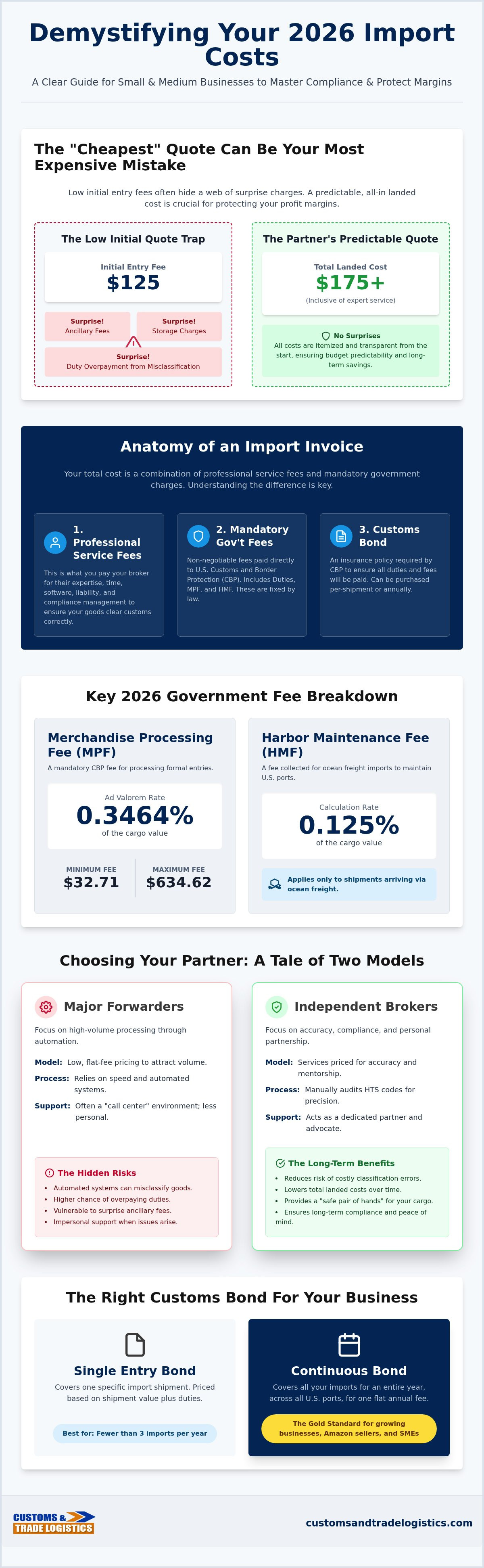
Choosing between a customs broker vs freight forwarder for small business needs is a choice between volume and precision. Major forwarders often use low, flat-fee models to attract high-volume clients. They rely on speed and automation. While this sounds efficient, it creates a "call center" environment where your shipment is just another number in a queue. If an automated system misclassifies your cargo, you're the one left holding the bill for overpaid duties.
Independent brokers typically price their services based on accuracy and personal mentorship. They take the time to audit your HTS codes, which can lower your total landed costs over time. The trade-off is clear. A major forwarder might offer a lower entry fee on paper, but you're more likely to face high ancillary hidden costs or surprise invoices for storage if a filing gets flagged. A dedicated partner provides a safe pair of hands, ensuring that the cheapest quote doesn't become your most expensive headache.
The 2026 Breakdown: Itemizing Your Import Costs
When you receive a quote for your shipment, the list of fees can look like a wall of technical jargon. It's helpful to remember that your partner is licensed, regulated and empowered by U.S. Customs and Border Protection to collect certain government fees on your behalf. Understanding which costs are fixed by law and which are service-based is the first step toward mastering your budget. Every standard quote should clearly break down the entry fee, the bond cost, and the specific government user fees associated with your mode of transport.
The Merchandise Processing Fee (MPF) is a primary cost for every formal entry. For 2026, the ad valorem rate remains at 0.3464%, but the minimum and maximum caps are what really impact your bottom line. Currently, the minimum is set at $32.71 and the maximum at $634.62 per entry. If you're importing via ocean freight, you'll also see the Harbor Maintenance Fee (HMF), which is calculated at 0.125% of the cargo's value. These are non-negotiable government charges, so if a quote seems unusually low, check if these have been omitted to make the initial price look better.
Customs Bonds: Single Entry vs. Continuous
Do you plan to import more than three times this year? If so, the choice between a single-entry and a continuous bond is a major cost driver. A single-entry bond is generally priced based on the value of the specific shipment plus duties. However, for growing Amazon sellers and SMEs, a continuous bond is almost always the gold standard. It covers all your imports for an entire year across all U.S. ports. If you're unsure which bond fits your volume, our team at Customs and Trade Logistics can run a quick cost-benefit analysis for you to find the most efficient path forward.
ISF Filing and the Cost of Late Data
The Import Security Filing (ISF), often called the "10+2" rule, is a mandatory requirement for ocean cargo that must be submitted at least 24 hours before the vessel is loaded at the port of origin. Standard filing fees for this service typically range from $25 to $50. While that seems small, the risk of late data is massive. CBP can issue a $5,000 penalty for late, inaccurate, or incomplete filings. This is a common area where the debate of customs broker vs freight forwarder for small business becomes critical. A dedicated broker provides the oversight needed to ensure this data is transmitted on time, protecting you from a penalty that could wipe out your entire profit margin on a shipment.
Comparing Major Forwarders: The Hidden Cost of Automation
Many small businesses choose digital forwarders because the interface looks sleek and the initial quote is low. These platforms often prioritize volume over technical precision. Understanding the distinction between Customs Brokers and Freight Forwarders is essential here. While a forwarder moves the box, a broker protects the business. When you use a high-volume forwarder, your entry is often processed by an algorithm or a clerk in a distant call center. If CBP flags the shipment, you're often stuck in a phone tree instead of talking to an expert who knows your history.
Have you ever looked closely at the administrative fees on a major forwarder's invoice? These small, recurring charges for document turnover or communication can bloat your total landed cost significantly. When comparing a customs broker vs freight forwarder for small business operations, look beyond the entry fee. A broker's service fee often covers the proactive oversight that prevents these line items from appearing in the first place. You're paying for a safe pair of hands that values accuracy over sheer speed.
The Risk of Automated Classification
Software-driven HTS classification is a major risk for those importing from China. Algorithms often default to the most general code, which can trigger unnecessary Section 301 duties. A human expert reviewing your factory invoices can often find a more specific, compliant classification that lowers your tax bill. We've seen SMEs save thousands in a single quarter simply because a human caught a recurring classification error that an automated system missed. This level of mentorship is what helps a small operation compete on a global scale.
Ancillary Charges: Where Forwarders Make Their Margin
Port storage is where forwarders often make their real margin. If a customs hold occurs, a reactive forwarder might let your container sit for days before notifying you. Demurrage and detention costs can reach hundreds of dollars per day. A proactive broker acts as your defense, monitoring the shipment's status and coordinating with the terminal to minimize these hidden costs. This oversight turns a simple service into a strategic partnership. It's about finding a stabilizing force that lifts the heavy administrative burden from your shoulders and keeps your supply chain moving.
Strategic Cost Avoidance for Amazon and SME Importers
Managing the China-to-US trade corridor requires more than just a shipping label. If you're importing high-tariff goods, your custom brokerage service fees should be viewed as a strategic investment rather than a sunk cost. A skilled broker helps you navigate the "First Sale" rule. This allows you to base duty calculations on the price a manufacturer paid their supplier, rather than the price you paid that manufacturer. This can significantly lower your valuation and the associated MPF. It's a complex maneuver that requires precise documentation, but the savings for a high-volume importer are substantial.
Are you exploring Duty Drawback programs? These allow you to recover up to 99% of duties paid on goods that are subsequently exported or destroyed. For an SME, this cash flow recovery can be the difference between a profitable quarter and a loss. When deciding on a customs broker vs freight forwarder for small business growth, look for a partner who proactively suggests these recovery programs. They act as a stabilizing force, ensuring you don't leave money on the table due to administrative oversight.
E-commerce and Amazon FBA Specifics
Coordinating delivery and redistribution from the port to FBA centers is a logistical puzzle. Many FBA freight forwarding services handle the transport but struggle with the granular compliance required for multiple SKUs. If you have hundreds of line items, an automated system might group them under a single HTS code to save time. This is a red flag for CBP. You need a partner who can manage complex invoices without letting your costs balloon. Our team ensures that every SKU is classified correctly, protecting your Amazon account from compliance strikes and overpaid duties.
The Mentorship Model for Startups
Success in import logistics for startups depends heavily on educational support. It's normal to feel anxious about your first major container. We replace that anxiety with assurance by acting as a knowledgeable bridge to the global marketplace. As a family-owned consultancy with 35+ years of experience, we don't just file your paperwork; we mentor you through the process. This personalized approach is the hallmark of a true partner, helping you avoid the "learning curve" fees that sink many new ventures.
Ready to optimize your landed costs and secure your supply chain? Contact Customs and Trade Logistics today to discuss a tailored strategy for your business.
Conclusion: Choosing a Partner Over a Provider
The decision between a customs broker vs freight forwarder for small business comes down to how much risk you're willing to carry alone. While a low entry fee might look attractive on a spreadsheet, it rarely results in the lowest total landed cost. A provider might move your boxes, but a partner protects your bottom line by ensuring every HTS code is accurate and every filing is punctual.
We've spent 35+ years acting as a stabilizing force for importers, replacing the anxiety of "surprise invoices" with the relief of professional assurance. True transparency starts with an itemized quote that leaves no room for guesswork. Before you sign your next Power of Attorney, use this checklist to audit your quotes and ensure you're getting the oversight your business deserves.
Checklist for Your Next Brokerage Quote
Before committing to a service, ask these three critical questions to avoid hidden cost traps:
- Does the quote include MPF and HMF estimates? Government fees are non-negotiable. If they aren't listed, your final invoice will be much higher than the initial quote.
- Is there a dedicated agent or a general support inbox? When CBP flags a shipment, you need a specific expert who knows your account, not a rotating clerk in a call center.
- How are additional line items and PGA filings charged? Complexity shouldn't be a blank check. Ensure you understand the surcharges for FDA, EPA, or multiple commodities upfront.
The Customs and Trade Logistics Difference
We provide a safe pair of hands for your entire supply chain. Our team manages the process from end-to-end, covering everything from import from China logistics to final delivery at your warehouse or FBA center. This comprehensive oversight ensures that compliance isn't an afterthought; it's the foundation of your shipping strategy.
Our family-owned firm offers national coverage across all U.S. ports, combining the reach of a major forwarder with the personalized mentorship of a boutique consultancy. We believe that when you understand the "why" behind your import costs, you're better equipped to grow. We act as your bridge to the global marketplace, ensuring your cargo moves smoothly and your business stays protected.
Don't let automated systems or hidden fees erode your margins. Request a transparent customs brokerage quote today and experience the security of a partner who values your growth as much as you do.
Securing Your Growth in the 2026 Global Market
You now have the tools to look past the surface of a shipping quote and see the true cost of compliance. We've seen how a low entry fee often masks risks that can stall your growth, from misclassified HTS codes to surprise ancillary charges. When you're making the final choice between a customs broker vs freight forwarder for small business operations, prioritize the partner who offers itemized transparency and proactive advocacy. The right choice protects your margins and keeps your supply chain moving without the burden of unexpected penalties.
At Customs and Trade Logistics, we bring over 35 years of experience in US Customs compliance to every shipment. We provide national service across all US ports of entry, offering specialized support for Amazon FBA and SME importers who need a safe pair of hands. You don't have to face the complexities of international trade alone. It's time to replace logistical anxiety with the relief of a dedicated mentor. Get a Transparent Customs Brokerage Quote from Our Experts and take the next step toward a more secure and profitable import strategy. Your business is ready for the global stage, and we're here to guide you every step of the way.
Frequently Asked Questions
What is the average customs broker fee per entry in 2026?
Brokerage fees vary based on the complexity of your shipment and the number of line items on your commercial invoice. While industry averages exist, your total cost depends on whether you require specialized filings for agencies like the FDA or EPA. A transparent quote should itemize these professional service charges clearly. Focus on the value of precise classification, which often saves you more in duties than the cost of the service fee itself.
Can I clear customs myself to avoid brokerage fees?
You have the legal right to file your own entries as the Importer of Record, but it's technically challenging for most small businesses. You would need to navigate the Automated Broker Interface and maintain a deep understanding of the Harmonized Tariff Schedule. Most importers find that the risk of filing errors and the significant time required to manage the paperwork far outweigh the cost of hiring a licensed professional who acts as a safe pair of hands.
Why does my freight forwarder charge a separate customs entry fee?
Transportation and customs clearance are two distinct services with different regulatory requirements. Even if your forwarder handles the physical movement of your goods, the legal entry into the United States requires a specific filing with CBP. Some forwarders handle this through an in-house department, while others partner with independent brokers. This separate fee covers the professional labor and liability involved in ensuring your cargo meets all federal import regulations without facing costly delays.
How much is the Merchandise Processing Fee (MPF) in 2026?
The MPF for formal entries is calculated at an ad valorem rate of 0.3464% of the cargo value. For the 2026 fiscal year, the minimum charge is set at $32.71 and the maximum cap is $634.62 per entry. These figures are mandatory government user fees that your broker collects and passes directly to CBP. It's important to verify that these specific caps are accurately reflected in any all-in quotes you receive from logistics providers.
What happens if my customs broker makes a mistake on my entry?
The Importer of Record is ultimately responsible for the accuracy of all data submitted to CBP, regardless of who filed the paperwork. If an error leads to underpaid duties, you'll be required to pay the difference along with any associated penalties or interest. While you may have legal recourse against a negligent broker, the government will look to you for immediate payment. This is why partnering with an experienced, diligent broker is your best defense against compliance risks.
Do I need a different broker for every US port I ship into?
You don't need multiple brokers because a firm with a national permit can file entries at any US port of entry. This allows you to maintain a single point of contact and a consistent compliance strategy across your entire supply chain. Working with one national partner simplifies your record-keeping and ensures that your classifications remain uniform, whether your cargo arrives via ocean freight or air transport. It's a methodical way to ensure no stage of the journey is overlooked.
Is a continuous customs bond worth the cost for a small business?
A continuous bond is usually the most cost-effective choice if you plan to import more than three or four times in a single year. While a single-entry bond might seem cheaper for a one-off shipment, the costs add up quickly for growing businesses. A continuous bond covers all your entries for twelve months and satisfies the security requirements for the ISF filing. It's a stabilizing investment that provides long-term peace of mind and simplifies your administrative burden.
What is the difference between a customs broker and a freight forwarder?
A freight forwarder focuses on the logistics of moving cargo from point A to point B, while a customs broker handles the legal compliance of entering those goods into the country. When deciding between a customs broker vs freight forwarder for small business needs, remember that the broker acts as your technical advocate with CBP. They specialize in HTS classification and regulatory filings, ensuring your business stays compliant while the forwarder manages the physical transportation of your inventory.


