

You open your tracking portal expecting a "cleared" status, but instead, you're met with a vague notification and the looming threat of daily storage fees. It's a stressful moment that can make even the most seasoned importer feel like their investment is slipping away. You're likely worried about unpredictable demurrage costs or, worse, the total refusal and destruction of your shipment. We know how heavy that administrative burden feels when you just want your products to reach your customers.
An FDA hold isn't a legal wall; it's a compliance puzzle that requires a systematic correction of your records. Our goal is to act as a safe pair of hands, guiding you through the 2026 FDA customs hold release process with clarity and confidence. By understanding the specific reason for the delay, you can transform a chaotic situation into a manageable step-by-step resolution. We've spent over 35 years helping importers find their footing, and we're ready to help you too.
This guide demystifies the latest 2026 regulations, including the impact of the ImportShield program and updated fee structures. You'll learn exactly how to respond to a Notice of Detention, what documents will satisfy the inspector, and how to build a profile that avoids future red flags. Let's turn this setback into a roadmap for long-term compliance and total peace of mind.
Key Takeaways
- Learn the critical difference between a "May Proceed" status and a "Detained" designation to accurately predict your shipment's delivery timeline.
- Follow our 5-step roadmap to navigate the FDA customs hold release process by auditing violation codes and gathering the specific evidence inspectors require.
- Identify common red flags, such as vague commercial invoice descriptions and labeling errors, to prevent your goods from being flagged by the PREDICT screening system.
- Discover how to compile professional "testimony," including lab reports and photos, to provide the FDA with the necessary proof for a swift shipment release.
- Understand how partnering with an experienced broker acts as a stabilizing force, helping you avoid unpredictable storage fees and the risk of shipment destruction.
Understanding the FDA Customs Hold Release Process in 2026
An FDA hold isn't a final judgment; it's a pause for verification. The agency stops your shipment because it suspects a violation of safety, labeling, or manufacturing standards. This experience can be intimidating, but it's part of the standard FDA customs hold release process. When your cargo arrives at a U.S. port, it's assigned a status. A "May Proceed" message is the green light every importer wants. However, a "Detained" status means the FDA has found a reason to keep your goods under wraps while they investigate further.
The agency doesn't target products at random. In 2026, there's a heavy focus on perishables, medical devices, and cosmetics. With the Modernization of Cosmetics Regulation Act (MoCRA) in full effect, the FDA is managing nearly a million active product listings. Specifically, as of January 2026, there were 992,907 unique cosmetic product listings on file. If your paperwork doesn't match these records, your shipment stops. The financial stakes are high. Storage fees, often called demurrage, can accumulate so quickly that they exceed the total value of your products within just 15 days. Acting quickly isn't just about compliance; it's about saving your investment.
FDA Hold vs. Customs Hold: Who Is Stopping Your Cargo?
It's a common mistake to think U.S. Customs and Border Protection (CBP) and the FDA are the same. They're separate agencies with different goals. CBP guards the border and collects revenue, ensuring you pay the correct Section 301 tariffs or Merchandise Processing Fees. The FDA protects public health. Your cargo can clear CBP easily but still hit a wall with the FDA. In this situation, your "Notice of FDA Action" is the most important paper you'll receive. It's your primary guide to what went wrong and how to fix it.
The PREDICT System: How the FDA Flags Your Shipment
The FDA uses a system called PREDICT to flag shipments. It isn't a guessing game. The system looks at your supplier's history and the type of product you're importing to create a risk score. Since the ImportShield program launched in August 2025, these reviews have become more centralized and efficient. If you're a new importer, the system treats you with extra caution. It's rarely a random choice when an inspector decides to take a closer look at your goods. They are looking for specific data points that don't align with their safety standards. Understanding these nuances helps you navigate the FDA customs hold release process without the usual anxiety.
The Lifecycle of an FDA Detention: From Flag to Release
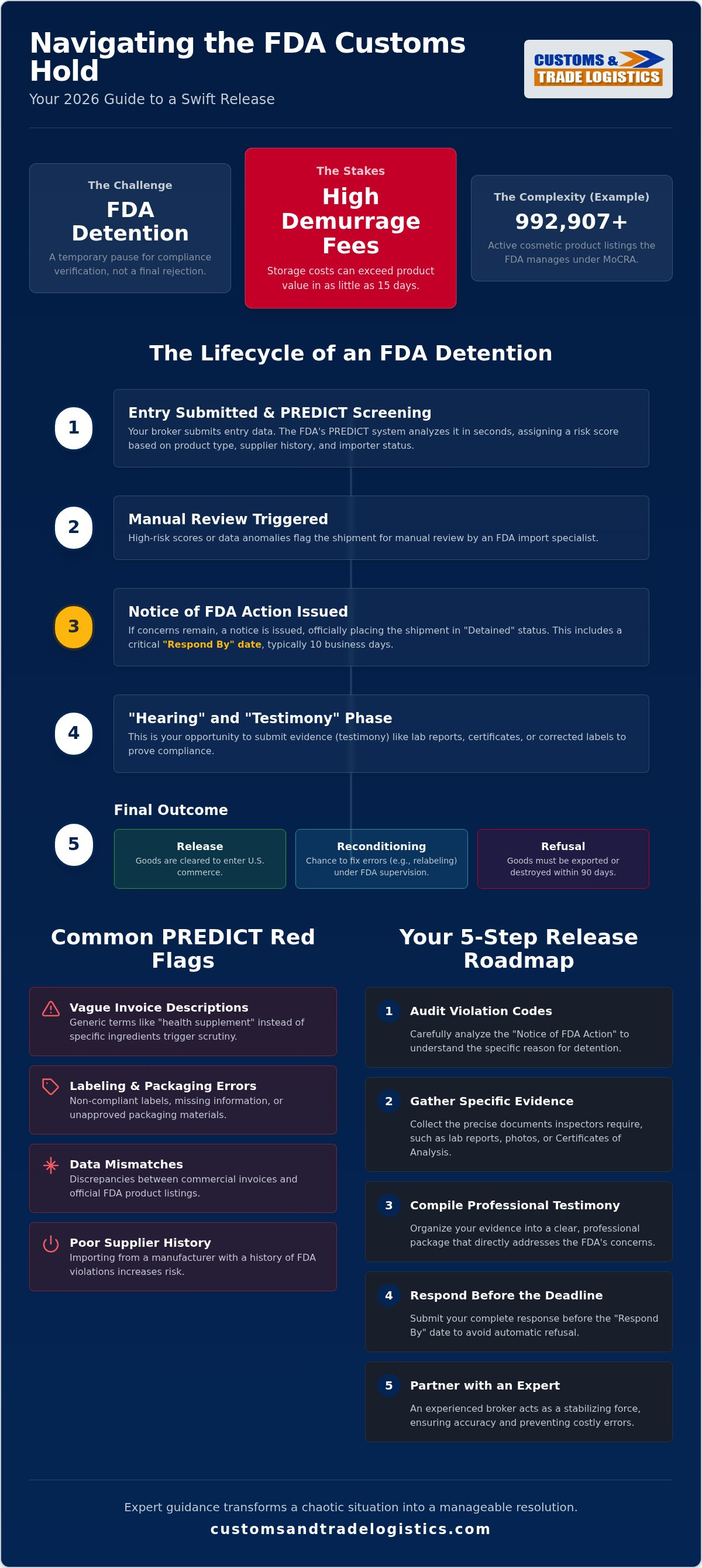
The journey from a flagged entry to a successful release follows a structured legal path. It begins the moment your broker submits entry data. The PREDICT system analyzes this data in seconds. If the system identifies a risk, it triggers a manual review by an FDA import specialist. This is the first step in the FDA customs hold release process, moving your shipment from a standard entry to a state of scrutiny. You aren't alone in this phase; it's a standard part of the agency's oversight.
When the specialist decides your cargo requires further inspection, you'll receive a Notice of FDA Action. This document officially designates the shipment as "Detained." It's not a final rejection. Instead, it invites you to a "Hearing." In the context of international trade, a hearing is usually your chance to submit "Testimony." This is evidence, such as certificates of analysis or updated labels, proving your goods meet U.S. standards. The process is methodical, and providing the right evidence is the key to moving forward.
The lifecycle ends with one of three outcomes. "Release" means your cargo is free to enter commerce. "Refusal" requires the goods to be exported or destroyed within 90 days. In some cases, you may be granted "Reconditioning," allowing you to fix labeling or packaging errors under FDA supervision. Navigating these options requires a "safe pair of hands" to ensure you don't make a costly procedural error. Partnering with a team that provides customs clearance services ensures your response is handled with professional care.
The Critical 'Respond By' Date
Time is your most valuable asset during a detention. Each Notice of Detention includes a "respond by" date, typically set at 10 business days from the date of the notice. Missing this deadline often leads to an automatic refusal of entry. If you need more time for complex laboratory testing, you must request an extension immediately. As the Importer of Record (IOR), you're ultimately responsible for these deadlines. Managing this FDA customs hold release process effectively means staying ahead of the calendar to protect your investment.
Digital Filing via the ACE System
The Automated Commercial Environment (ACE) is the central portal for all U.S. trade processing. It acts as the digital bridge between your broker and the FDA. Filing electronically through a broker speeds up the review process significantly because it allows for instant data transmission. For those managing Amazon FBA inventory, this digital integration is vital. It provides real-time status updates, allowing you to pivot your supply chain strategy the moment a status changes from "Held" to "Released."
Common Red Flags: Why Your Shipment Is Stuck
Most shipments don't get flagged because of a major health crisis. Instead, they get stuck because of small data mismatches that trigger the PREDICT system. The most frequent technical error we see with small businesses and Amazon FBA sellers is a mismatch between the Harmonized Tariff Schedule (HTS) code and the FDA Product Code. While CBP uses the HTS to determine duties, the FDA uses its own seven-character product code to categorize health risks. If these two numbers don't tell the same story, an inspector will likely pause your entry to investigate.
Marketing claims are another major trigger. We often see importers attempt to bring in "supplements" that feature packaging claims reserved for "drugs." If your label suggests the product can treat, cure, or prevent a disease, the FDA will immediately detain it as an unapproved new drug. Navigating the FDA customs hold release process becomes much simpler when you eliminate these common triggers before your goods ever leave the factory floor. For Amazon sellers, these delays are especially painful because they can lead to stockouts and the loss of your "Buy Box" status.
Perfecting Your Commercial Invoice for FDA Review
Your commercial invoice is the first document an inspector reviews. To pass scrutiny, it must include five essential elements: the manufacturer's full name and address, a detailed product description, the country of origin, the FDA Establishment Identifier (FEI) number, and the intended use of the goods. A common mistake is listing the trading company as the manufacturer. The country of origin must match the actual location of the factory where the goods were produced. Using professional customs clearance services us allows you to audit these documents before they reach the port, ensuring every detail is accurate and compliant.
Sanitation and Adulteration Concerns
The FDA can detain products based on the "Appearance of Violation." This means they don't always need a laboratory test to stop your cargo. If an inspector finds "insanitary conditions" during a physical exam, such as evidence of pests or water damage on the outer packaging, they can refuse the entire lot. You also face a higher risk if your supplier is on an Import Alert list. When a manufacturer has a history of violations, the FDA assumes your specific shipment is also adulterated. This "detention without physical examination" is difficult to overcome without a seasoned partner who knows how to provide the right testimony to prove your batch is safe.
Your 5-Step Roadmap to Securing an FDA Release
Receiving a detention notice feels like a heavy administrative burden, but it's actually the start of your formal defense. To successfully manage the FDA customs hold release process, you must move from panic to precision. Your roadmap begins with a thorough audit of the "Notice of FDA Action." Look specifically for the section labeled "Charges." These violation codes tell you exactly why the agency is concerned. Once you identify the charge, you can gather your "Testimony." This isn't just a simple email; it's a collection of evidence like lab reports, product photos, or manufacturing flowcharts that directly address the FDA's concerns.
If the issue is purely technical, such as a missing ingredient in the English translation, you'll need to submit a "Request for Reconditioning." While this is happening, don't let financial obligations slip. Pay all outstanding duties and storage fees immediately. Unpaid fees can lead to a Customs Hold on top of your FDA Hold, doubling your trouble. Finally, don't rely on your carrier for updates. They often have limited information and cannot advocate for your specific business needs. Instead, partner with an expert broker who can communicate directly with the FDA Compliance Officer assigned to your case. If you need a seasoned advocate to handle these complex negotiations, our team provides the customs clearance services you need to secure a swift release.
Drafting Effective Testimony
Your Testimony is your opportunity to prove your product meets U.S. standards using third-party data. A professional Letter of Explanation should anchor your submission. This letter must be concise and fact-based, explaining how your evidence refutes the "Appearance of Violation." In cases where the FDA suspects contamination, you might need to hire a private laboratory. These labs must be independent of your supplier to be considered credible by the agency. Providing a clear, organized packet of data makes it easier for the Compliance Officer to review your file and grant a release.
Navigating the Reconditioning Process
Reconditioning is a formal process for bringing non-compliant goods into safety standards. You'll need to file Form FDA 766 to request permission to relabel or repair your goods. Once approved, your cargo moves to a bonded warehouse. This is a secure facility where you can perform the necessary fixes under supervision. After the work is finished, an FDA inspector will verify the changes. If the reconditioning meets their requirements, the status finally shifts to "Released." This methodical approach ensures your goods aren't destroyed and your investment remains intact.
Protecting Your Business: The Value of Expert Brokerage
Managing the FDA customs hold release process shouldn't feel like a solo battle against a faceless bureaucracy. It's a heavy administrative burden that can distract you from what matters most: growing your brand. With over 35 years of industry experience, we act as a seasoned mentor, transforming a stressful compliance hurdle into a manageable part of your business journey. We provide a "safe pair of hands" approach to import logistics for startups, ensuring that new ventures aren't derailed by their first encounter with federal oversight. By conducting proactive compliance audits, we identify potential red flags before your goods even leave the factory floor.
Our long-standing industry relationships allow us to resolve holds faster than an importer acting alone. We understand the nuances of how different ports operate and how to communicate effectively with Compliance Officers. This expertise acts as a stabilizing force for your supply chain, replacing anxiety with the relief of knowing your shipment is being handled by professionals. We don't just react to problems; we build a foundation of compliance that protects your business from future disruptions and costly storage fees.
Specialized Support for Amazon FBA and China Imports
China-based sourcing requires extra scrutiny in 2026. With the FDA managing nearly a million active cosmetic listings and expanding oversight through the ImportShield program, your documentation must be flawless. By leveraging specialized import from China logistics, you ensure that manufacturer details and product codes are verified against current standards. This is vital for Amazon FBA sellers who cannot afford for inventory to hit a "General Order" warehouse. If goods sit in a GO warehouse for more than 15 days, storage costs skyrocket and your "Buy Box" status is at risk. We work diligently to keep your goods moving and your listings active.
Investing in Compliance with Transparent Fees
It's helpful to view custom brokerage service fees as a strategic insurance policy rather than just another expense. A continuous customs bond, for example, offers a high long-term ROI by simplifying the FDA customs hold release process for repeat shipments. Our fee structure is transparent, helping you budget accurately for your global trade operations without fear of hidden costs. This professional oversight ensures you meet the 0.3464% Merchandise Processing Fee requirements and other CBP mandates with total accuracy. Ready to secure your supply chain? Request a consultation with Customs and Trade Logistics today to see how we can streamline your path to the U.S. market.
Securing Your Supply Chain for the Road Ahead
An FDA hold doesn't have to mean the end of your shipment or your profit margins. By identifying the specific charges on your Notice of FDA Action and responding with precise testimony, you can turn a potential refusal into a successful release. It's vital to remember that the 10-day response window is critical; missing it can lead to the destruction of your goods. Whether you're navigating the FDA customs hold release process for the first time or managing a complex Amazon FBA inventory from China, having a seasoned advocate makes all the difference.
Our family-owned team brings over 35 years of industry-leading expertise to every port in the nation. We specialize in lifting the administrative weight from your shoulders so you can focus on building your brand. Don't let vague tracking updates or storage fees create unnecessary anxiety for your business. Let our family-owned team handle your customs clearance today and experience the peace of mind that comes with a dedicated partner. Your global growth is within reach, and we're here to ensure your cargo arrives safely and on time.
Frequently Asked Questions
How long can the FDA legally hold my package in 2026?
The FDA doesn't have a fixed legal expiration for a hold, but the timeline is driven by your response speed. Since the launch of the ImportShield Program in August 2025, processing speeds have increased by 66% for many lines. Typically, you'll receive a notice within a few days of arrival. If you don't respond to a detention notice within the specified 10 to 20 day window, the agency will move toward a final refusal.
What is the difference between an FDA hold and an FDA detention?
Think of an FDA hold as a temporary pause for a closer look or a physical exam. It's the preliminary stage of the FDA customs hold release process. An FDA detention is a more serious, formal status. It means the agency has already identified a potential violation. Once detained, you must provide testimony or evidence to prove your shipment complies with U.S. health and safety regulations to secure its release.
Can I get my package released if I don't have a customs broker?
While you can attempt to clear goods yourself, it's a risky path for commercial importers. Most FDA-regulated shipments require filing through the Automated Commercial Environment (ACE) system, which is designed for professional use. Without a broker, you'll likely struggle to reach the specific Compliance Officer assigned to your case. A broker acts as your advocate, using their expertise to navigate the technical requirements and industry relationships needed for a successful outcome.
Who is responsible for paying storage fees during an FDA hold?
As the Importer of Record, you're the one responsible for all storage, demurrage, and detention fees. These costs come from the ocean carrier, airline, or terminal, not the government. Because these fees can exceed your product's value in as little as 15 days, it's vital to have a "safe pair of hands" managing your entry. Quick action and accurate documentation are the only effective ways to keep these unpredictable expenses under control.
What happens if the FDA refuses my shipment?
A refusal means your shipment cannot enter the U.S. market. You generally have 90 days to either export the goods back to the country of origin or destroy them under government supervision. If you ignore this requirement, you'll face heavy fines and liquidated damages from U.S. Customs. In certain situations, you can avoid this by requesting "reconditioning" to fix labeling or packaging errors before the final refusal is officially issued.
How do I know if my supplier is on an FDA Import Alert list?
You can search the FDA’s official Import Alert database using your manufacturer’s name or geographic location. This system identifies suppliers who have a history of safety violations or non-compliance. If your supplier is on this list, your goods are subject to "Detention Without Physical Examination." We recommend checking this list during your initial sourcing phase to avoid the FDA customs hold release process becoming a permanent roadblock for your business growth.
Will the FDA notify me directly if my shipment is held?
The FDA officially notifies the Importer of Record and the customs broker listed on the entry. While you might see a "hold" status on a carrier’s tracking portal, that information is often vague and lacks the specific "Notice of FDA Action." This official document is what you need to understand the violation codes and start your defense. Relying on a broker ensures you receive these notices the moment they are issued.
Can I move my shipment to my own warehouse while it is on FDA hold?
No, you cannot move your shipment to a private warehouse while it’s under an active hold. The goods must stay at the port of entry or a designated bonded facility. Moving "held" cargo without explicit permission is a major violation that can lead to seizures and massive fines. If reconditioning is required, you must wait for approval to move the goods to a specific bonded site where the repairs can be supervised.


