
Have you ever watched a shipment sit at the docks for days, racking up hundreds of dollars in storage fees, just because of a single missing acronym? It's a common nightmare for small business owners who feel like they're walking a tightrope every time they bring goods into the country. You've worked hard to source your products, so the last thing you need is the stress of a cargo seizure or a surprise inspection. Between the June 2026 suspension of the $800 de minimis threshold and the updated Merchandise Processing Fees that took effect late last year, clearing customs at us ports has become more complex than ever before.
We understand that the alphabet soup of ISF, HTS, and PGA can feel like a barrier to your growth. That's why we've designed this comprehensive checklist to help you regain control and replace that anxiety with professional assurance. You'll learn how to navigate the 2026 CBP regulations with total confidence, ensuring your goods move from the ship to your warehouse without expensive detours. We're going to break down the essential documentation, explain the new fee structures, and provide a clear path to lower your total landed costs and keep your supply chain moving smoothly.
Key Takeaways
- Understand the vital distinction between legal entry and physical movement to ensure your administrative work doesn't stall your cargo's progress.
- Prepare for arrival by mastering the Importer Security Filing (ISF) requirements and securing the correct bond for your specific business model.
- Follow a clear, step-by-step roadmap for clearing customs at us ports that streamlines your interaction with CBP and minimizes the risk of storage fees.
- Learn how to satisfy Partner Government Agency (PGA) rules and marking standards to keep your shipments moving through the "green lane" without inspections.
- Shift from being just a "tracking number" to a priority partner by leveraging decades of logistical expertise to protect your bottom line.
Understanding the Foundations of Clearing Customs at US Ports
Think of U.S. Customs and Border Protection (CBP) as more than just a security force. They are the primary gatekeepers of our national economy. Every time you are clearing customs at us ports, you are interacting with a complex system designed to protect domestic industries and ensure national safety. Whether your cargo arrives via a massive container ship in Savannah or a commercial truck in Detroit, it must pass through a designated Port of Entry. This term applies to sea, air, and land borders alike, each following a specific set of federal protocols.
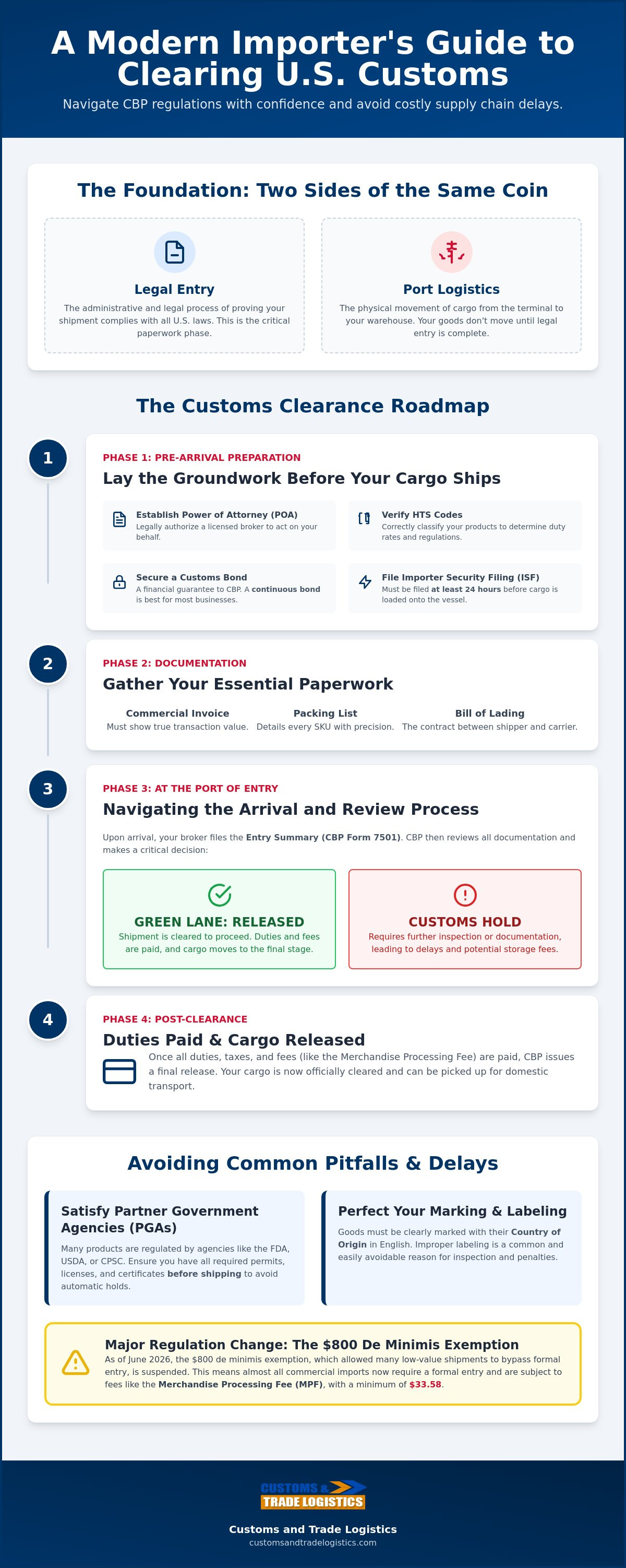
It helps to distinguish between two terms that often get lumped together: legal entry and port logistics. Clearing customs is the administrative and legal act of proving your shipment complies with U.S. laws. Port logistics, on the other hand, is the physical movement of that cargo from the terminal to your warehouse. You might have a truck ready and waiting—perhaps one recently serviced by Tim Halpin Equipment Corp to ensure reliability—but if the legal paperwork isn't perfect, that cargo isn't going anywhere. The cornerstone of this legal process is the customs declaration. Specifically, the Entry Summary (CBP Form 7501) serves as the foundational document that records the value, classification, and origin of your goods.
The Legal Framework: Why Compliance Matters
Modern trade is governed by the Tariff Act, which establishes a high bar for importers. CBP operates under a "Reasonable Care" standard. This means the government expects you to take proactive steps to ensure your filings are accurate. Relying on "I didn't know" isn't a valid defense. If your documentation is found lacking, the consequences go beyond simple delays. You could face seized cargo or liquidated damages, which are significant financial penalties designed to enforce strict compliance. We've seen how a small oversight in classification can lead to a long-term audit, so getting the foundation right is your best insurance policy.
Commercial vs. Personal Shipments
The rules for small business owners changed significantly in June 2026. Previously, many low-value shipments fell under the $800 de minimis exemption, allowing them to bypass formal entry. With that exemption currently suspended, almost all imports now require more rigorous documentation and are subject to fees like the Merchandise Processing Fee (MPF), which now has a minimum of $33.58 for formal entries. This shift means you must treat every shipment as a commercial entry, regardless of its size. Navigating these new hurdles is much simpler when you work with a customs clearance agent usa. They act as your advocate, ensuring that your business meets every 2026 requirement while you focus on serving your customers.
Pre-Arrival Checklist: What to Prepare Before Your Cargo Ships
Success in clearing customs at us ports begins long before your goods reach the water. It's about a methodical order of operations that transforms a complex process into a manageable routine. First, you must establish a Power of Attorney (POA) with a licensed broker. This legal document gives your "safe pair of hands" the authority to act on your behalf. Next, you need to verify your Harmonized Tariff Schedule (HTS) codes. These ten-digit numbers are the DNA of your shipment. They determine your duty rates and whether your goods are subject to specific agency regulations. Getting these wrong can lead to overpayment or, worse, a compliance audit.
You'll also need to secure a customs bond. Think of this as a financial guarantee to the U.S. government that all duties and fees will be paid. For most growing businesses, a continuous bond is the most cost-effective choice. It covers all your entries for a full year across any port. If you only plan to import once or twice, a single entry bond might suffice. However, single entry bonds often lead to more paperwork and higher costs over time. We've found that a continuous bond provides the peace of mind needed to scale without logistical interruptions.
Essential Documentation for Every Shipment
Accurate paperwork is your best defense against unexpected inspections. The commercial invoice must reflect the true transaction value. CBP is quick to flag values that seem suspiciously low, which can trigger a seizure. Your packing list should detail every SKU with precision. If a port officer opens a container, they should find exactly what's on the page. Finally, the Bill of Lading (BOL) acts as your title to the goods. These documents are the heart of the official guide for commercial importers, and getting them right saves you from the frustration of preventable delays.
The Critical ISF Timeline
For ocean freight, the Importer Security Filing (ISF), often called the "10+2" rule, is non-negotiable. You must file this data at least 24 hours before the vessel is loaded at the foreign port. If you miss this window, CBP can issue a $5,000 penalty per violation. We recommend coordinating with your foreign supplier at least a week before the scheduled departure to ensure you have the necessary data. This proactive approach is a cornerstone of our customs clearance services, where we help you manage these timelines so you can focus on your business while your cargo is in transit. Clearing customs at us ports is much smoother when you've already won the battle of preparation.
The Step-by-Step Process of Clearing Customs at the Port
Once your vessel docks, the pace of clearing customs at us ports accelerates significantly. How does your cargo actually move from the ship's hold to your warehouse? It's a choreographed sequence of five key steps. First, you'll receive an arrival notification from your carrier or freight forwarder. This signal tells your broker it's time to file CBP Form 3461. Think of this as a request for immediate delivery. It provides the essential data CBP needs to decide if they want to inspect your goods or let them pass. If the system gives the green light, your cargo can move off the pier almost immediately.
The process doesn't end when the truck leaves the terminal. Within ten working days of the initial release, your broker files the Entry Summary (CBP Form 7501). This document finalizes the duty, tax, and fee calculations. It's the official record of your import. Finally, the process concludes with "liquidation." This usually happens 314 days after entry. It serves as the government's final seal of approval on the transaction, meaning the entry is closed and the duties paid are considered final.
Duty Payments and Tax Calculations
Calculating what you owe involves more than just a single percentage. Duties are determined by your HTS code and the country of origin, but there are additional fees to consider. Most ocean shipments are subject to the Harbor Maintenance Fee (HMF) at 0.125% of the cargo value. You'll also pay the Merchandise Processing Fee (MPF). As of October 1, 2025, the minimum MPF for formal entries is $33.58, while the maximum cap is $651.50. Utilizing professional us customs entry services is the most reliable way to ensure these figures are accurate, preventing the headache of overpayments or late-payment penalties.
The Release Process: When Can You Take Your Goods?
Getting a "Customs Release" is a major milestone, but it's not the final one. You also need a "Carrier Release." This happens only after the ocean carrier or airline confirms that freight charges are paid and the original Bill of Lading is surrendered. If a Partner Government Agency (PGA) like the FDA is involved, you might receive a "Conditional Release." This means you can move the goods to your facility, but you cannot open or sell them until that specific agency gives its final approval. Once both keys are turned, your "last mile" delivery partner can finally whisk your cargo away. Clearing customs at us ports is a team effort, and coordinating these final steps is what keeps your supply chain moving.
Avoiding the "Customs Hold": A Checklist for Compliance
While the process of clearing customs at us ports follows a set rhythm, a "Customs Hold" can disrupt your entire business plan in an instant. Many importers believe inspections are purely random, but most delays are actually predictable and preventable. Success in 2026 requires a proactive approach to compliance that looks beyond just the paperwork. You must first identify if your goods fall under the jurisdiction of a Partner Government Agency (PGA). Whether it's the FDA for food and cosmetics, the EPA for engines, or the FCC for electronics, these agencies have their own set of rules that CBP is required to enforce at the border.
Every individual product unit in your shipment must have a clear, permanent country-of-origin marking. A simple "Made in China" or "Product of Vietnam" tag is a legal necessity, not a suggestion. Additionally, you should audit your HTS classifications every season. The 2026 updates may have shifted the duty rates or requirements for your specific goods, especially with the increased scrutiny following the June 2026 suspension of the $800 de minimis threshold. Finally, build the habit of maintaining a "Compliance Folder" for every shipment. U.S. law requires you to keep these records for at least five years, and having them organized is your best defense during a post-entry audit.
Common Triggers for Port Inspections
Why does some cargo get flagged while others sail through? Discrepancies between your packing list and commercial invoice are a primary trigger. If the weights or piece counts don't match exactly, CBP systems will likely flag the entry for review. Vague product descriptions are another common trap. Using terms like "Gift," "Samples," or "Machine Parts" instead of specific technical names invites a physical inspection. If you are a new importer, your first few shipments will often carry a "First-Time" flag. This is a standard procedure where CBP verifies that your business is a legitimate and compliant actor in global trade.
Strategies for Reducing Customs Clearance Delays
The most effective way to keep your cargo moving is to implement a pre-clearance strategy. In many cases, your broker can file your entry data while the ship is still days away from the coast. This allows CBP to review your documents and issue a release before the container even touches the pier. If your cargo is selected for an Intensive Exam, such as a VACIS (X-ray) or a CET (physical exam), don't panic. These are routine parts of border security. Having a seasoned partner helps you manage the transfer to a Centralized Examination Station (CES) efficiently. For more detailed tips on staying ahead of the curve, read our full guide on reducing customs clearance delays.
Clearance doesn't have to be a source of anxiety for your business. If you want a dedicated advocate to oversee your compliance and protect your bottom line, explore our customs clearance services today. Clearing customs at us ports is much simpler when you have a safe pair of hands guiding every step of the journey.
The Value of a Seasoned Partner in Port Logistics
The logistics of clearing customs at us ports is a high-stakes environment where experience is the only true currency. While software can automate a form, it can't replicate the intuition gained from 35 years of managing complex entries. This depth of expertise acts as your best insurance policy against the unpredictable. Whether it's a sudden port strike, a new regulatory shift in 2026, or a localized delay at a specific terminal, a seasoned partner knows which levers to pull to keep your cargo moving. We view ourselves as a stabilizing force, lifting the administrative weight off your shoulders so you can focus on your brand's growth.
There's a significant benefit to choosing a family-owned consultancy over a massive, faceless corporation. In our world, you're a partner with a name and a specific business goal; you aren't just a tracking number in a database. This personal investment means we're looking at your "End-to-End" chain with a protective eye. We don't just wait for the ship to dock. We look back at the foreign factory's documentation and forward to the final U.S. destination. Professional consulting also saves you money by identifying duty-saving opportunities, such as tariff engineering or duty drawback programs, that automated systems often overlook. We're here to ensure your landed costs remain as low as possible.
Why Small Businesses Need a Dedicated Broker
Small and medium-sized businesses face unique hurdles, especially when managing high-volume imports for Amazon FBA or e-commerce platforms. These platforms have strict delivery windows, and a single customs delay can lead to stockouts and lost rankings. We specialize in handling the "unseen" paperwork that prevents expensive demurrage and detention fees from eating your margins. If you're importing from China, the complexity of trade relations and specific tariffs requires a "safe pair of hands" to ensure every entry is compliant and cost-effective. We act as your dedicated advocate, bridging the gap between your small-scale operations and the global marketplace.
Your Next Steps for a Seamless Import
Success in international trade isn't about reacting to problems; it's about preventing them. Your first step should be a thorough review of your current logistics chain to identify hidden compliance gaps. Are your HTS codes truly up to date for the 2026 fiscal year? Is your customs bond sufficient for your projected growth? We recommend an initial consultation before you place your next big order. This allows us to set the foundation for a delay-free entry process from day one. For a deeper look at the regulatory environment, explore our customs clearance services us pillar. Clearing customs at us ports doesn't have to be a source of anxiety when you have a veteran mentor by your side.
Take Control of Your 2026 Import Strategy
Success in international trade isn't defined by the size of your shipment, but by the strength of your preparation. We've explored how a clear understanding of legal entry, a rigorous pre-arrival checklist, and a proactive compliance strategy can transform your operations. By mastering the step-by-step process of clearing customs at us ports, you can eliminate the fear of seized cargo and the drain of unexpected storage fees. You've worked hard to build your brand; your logistics should be an engine for that growth, not a roadblock.
As a family-owned partner with over 35 years of industry experience, we understand the unique pressures facing small and medium-sized businesses today. Whether you're managing high-volume Amazon FBA inventory or navigating complex imports from China, we provide the national coverage and local expertise you need to stay compliant. Our goal is to act as your dedicated advocate, ensuring every entry is handled with protective care and professional oversight. Don't leave your next shipment to chance. Get a Professional Customs Consultation for Your Next Shipment and experience the relief of a truly seamless supply chain. We're ready to help you move forward with confidence.
Frequently Asked Questions
How long does it typically take to clear customs at a US port?
Standard clearance typically takes 24 to 48 hours after the vessel arrives, provided your documentation is complete and accurate. If you utilize pre-clearance strategies, your cargo can often be released before the ship even docks. However, physical inspections or document discrepancies can extend this timeline to several days or even weeks. Having a proactive partner helps you navigate these variables to keep your supply chain moving predictably.
Can I clear customs myself without a broker?
You are legally allowed to clear your own customs entries, but most businesses find the process prohibitively complex. Commercial importers must have a deep understanding of the Harmonized Tariff Schedule and maintain a secure connection to CBP's electronic filing systems. Most small businesses prefer to use a licensed broker to avoid the risk of costly classification errors or missed filing deadlines that frequently lead to heavy government fines.
What is the difference between a customs hold and a carrier hold?
A customs hold is a government action, while a carrier hold is a private matter between you and the transportation company. CBP issues holds for security screenings, intensive exams, or regulatory compliance checks. Carrier holds usually happen because of unpaid freight invoices or a missing original Bill of Lading. You must resolve both types of holds before your cargo can leave the terminal and begin its final delivery.
What are the most common documents required for clearing customs at US ports?
The essential documents for clearing customs at us ports include the commercial invoice, the packing list, and the Bill of Lading. Depending on the nature of your goods, you might also need a Certificate of Origin or specific permits from agencies like the FDA or EPA. Ensuring these documents are accurate and consistent is the most effective way to prevent your shipment from being flagged for a time-consuming inspection.
How much are customs brokerage fees for a standard commercial entry?
Brokerage fees depend on the complexity of your shipment and the number of specific line items being filed. Factors like Partner Government Agency (PGA) requirements or the need for a single entry bond will influence the total cost of the service. Instead of looking for the lowest price, focus on finding a partner who offers comprehensive oversight to prevent expensive port storage fees and long-term compliance penalties.
What happens if my shipment is inspected by CBP?
If CBP selects your shipment for inspection, it will be moved to a Centralized Examination Station (CES). You will be responsible for the costs of drayage to the facility and the labor fees associated with the exam itself. These inspections can range from a non-intrusive X-ray (VACIS) to a full physical exam where officers open and inspect every individual carton to verify the contents match your filing.
Do I need a different broker for different US ports?
You don't need a different broker for every city because a licensed professional with a national permit can handle entries at any port in the country. This centralized approach simplifies your communication and ensures a consistent compliance strategy across your entire supply chain. Whether your goods arrive in Los Angeles, Savannah, or a land border, a single partner can manage the entire process for you with total oversight.
What is an ISF filing and when must it be done?
An ISF filing, or Importer Security Filing, is a mandatory electronic document for all ocean freight entering the country. It's often called the "10+2" rule because it requires ten data elements from the importer and two from the carrier. You must submit this filing at least 24 hours before your goods are loaded onto the vessel at the foreign port to avoid a $5,000 penalty when clearing customs at us ports.


