
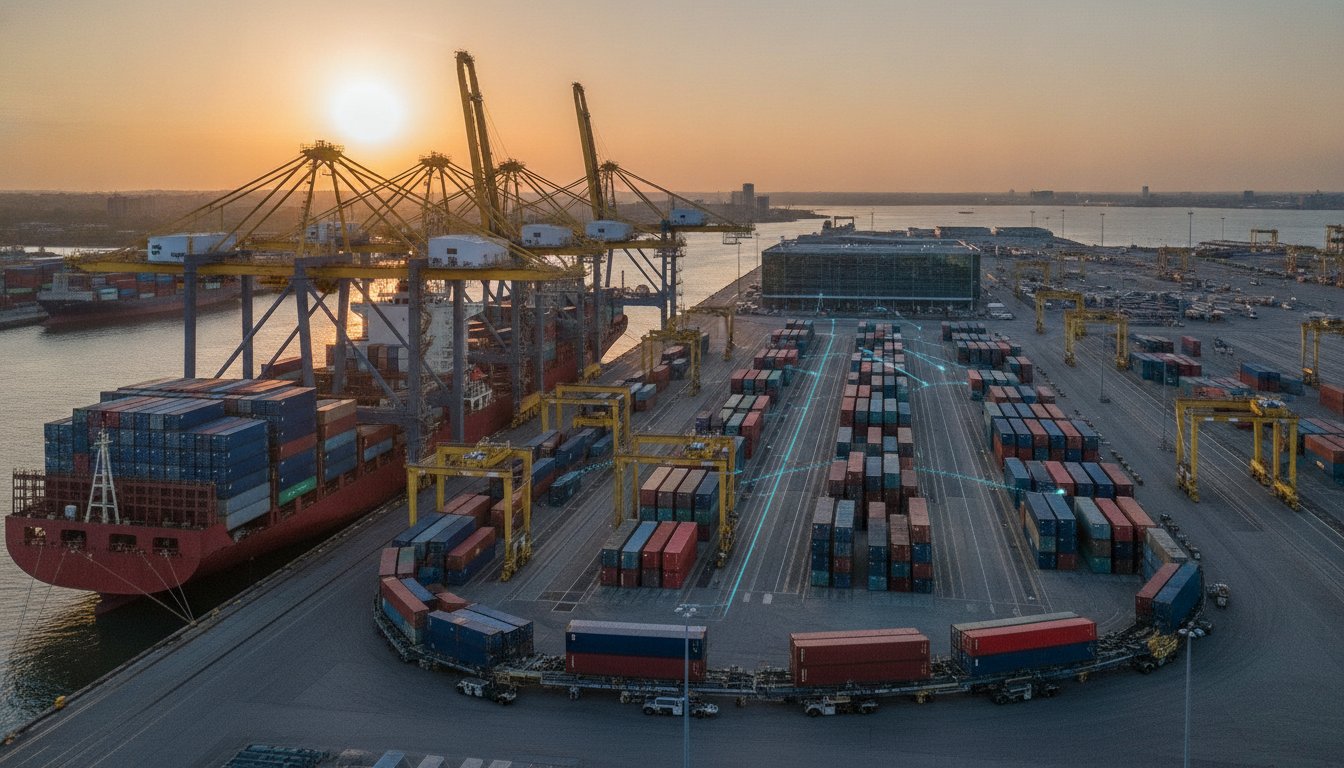
Under the new June 2026 Executive Order, U.S. Customs now treats international trade as a privilege rather than a right. This shift means that even a minor paperwork error can trigger an immediate seizure or a costly port hold. If you've ever dealt with mounting storage fees or the stress of out-of-stock alerts, you know that reducing customs clearance delays is the only way to protect your bottom line. It's exhausting to manage these complex requirements alone, especially when your business growth depends on a predictable supply chain.
We're here to help you turn that anxiety into a clear, actionable plan. You'll learn the exact administrative and logistical steps needed to prevent holds and keep your goods moving toward your customers. We'll preview the new 2026 Importer of Record eligibility rules and show you how to align your foreign documentation with U.S. standards. By the end of this guide, you'll have the tools to ensure zero compliance penalties and regain total control over your delivery timelines.
Key Takeaways
- Understand how the 2026 shift toward "Informed Compliance" and electronic risk-profiling impacts your shipment's priority at the port.
- Learn how to structure Commercial Invoices and Packing Lists with the granular detail required to satisfy modern CBP inspection standards.
- Master the nuances of the Harmonized Tariff Schedule (HTS) to ensure accurate valuation, which is a critical step in reducing customs clearance delays and avoiding penalties.
- Discover the "Pre-Clearance" advantage of filing entries before your vessel arrives to keep your supply chain moving without a hitch.
- Identify why a seasoned, family-run brokerage offers the protective oversight and accountability needed to navigate today’s complex trade landscape.
Common Triggers for Customs Delays in 2026
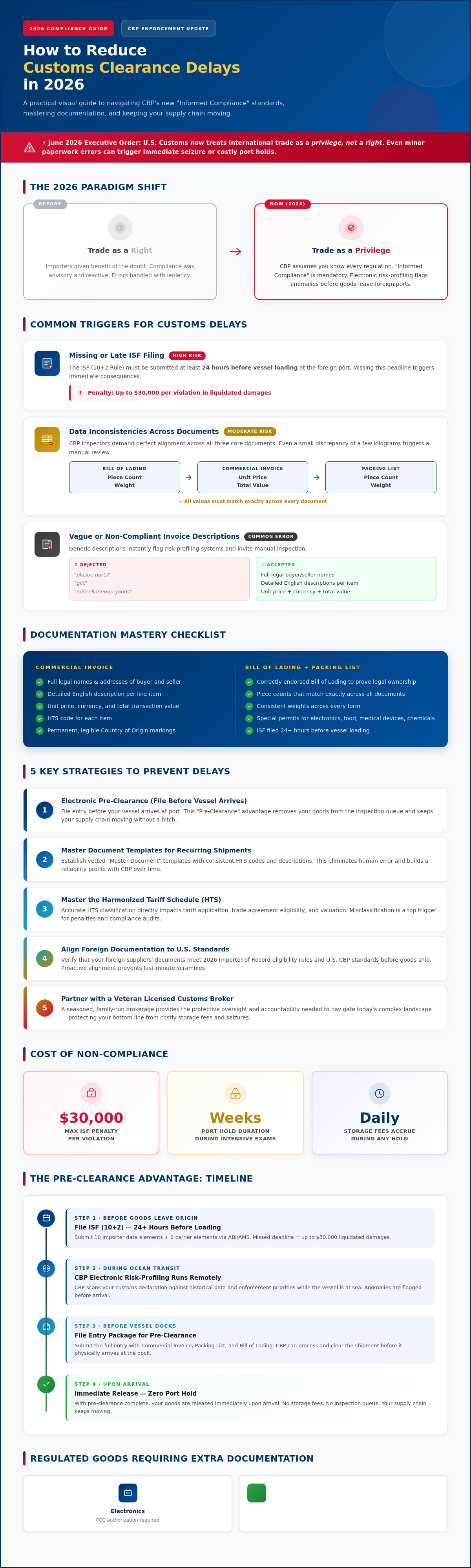
Customs delays rarely happen by accident. In 2026, they're usually the result of precise, data-driven interventions by U.S. Customs and Border Protection (CBP). Following the June 3, 2026 Executive Order on Strengthening Customs Enforcement, the agency has shifted its stance significantly. They now view importation as a privilege rather than a right. This means CBP expects "Informed Compliance," assuming you already know every regulation governing your goods. When you take this proactive approach, reducing customs clearance delays becomes a matter of administrative precision rather than luck.
CBP uses sophisticated electronic risk-profiling to scan shipments before they even leave the foreign port. Their systems look for anomalies in your customs declaration and flag anything that doesn't match historical data or current enforcement priorities. If a shipment is flagged, it isn't just a routine check. It's a compliance-driven hold that can lead to intensive exams and weeks of storage fees. Understanding these triggers is the first step toward securing your supply chain.
The Impact of Missing or Late ISF Filings
For ocean freight, the Importer Security Filing (ISF), often called the 10+2 rule, is your first major hurdle. You must submit this data at least 24 hours before the vessel is loaded at the foreign port. It's a non-negotiable deadline. If you miss it, you're not just looking at a delay. You're facing liquidated damages that can reach up to $30,000 per violation. We've seen how these fines can devastate a small business's margins. Early filing is your best defense against these avoidable costs.
Data Inconsistencies Across Shipping Documents
CBP inspectors have a keen eye for "data hygiene." They look for perfect alignment between your Bill of Lading, Commercial Invoice, and Packing List. Do the piece counts match exactly? Is the weight consistent across every form? Even a small discrepancy of a few kilograms can trigger a manual review. These mismatches suggest a lack of oversight, which prompts the system to dig deeper into your cargo. Maintaining a clean digital supply chain ensures that your paperwork supports movement instead of causing a standstill at the port.
Mastering Documentation: The Foundation of Smooth Clearance
Think of your shipping documents as a detailed roadmap for U.S. Customs. If the map is blurry or missing key landmarks, the inspector will stop the vehicle. Mastering your paperwork is the single most effective strategy for reducing customs clearance delays. While many importers view the Commercial Invoice as just a price list, CBP sees it as a legal declaration of value and intent. Under the June 2026 Executive Order, the burden of proof for transparency has increased significantly. When you focus on administrative precision, reducing customs clearance delays becomes a predictable outcome rather than a lucky break.
Establishing a "Master Document" template for your recurring shipments is a wise move. It ensures that every shipment uses the same vetted descriptions and HTS codes, leaving no room for human error during the data entry phase. This consistency builds a profile of reliability with the agency over time. You should also verify that your Country of Origin markings are permanent and legible. These are frequently audited because they directly impact trade agreement eligibility and tariff applications. If you're feeling overwhelmed by the paperwork trail, our customs clearance services can provide the seasoned oversight needed to keep your files audit-ready.
The Bill of Lading serves a different but equally vital purpose in your folder. It acts as the contract of carriage and the primary document of title. Without a correctly endorsed Bill of Lading, you can't prove legal ownership, which can lead to indefinite holds at the terminal while storage fees mount. Following official CBP Tips for Importers ensures that these foundational documents meet the strict standards required for immediate entry.
Essential Elements of a US-Compliant Commercial Invoice
A compliant invoice must include the full legal names and addresses of both the buyer and the seller. Vague descriptions like "plastic parts" or "gift" are no longer sufficient for modern risk-profiling. You must provide detailed English descriptions of every item, along with a clear breakdown of the unit price, the currency used, and the total transaction value. This level of detail satisfies the electronic risk-profiling systems and prevents manual flags.
Managing Special Documentation for Regulated Goods
Certain products require more than just standard paperwork to cross the border. If you are importing electronics, food, medical devices, or chemicals, you'll likely need additional filings for the FDA, EPA, or DOT. You must also maintain valid certificates of origin to claim benefits under specific trade agreements like the USMCA. The Entry Summary (CBP Form 7501) serves as the final record of the transaction and the official document used to calculate duties.
Accurate Product Classification and Valuation Strategies
Assigning the correct code to your product is more than just a clerical task; it's a legal declaration. The Harmonized Tariff Schedule (HTS) is the universal language of global trade, but many importers make the mistake of stopping at the first six digits. While those initial numbers are standardized internationally, the full 10-digit code is specific to the United States. Getting this right is a cornerstone of reducing customs clearance delays. If you provide an incorrect code, you risk duty underpayment. CBP doesn't view these as simple typos. They see them as compliance failures that can lead to heavy penalties and increased scrutiny on all your future shipments.
Valuation is the second pillar of a smooth entry. You must ensure your "Transaction Value" is defensible and reflects the price actually paid or payable for the goods. A common trap for newer businesses is the use of "Free Samples" or "Gifts" within commercial shipments. CBP requires a fair market value for every item, even if you didn't pay for it. Declaring a value of zero is a guaranteed way to trigger a manual review. Following official CBP Tips for New Importers helps you understand that classification and valuation are your responsibility, not your supplier's.
How to Determine the Correct HTS Code
Don't rely solely on your foreign supplier's classification. Their local codes often differ from U.S. requirements. Instead, use the Customs Rulings Online Search System (CROSS) database to find existing rulings for similar products. If your product is innovative or doesn't fit a standard category, you can request a formal binding ruling from CBP. This provides a "safe harbor" that prevents agents from questioning your classification at the port, effectively reducing customs clearance delays for the life of that product line.
Valuation and Duty Management
When calculating your "Dutiable Value," you can typically exclude international freight and insurance costs, provided they are separately stated. However, you must include "assists," such as molds or tools you provided to the manufacturer, as well as royalties and certain commissions. For those importing from China, managing Section 301 tariffs is essential. These additional duties can be significant, so verifying if your product qualifies for any active exclusions is a vital step in your financial planning. Accurate valuation ensures you pay exactly what is owed, no more and no less.
Proactive Logistics Management and Communication
While your paperwork is the foundation, your logistics strategy is the engine that keeps your goods moving. One of the most powerful tools in your arsenal is the "Pre-Clearance" advantage. By filing your entry before the vessel even docks at a U.S. port, you're essentially placing your shipment in the fast lane. This proactive step is crucial for reducing customs clearance delays because it allows CBP to review and release your cargo while it's still at sea. If there's a flag or a request for more data, you have a head start to resolve it before the container hits the terminal floor.
Your broker serves as a protective buffer in this process. They don't just file forms; they monitor every status change and act as your primary advocate. We recommend maintaining a transparent line of communication so your partner can anticipate issues before they escalate. If you're looking for a team to handle the heavy lifting, our international freight logistics team can manage the entire journey from the factory gate to your warehouse.
The Role of Real-Time Communication
It's vital to stay alert for status changes. Sometimes, CBP issues a Form 28, which is a formal "Request for Information." You typically have a 30-day window to respond. If you miss this deadline, your shipment could be stuck indefinitely, or worse, your future imports could face increased scrutiny. A veteran broker ensures you respond with the exact data CBP needs, protecting your reputation with the agency. Setting up automated alerts for status changes keeps you informed without having to manually check tracking numbers every hour.
Logistics Coordination for E-commerce
Amazon FBA sellers face a unique set of challenges. Managing the transition from a congested port to an FBA warehouse requires precision. If your container sits too long, you'll face "demurrage" fees, which are daily charges for container use. You might also encounter "chassis split" fees if the trucking equipment isn't ready. A partner who offers specialized redistribution support can help you avoid these "hidden" costs. By coordinating the "last mile" and managing delivery redistribution, you ensure your inventory stays in stock without the sting of unexpected port fees.
Partnering with a Veteran Broker for Seamless Importation
Digital platforms often promise speed through automation, but they frequently lack the human advocacy required when a shipment is actually flagged. A software algorithm won't pick up the phone to discuss a nuanced classification point with a CBP officer. This is where the value of a family-owned firm becomes clear. We provide a level of accountability and personal investment that massive, digital-only portals simply can't match. By acting as a "Safe Pair of Hands" with 35 years of navigating U.S. Customs, we focus on reducing customs clearance delays through veteran oversight and direct communication.
Our role as your partner goes beyond just filing the next entry. We act as a consultant who looks for ways to improve your bottom line. This includes auditing your past entries for refund opportunities. For instance, with the ongoing IEEPA refund process and evolving Section 301 exclusions, you might be entitled to recover duties paid on previous shipments. This type of expert administrative relief ensures your business isn't just surviving the complexities of international trade but is actually thriving within them. When you have a dedicated advocate, reducing customs clearance delays becomes a byproduct of a well-managed, compliant supply chain.
The Advantage of Personalized Customs Brokerage
Small and medium-sized businesses often feel lost in the shuffle of large-scale logistics providers. We offer tailored solutions that respect the unique needs of your specific product lines. You get direct access to senior consultants who understand the history of your imports and the specific regulations governing them. This personal connection means we handle the heavy administrative burden, allowing you to focus your energy on scaling your business and serving your customers.
End-to-End Logistics Integration
Success in global trade requires a seamless flow from the foreign supplier to the final customer. We provide a single point of contact for all U.S. ports, coordinating everything from foreign factory pickups to final delivery redistribution. Whether you're navigating the busy terminals of Los Angeles or the smaller inland ports, our integrated approach ensures your goods never sit idle. If you're ready to replace logistical anxiety with professional assurance, let Customs and Trade Logistics manage your next shipment. We'll provide the steady, methodical oversight your business deserves.
Secure Your Supply Chain for the Future
Your business deserves a supply chain that moves without friction or fear of unexpected port holds. We've explored how administrative precision, accurate HTS classification, and proactive logistics management are the essential pillars of reducing customs clearance delays. By implementing these strategies, you replace uncertainty with a predictable timeline that keeps your inventory in stock and your customers happy.
As a family-owned and operated firm with over 35 years of industry experience, we specialize in the nuances of China-to-US import logistics. We act as your dedicated mentor, demystifying complex regulations and providing the "safe pair of hands" your operations require. You don't have to manage these evolving compliance standards alone. We're here to lift the heavy administrative burden from your shoulders so you can focus on what you do best: growing your business.
Ready to experience total peace of mind with your next shipment? Request a Consultation with Our Customs Experts today. Let's work together to build a reliable, compliant, and thriving international operation.
Frequently Asked Questions
How long does a typical customs delay last at US ports?
Customs delays generally last between 24 and 72 hours for routine documentation reviews. However, if your cargo is selected for an intensive physical examination, the timeline can stretch to several weeks. These extended holds often occur when electronic risk-profiling flags inconsistencies in your paperwork. Reducing customs clearance delays requires ensuring that your data is submitted correctly well before the vessel arrives to minimize these windows.
Can I clear customs myself as a small business owner?
While you technically can clear customs yourself, most small business owners find the process overwhelming and legally risky. You'd need to navigate complex federal regulations and secure a customs bond on your own. Most importers prefer partnering with a veteran broker who acts as a protective advocate, handling the technical filings so the business owner can focus on sales and growth.
What is an ISF filing and why is it causing my delays?
ISF stands for Importer Security Filing, also known as the 10+2 rule. It's a mandatory electronic submission for ocean freight that must be completed 24 hours before the goods are loaded onto the vessel at the foreign port. If this filing is late or missing, CBP will likely issue a "no load" order or hold the shipment upon arrival, often accompanied by a $5,000 fine per violation.
How much are the penalties for incorrect HTS classification?
Penalties for incorrect HTS classification can be severe and often depend on the level of negligence. Under the June 2026 guidelines, repeat offenders may lose all eligibility for penalty mitigation. CBP can charge fines based on the value of the goods or the amount of duty lost. Accurate classification is a vital step in reducing customs clearance delays and protecting your business from these mounting financial hits.
What happens if my shipment is selected for a CBP exam?
If selected for an exam, your container is moved to a Centralized Examination Station (CES) for inspection. You are responsible for the costs of transporting the container and the labor fees associated with the exam itself. While these inspections are sometimes random, they're often triggered by data mismatches. Having a broker manage the communication during this stage provides much-needed relief and oversight while the process unfolds.
How can a customs broker help me reduce my import duties?
A customs broker helps you identify legal ways to lower your costs through HTS optimization and trade agreement benefits. They can determine if your products qualify for duty-free status or if you're eligible for duty drawback refunds on previously paid tariffs. Their expertise ensures you pay the lowest legal amount while staying fully compliant with U.S. trade laws and protecting your profit margins.
Do I need a different broker for every US port I use?
No, you don't need a different broker for every port. A broker with a national permit can clear your goods at any U.S. port of entry through the Automated Commercial Environment (ACE) system. This provides you with a single point of contact and consistent service, regardless of whether your shipment arrives in Los Angeles, Savannah, or an inland terminal. It simplifies your administrative burden significantly.
What is the most common paperwork mistake for China imports?
The most frequent mistake is using vague product descriptions on the Commercial Invoice. Terms like "gift," "daily necessities," or "electronics" are too broad and will likely trigger a manual review. You must provide clear, English descriptions that explain exactly what the item is and what it's made of to satisfy the electronic screening systems and avoid the stress of unnecessary port holds.


