

What if the $800 "free pass" your business once relied on for small shipments vanished entirely? Since the suspension of the de minimis exemption, every commercial package entering the country now requires a formal entry and a 10-digit HTS code. It's completely normal to feel overwhelmed by the mountain of government paperwork and the looming threat of CBP Form 3461 errors. You want your goods to move through the port without friction, but the June 2026 Executive Order on "Strengthening Customs Enforcement" has made the process more rigorous than ever.
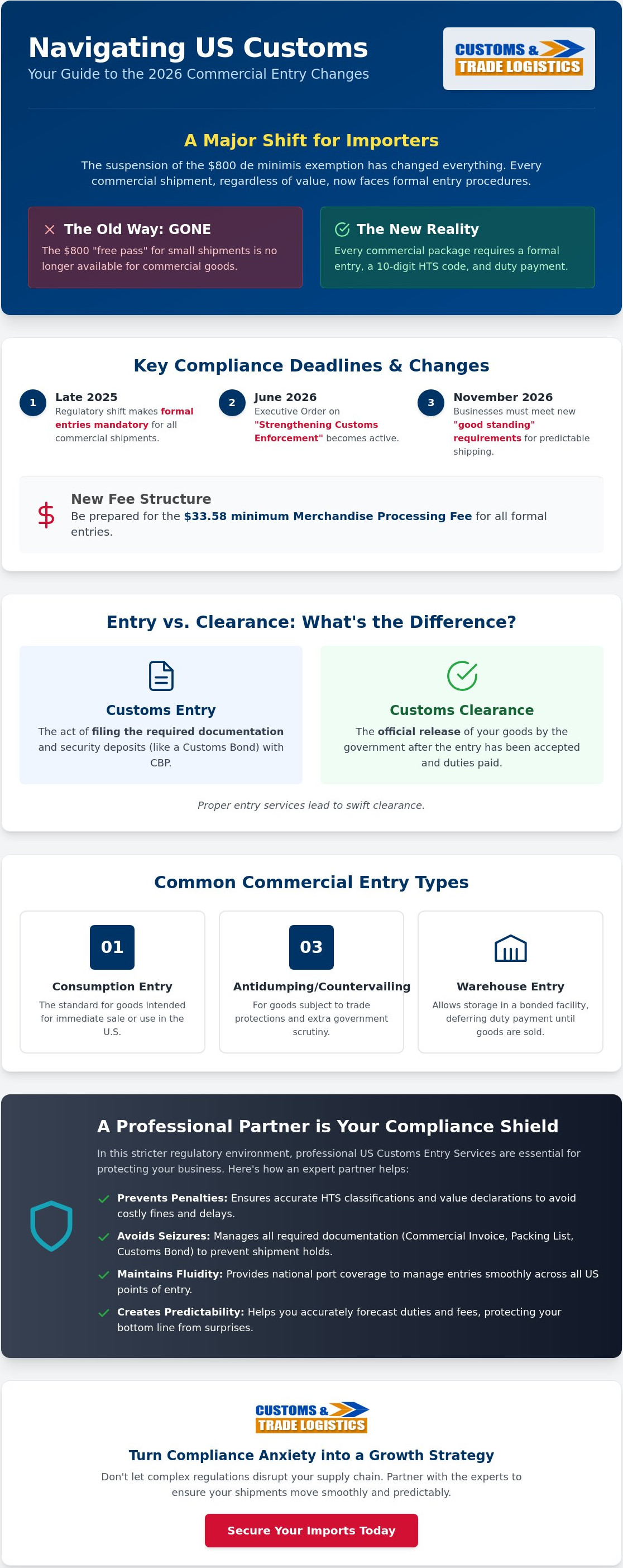
We're here to help you turn that anxiety into a steady strategy for growth. This guide will help you master the nuances of commercial compliance and demonstrate how professional us customs entry services act as a protective shield for your bottom line. You'll learn exactly how to handle the latest 2026 fee adjustments, including the $33.58 minimum Merchandise Processing Fee for formal entries. We'll also walk you through the essential steps to ensure your business meets the November 2026 "good standing" requirements, giving you the predictable shipping timelines and peace of mind you deserve.
Key Takeaways
- Understand the critical differences between personal and commercial entries to ensure your cargo meets the latest 2026 CBP requirements.
- Learn how professional us customs entry services act as a compliance shield, managing complex HTS classifications to prevent overpayment and penalties.
- Identify the specific details required for your Commercial Invoice and Packing List to avoid shipment seizures and administrative delays.
- Discover why choosing a partner with national port coverage is essential for maintaining a fluid supply chain across various US entry points.
- Master the distinction between formal and informal entries so you can accurately predict your duty obligations and processing fees.
What are US Customs Entry Services?
Think of us customs entry services as the vital bridge between your international supplier and the American market. While many people assume importing is simply about paying for shipping, the legal reality is much more structured. At its core, a customs entry service is the professional management of the declarations and data required by U.S. Customs and Border Protection (CBP). It's the process of ensuring that every piece of information about your cargo, from its value to its country of origin, is documented with surgical precision.
There's a significant distinction between a personal traveler entry and a commercial cargo entry. When you return from a vacation with a souvenir, you're making an informal declaration. However, for businesses, "entry" is a formal legal act. It signifies the moment your goods officially enter the U.S. commerce stream. Because the Customs authority maintains strict oversight of all commercial trade, this act requires specific forms, bonds, and duty payments that go far beyond a simple verbal statement.
In the eyes of the government, the most important figure in this process is the Importer of Record (IOR). Whether you're a small e-commerce seller or a large distributor, the IOR is the entity legally responsible for the accuracy of the entry documents. If the paperwork is wrong, the IOR faces the consequences. This is why professional oversight isn't just a convenience; it's a necessity for protecting your business's reputation and financial health, especially as enforcement becomes more aggressive in 2026.
The Legal Responsibility of the Importer
CBP operates under the principle of "Reasonable Care." This means the government expects you to take proactive steps to ensure your imports are compliant. You can't simply claim ignorance if an HTS code is incorrect or a value is understated. Expert entry services help you meet this high legal standard by verifying data before it ever reaches a port. Attempting to self-file without professional guidance often leads to costly mistakes; even a minor clerical error can trigger an audit or a shipment seizure.
Entry vs. Clearance: Understanding the Difference
It's easy to use these terms interchangeably, but they represent different stages of the journey. Entry is the act of filing the required documentation and security deposits with CBP. Clearance, on the other hand, is the official release of those goods by the government. Our us customs entry services facilitate the entry process so that clearance happens quickly and without surprise inspections. For a deeper look at the release phase, you can explore our guide on Customs Clearance Services in the US: The Complete Importer’s Guide for 2026.
Common Types of Commercial Customs Entries
Do you know which box to check when filing your declaration? While the government recognizes dozens of different entry types, most businesses only need to master a handful to keep their supply chain moving. Choosing the wrong classification isn't just a clerical error; it can lead to massive delays or unexpected bills for unpaid duties. Most commercial importers rely on the Consumption Entry (Type 01), which is the standard for goods intended for immediate sale or use within the United States. If you're bringing in a standard shipment of electronics or textiles, this is almost certainly your starting point.
However, not all goods are treated equally. If your products are subject to trade protections, you'll need an Antidumping/Countervailing Duty Entry (Type 03). These require extra scrutiny because they involve goods the government believes are being sold at unfairly low prices to harm domestic industries. For businesses looking to manage cash flow, a Warehouse Entry allows you to store goods in a bonded facility without paying duties immediately. You only pay the government when the goods are withdrawn for sale. If you're feeling overwhelmed by these choices, reaching out for expert guidance on customs filing can simplify the decision-making process and ensure you're using the most cost-effective entry type.
Formal Entry Requirements for Businesses
When does an entry become "formal"? Historically, the $2,500 threshold was the primary trigger. However, the regulatory landscape shifted significantly in late 2025. Now, all commercial shipments, regardless of value, are subject to formal entry requirements and full duty payments. The biggest hurdle in this process is the Customs Bond. This is a financial guarantee to the government that all duties and taxes will be paid. A us customs entry services provider will typically manage this bond application for you, ensuring your business stays in "good standing" with CBP. Working with a licensed customs broker is the most reliable way to secure these bonds and navigate the 2026 bonding requirements mandated by the latest Executive Order.
Informal Entry: Is it Right for Your Business?
Informal entries were once the go-to for small e-commerce shipments, but their utility has narrowed. While they still exist for certain categories with lower fees, like the $2.69 automated release fee, they're no longer a way to bypass duty payments. It's important to remember that as of August 2025, the $800 de minimis exemption was suspended for all commercial shipments. Additionally, the June 2026 Executive Order now prohibits foreign Importers of Record from filing informal entries entirely. If your business is growing, you'll likely find that professional us customs entry services become necessary to handle the transition to formal entries as your shipment volume and compliance burden increase.
The Role of a Customs Broker in Entry Filing
Who is actually standing between your cargo and a government hold? A customs broker isn't just a service provider; they are your legal advocate and expert liaison with CBP. By choosing professional us customs entry services, you're putting a shield between your business and the complexities of international trade law. They take the technical jargon found in the U.S. Customs and Border Protection's Guide for Importers and turn it into a clear, compliant path for your goods.
Effective us customs entry services rely on extreme technical precision. Your broker manages the Harmonized Tariff Schedule (HTS) classification for every item you import. This is vital because accurate classification prevents you from overpaying on duties while ensuring you're fully compliant with current trade laws. All of this data is filed electronically through the Automated Commercial Environment (ACE), the government's primary system for trade processing. To make this happen, you'll provide a Power of Attorney (POA). This legal authorization allows your broker to sign documents and file entries on your behalf, providing a seamless experience that keeps you focused on your business.
Preventing Costly Delays Through Expertise
Experience allows a broker to see what an automated system might miss. They identify "red flags" in your paperwork, such as conflicting values or vague product descriptions, before a Customs officer ever sees them. Misclassifying your goods on the HTS schedule can trigger multi-year audits that drain your company's resources and focus. Proactive management is the only way to maintain a fluid supply chain. For more tips on staying ahead of the curve, read our guide on How to Reduce Customs Clearance Delays: A Proactive Guide for US Importers.
The Advantage of a Seasoned Partner
In an era of digital-only platforms, there is immense value in a seasoned partner. We bring over 35 years of experience to the table, offering a "safe pair of hands" that understands the specific nuances of different U.S. ports. This long-standing expertise replaces the anxiety of the unknown with a sense of security. As a family-oriented firm, we provide a level of dedicated advocacy that a software algorithm simply can't replicate. We treat your shipments with the same protective care we would our own, acting as a knowledgeable bridge to the global marketplace.
Essential Documentation for US Customs Entry
Paperwork is the heartbeat of international trade. If your documents are flawed, your cargo simply stops moving. While the digital systems used by us customs entry services have made filing faster, the quality of the data you provide remains your responsibility. Think of these documents not just as administrative hurdles, but as the evidence required to prove your shipment is safe, legal, and correctly valued. To ensure a smooth arrival, you'll need to coordinate a specific set of records before your goods reach the port.
- Step 1: The Commercial Invoice. This is far more than a simple bill. It must be in English and include the seller, buyer, a detailed description of the goods, and the country of origin.
- Step 2: The Packing List. This provides a granular breakdown of your cargo, detailing the weight, dimensions, and specific contents of every individual carton or pallet.
- Step 3: The Bill of Lading (BOL). This is your contract of carriage and serves as the official title to the goods.
- Step 4: The Arrival Notice. Issued by the carrier, this document alerts you and your broker that the shipment is nearing its destination and is ready for entry filing.
- Step 5: CBP Form 3461. Known as the "Entry/Immediate Delivery" form, this is the document our team uses to secure the initial release of your goods from Customs custody.
If you're unsure if your current paperwork meets these standards, it's a good idea to request a document review before your next shipment departs. Catching an error early is always cheaper than fixing it at the port.
Anatomy of a Perfect Commercial Invoice
Consistency is the number one rule of customs compliance. If your invoice says "plastic toys" but your packing list says "educational figurines," you're inviting a manual inspection. A perfect invoice includes the purchase price in the transaction currency and a clear, non-vague description of the items. Avoid generic terms like "samples" or "parts." These vague descriptions are common mistakes that trigger secondary exams, leading to storage fees and delivery delays. We help you audit these details to ensure they align perfectly with your HTS classifications.
Post-Entry Documentation: CBP Form 7501
The process doesn't end once your truck leaves the pier. While Form 3461 gets your goods released, CBP Form 7501 (the Entry Summary) is what finalizes the transaction. This form must be filed within 10 working days of the initial release to settle duty payments and provide final statistical data to the government. It's also vital to remember your record-keeping obligations. U.S. law requires you to maintain all entry-related files for a minimum of five years. Our us customs entry services include organized digital archiving, ensuring you're always prepared if the government requests an audit years down the road. For companies with a presence in the Middle East, CTC Tax & Accounting offers specialized bookkeeping and tax compliance to ensure your international records remain as organized as your customs data.
Choosing the Right US Customs Entry Service Partner
Choosing a partner for your us customs entry services is one of the most critical decisions you'll make for your supply chain. You aren't just hiring someone to fill out forms; you're selecting a dedicated advocate who understands the high stakes of international trade. In the complex regulatory environment of 2026, where every shipment is scrutinized, you need a partner with national coverage. Can they file at any U.S. port? If your cargo is diverted from Los Angeles to Savannah, your broker must be able to follow the shipment without missing a beat.
Transparency is another essential factor. You should never feel confused by your brokerage fees. A reliable partner provides clear, upfront information about costs, helping you avoid the hidden fee trap that often plagues automated platforms. While many digital-only services rely on ticket systems and chatbots, a true partner offers direct access to experts. You deserve to speak with a human being who knows your business goals and can provide immediate answers when a shipment is on the line.
Specialized Support for Amazon and E-commerce Sellers
E-commerce logistics come with a unique set of hurdles, particularly for those using Fulfillment by Amazon (FBA). Navigating the strict labeling and delivery requirements of Amazon's warehouses requires a specialized touch. Our us customs entry services are designed to bridge the gap between foreign factories and domestic fulfillment centers. We handle the heavy lifting of compliance so you can focus on scaling your brand. For a comprehensive look at these specific needs, see our Amazon Seller Import Help: The 2026 Guide to FBA Freight Forwarding Services. Beyond just entry filing, we facilitate the redistribution and final delivery of your goods, ensuring a seamless journey from the factory floor to the customer's doorstep.
Why Customs and Trade Logistics is Your Safe Pair of Hands
We believe that small and medium businesses deserve the same level of expertise as global corporations. With 35 years of experience as a family-owned firm, we've seen every shift in trade policy, from the early days of electronic filing to the sweeping reforms of 2026. We don't just process paperwork; we manage the entire shipping chain. Whether you need Import From China Consulting or International Freight Logistics, we act as your knowledgeable mentor. You'll have direct access to a team that values personal connection as much as technical compliance. We're here to lift the administrative burden from your shoulders, providing the security and relief you need to grow your business with confidence.
Secure Your Supply Chain for 2026 and Beyond
Are you ready to transform your importing process from a source of stress into a competitive advantage? The regulatory landscape of 2026 requires more than just submitting paperwork; it demands a proactive approach to compliance and a deep understanding of evolving CBP requirements. By prioritizing accurate HTS classification and maintaining robust record-keeping, you protect your business from the costly delays that stall growth.
Partnering with a veteran advocate for your us customs entry services provides the security of a "safe pair of hands" at every U.S. port. With over 35 years of industry experience, our family-owned team offers the personalized support and national coverage your business needs to thrive. We're here to manage the technical complexities so you can focus on what you do best: expanding your brand into new markets.
Take the first step toward predictable shipping timelines and total peace of mind. Request a Customs Entry Consultation with Our Experts today. We look forward to helping you navigate the global marketplace with confidence and ease.
Frequently Asked Questions
What is a US customs entry service?
A US customs entry service is the professional management of the declarations and data required by U.S. Customs and Border Protection to release commercial cargo. These services ensure that your goods are legally declared, duties are calculated correctly, and all regulatory standards are met. By using us customs entry services, you shift the complex administrative burden of filing from your business to a seasoned advocate who understands the law.
How much do customs entry services cost in 2026?
The cost of these services typically depends on the complexity of your shipment and the volume of entries you file each year. While there isn't a single flat rate for the industry, fees are generally based on the broker's expertise in handling formal entries, bonds, and specific commodity requirements. It's best to request a personalized quote to understand the specific costs associated with your cargo's entry and clearance needs.
Can I file my own US customs entry for a business?
Yes, an Importer of Record is legally permitted to file their own entries, but it's rarely recommended for commercial operations. The technical requirements for HTS classification and ACE electronic filing are incredibly steep and leave little room for error. Most businesses find that the risk of a multi-year audit or shipment seizure far outweighs the cost of hiring a professional partner to ensure total compliance.
What happens if my customs entry is filed incorrectly?
Filing an incorrect entry can lead to immediate shipment delays, significant financial penalties, or the total seizure of your goods. Beyond the initial fine, repeated errors can damage your "good standing" with CBP, making future imports subject to much higher levels of scrutiny. Professional us customs entry services act as a safeguard, auditing your paperwork to catch red flags before they ever reach a Customs officer.
How long does the customs entry process take?
The actual filing process is nearly instantaneous through the ACE system, but the overall timeline depends on how early you prepare. Ideally, your broker should file the entry up to five days before the vessel arrives at the port. If your documentation is complete and accurate, CBP often releases the goods within hours of arrival, allowing your cargo to move quickly to its final destination.
Do I need a customs bond for every entry?
You need a customs bond for all formal entries, which now includes the vast majority of commercial shipments following the 2025 regulatory changes. You can choose a single entry bond for one-off shipments or a continuous bond that covers all your imports for an entire year. Your service partner will help you evaluate which bond type is the most cost-effective based on your specific shipping frequency.
What is the difference between a customs broker and an entry service?
These terms are often used interchangeably, but an entry service is a specific task performed by a licensed customs broker. The entry service focuses specifically on the legal declaration and release of goods, while a broker may offer a broader range of logistics and consulting. Both roles are essential for navigating the complex web of trade laws and ensuring your business stays on the right side of the law.
Can entry services help with imports from China?
Yes, specialized entry services are vital for managing the unique challenges of importing from China, including Section 301 tariffs and Antidumping duties. A seasoned partner understands the specific documentation required for these shipments and helps you navigate the 2026 vetting requirements for foreign Importers of Record. This expertise ensures your Chinese imports move through the port without the stress of unexpected hurdles or hidden costs.


