

FCC requirements for imported electronic devices don’t mean every product needs an FCC ID. Devices covered by FCC rules must meet the applicable equipment authorization requirements before import or marketing. The route depends on the device: some require Certification and an FCC ID, while others use a Supplier’s Declaration of Conformity or qualify for an exemption.
It’s easy to assume every electronic product entering the United States needs the same approval and label. In practice, requirements depend on how the device generates radiofrequency energy and which FCC rules apply. This article explains when authorization is required, how Certification differs from a Supplier’s Declaration of Conformity, and what labeling and user-information rules mean for imported products.
You’ll also learn why a pre-certified wireless module doesn’t necessarily settle a host product’s compliance, which import conditions may apply before authorization, and how FCC restrictions on foreign-produced routers affect new equipment authorizations. Understanding these distinctions helps you identify the compliance steps to plan for before an electronic product reaches the U.S. market.
Key Takeaways
- Determine the authorization route by how a device generates radiofrequency energy; not every electronic product needs an FCC ID.
- Plan for certification of Wi-Fi and Bluetooth products before marketing them in the United States.
- Account for device labels and required compliance information alongside the authorization process.
- Understand how restrictions on foreign-produced routers may affect new equipment authorizations and import planning.
What do the FCC equipment authorization rules cover?
FCC equipment authorization applies to radio-frequency devices and certain electronics imported into the United States. The required route depends on how a device generates or uses radiofrequency energy.
Devices Covered by FCC Authorization
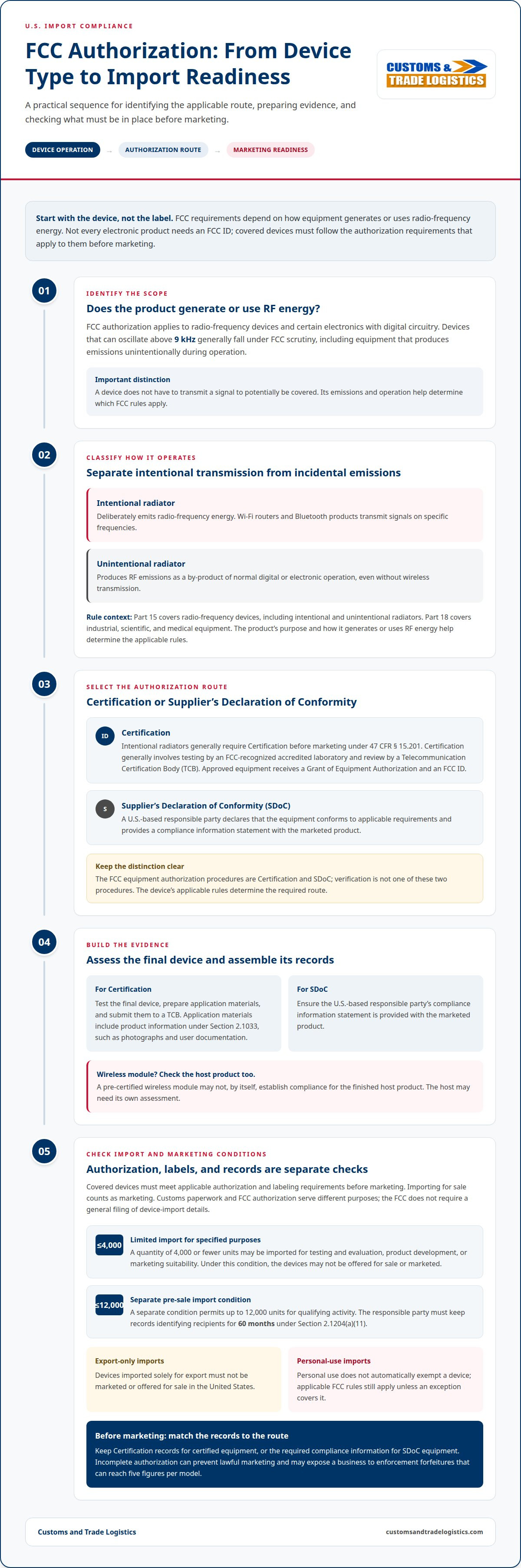
Radio-frequency devices and electronics with digital circuitry may need authorization before they are marketed or sold in the United States. Part 15 covers radiofrequency devices, including products that generate emissions unintentionally, even if they don’t transmit signals. Devices that can oscillate above 9 kHz generally fall under FCC scrutiny. Under 47 CFR § 2.803, covered devices must meet applicable authorization and labeling requirements before marketing. Importing for sale counts as marketing, and forfeitures for marketing noncompliant equipment can reach five figures per model.
There is no general requirement to file radio-frequency device import information with the FCC as of November 2, 2017. That does not remove the need for the device’s required authorization or supporting records.
Authorization Procedures
The FCC’s equipment authorization procedures are Certification and Supplier’s Declaration of Conformity (SDoC); verification is not one of these two procedures. Certification generally requires testing by an FCC-recognized accredited laboratory, followed by review through a Telecommunication Certification Body. Under SDoC, the U.S.-based responsible party declares that the equipment conforms to applicable requirements. The route matters because it determines what evidence supports the device’s authorization.
Some devices require testing to demonstrate compliance with FCC limits. A pre-certified wireless module may not, on its own, establish compliance for the host product, which may need its own assessment. For SDoC equipment, the responsible party provides a compliance information statement with the marketed product.
Exemptions for Certain Imports
Limited import conditions allow certain devices into the United States before ordinary marketing, but they don’t authorize general sale. According to the Federal Communications Commission, a radio-frequency device may be imported in a quantity of 4,000 or fewer units for testing and evaluation, product development, or marketing suitability, but it may not be offered for sale or marketed under this condition.
A separate pre-sale import condition permits up to 12,000 units for qualifying activity. According to the Federal Communications Commission, the responsible party must keep records identifying recipients for sixty (60) months under Section 2.1204(a)(11). Devices imported solely for export must not be marketed or offered for sale in the United States. Personal-use imports aren’t automatically exempt; applicable FCC rules still apply unless an exception covers the device.
Obtaining Certification and Listing Devices
FCC certification involves testing the final device, preparing its application materials, and submitting them for review by a Telecommunication Certification Body. The application includes product information under Section 2.1033, along with materials such as photographs and user documentation. If approved, the device receives a Grant of Equipment Authorization and an FCC ID. These records help establish importer proof of authorization.
Before import or sale, ensure your records match the authorization route: certification records for certified equipment, or the required compliance information for SDoC equipment. Customs paperwork and FCC authorization serve different purposes; the FCC does not require a general filing of device-import details. Missing or incomplete authorization can prevent lawful marketing and may expose a business to enforcement forfeitures.
Intentional radiators
A device that deliberately emits radio-frequency energy is an intentional radiator. Wi-Fi routers and Bluetooth products transmit signals on specific frequencies, making their wireless functions central to FCC review. FCC requirements for imported electronic devices depend partly on whether a product intentionally transmits or only produces emissions during operation. This distinction helps identify the relevant testing and authorization path before U.S. marketing.
Under 47 CFR § 15.201, intentional radiators generally require Certification before marketing. The process includes testing at a suitable laboratory and submitting an application to a Telecommunication Certification Body (TCB). The TCB reviews supporting information and test results to assess compliance with applicable FCC rules. A wireless feature can therefore affect authorization even when it forms only one part of a larger product, such as a connected appliance.
Parts 15 and 18 cover different types of radio-frequency equipment. Part 15 addresses radio-frequency devices, including intentional radiators and unintentional radiators that produce emissions through normal operation. Part 18 covers industrial, scientific, and medical equipment. The product’s purpose and how it generates or uses radio-frequency energy help determine the applicable rules. The device’s commercial or consumer audience alone does not settle that classification.
FCC limits address emissions that could cause harmful interference with wireless communications and other radio services. Intentional radiators transmit by design; unintentional radiators can produce radio-frequency energy as a by-product of digital or electronic operation. Both must meet the technical requirements for their device categories. For example, a Bluetooth product’s intentional transmissions need assessment, while digital circuitry in a product without wireless features may also need emissions evaluation. FCC requirements for imported electronic devices therefore depend on how a device operates, not just how it is described in marketing.
Keep the radio review distinct from shipment coordination: FCC authorization does not replace customs clearance, and customs paperwork does not establish FCC compliance. Import logistics planning can help coordinate shipment movement with U.S. market-entry planning.
Labeling and user-information requirements
FCC labeling connects a device’s authorization to the information provided with it. Covered products need applicable labels and user information about authorization, interference, and modifications. Depending on the applicable rule, this information may appear on the device, its packaging, its manual, or a combination of these. FCC compliance details are distinct from customs entry paperwork.
For Certification, the application includes an FCC ID label and supporting product materials. These can include photographs, the user manual, schematics, and a parts list; test results support the certification review. The FCC’s KDB Publication 784748 provides equipment-labeling guidance. Keep the label and documentation aligned with the approved device so the product identity and authorization information remain clear.
A screen-equipped device may use electronic labeling under FCC rules. Very small devices without screens may instead provide label information in the user manual. Electronic labeling may not remove every external marking requirement, so check whether the product or its packaging needs additional markings. The correct placement depends on the device format and applicable authorization requirements.
For equipment using a Supplier’s Declaration of Conformity, the responsible party must provide a compliance information statement with the product when marketed. This statement supports the declaration and accompanies the device’s user information. For multi-unit packages of pre-sale imports, Section 2.1204(11)(vii) describes an alternative bulk-enclosure procedure with records for each enclosure. Required details include the entry number, port and date of entry, Harmonized Tariff Number, total quantity, container identification, and inventory by FCC ID and device identification. These records support traceability; they are not a substitute for required device labeling.
FCC restrictions on foreign-produced routers
Foreign-produced routers within the FCC-defined category face a specific authorization restriction. On March 23, 2026, the Federal Communications Commission added those routers to its Covered List, restricting new equipment authorizations unless the Commission grants an applicable conditional approval. This affects the path to new authorization; it does not mean every router made abroad is automatically covered.
A Wi-Fi router is a radio-frequency device, like Bluetooth products and remote-control toys. Its digital functions can also generate emissions that need assessment. The FCC regulates these devices to address harmful interference with wireless communications and other radio services. The device’s function and whether it falls within the defined router category matter when determining which FCC restrictions apply.
The Covered List restriction concerns new equipment authorizations. It should be distinguished from ordinary compliance requirements for devices subject to FCC rules. Section 302(b) of the Communications Act prohibits manufacturing, importing, selling, offering for sale, or shipping devices that fail applicable regulations. Importing a router for resale counts as marketing, so a shipment plan must account for both the device’s authorization status and any restriction affecting its category.
FCC authorization and product safety testing address different risks. FCC testing evaluates radio emissions and interference; it does not establish electrical or fire safety. A consumer router may therefore require separate attention to these compliance areas. Existing FCC authorization also does not remove the Covered List restriction on new authorizations for routers within the defined category.
For an affected product, the practical sequence is to identify the exact router category, establish whether an existing authorization applies, and determine whether a new authorization is restricted or conditionally approved. Keep that regulatory review distinct from customs filing and freight arrangements. Plan router import logistics alongside the compliance timeline so shipment planning reflects the product’s authorization position.
Customs and Trade Logistics: Import From China Consulting
Customs and Trade Logistics helps businesses coordinate imports through its Import From China Consulting service. If you’re sourcing electronic devices from China, plan import logistics early so authorization requirements, shipment timing, and entry arrangements can be considered together. FCC certification and customs clearance are separate requirements, but both can affect when products are ready for the U.S. market.
Customs and Trade Logistics’ Customs Clearance Services and International Freight Logistics support the movement of goods into the United States, while Delivery and Redistribution Services help coordinate onward delivery. These services can help align shipment planning with a product’s compliance status. Contact Customs and Trade Logistics to discuss your import needs and take advantage of a free consultation.
Build compliance into your next import plan
Use the decisions around FCC requirements for imported electronic devices to shape your import plan before products are ready to ship. Align compliance planning with supplier coordination and shipment arrangements so separate responsibilities stay visible as your product moves toward the U.S. market. Treat regulatory preparation and logistics as connected parts of the plan, not last-minute tasks.
Customs and Trade Logistics supports the process through Import From China Consulting, Customs Clearance Services, and International Freight Logistics. These services help businesses coordinate sourcing, customs entry, and freight movement around their import needs. They support logistics planning, while FCC authorization remains a separate regulatory matter.
Ready to plan an upcoming import? Contact Customs and Trade Logistics to discuss the logistics support that fits your shipment. A clear plan gives you a practical starting point for moving forward with confidence.
Frequently Asked Questions
Do I need an FCC ID for every electronic product?
No. An FCC ID is associated with equipment approved through Certification, not every electronic product. Other devices may follow a Supplier’s Declaration of Conformity or qualify for an exemption under Section 15.103. A product containing digital logic can still be subject to FCC technical rules while being exempt from equipment authorization. The device’s applicable category and authorization route determine whether an FCC ID is required.
What Products Are Covered Under the FCC?
FCC rules cover devices that generate radiofrequency energy, including wireless products and electronics with digital circuitry. Examples include Wi-Fi equipment, Bluetooth devices, and some scientific, industrial, or medical equipment. Part 15 addresses radiofrequency devices, while Part 18 covers industrial, scientific, and medical equipment. FCC authorization addresses radio emissions and interference, not electrical or fire safety, which are separate considerations for imported products.
How much does FCC certification cost?
These figures concern testing and certification, not customs clearance or freight. Product design and the number of radios affect the testing route.
Is FCC Form 740 still required for imports?
No. Importers no longer have to file FCC Form 740 to bring radiofrequency devices into the United States, as of November 2, 2017. That change removed the form, not the equipment rules. A covered device still needs its applicable authorization, and imports must meet a permitted condition under Section 2.1204. Keep the authorization and import-condition records relevant to the shipment.
Need FCC Testing & Certification Help?
For import coordination around FCC testing and certification, Customs and Trade Logistics offers Import From China Consulting, Customs Clearance Services, and International Freight Logistics. These services support the shipment and customs-entry side of bringing products into the United States. FCC laboratory testing and technical approval are separate parts of the compliance process, so include them in import planning before marketing begins. A free consultation can help you discuss the logistics involved.
What FCC labeling, FCC ID, and user-manual notices are required for imported devices?
Requirements depend on the device’s authorization route and form. A certified product carries its FCC ID as required; covered equipment also needs applicable authorization, interference, and modification information. A screen-equipped device may use electronic labeling, while a very small device without a screen may provide label details in its manual. Electronic labeling may not eliminate the need for physical product or packaging information.