

When importing electronics into the US, goods valued below $800 can enter under the De Minimis rule without duty or tax, but that doesn’t remove product-specific restrictions. Devices that emit radio-frequency energy, such as cell phones and Wi-Fi routers, must meet applicable FCC testing and certification requirements before entering the country for sale.
It’s understandable to focus on the duty rate, but the landed cost can also depend on the product’s tariff classification, country of origin, and any applicable Section 301 tariffs. Getting those details right helps you anticipate clearance costs and avoid preventable delays.
This guide explains how to check restrictions, classify electronics under the U.S. tariff schedule, and estimate duties and other import costs when importing electronics into the US. You’ll also learn how customs clearance fits into the process, so you can plan each step with a clearer understanding of what your shipment requires.
Key Takeaways
- Learn what a customs broker does and how to address paperwork or entry issues when an electronics shipment hasn’t cleared.
- Understand how to assess whether Section 301 tariffs apply to covered products from China.
- See which product details shape tariff classification and how classification feeds into a duty estimate.
- Plan for clearance costs beyond duty, and understand when customs clearance and freight logistics support can help.
What Is A US Customs Broker?
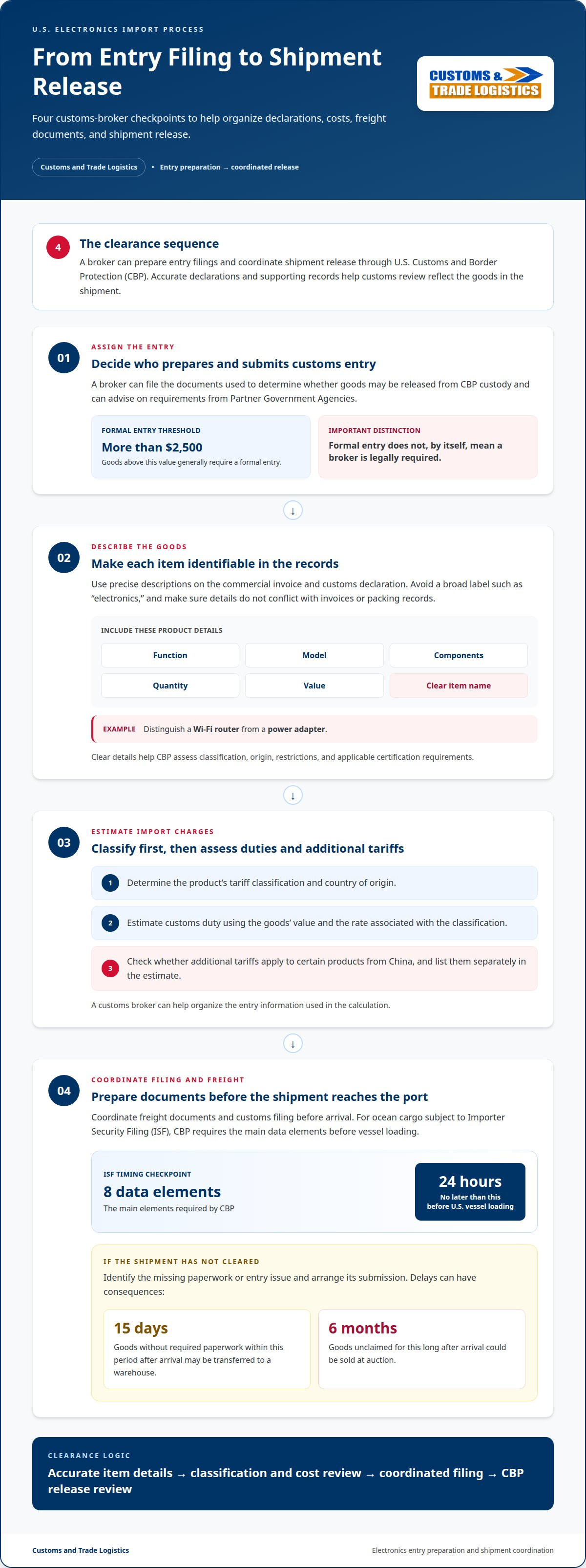
A customs broker helps importers prepare entry filings and coordinate shipment release through U.S. Customs and Border Protection (CBP). For electronics, accurate declarations and supporting records help ensure the customs review reflects the goods in the shipment.
-
Understand Broker Roles and Requirements
Start by identifying who will prepare and submit the customs entry. A broker can file the documents used to determine whether goods may be released from CBP custody and advise on requirements from Partner Government Agencies. In the United States, goods valued at more than $2,500 generally require a formal entry. A formal entry does not, by itself, mean a broker is legally required.
-
Prepare Customs Declarations and Item Descriptions
Describe each electronic item precisely on the commercial invoice and customs declaration. Include its function, model, components, quantity, and value. For example, distinguish a Wi-Fi router from a power adapter. Avoid vague labels such as “electronics” and descriptions that conflict with invoices or packing records. Clear details help CBP assess classification, origin, restrictions, and applicable certification requirements.
-
Account for Duties and Additional Tariffs
Determine the tariff classification and country of origin before estimating costs. Customs duty generally depends on the goods’ value and the rate associated with their classification. Additional tariffs may apply to certain products from China, so list them separately in your estimate. A customs broker can help organize the entry information used in the calculation.
-
Coordinate Freight Shipping and Customs Brokerage
Coordinate freight documents and customs filing before the shipment reaches the port. For ocean cargo subject to Importer Security Filing, CBP requires the main eight data elements no later than 24 hours before vessel loading for the United States. If a shipment has not cleared, identify the missing paperwork or entry issue and arrange its submission. Goods without required paperwork within 15 days of arrival may be transferred to a warehouse; goods unclaimed for six months after arrival could be sold at auction.
Section 301 tariffs on certain Chinese products
Before placing an order, identify the product, its origin, and its likely tariff treatment. That groundwork helps distinguish ordinary customs duty from additional Section 301 tariffs.
-
Identify Products Before Import
Before shipment, record each product’s function, materials, model, components, and manufacturing origin. A supplier invoice may state the shipping country, but U.S. customs authorities may consider whether processing elsewhere substantially transformed the product. A supplier’s origin statement or certificate can help, but may not settle the customs origin determination. Match product records to the specific item, not just a broad category such as “electronics.”
-
Assess Section 301 Tariffs
Determine whether the product is subject to Section 301 tariffs, which are additional duties on certain goods from China, including some electronics and components. Use the product’s classification and origin to assess applicability; don’t assume every Chinese-made electronic item receives the same treatment. The Harmonized Tariff Schedule of the United States helps establish classification and ordinary duty, while the applicable Section 301 treatment can affect the total expected duty. A broker can help organize these details for the entry.
-
Review Safety and RoHS.
Identify applicable product-safety requirements before shipping and keep supporting technical records with the product file. The Restriction of Hazardous Substances (RoHS) Directive restricts certain hazardous substances in electrical and electronic equipment. Treat RoHS documents as relevant product information, not proof that every U.S. safety requirement has been met. CBP’s release of a shipment does not establish compliance with all product-safety rules.
-
Plan for Hazard Reporting.
Keep a process for responding to safety information after import. The Consumer Product Safety Commission (CPSC) enforces requirements for certain consumer products, including electronics. Importers may have a duty to notify the CPSC when information suggests a substantial product hazard or another reporting requirement applies. A product that fails an applicable safety requirement or presents a hazard may face a recall, import restrictions, or civil penalties. For China sourcing, China import planning can help organize product and shipment details.
How Do I Determine My Tariff Classification?
Use the product’s characteristics to find its Harmonized Tariff Schedule of the United States (HTSUS) classification. That code determines the applicable duty rate and supports the customs declaration.
-
Find the HTSUS Classification
Start with the HTSUS, which U.S. customs uses to classify imported electronics and determine duties. Search by the product’s specific function and construction, rather than relying only on a supplier’s broad description. The United States International Trade Commission explains that the first six tariff-code digits are harmonized internationally, while later digits, product descriptions, and duty rates can vary by country.
-
Classify the Product
Describe the complete item before selecting a classification. Record what it does, its components, and how they work together. For example, distinguish a finished electronic device from a separate component, as they may have different tariff classifications. Keep product specifications and the commercial invoice consistent with the declared item. A code used in another country may not be the correct U.S. classification.
-
Calculate Duty and Review the Entry
Apply the duty rate associated with the HTSUS classification to the goods’ value in U.S. dollars, then account for any applicable preferential tariff treatment. This produces a customs-duty estimate, not a complete landed-cost total. Keep the classification, declared value, and supporting product description aligned in the entry. CBP may review an import entry and determine that an electronics product was misclassified.
If CBP finds an error, the importer may owe additional duties and interest. Penalties may also apply, depending on the circumstances. Before filing, compare the proposed code with the product’s actual function and records, and correct any mismatches in the declaration. Accurate classification supports the release process and makes the duty calculation more reliable.
Electronics import duties and clearance quotes
Build your estimate around the product, origin, shipping plan, and clearance needs. The FCC regulates communications, while the CPSC enforces safety requirements for certain consumer products, including electronics. FDA oversight applies to products within its regulated categories.
-
Determine Duties by Product and Origin
Identify the product’s tariff classification and country of origin before estimating duties. Rates depend on the product classification and applicable tariff treatment, so electronics do not share one universal duty rate. Section 301 tariffs add duties to certain products from China, including some electronics and components. Goods valued below $800.00 can be imported under the De Minimis rule without paying duty or tax.
For a clearance quote, provide a detailed invoice, product description, origin information, shipment value, and freight details. Customs brokerage charges depend on shipment value, import complexity, and the expertise required. Keep brokerage and other clearance charges separate from federal duties and additional tariffs in your estimate.
-
Calculate Electronics Landed Cost
Estimate landed cost by combining the goods’ value with freight, applicable customs duties, additional tariffs, and clearance-related charges. Use the correct classification and origin to calculate duty, then include the costs of transporting and clearing the shipment. The United States has no value-added tax, but customs duties and other import expenses still apply.
Build the estimate line by line. Separate product value, freight, duty, any Section 301 tariff, and brokerage or other clearance costs. A clearance quote depends on the shipment’s value, complexity, and required expertise, so complete invoice and product details help define the work. Customs and Border Protection release also does not establish that every product-safety requirement has been met.
For China-origin shipments, request Import From China Consulting to plan tariff and clearance considerations before shipping.
Customs and Trade Logistics: Import From China Consulting
Customs and Trade Logistics helps businesses importing electronics from China through Import From China Consulting, Customs Clearance Services, and International Freight Logistics. Turn to the team for help coordinating the import process, preparing for customs clearance, or planning freight around your shipment’s requirements.
Clear product and shipment information helps align tariff classification, origin details, freight arrangements, and entry filing. Customs and Trade Logistics provides customs clearance and, after release, Delivery and Redistribution Services to move goods onward. These services offer practical coordination from import planning through delivery, while recognizing that customs release is not proof of product-safety compliance.
Contact Customs and Trade Logistics for a free consultation about your electronics import and the support you need.
Prepare Your Next Shipment With Confidence
For teams importing electronics into the US, the next step is to turn product and shipment details into a workable import plan. Align sourcing decisions, freight arrangements, and clearance preparation before the goods move. This gives your business a clearer foundation for coordinating the people and paperwork involved, while leaving room to respond if shipment details change.
Customs and Trade Logistics offers Import From China Consulting, Customs Clearance Services, and International Freight Logistics. These services help businesses plan China-origin shipments, prepare for customs entry, and coordinate freight movement. Choose the support that fits the work ahead, whether you’re planning a new import or organizing an upcoming shipment.
Start a conversation about your import plans. Contact Customs and Trade Logistics to discuss the support that fits your shipment and next steps. A clear plan can help you move forward with greater confidence.
Frequently Asked Questions
Are There Any Import Restrictions In Place That Would Prevent Me From Importing My Goods?
Yes. Product-specific restrictions or safety requirements can affect whether electronics can be imported or sold. Before importing electronics into the US, identify the product’s function, components, intended use, and country of origin. Radio-frequency devices, lithium-ion batteries, and certain routers may have distinct requirements. These details help determine which agencies or product rules may apply and which supporting documents to include with the shipment.
Does Every Electronic Product Need FCC Certification?
No. FCC requirements depend on the product, including whether it emits radio-frequency energy. Devices such as cell phones and Wi-Fi routers require applicable testing and FCC certification or a Grant of Equipment Authorization before entering the United States for sale. Keep documentation tied to the specific product and configuration. A supplier’s general certificate may not establish that every model meets the relevant standard.
How Do I Calculate Duty?
Multiply the goods’ value in U.S. dollars by the duty rate associated with the correct tariff classification, then subtract applicable preferential tariff treatment. Keep ordinary duty separate from any additional tariff that applies to the product’s origin, such as Section 301 duties on certain Chinese goods. The classification, origin, and declared value should align across the calculation and customs entry.
How Do I Value My Goods For Customs Purposes?
Use a complete commercial invoice that accurately describes the goods and their declared value. When importing electronics into the US, keep purchase records and product details together so the entry reflects the transaction, not an incomplete description or unsupported estimate. List distinct models or components separately when their values differ. Consistent records support the declared amount used in the duty calculation.
What Entry Type Can I Use To Clear My Goods?
The suitable entry depends on shipment value, shipping method, and whether the goods face restrictions or other entry requirements. Goods valued at $800 or less can use a low-value Section 321 consumption entry. Goods under $2,500 shipped by mail or freight can generally use an informal entry in most cases, while formal entry generally applies above $2,500. Product requirements still apply.
What Is Customs Compliance?
Customs compliance means submitting accurate entry information and meeting applicable import requirements. Keep the commercial invoice, product specifications, tariff classification, origin information, and relevant testing or certification records organized together. Account for requirements from agencies beyond U.S. Customs and Border Protection, too. Release from CBP custody does not establish that an electronic product meets every applicable safety requirement.