
Customs requirements for clothing imports in the United States cover both customs entry and product labeling. U.S. Customs and Border Protection oversees apparel imports, while Federal Trade Commission rules govern labels showing fiber content, country of origin, the responsible business, and care instructions. Children’s clothing may also be subject to product-safety requirements.
Tariffs and paperwork matter, but a compliant shipment also depends on accurate product details and labels. This guide explains which agencies regulate textile imports, what U.S. clothing labels need to include, and how origin can affect duties. It also explains how a customs broker can help coordinate classification and entry information, so you can understand the requirements before your shipment arrives.
Key Takeaways
- Different agencies oversee customs entry, textile labeling, and product safety, so knowing which rules apply helps prevent compliance gaps.
- U.S. apparel labels need accurate product details, and some materials or garment categories have additional considerations.
- Country of origin and trade-program eligibility can affect the duties applied to clothing shipments.
- Customs broker support can help connect import planning, shipment logistics, and clearance, particularly for goods sourced from China.
What is required for labeling in the U.S.?
U.S. clothing labels identify fiber content, country of origin, the responsible business, and care instructions. Meeting customs requirements for clothing imports means accounting for label information as well as the garment’s journey to market.
Fiber Content Labels
A fiber-content label names a garment’s textile fibers and states their percentages by weight. The Textile Fiber Products Identification Act (TFPIA) requires accurate fiber-content information for imported apparel. For example, a cotton-and-rayon garment must identify both fibers and their respective shares. Use correct fiber names and percentages, not a broad description such as “fabric.” Apparel labels should be in English and affixed to the garments. This information helps buyers understand the materials in each item.
Country-of-Origin Information and Marking
Country-of-origin information identifies where an imported garment was manufactured, grown, or produced. The marking should be legible and remain on the item through shipping and handling until it reaches consumers. Sourcing textile materials in one country does not by itself establish the finished garment’s origin. For example, if fabric comes from one country and the garment is assembled in another, the marking should reflect the assembly and component origins. One format is “Assembled in (country), from components of (country of origin).” Accurate marking describes the production history.
Textile sourcing spans different markets. In 2022, textiles from Mexico represented 13.5% of U.S. textile and apparel imports. That market share is not an origin rule; the garment’s marking still identifies its applicable country of origin. Shipment details can also include product name, gender, whether the item is woven or knitted, and material.
Labels also name the manufacturer or importer by trade name and provide care instructions. According to the U.S. Consumer Product Safety Commission, plain-surface fabrics weighing 2.6 ounces per square yard or more are exempt from CPSC testing requirements. That exemption concerns testing, not labeling. The Wool Products Labeling Act and Fur Products Labeling Act apply to specific products. These customs requirements for clothing imports call for particular attention to material and origin details.
What Agencies Regulate Textile Imports?
U.S. textile shipments involve customs classification, trade rules, and product-safety oversight. The requirements that apply depend on the apparel, its materials, and its origin.
Customs Information and HTS Classification
Customs information describes the goods, while an HTS code classifies them for import duties. Apparel classification matters because the code determines the applicable tariff rate. Textile shipment details include country of origin, product name, gender, material, and whether an item is woven or knitted. These details help distinguish products that may look similar but have different construction or fiber content. Customs and Border Protection monitors apparel imports and receives declarations at the border.
Other agencies oversee specific concerns. The FTC handles apparel labeling, while the CPSC addresses children’s clothing and product safety, including flammability and hazardous substances. Importers may need to provide information about chemicals used in production. The USDA oversees organic clothing claims. Each agency’s role relates to a different aspect of the shipment.
Quotas, Trade Remedies, and Material Restrictions
Trade remedies can affect duties, while material-specific rules can create additional labeling or safety considerations. Some Chinese textile products covered by Section 301 tariff increases may face an additional 25% tariff on top of the normal trade relation rate. Clothing imports may therefore face trade remedies; quota exposure depends on the measures applicable to the product and origin. Fur products are subject to specific labeling requirements under the Fur Products Labeling Act. Wool products are covered by the Wool Products Labeling Act. For leather garments, accurate material details help describe the goods to customs.
The reciprocal-tariff announcement was made on April 2, 2025. The White House announced a 90-day pause on reciprocal tariffs, after which countries other than China would face a flat 10% tariff. Tariff measures can change the cost calculation alongside the HTS rate, so classification and origin both matter. For help with customs entry, customs clearance support can help organize the shipment’s declaration details.
Manufacturer identity and care instructions
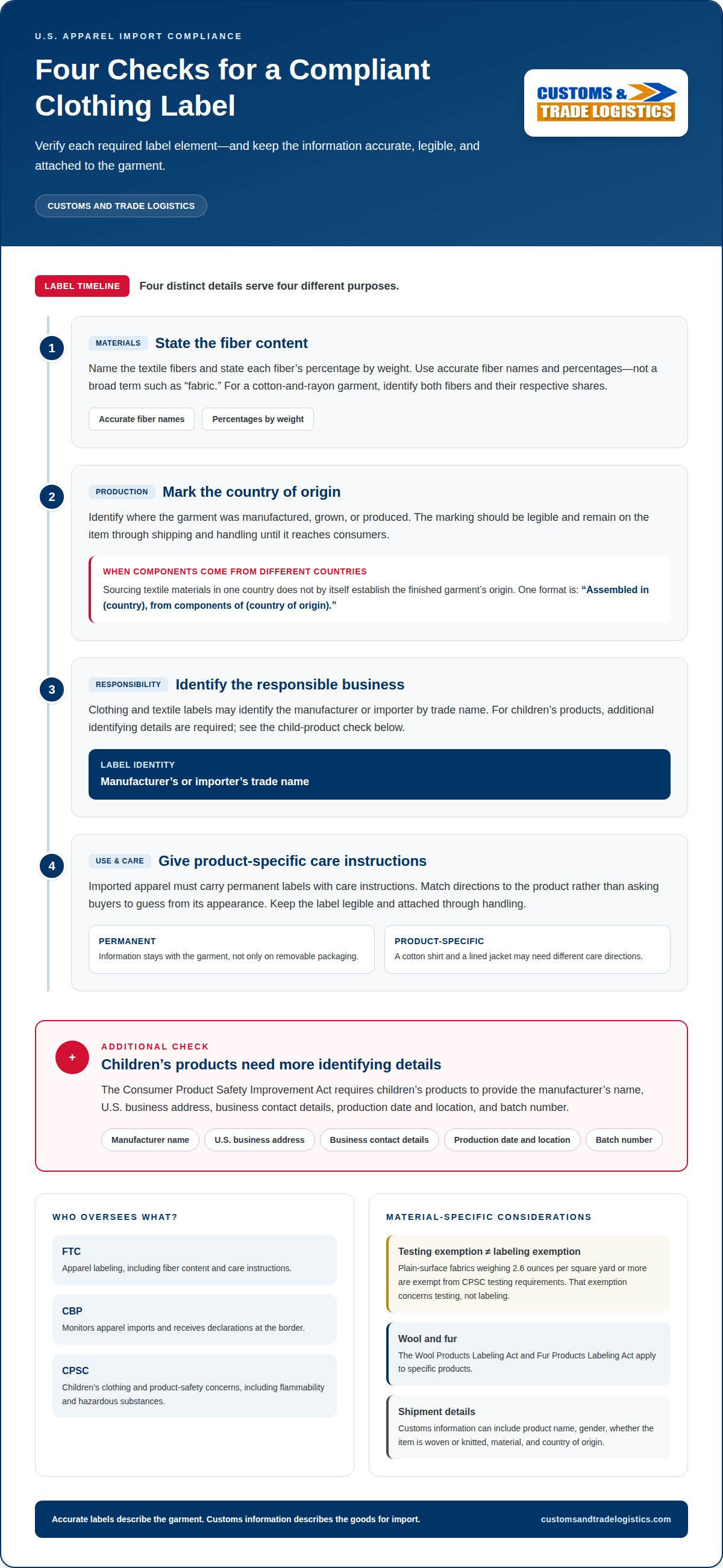
U.S. apparel labels identify the manufacturer or importer, country of origin, fiber content, and care instructions. Under the Care Labeling Rule, imported apparel must carry permanent labels with these details. A permanent label keeps required information attached to the garment, rather than only on removable packaging. Each element serves a distinct purpose: identity points to a responsible business, while care details guide the garment’s use.
Manufacturer identity means the business name shown on the label. Clothing and textile labels may state the manufacturer’s or importer’s trade name. For children’s products, the Consumer Product Safety Improvement Act requires additional identifying details: the manufacturer’s name, U.S. business address, business contact details, production date and location, and batch number. These details identify the responsible business and provide production information for a children’s garment.
Care instructions explain how to care for the garment. The label should give product-specific information rather than leaving buyers to guess from the item’s appearance. A cotton shirt and a lined jacket may need different care directions, so instructions should match the product. Include them on the permanent label required for imported apparel. Keep the label legible and attached through handling, so the information remains available after packaging is removed.
Manufacturer and importer identity matter alongside customs entry information. The business named on the label should be consistent with the party identified as the manufacturer or importer. For children’s products, the production date, location, and batch number provide further identification. These details do not replace the business name or U.S. business address required under the CPSIA. Clear records help connect a garment to its production information if questions arise.
Factory payment terms are commercial arrangements, not clothing-label requirements. Apparel factories commonly require an upfront deposit of 30-50% before production begins. Importers should distinguish that production payment from label compliance: paying a deposit does not establish that identity or care information is accurate. For a shipment made to order, coordinate the label details with the manufacturer before production, so the finished garments carry the intended information.
How do country of origin and trade agreements affect clothing import duties?
Country of origin can affect clothing duties because tariff treatment may depend on whether goods qualify as originating under applicable rules. Customs considers manufacturing origin, not simply the country or port from which goods ship. This distinction matters when apparel uses fabric from one country and is assembled in another. Origin records connect production details with the applicable tariff treatment. A shipment’s route alone does not establish eligibility under a trade agreement.
For textiles from countries without a U.S. free trade agreement, duties are generally described as ranging from 0% to 25% of value. The applicable rate depends on the product’s classification and the rules governing its origin. Trade programs can change the rate when goods meet their requirements. USMCA, the United States-Mexico-Canada Agreement, and GSP, the Generalized System of Preferences, are examples of programs that can affect apparel tariff rates. Eligibility depends on the applicable program’s origin criteria.
USMCA sets detailed rules of origin for textile and apparel products. These rules determine whether a garment qualifies under the agreement based on its production and materials. For example, the origin analysis may involve where the fabric was made and where the garment was assembled. A certificate of origin documents the origin claim and can support a request for preferential tariff treatment, but the goods must also meet the agreement’s applicable rules.
Mexico illustrates why origin can matter commercially: the United States imported more than $7 billion worth of textiles from Mexico in 2022. That trade figure does not itself grant a reduced duty. The specific garment must qualify under the applicable origin rules. For China-sourced apparel, sourcing plans and production details can shape the origin analysis. Get help planning China imports with origin and trade-program considerations in view. Clear production records help connect the garment, its materials, and its claimed origin.
Customs and Trade Logistics: Import From China Consulting
Customs and Trade Logistics helps businesses connect China sourcing plans with U.S. import steps through Import From China Consulting. Use this support when product details, origin considerations, and shipping arrangements need to be coordinated before clothing arrives. Customs Clearance Services support the entry process, while International Freight Logistics helps coordinate the movement of goods. Delivery and Redistribution Services support the next stage after arrival.
These services connect sourcing, customs clearance, and delivery, helping you manage apparel movement as one import process. Contact Customs and Trade Logistics for a free consultation about your clothing import needs.
Build compliance into your next clothing order
Make import planning part of your purchasing decisions, rather than leaving it until the goods are ready to ship. Align sourcing, product information, and shipping arrangements early, so everyone involved understands their role before the shipment moves. This makes customs requirements for clothing imports a practical part of your buying process, not a last-minute scramble.
For support moving goods from supplier to U.S. entry, Customs and Trade Logistics offers Import From China Consulting, Customs Clearance Services, and International Freight Logistics. The right starting point depends on where you need help, whether you are planning a purchase from China, coordinating freight, or managing customs entry.
Contact Customs and Trade Logistics to discuss your clothing import plans. With a clear process in place, you can move forward with greater confidence.
Frequently Asked Questions
What are the penalties for non-compliance?
Incorrectly labeled imported goods may face duties of up to 10% of the product’s value. Falsifying labels may result in monetary penalties of up to $50,000. The consequences depend on the issue, so distinguish an inaccurate label from deliberate falsification. For example, a fiber-content discrepancy and a knowingly false origin statement involve different compliance concerns.
What documents do I need to prepare for shipping clothes, clothing and other textile products to the U.S.?
Prepare a commercial invoice and the applicable transport document: an air waybill for air freight or a bill of lading for ocean freight. A broader apparel clearance file may also include a packing list and certificate of origin. The invoice should describe the goods clearly, so the shipment’s contents and transaction details are understandable during entry processing.
What documents are required to import clothing into the United States?
A typical apparel clearance file includes a commercial invoice, packing list, bill of lading, and certificate of origin. For air freight, the transport document is an air waybill. The invoice records product descriptions, quantities, unit prices, and total value. For example, descriptions and quantities for separate garment styles should let customs distinguish each item in the shipment.
How are clothing imports classified under the U.S. HTS tariff schedule?
Clothing imports are classified under the Harmonized Tariff Schedule (HTS), and the codes determine applicable tariff rates. Classification depends on the garment and how it is made. Product details such as material, gender, and whether the textile is woven or knitted help identify the correct category. A shirt and a knitted sweater, for instance, may have different classifications.
What are the U.S. import duty rates for different types of clothing and fabrics?
There isn’t one duty rate for all clothing: the HTS classification and country of origin affect the applicable rate. Textiles from countries without a U.S. free trade agreement are generally described as facing duties from 0% to 25% of value. Some Chinese textile products covered by Section 301 may face an additional 25% tariff. The garment’s classification and origin determine which treatment applies.
What textile and apparel labeling requirements apply to clothing sold in the United States?
Clothing labels generally identify fiber content and percentages, country of origin, the manufacturer’s or importer’s trade name, and care instructions. Imported apparel labels should be in English and attached to the garments. Details must match the specific item: for example, a garment containing rayon should identify rayon rather than use a vague material description. Wool and fur products also have specific labeling laws.


