

A product’s claims can change how it is regulated. Customs clearance for cosmetics and supplements starts with identifying the product and what its claims promise: therapeutic claims may bring a cosmetic under drug regulation, while a supplement claim that places it in the medicine category means it must be registered as a medicine rather than marketed as a dietary supplement.
It’s easy to focus on the product itself, but the label, ingredient information and import documents matter too. Missing or inconsistent details can draw FDA scrutiny and delay entry.
This guide explains how U.S. authorities distinguish cosmetics, drugs and dietary supplements, and why product claims matter when assessing possible medical-device classification. You’ll also learn what labeling information to review, which issues can lead to refusal of entry, and how careful preparation can help keep a shipment moving.
Key Takeaways
- Classify products by their ingredients, intended use and claims; therapeutic or medicine-related claims can change how they’re regulated.
- Review ingredient lists, product identity and other label details before shipping. According to the U.S. Food and Drug Administration, cosmetic ingredient-label lettering must be at least 1/16th of an inch high.
- Check for safety and compliance issues that can lead to refusal, including unsafe ingredients, color additive violations, contamination and labeling problems.
- Keep adverse-event procedures in view: according to the U.S. Food and Drug Administration, serious cosmetics adverse events must be reported within 15 business days.
How Are Cosmetic Imports Defined?
U.S. import requirements start with accurate product classification and entry documents. Imported cosmetics must meet the same laws as domestic products. The importer is responsible for tariff classification, while U.S. Customs and Border Protection makes the final duty-rate determination. Prepare a commercial invoice showing the purchase price, country of origin and HTS tariff classification, along with a packing list, bill of lading and arrival notice.
FDA review considers product composition, intended use, claims and entry information. A cosmetic claim promising therapeutic effects can bring drug regulation into play. For supplements, the FDA definition covers ingested products intended to supplement the daily diet with ingredients such as vitamins, minerals, herbs or amino acids. Serious cosmetics adverse events must be reported to FDA within 15 business days, according to the U.S. Food and Drug Administration.
Registration and listing requirements depend on the product and responsible party. Manufacturers and processors of cosmetics distributed in the United States must register their facilities, and responsible persons must list cosmetic products and ingredients annually. Firms importing products considered solely cosmetics don’t need FDA registration, and no FDA registration number is required for their import. Dietary supplement manufacturers or exporters must complete FDA registration, and the exporting company must appoint an FDA Agent.
For dietary supplements, treat the shipment as food for Prior Notice purposes. According to the U.S. Food and Drug Administration, a food shipment arriving by water requires Prior Notice no less than 8 hours hours before arriving at the port of arrival. Don’t assume personal use creates an automatic exemption approval; identify the product and applicable entry requirements before shipping.
Incomplete or inconsistent paperwork can trigger a hold. Match product descriptions, country of origin and facility codes across the ACE entry and FDA data. FDA’s PREDICT system targets shipments for review, while Import Alerts help inspectors focus on violation trends. If a notice or detention identifies a mismatch, correct the underlying issue in the entry data and supporting records before future shipments. This review is an important part of customs clearance for cosmetics and supplements. Tariffs depend on the correct classification and CBP’s duty determination; no single rate applies to every product.
Product labeling and missing information
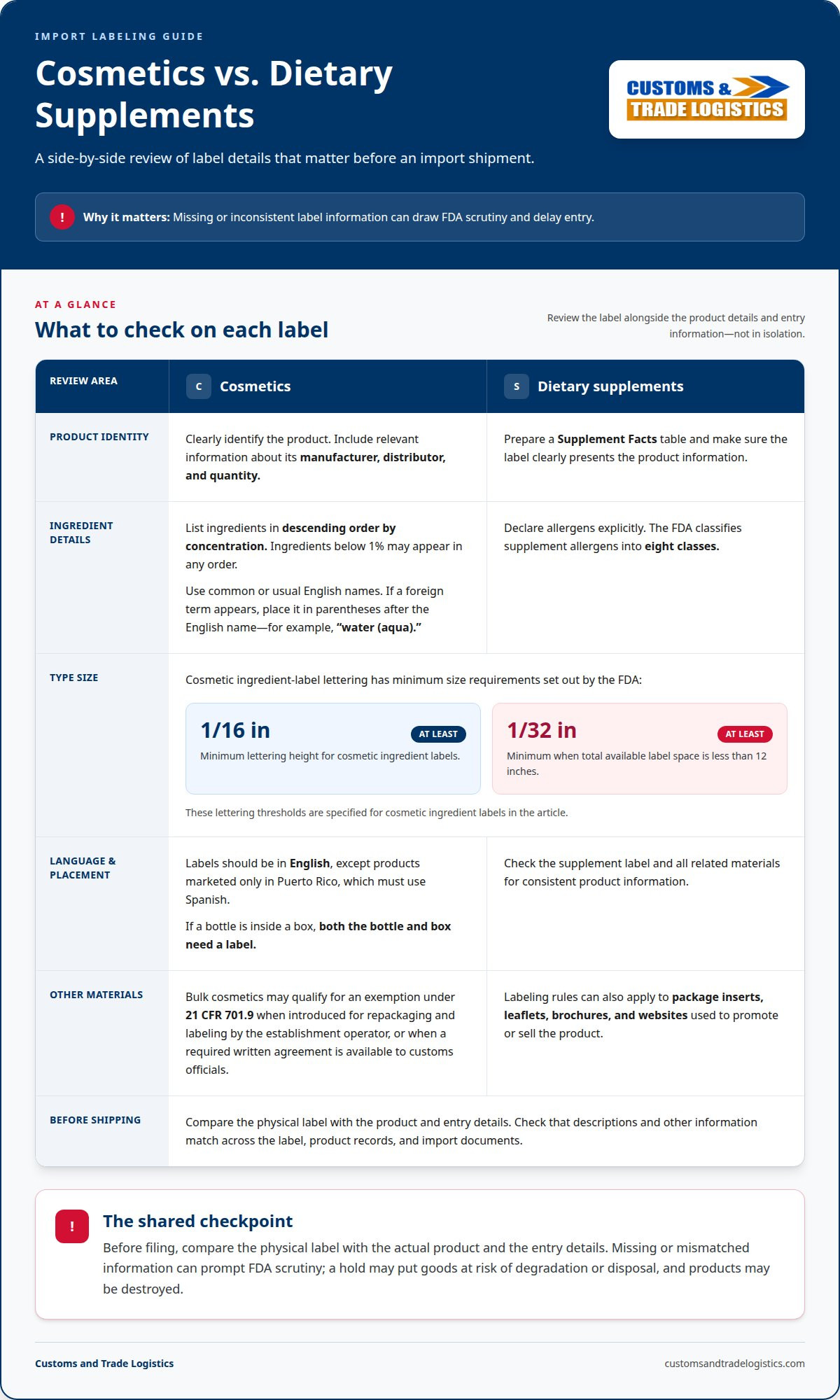
Imported cosmetics and dietary supplements need labels that identify the product and accurately present its ingredients and use. Missing or improper information can draw FDA scrutiny. Cosmetic labels should clearly identify the product and provide relevant information about its manufacturer, distributor, and quantity.
Ingredient details need careful attention. According to the U.S. Food and Drug Administration, cosmetic ingredient-label lettering must be at least 1/16th of an inch high. For labels with less than 12 inches of total available label space, lettering cannot be smaller than 1/32nd of an inch high, according to the U.S. Food and Drug Administration. List ingredients in descending order by concentration. Ingredients below one percent may appear in any order. Use common or usual English names, with foreign terms such as “aqua” in parentheses after the English name.
Check that the ingredient list is easy to locate and labels are in English, except products marketed only in Puerto Rico, which must use Spanish. A bottle inside a box needs a label on both. Bulk cosmetics may qualify for an exemption under 21 CFR 701.9 when the establishment operator introduces them for repackaging and labeling, or a required written agreement is available to customs officials.
For supplements, prepare a Supplement Facts table and declare allergens explicitly. FDA classifies supplement allergens into eight classes. Labeling rules can also apply to package inserts, leaflets, brochures and websites used to promote or sell the product. Review every format for consistent product information, not just the container label.
Before an international shipment leaves, compare the physical label with product and entry details. Correct mismatches before filing, since a hold can put goods at risk of degradation or disposal, and products may be destroyed. A careful import shipment review helps connect label details with the information used for entry.
Reasons cosmetics may be refused entry
Cosmetics may be refused entry if they appear to violate U.S. regulations or raise a safety concern. Review the product, its claims and the shipment records together.
Customs Clearance Refusals
Refusal can follow concerns such as unsafe ingredients, a color additive violation, microbial contamination or labeling violations. FDA requires pre-approval for color additives used in cosmetics for their intended use. A product may also be refused if it appears misbranded, tainted or otherwise out of compliance. Before shipment, compare the label and declared product details with the actual contents.
Detentions and Refusals of Admission
A detention means a shipment is being held for review; it is not the same as a final refusal. FDA works with U.S. Customs and Border Protection (CBP) to monitor imports, and CBP may examine cosmetics at entry. Read the customs notice or detention documents closely. They can identify the compliance issue that needs attention, such as a description mismatch or suspected contamination.
Enforcement can involve more than a labeling problem. Microbial contamination that poses a health hazard may make a cosmetic adulterated, though cosmetics aren’t required to be sterile. Foreign cosmetics that appear tainted or misbranded may be refused. An import alert can also help inspectors focus on violation trends, so review the product and its origin in light of the specific concern raised.
Use the notice to identify and correct the underlying issue before another shipment moves. Match the entry description to the product, check the origin and ingredients, and review supporting records for contradictions. If the concern involves a color additive, confirm it is permitted for the intended cosmetic use. Record the correction and apply it to future entries. Cosmetics not examined at entry remain subject to applicable FDA-enforced laws.
Cosmetic, drug, dietary supplement, and medical device classification
Classification starts with what a product is, how it is used and what its claims promise. These details affect both regulatory treatment and the tariff code entered for import.
Product Classification
Separate a product’s identity from its marketing language. The U.S. Food and Drug Administration doesn’t require pre-market approval for cosmetics, but therapeutic claims may bring a cosmetic under drug regulation. A dietary supplement is intended for ingestion to supplement the diet. A label claim can affect whether a product is treated as a dietary supplement or as a medicine.
Medical-device classification also calls for a careful review of the product’s stated purpose and claims. Don’t assume a topical product is always a cosmetic or an ingestible product is always a supplement. For example, a claim promising treatment can change how a product is classified. “Food and drug” wording in promotional material can also signal that claims need closer review.
HTS Code Selection
To determine an HTS code, start with the product’s composition, physical form, intended use and complete description. Compare those details with the tariff classification language, then use the code consistently on the commercial invoice and entry. A cream, powder and capsule shouldn’t be treated as interchangeable simply because they share an ingredient.
The importer is responsible for proper tariff classification, while U.S. Customs and Border Protection makes the final duty-rate determination. Keep the reasoning and product details together so the declared code reflects the actual item, not a broad catalog label. If the formula, presentation or claims change, reassess the classification before the next shipment.
Classification is a separate decision from FDA product review. A correct HTS code doesn’t resolve a drug-like claim, and regulatory review doesn’t establish the tariff code. Align the product description, invoice and supporting entry details before filing. For help coordinating the entry process, request customs clearance support.
Customs and Trade Logistics: Customs Clearance Services
Customs and Trade Logistics helps coordinate customs clearance for cosmetics and supplements entering the United States. Its Customs Clearance Services support the entry process, including attention to product classification and shipment paperwork. International Freight Logistics can also connect clearance with the movement of imported goods.
Consider professional support when product details, entry records or agency requirements are difficult to align, or when a shipment has been held and you need to understand the notice. Organize the product description, invoice and any detention documents first, so the issue is clear and actionable.
For help with an upcoming import or customs hold, contact Customs and Trade Logistics to discuss your shipment.
Prepare Your Next Import With Confidence
Make product readiness part of your import planning, not a last-minute task. Before committing to a shipment or launch date, align the product’s intended use, market claims and import documents among the people responsible for compliance and logistics. This shared understanding gives your team a clearer starting point when product details change or a new supplier enters the picture.
Customs clearance for cosmetics and supplements is easier to manage when classification and shipment coordination are part of one import plan. Customs and Trade Logistics offers Customs Clearance Services and International Freight Logistics, as well as Import From China Consulting for businesses sourcing from China. These services help organize the movement and clearance steps around your import needs.
Take the next step with a focused discussion about your product and shipment. Contact Customs and Trade Logistics to explore support for your U.S. import. A clear plan can help your team move forward with greater confidence.
Frequently Asked Questions
What ingredients are prohibited or restricted?
There isn’t one universal ingredient list for every cosmetic and supplement; the product’s intended use and formulation matter. For cosmetics, color additives require FDA pre-approval for their intended use, and unsafe ingredients or hazardous microbial contamination can raise entry concerns. For supplements, color additives and preservatives must be permitted for food and dietary supplement marketing. Assess each ingredient and its purpose in the finished formula.
What are the U.S. customs requirements for importing dietary supplements?
Dietary supplements are treated as food for relevant import requirements, so plan for facility, supplier and shipment information. Imported food must come from a registered foreign facility, and the Foreign Supplier Verification Program requires U.S. food importers to conduct documented, risk-based supplier verification. FDA Prior Notice also applies: for international air shipments, file at least 8 hours before arrival. For water arrivals, file no less than 8 hours hours before arriving at the port of arrival.
What customs documents are needed to clear cosmetics and supplements through U.S. Customs and Border Protection?
Prepare records that help officials identify the product, its origin, value and shipment details. Beyond core transport and entry paperwork, keep product descriptions and facility codes consistent across the ACE entry and FDA data. For supplements, organize relevant supplier and facility information for food-safety verification. If FDA or CBP issues a notice, retain it with the shipment records so the stated concern can be traced to specific product or entry details.
What steps are involved in customs clearance for cosmetics and supplements entering the U.S.?
Start by documenting the product’s formula, intended use and claims, then determine its regulatory category and tariff classification. Next, align the invoice and shipment data with the product information submitted through ACE and FDA systems. Complete applicable food notifications for supplements before arrival, then monitor entry notices and respond to any hold using the requested records. This sequence helps teams identify discrepancies before they recur on later shipments.
What are the customs broker and clearance costs for cosmetics and supplement imports?
Customs and Trade Logistics provides a quote based on the details of each case. The work can vary with shipment details, documentation needs and the coordination required for import logistics. Customs duties are separate from service fees; U.S. Customs and Border Protection makes the final duty-rate determination based on the applicable tariff classification. Request a quote tailored to your shipment and clearance needs.
What happens if imported cosmetics or supplements are detained, refused, or found noncompliant by the FDA?
A detention can pause release while officials review a concern; refusal may prevent entry. Read the detention notice or refusal documents first, then identify the cited product, label, safety or data issue and gather the records that address it. Holds can disrupt launch plans and may expose goods to degradation, disposal, shipping penalties or storage fees. Correct the underlying compliance problem before arranging another import.