

A food shipment can face refusal if its required advance notice is missing or inadequate. FDA prior notice for food imports is the filing that tells the U.S. Food and Drug Administration about incoming food before it arrives. For shipments arriving by rail or air, FDA must receive and confirm the notice at least 4 hours before arrival; for shipments arriving by water, the minimum is 8 hours, according to FDA.
If you’re managing FDA prior notice for food imports alongside FSVP and food-facility registration, it’s easy to confuse requirements that cover different parts of the process. Knowing what each one does helps you prepare the right information for a shipment. This guide explains what a Prior Notice filing requires, which foods and animal feeds it covers, and how filing timelines vary by arrival method. It also distinguishes Prior Notice from FSVP and facility registration, so you can see how each fits into an import.
Key Takeaways
- Separate Prior Notice from other import obligations by identifying what each requirement covers and when it applies.
- Prepare the product, manufacturer, shipper, and shipment details needed to complete a filing accurately.
- Check whether human food, animal feed, or goods moving through the United States fall within the notice requirements.
- Understand how customs clearance and freight logistics can support the movement of food imports through the entry process.
What is the FDA Prior Notice?
Prior Notice is advance information submitted to the U.S. Food and Drug Administration (FDA) about incoming food. It helps the agency assess shipments before they arrive, including food offered for import into the United States.
Prior Notice Purpose and Requirements
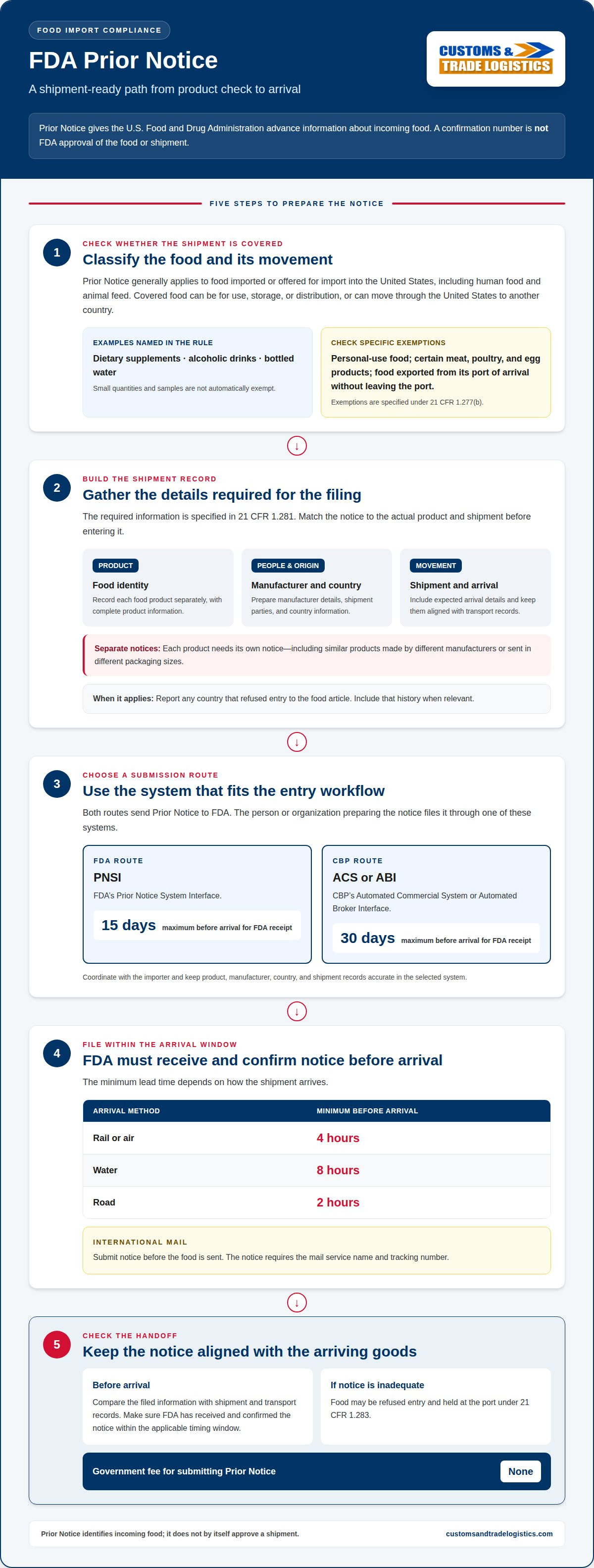
FDA Prior Notice is a federal filing that identifies food shipments before they enter the United States. Under 21 CFR 1.281, a submission must provide specified information about the food and its arrival. The FDA uses advance notice, with support from U.S. Customs and Border Protection, to target import inspections and help protect the food supply. A confirmation number does not mean FDA has approved the food or shipment.
Required Shipment and Manufacturer Details
A Prior Notice filing brings together information that identifies the product, its manufacturer, and its shipment. The required elements are specified in 21 CFR 1.281. Prepare the food’s identity, manufacturer details, shipment parties, country information, and expected arrival details so the notice can be completed accurately. Each product requires a separate notice, including similar products made by different manufacturers or sent in different packaging sizes.
Submission Timing and Arrival
Submission timing depends on the filing system and how the food arrives. For notices submitted through FDA’s PNSI interface, FDA must receive them no more than 15 days before arrival; notices through CBP’s ACS or ABI may be received no more than 30 days before arrival. According to the U.S. Food and Drug Administration, FDA must receive and confirm notice at least 4 hours before arrival for rail and air shipments, and 8 hours for water shipments. For road shipments, the minimum is 2 hours. International mail notice must be submitted before the food is sent, and mail notices require the mail service name and tracking number.
Exemptions and Submission Fees
Exemptions are specific categories that do not require Prior Notice under the applicable rule. Food carried for personal use and certain meat, poultry, and egg products are excluded under 21 CFR 1.277(b); food exported without leaving its port of arrival is also exempt. Food refused entry for inadequate notice may be held at the port under 21 CFR 1.283. FDA charges no government fee for submitting Prior Notice.
Information required for a filing
A Prior Notice filing is a structured submission identifying the food and its shipment. The required elements are specified in 21 CFR 1.281, so organize the product, manufacturer, country, and arrival information before entering the notice.
Start by matching product details to the shipment being announced. Keep the food’s identity and manufacturer information with the shipment records, including the country associated with the food. Matching these details helps prevent discrepancies between the notice and the arriving goods. Record each product separately and include its complete information in the filing.
You can submit Prior Notice through either the U.S. Customs and Border Protection (CBP) Automated Broker Interface or FDA’s Prior Notice System Interface (PNSI). The first uses CBP’s entry system; PNSI is FDA’s notice system. Choose the route that fits the shipment’s entry workflow, then submit the required information through that system. Both methods send Prior Notice to FDA.
Who submits FDA Prior Notice? The person or organization preparing the notice files it through PNSI or the CBP Automated Broker Interface. The importer should coordinate with the filer and provide accurate product, manufacturer, country, and shipment records so the notice correctly describes the incoming food.
Use a simple preparation sequence: identify the food and manufacturer, match those details to the shipment and country, then complete the required fields in the selected system. The filing rules also require reporting any country that refused entry to the food article, under an FDA interim final rule published on May 5, 2011. Include this history when it applies; it helps distinguish a prior refusal from ordinary storage or transit details.
Before submission, compare the entered information with the records used to arrange the shipment. Keep the filing and transport details aligned as the cargo moves toward arrival. For broader shipment planning, organize the notice alongside international freight logistics records.
Food and animal feed covered
Prior Notice generally applies to food imported or offered for import into the United States, including animal feed. Whether it applies depends on the product and its intended movement; regulations specify certain exemptions.
Foods Covered by the Rule
Covered food includes products imported for use, storage, or distribution, as well as food moving through the United States to another country under 21 CFR 1.277(a). The rule covers human food and animal food, so feed shipments also need consideration. Examples listed in 21 CFR 1.276 include dietary supplements, alcoholic drinks, and bottled water.
Consider more than food sold directly to consumers. A product may be covered even if it will be stored before distribution or transshipped onward. Small quantities and samples are not automatically exempt. In a mixed shipment, identify each food product separately, because each requires its own Prior Notice. Product names and packaging details can help distinguish items that might otherwise appear similar.
A broker or carrier may help coordinate shipment information, but the product category and route determine whether Prior Notice applies. Use those details to classify the food before arranging its entry.
Food Exemptions
Exemptions are specific situations in which a food shipment does not require Prior Notice. Food carried for personal use and certain meat, poultry, and egg products are excluded under 21 CFR 1.277(b). Food exported from its port of arrival without leaving that port is also exempt.
Assess exemptions based on the actual movement, not just the product name. For example, food that enters the United States and then continues to another country remains covered unless an exemption applies. Record the destination and route clearly, especially when multiple parties are involved in an automated entry process.
FDA distinguishes covered from exempt food based on both the product and the circumstances. Before filing, determine whether the goods are human food or animal feed, their intended use, and whether they will enter domestic storage or distribution. This review helps avoid claiming an exemption when the shipment’s route does not qualify.
Prior Notice compared with FSVP and facility registration
Prior Notice is an advance, shipment-specific notification to FDA about food imported or offered for import into the United States. It provides information about an incoming shipment, helping FDA and customs agencies plan inspections. On its own, it does not explain how an importer manages food-safety risks across the supply chain.
The Foreign Supplier Verification Program (FSVP) concerns an importer’s process for verifying foreign suppliers and the safety of imported food. It focuses on supplier and food-safety oversight, rather than advance arrival details for a specific shipment. The distinction is important: Prior Notice addresses the shipment; FSVP addresses importer verification practices. Completing one does not replace the other.
Food-facility registration identifies a facility in FDA’s registration system. It is separate from both shipment notice and supplier verification. Registering a facility does not replace shipment-specific Prior Notice, and filing Prior Notice does not register a facility. FDA treats these as distinct requirements, although both may be relevant to an import.
Use the three terms as a practical sorting guide:
- Prior Notice: Ask what food shipment is arriving and what advance notice FDA needs.
- FSVP: Consider how the importer verifies its foreign supplier and food-safety controls.
- Facility registration: Identify whether the relevant food facility has a registration issue.
This separation matters during customs processing. A Prior Notice confirmation number is not FDA approval, while a registration problem can create a separate hold. If a facility-registration problem causes a hold, a valid registration must be provided within 30 days. For international mail, Prior Notice remains a separate shipment notification, not a replacement for supplier verification or facility registration. Map each requirement to its own record before coordinating an import, and keep the shipment, supplier, and facility details distinct.
Customs and Trade Logistics: Customs Clearance Services
Customs and Trade Logistics provides Customs Clearance Services to help importers manage the customs requirements for incoming shipments. Once you understand the separate FDA Prior Notice, FSVP, and facility registration requirements, customs clearance can help coordinate the next steps in the import process.
Consider customs clearance support when food shipments need to move through U.S. entry procedures and the accompanying documentation must match the shipment details. International Freight Logistics can also support the movement of goods toward arrival. These services address import logistics; they do not replace FDA filings or food-safety obligations.
For support coordinating shipment planning and entry, contact Customs and Trade Logistics to discuss your import needs.
Build a More Predictable Import Workflow
Build food compliance into the import plan rather than leaving it until the last minute. A repeatable process for FDA prior notice for food imports can connect product records, supplier coordination, freight arrangements, and customs preparation before a shipment moves. Assign clear responsibilities and keep shipment details organized to smooth handoffs if plans change or several teams are involved.
For support beyond understanding the filing, Customs and Trade Logistics offers Customs Clearance Services, International Freight Logistics, and Import From China Consulting. These services support different stages of an import, from coordinating customs entry to planning freight or developing an import approach for goods sourced from China. The right next step depends on where your process needs coordination.
Bring your shipment plans and import questions together in one conversation. Contact Customs and Trade Logistics to discuss your food import workflow. With a clear plan and thoughtful coordination, you can move ahead with greater confidence.
Frequently Asked Questions
What is FDA prior notice for imported food?
FDA Prior Notice is advance information about an incoming food shipment, submitted so the agency can assess it before arrival. It generally applies to food imported or offered for import into the United States unless an exemption applies. The notice supports FDA’s inspection planning with U.S. Customs and Border Protection. A confirmation number shows that the notice was received; it does not mean FDA approved the food or shipment.
Which foods and shipments require FDA prior notice?
Prior Notice generally applies to human food and animal food imported for use, storage, or distribution in the United States. It can also apply to food transshipped through the country. Examples include dietary supplements, alcoholic drinks, bottled water, and animal feed. Food carried for personal use and certain meat, poultry, and egg products are exempt. Check both the product and its route, as either can affect whether an exemption applies.
How do you submit FDA prior notice through FDA’s Prior Notice System Interface or CBP ACE?
Submit through FDA’s Prior Notice System Interface (PNSI) or U.S. Customs and Border Protection’s Automated Broker Interface (ABI) within the Automated Commercial Environment (ACE). Use the system that fits the shipment, enter the required details, and retain the confirmation number. For international mail, Prior Notice may be submitted through PNSI or CBP’s ABI/ACE/ITDS. The notice must be received within the filing window that applies to its transport method.
What information and documents are required for FDA prior notice?
The filing requires information identifying the food article, its manufacturer, shipment parties, country information, and expected arrival. The required elements are set out in 21 CFR 1.281. For international mail, include the mail service name and tracking number under the rule taking effect October 1, 2026; FDA does not expect those details until May 1, 2027. Keep shipment records available to enter accurate information.
What are the FDA prior notice rules for food carried by travelers, mailed, or shipped by courier?
Food carried for personal use is exempt, but commercial food shipments need assessment under the usual coverage rules. International-mail notices must be submitted before the food is sent. Starting October 1, 2026, they must include the mail service name and tracking number, though FDA does not expect those details until May 1, 2027. Courier shipments follow their arrival mode: road, air, rail, or water.
How can importers check prior notice status and correct or cancel a submission?
Keep the confirmation number and use it to identify the filing in the system through which it was submitted. A confirmation number indicates receipt, not FDA approval or release. If FDA refuses a notice, a corrected Prior Notice generally must be submitted within 10 calendar days of the refusal notice, effective October 27, 2025. For a cancellation, use the original filing system and retain the notice details for reference.