

Businesses importing products regulated by the FDA must meet the same requirements as U.S.-made products. Imported goods must be held until the FDA determines whether they can enter U.S. commerce, and the agency may sample and test them. A hold, detention, or import alert can affect when a shipment is released and what happens next.
Freight and customs clearance are only part of the process: FDA requirements add a separate layer of review. The rules depend on the product, and missing or conflicting entry information can complicate the process.
This guide explains how product-specific requirements, customs entries, duties, fees, and storage conditions affect an import. You’ll also learn what FDA holds, detentions, and import alerts mean, why shipments may be delayed or refused, and how customs clearance and freight logistics fit into the process.
Key Takeaways
- FDA requirements vary by product category, so identify the rules that apply before planning a shipment.
- According to U.S. Customs and Border Protection, the Importer of Record is required to obtain an import bond for most commercial shipments valued at $2,500.00 USD or more.
- Storage facilities for imported goods must meet FDA and other applicable agency requirements, which may include registration.
- Learn what can trigger an FDA hold, detention, or import alert, and how customs clearance and freight logistics fit into the response.
Commodity-specific FDA requirements
Which products are regulated by the FDA when imported into the United States? FDA oversight covers food, drugs, medical devices, cosmetics, dietary supplements, tobacco, animal products, and radiation-emitting electronics. Each category has distinct requirements, so correctly identifying the product helps clarify what applies to a shipment. Importing products regulated by the FDA starts with identifying the commodity and its intended use.
Products Covered by FDA Oversight
FDA-regulated products include human and veterinary drugs, biological products, medical devices, cosmetics, food, tobacco, and radiation-emitting electronic products. Human foods include dietary supplements and food-contact substances; animal products include pet food, animal feed, and veterinary medicines. Some meat, poultry, and egg products fall under USDA oversight, and FDA and USDA jurisdictions overlap for certain foods. The category matters because it determines which requirements and agency reviews may apply.
Requirements by Product Type
Requirements by product type are the rules and records tied to a commodity’s intended use and characteristics. A bandage, contact lens, or pacemaker is a medical device; a microwave oven or laser pointer is a radiation-emitting product. These distinctions matter because a shipment’s product description must support the correct regulatory review. Cosmetics such as shampoo and face creams, and tobacco products such as e-cigarettes, also fall within FDA oversight.
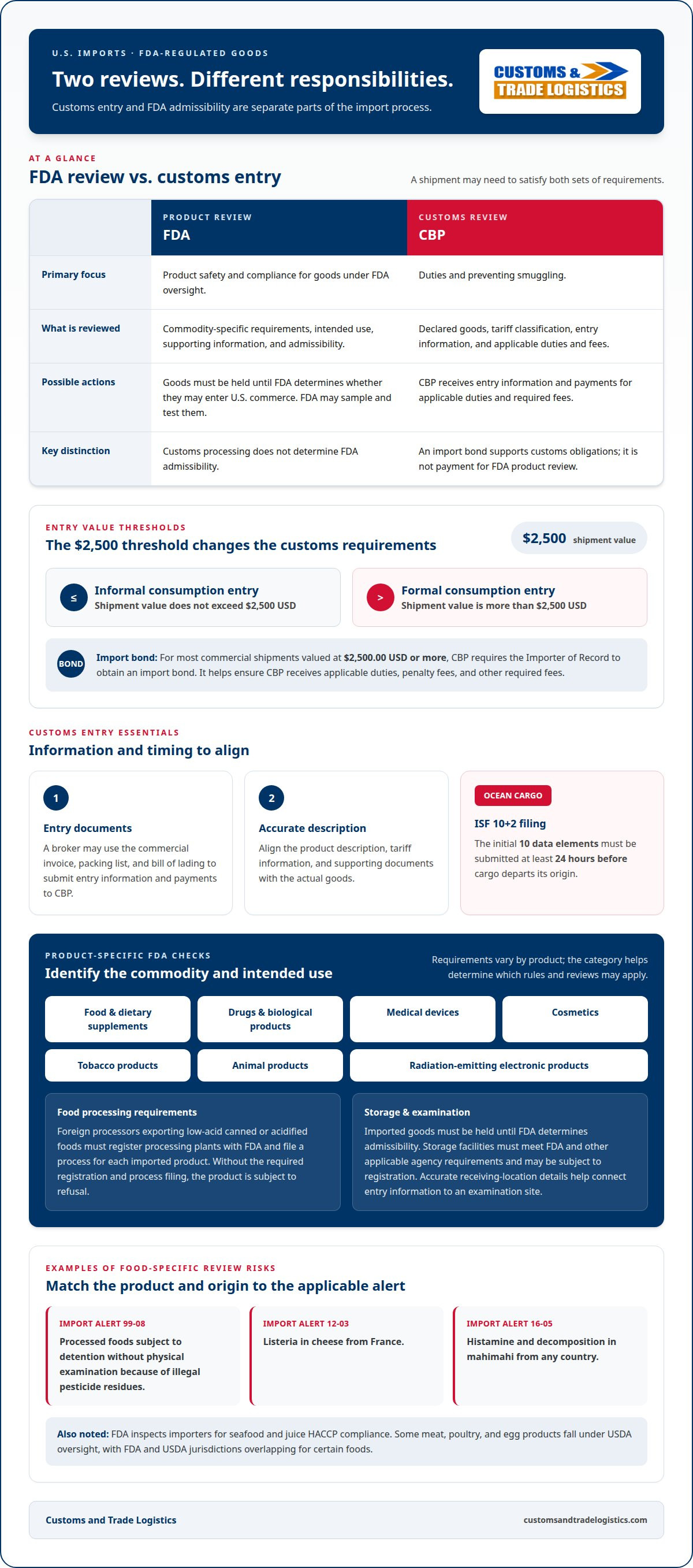
Food requirements can depend on how a product is processed. Foreign processors exporting low-acid canned or acidified foods must register their processing plants with the FDA and file a process for each imported product. Without the required registration and process filing, the product is subject to refusal. Because these steps depend on the food type, a general description such as “canned food” may not provide the details an entry needs.
Other food shipments can face commodity-specific checks. FDA inspects importers for seafood and juice HACCP compliance. Import Alert 99-08 identifies processed foods subject to detention without physical examination because of illegal pesticide residues. Alert 12-03 concerns Listeria in cheese from France, while Alert 16-05 concerns histamine and decomposition in mahimahi from any country. For businesses importing products regulated by the FDA, matching the exact product and origin to applicable requirements can help identify review risks before a shipment moves.
Customs entries, duties, taxes, and fees
Customs entry and FDA review are separate parts of importing. U.S. Customs and Border Protection (CBP) focuses on duties and preventing smuggling, while the FDA focuses primarily on product safety and compliance. All goods offered for entry into the United States, including products for personal use, must be declared to CBP. This declaration is essential for both commercial and personal shipments.
For FDA-regulated goods, consumption entries may be informal when shipment value does not exceed $2,500 USD, and formal when value is more than $2,500 USD. The entry process identifies the goods and their tariff classification, which supports the customs review and duty assessment. A licensed customs broker can help with customs compliance, tariff codes, and duty payments. The Importer of Record is often the importing company, but may be a third party, such as a customs broker.
For most commercial shipments valued at $2,500.00 USD or more, U.S. Customs and Border Protection requires the Importer of Record to obtain an import bond. The bond helps ensure CBP receives applicable duties, penalty fees, and other required fees. It is part of the customs-entry obligations, not a payment for FDA product review.
Plan the entry around accurate documents and timely filing. The broker may use the commercial invoice, packing list, and bill of lading to submit entry information and payments to CBP. For ocean cargo, an Import Security Filing, or ISF 10+2, is transmitted through the customs system; the initial 10 data elements must be submitted at least 24 hours before cargo departs its origin.
Before a shipment moves, align the product description, tariff information, and supporting documents so the entry reflects the actual goods. Customs Clearance Services can help coordinate entry information and duty-payment actions. This supports customs processing, while FDA admissibility remains a separate review.
FDA and other agency requirements for storage facilities
A facility storing imported goods must meet FDA and other applicable government agency requirements, and it may also be subject to FDA registration requirements. The facility’s role matters: storage during an FDA review differs from holding goods ready for distribution. Map the shipment’s route from arrival through storage and release. Identify the receiving facility and the agency requirements that apply there.
Product category helps determine which agencies and requirements may apply. For example, an FDA-regulated food shipment may involve food safety oversight, while certain meat, poultry, and egg products fall under USDA regulation. FDA and USDA jurisdictions overlap in some food areas. A storage plan should account for the goods, the facility, and each agency’s responsibilities, rather than treating every imported product alike.
FDA admissibility also affects how a facility handles imported goods. Products must be held and cannot be distributed into U.S. commerce until the FDA determines their admissibility. If the FDA requests an examination, importers can use ITACS to provide the examination location. Accurate facility details link the shipment’s entry information to the place where the agency can examine the goods. Keep the receiving location consistent with the shipment records.
Before goods arrive, coordinate the facility’s receiving role with the importer’s entry information. Confirm internally which location will hold the shipment, who can provide access for an examination, and how the goods will remain identifiable during review. These are practical coordination steps, not substitutes for applicable agency requirements. A facility’s registration status and obligations depend on the activities and goods involved.
Release from storage follows the regulatory decision, not simply arrival or customs processing. Keep the shipment held until FDA determines admissibility, and avoid distribution into U.S. commerce beforehand. If a product is refused entry, it must be destroyed or exported from the United States within 90 days. That deadline makes clear why the storage plan should account for review outcomes, not only routine receipt and onward movement.
Import requirements for FDA-regulated products
Product-specific rules shape entry filings, labeling, inspections, and responses to FDA action. Accurate product and shipment details help connect each stage of the process.
Import Filing and Labeling Information
An FDA entry filing identifies the product, the parties involved, and shipment details. It includes information about the product, origin, arrival, quantity, value, manufacturer, shipper, importer, and recipient. The Harmonized Tariff Schedule number belongs in the entry, but it does not always indicate whether FDA review is required. Some products also require three-letter Affirmation of Compliance codes.
Food must be safe, produced under sanitary conditions, and labeled informatively and truthfully in English. The FDA routinely examines and samples imported food for labeling compliance. Requirements depend on the product category, not the size of the business; goods for personal use must also be declared to U.S. Customs and Border Protection. For samples, accurately describe the product and shipment in the entry.
Facility Registration and Prior Notice
Facility registration and prior notice are separate food-import requirements. The FDA must receive prior notice before food is offered for import into the United States. Foreign processors exporting low-acid canned or acidified food must register their processing plants with the FDA and file a process for each imported product.
Without the required registration and process filing, these products are subject to refusal. Food facility registration information is confidential and not publicly available. The FDA FEI Portal lets users look up an FDA Establishment Identifier by firm name and address or validate an FEI address. Importers are also responsible for verifying that foreign suppliers have adequate preventive controls.
Inspections and Import Clearance
The FDA and U.S. Customs and Border Protection coordinate distinct parts of import review. CBP handles customs entry, duties, and smuggling prevention; the FDA focuses on product safety and compliance. The FDA electronically screens regulated imports and may sample and test products. A shipment may be held until the agency determines admissibility, even while customs processing proceeds.
ITACS lets importers check entry status, view estimated lab completion dates, submit documents electronically, provide an examination location, and retrieve Notices of FDA Action. Accurate entry details matter: the FDA may detain food when information conflicts with its internal data systems. These tools help importers track status and respond to agency requests.
Responding to Detention or Refusal
A detention gives the importer an opportunity to address alleged violations. The Importer of Record may submit evidence to refute them or request FDA approval to recondition goods for compliance. The FDA may also notify the importer of non-compliance; relabeling or processing may address some issues. Keep any response specific to the product and alleged violation.
If FDA refuses entry, the product must be destroyed or exported from the United States within 90 days. Failure to meet that deadline may lead to CBP liquidated damages against the import bond. Other possible consequences include seizure, civil monetary penalties, bond actions, state embargo or stop-sale orders, food importer debarment, and prosecution. These actions can extend beyond the immediate shipment.
Customs and Trade Logistics: Customs Clearance Services
Customs and Trade Logistics supports importers coordinating customs entry and international freight for FDA-regulated shipments. Use its Customs Clearance Services to manage entry details, tariff information, and supporting documents alongside shipment movement. Customs clearance and FDA admissibility are separate processes, so the agency’s product-release decision remains distinct from customs entry work.
For shipments from China, Import From China Consulting helps importers plan the import process. International Freight Logistics supports shipment movement, while Delivery and Redistribution Services can help coordinate delivery after release. The right support depends on the shipment’s stage and the logistics tasks involved.
Contact Customs and Trade Logistics for a free consultation about customs clearance or freight logistics for your import.
Build a More Predictable Import Plan
Plan your next steps before the shipment moves: map who handles each part of the import, from freight planning to customs entry and onward delivery. A clear division of responsibilities keeps logistics tasks organized while FDA review remains a separate regulatory process. For businesses importing products regulated by the FDA, understanding this distinction is a useful foundation for planning future shipments.
Customs and Trade Logistics offers Customs Clearance Services, International Freight Logistics, and Import From China Consulting. These services support importers coordinating entry requirements and the movement of goods, including shipments sourced from China. The next step is to match your product, origin, and logistics needs with the support your import requires.
Plan your next import with Customs and Trade Logistics and move forward with a clearer path for your shipment.
Frequently Asked Questions
What is an FDA Hold, Detention, and Import Alert?
An FDA hold means a shipment remains unavailable for distribution while the agency decides admissibility or requests more information or testing. Detention is an agency action that can prevent a specific product from moving forward during review. An import alert identifies products or firms that may face detention without physical examination. These terms describe distinct stages or mechanisms, not interchangeable outcomes.
What is the Foreign Supplier Verification Program (FSVP)?
The Foreign Supplier Verification Program (FSVP) makes food importers responsible for verifying that foreign suppliers have adequate preventive controls for food safety. This duty applies to the importer’s role in the supply chain, not simply to the overseas producer. FDA Import Alert 99-41 concerns human and animal foods imported by importers who do not comply with FSVP requirements, underscoring the importance of supplier oversight.
When are FDA-Regulated Products Refused?
The FDA may refuse products that violate, or appear to violate, the Federal Food, Drug, and Cosmetic Act. Grounds include adulteration, misbranding, or products forbidden or restricted for sale. For example, a food entry may be refused if the FDA considers it adulterated or misbranded. A refusal means the product cannot enter U.S. commerce; the importer must address the shipment’s disposition under applicable requirements.
Who is the Importer?
The importer is the party bringing goods into the United States, while the Importer of Record is responsible for compliance with federal import laws. Often that party is the importing company, though it may be a third party, such as a customs broker. Goods may be entered by their owner, purchaser, or a licensed broker, so the filing party and Importer of Record are not always the same.
What FDA import requirements apply to food, drugs, medical devices, cosmetics, and dietary supplements?
Each category must meet applicable U.S. requirements, which depend on the product and its intended use. Food must be safe, made under sanitary conditions, and labeled informatively and truthfully in English. Drugs, medical devices, cosmetics, and dietary supplements have category-specific requirements; a product’s name alone may not establish its regulatory classification. Identify the product accurately before preparing its import entry.
What are FDA import alerts, import holds, detention, and refusal of admission?
An import alert flags products or firms for heightened FDA attention and may lead to detention without physical examination. A hold keeps a shipment from distribution while admissibility is pending; detention is an agency action affecting goods under review. Refusal of admission is the decision that a product cannot enter U.S. commerce. These terms mark distinct points in the review, from scrutiny to an entry decision.