

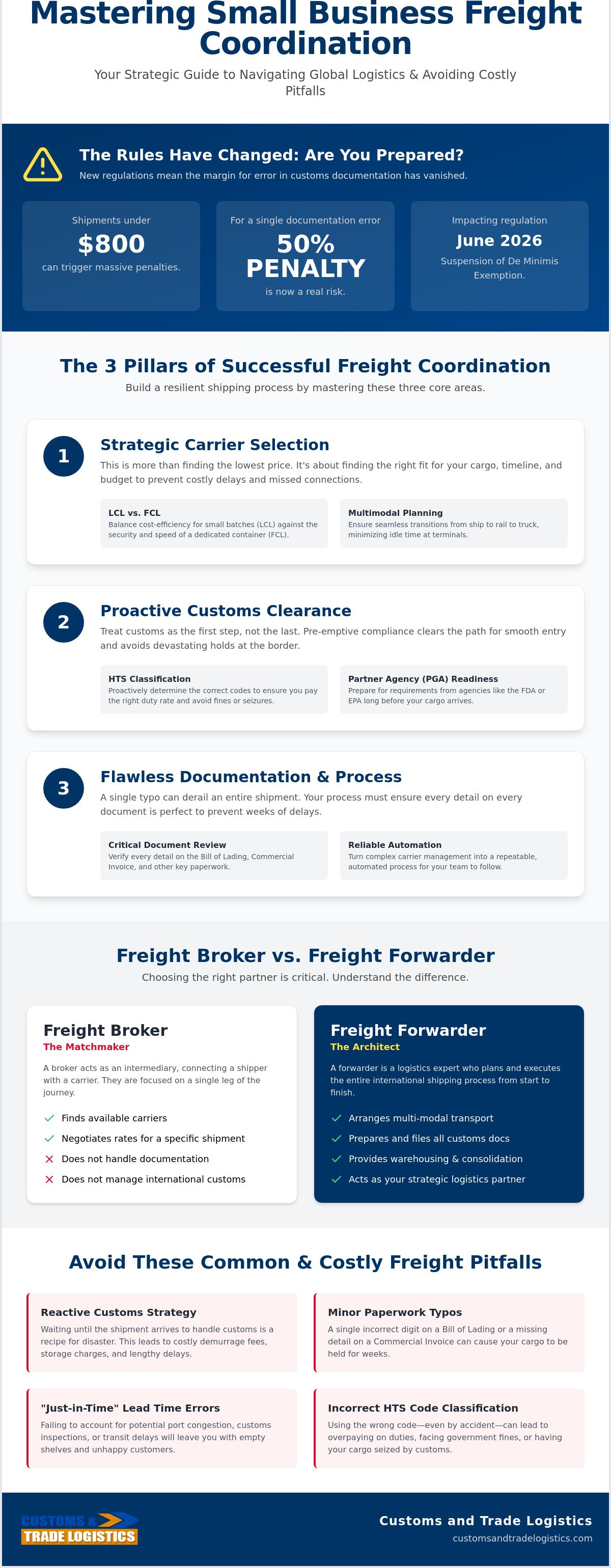
Did you know that even a small shipment valued under $800 can now trigger a 50% penalty if your documentation misses a single beat? With the June 2026 suspension of the de minimis exemption and new Executive Orders on customs enforcement, the margin for error has vanished. It's completely normal to feel overwhelmed by shifting density-based rates and the constant fear of hidden fees. Effective small business freight coordination shouldn't feel like a high-stakes gamble every time you place an order.
You've worked too hard on your business to let shipping jargon or carrier delays stall your momentum. We're here to help you master the complexities of global logistics with a framework designed specifically for smaller operations. This guide will walk you through building a reliable shipping process that runs on autopilot. You'll learn how to secure predictable costs, manage customs with confidence, and find a partner to handle the heavy lifting so you can focus on your growth. We'll break down the technical density into a steady, step-by-step path toward total peace of mind.
Key Takeaways
- Learn how to shift from reactive shipping to a proactive strategy that treats customs clearance as the foundational first step of every journey.
- Discover a clear framework for small business freight coordination that turns complex carrier management into a reliable, automated process for your team.
- Understand the critical differences between freight brokers and forwarders to ensure you select the right "architect" for your international cargo.
- Identify and avoid common pitfalls like "just-in-time" lead time errors and minor paperwork typos that frequently lead to costly delays at the border.
- Find out why partnering with a seasoned, family-oriented mentor provides the "safe pair of hands" needed to navigate 2026’s evolving regulatory landscape.
What is Small Business Freight Coordination?
Have you ever felt like you're trying to solve a puzzle where the pieces keep changing shape? For many entrepreneurs, managing international logistics feels exactly like that. At its heart, What is Freight Coordination? It's the strategic oversight of every link in your international shipping chain, specifically tailored for the needs of smaller enterprises. While a massive corporation might have an entire department dedicated to this, a small business owner often wears that hat alone. Essentially, freight coordination acts as the vital bridge between your foreign suppliers and the final delivery at your US warehouse.
The Core Components of a Coordinated Shipment
To keep your goods moving smoothly, three elements must work in perfect harmony. First is transportation. Should you choose the speed of air freight or the cost-efficiency of ocean transit? The right choice depends on your cargo's weight, its value, and how quickly you need it on your shelves. Second is documentation. A single typo on a Bill of Lading or a missing detail on a Commercial Invoice can trigger weeks of delays. Finally, there's compliance. Navigating the maze of US Customs regulations is the only way to avoid the dreaded customs hold that leaves your inventory sitting in a dark warehouse while your customers wait.
Why Small Businesses Cannot Afford Poor Coordination
Poor small business freight coordination isn't just an inconvenience; it's a financial drain. Have you considered the hidden costs of a mistake? Demurrage and storage fees at the port can accumulate to hundreds of dollars per day if your paperwork isn't ready when the ship docks. Even worse, using the wrong HTS code classification can lead to cargo seizures or heavy fines from the government. Beyond the money, inconsistent shipping cycles destroy the trust you've built with your customers. If your shelves are empty because a shipment got stuck, those customers won't wait; they'll simply go to a competitor. Reliability is the foundation of your growth.
The 3 Pillars of Successful Freight Coordination
Success in global trade isn't about luck; it's about structure. Think of successful small business freight coordination as a tripod. If one leg buckles, the entire shipment falls. A breakdown in carrier vetting leads to delays at sea, while a failure in customs strategy causes a domino effect that ruins your final-mile delivery schedule. By focusing on these three core pillars, you transform shipping from a source of anxiety into a competitive advantage that supports your growth.
Strategic Carrier Selection
Selecting a partner is about more than finding the lowest quote. You have to decide between Less than Container Load (LCL) or Full Container Load (FCL). LCL is great for smaller batches, but it adds extra handling steps and potential delays. FCL offers more security but requires more inventory. Choosing the "cheapest" option often leads to late arrivals or missed connections. These errors cost you more in the long run than the initial savings. A coordinated approach includes multimodal planning. This ensures your goods move seamlessly from a ship to a train or truck for inland delivery without sitting idle at the terminal.
Customs Clearance as a Growth Tool
Most importers wait until the ship arrives to think about customs. That's a major mistake. We believe import logistics for startups must begin with compliance long before the cargo leaves the factory. By proactively determining your HTS classification, you ensure you pay the correct duty rate and avoid overpayment. You also need to account for Partner Government Agencies (PGA) like the FDA or EPA. Failing to prepare for these requirements is one of the most common freight pitfalls that small businesses face. When you treat customs as a strategic first step, you clear the path for growth rather than hitting a legal wall.
Redistribution and Final Delivery
The journey doesn't end at the port. You need reliable drayage truckers to pull your container and move it to its next stop. Whether you're sending goods to your own warehouse or an Amazon FBA center, redistribution requires precise timing. We see many businesses struggle with the last leg, but it's where your customer's experience is finally decided. Proper coordination ensures that your inventory is exactly where it needs to be when the demand hits.
- Coordination with local truckers for rapid port exit and reduced storage fees.
- Splitting shipments for multiple destination points or regional fulfillment centers.
- Capturing clear proof of delivery for financial records and inventory tracking.
If you're ready to move past the stress of DIY logistics, we can help you implement International Freight Logistics that protect your bottom line and keep your promises to your customers.
Freight Broker vs. Freight Forwarder: Which Do You Need?
Choosing the right partner for your logistics is like hiring a contractor for a major home renovation. Do you need an architect to design the entire plan, or do you just need a handyman to fix a specific leak? In the world of small business freight coordination, knowing the difference between a forwarder and a broker is vital for your bottom line. A freight forwarder acts as the architect of your move. They design the entire route, often take physical possession of your cargo, and manage the movement across international borders. A freight broker, however, is a matchmaker. They connect you with available carriers but never actually touch your goods.
You also have to consider the role of the customs broker. This professional acts as your legal representative before US Customs and Border Protection. They ensure your entries are filed correctly so you don't face the 50% penalties mentioned earlier. For a smaller company, managing three separate entities is exhausting. That's why a "hybrid" partner who provides all these services under one roof offers a massive advantage. It simplifies your communication and ensures that your transportation and legal compliance are always in sync.
If you are looking for a logistics provider that combines brokerage expertise with personalized service, you can discover Tranzit Express Inc. to see how they help businesses manage these complex carrier networks.
Key Differences at a Glance
- Liability: Forwarders generally assume more responsibility for your cargo during its journey; brokers act as intermediaries with limited cargo liability.
- Scope of Service: A forwarder handles the "factory to front door" journey, while a broker often focuses on connecting you with a truck for a specific domestic leg.
- Cost Structures: Brokers usually charge a commission on the carrier's rate. Forwarders provide a comprehensive service fee that covers the entire logistical puzzle.
Special Focus: Importing from China
The China-to-US trade lane is the most complex route for many small importers. With the June 2026 suspension of de minimis exemptions, every single box now requires a formal or informal entry, regardless of value. You'll likely face Section 301 duties, which can significantly inflate your costs if not handled correctly. This is where a China to USA import consultant becomes your best asset. They help you navigate these tariffs and ensure your Chinese suppliers follow strict US labeling and packaging standards. Effective small business freight coordination on this lane prevents your goods from being flagged or rejected at the port of entry, keeping your inventory moving and your customers happy.
Avoiding Common Small Business Freight Pitfalls
Have you ever had a shipment arrive at the port only to realize you didn't have the right insurance or that your lead times were too optimistic? Mistakes in small business freight coordination are often invisible until they become expensive. For instance, many small importers rely on a "just-in-time" inventory model, but this is increasingly risky. With June 2026 data showing a van tender rejection rate of 18.3%, capacity is strained. If your carrier rejects your load, do you have a buffer built into your schedule? Relying on a perfect timeline is a pitfall that can leave your shelves empty and your customers frustrated.
Another major trap is ignoring the fine print of Incoterms. Do you know exactly where your responsibility ends and your supplier's begins? If you don't, you might find yourself paying for freight costs or assuming risks you didn't budget for. Similarly, relying on standard carrier liability is a gamble. Most carriers only cover a fraction of your cargo's value in the event of a total loss. Investing in separate cargo insurance is the only way to truly protect your investment from the unpredictable nature of global transit.
Finally, never underestimate the impact of a single typo. A minor error on a Commercial Invoice can trigger an intensive customs exam, leading to storage fees that eat your entire profit margin. Success requires a "safe pair of hands" to review every document before it ever reaches a government official's desk.
Mastering the Paperwork Trail
Your documentation is the DNA of your shipment. The Bill of Lading acts as your title to the goods; without it, you simply don't own what you've paid for. Accuracy is even more critical when using FBA freight forwarding services. Amazon requires precise SKU-level data on your packing list, and a single discrepancy can lead to your inventory being rejected at the fulfillment center. You must also prioritize your Importer Security Filing (ISF). This "10+2" rule requires data to be submitted to CBP 24 hours before the ship leaves the foreign port. Missing this deadline is a guaranteed way to trigger fines and inspections.
Managing Costs and Cash Flow
Understanding your final invoice requires a keen eye for surcharges. In 2026, surcharges account for approximately 33% of the average package cost. If you're only looking at the base linehaul rate, you're missing a huge part of the picture. You must also budget for duties and taxes well before your shipment arrives. Don't let "fee fatigue" drain your cash flow. Professional consulting helps you calculate your true landed cost, ensuring you remain profitable on every unit sold. If you want to avoid these costly errors, our team provides the Customs Clearance Services you need to import with confidence.
Why a Family-Owned Partner is the Best "Safe Pair of Hands"
In an industry increasingly dominated by impersonal digital portals and automated chatbots, where does a growing business go for actual advice? While massive logistics conglomerates focus on "multimodal technology" and "network scale," they often treat smaller importers as just another line in a spreadsheet. We believe that small business freight coordination requires a human touch. A family-owned partner acts as a seasoned mentor, providing a "safe pair of hands" that values your company’s growth as much as you do. You aren't just moving boxes; you're building a legacy, and you deserve a partner who understands the weight of that responsibility.
Experience isn't just a number; it's a shield. Navigating the constant shifts in US Customs policy since the 1990s has taught us that regulations never stop evolving. Whether it's the implementation of new Executive Orders or the overhaul of density-based classification systems, having 35 years of historical context allows a partner to anticipate changes before they disrupt your supply chain. This longevity ensures that your goods are managed with "customs-first" logistics, where compliance is verified before your cargo even hits the water. This proactive stance is the only way to ensure a truly stress-free journey from the factory floor to your warehouse.
The Value of Personalized Oversight
When a crisis happens at the port, you don't want to wait for a support ticket to be processed. You need to know exactly who is handling your customs entry. Personalized oversight means having direct communication with an expert who can resolve port issues before they turn into expensive storage fees. We specialize in tailored solutions for Amazon sellers and e-commerce brands who need to scale quickly. Whether you're moving your first pallet or your 50th container, your logistics strategy should adapt to your needs, not the other way around. This level of protective care is what separates a vendor from a true advocate.
Getting Started with Your Freight Strategy
Ready to move away from the anxiety of DIY shipping? Building a reliable framework for small business freight coordination starts with a simple conversation. To get the most out of your first logistics consultation, try to gather a few key pieces of data: your supplier's location, detailed product descriptions for HTS classification, and your target delivery dates. Having this information ready allows us to map out a clear, predictable path for your cargo. You don't have to master the complexities of global trade alone when you have a dedicated partner to guide every step.
Ready to simplify your supply chain? Contact Customs and Trade Logistics today for expert guidance.
Secure Your Future with Proactive Logistics
Success in the 2026 trade landscape requires more than just finding a carrier; it demands a shift in how you view your supply chain. By prioritizing customs strategy and mastering the paperwork trail, you can turn logistics from a source of anxiety into a stabilizing force for your business. Avoiding common pitfalls like documentation errors or underestimated lead times ensures that your inventory arrives on time and without the sting of hidden penalties. Investing in professional small business freight coordination is the most effective way to protect your margins and maintain the trust of your customers.
You don't have to face these complexities alone. With over 35 years of industry experience and expertise across all US Customs ports, our family-owned team is here to act as your dedicated advocate. We provide the personal service and mentorship that massive corporations simply can't match. Are you ready to lift the administrative burden off your shoulders? Simplify your logistics with a free consultation from Customs and Trade Logistics. Let's work together to build a reliable shipping process that supports your long-term growth.
Frequently Asked Questions
What is the most common reason for small business freight delays?
Documentation errors are the primary culprit for unexpected holds. Even a simple typo on a Commercial Invoice or a late ISF filing can cause a significant bottleneck at the port. In 2026, with stricter Importer of Record requirements, these minor mistakes lead to major headaches. Professional small business freight coordination ensures every document is audited for accuracy before the ship ever leaves the foreign dock, keeping your timeline intact.
Do I need a customs broker for every international shipment?
While you can technically file your own entries, it's rarely advisable for commercial goods. Since the June 24, 2026, suspension of the de minimis exemption, every shipment regardless of value now requires a formal or informal entry. A customs broker acts as your legal shield, ensuring you comply with beneficial ownership disclosures and asset requirements mandated by recent Executive Orders. They handle the "scary" legal parts so you don't have to.
How much does freight coordination typically cost for a small business?
Costs depend on your cargo's volume, weight, and the specific trade lane you're using. Instead of a flat price, you'll encounter a mix of base freight rates and various surcharges. In 2026, surcharges account for roughly 33% of the average package cost. Working with a consultant helps you identify and mitigate "fee fatigue" from accessorial charges like liftgate or residential delivery fees, which have increased significantly this year.
What is the difference between LCL and FCL for small importers?
LCL, or Less than Container Load, means your goods share space with other shippers, which is cost-effective for smaller batches. FCL, or Full Container Load, gives you exclusive use of the entire container. Small importers often start with LCL to save money, but FCL is generally faster and safer because it avoids the extra handling and deconsolidation steps that often lead to damage or delays at the port.
Can I coordinate my own freight using online platforms?
You can use digital portals, but they often lack the personalized oversight needed for complex international moves. Automation is excellent for tracking, but it won't help you when a Partner Government Agency flags your cargo for an intensive inspection. Effective small business freight coordination requires a human expert who can pick up the phone and resolve port issues that a chatbot simply isn't equipped to understand or solve.
How do I choose the right HTS code for my products?
You must match your product to the specific 10-digit code in the Harmonized Tariff Schedule based on its material and function. It's a highly technical process where even a small detail can change your duty rate. Since June 2026, the minimum penalty floor for customs violations is 50%, making it vital to get professional help. Correct classification ensures you pay exactly what you owe and not a penny more.
What paperwork do I need to import goods from China to the US?
You'll need four core documents: the Bill of Lading, Commercial Invoice, Packing List, and the ISF "10+2" filing. For China imports, you must also ensure your supplier provides accurate beneficial ownership details to meet new US disclosure rules. If your goods fall under Section 301 duties, having clear, precise documentation is the only way to ensure your shipment isn't flagged or rejected at the border.
What happens if my shipment is flagged for a customs exam?
Your container will be moved to a Centralized Examination Station (CES) for a physical or X-ray inspection by CBP officers. This process adds time to your delivery schedule and creates additional costs for drayage, storage, and labor. While no one can guarantee you'll never be flagged, having a seasoned partner to review your paperwork beforehand significantly reduces your risk and ensures the process is handled efficiently if it occurs.


