

What if a single typo on your commercial invoice could trigger a mandatory penalty of 50% of your cargo's value? With the June 2026 Executive Order "Strengthening Customs Enforcement" now in full effect, the margin for error has effectively disappeared. You're likely feeling the pressure of unpredictable storage fees and the constant worry that your Amazon FBA inventory will get stuck in a weeks-long exam. We understand how overwhelming these shifting rules feel, but the truth is that inspections aren't just random bad luck. There are concrete ways to learn how to reduce the risk of a customs inspection by aligning your business with the new "good standing" requirements.
It's frustrating to feel like your supply chain costs are a moving target. You deserve the peace of mind that comes with knowing your paperwork is 100% compliant before the vessel even berths. In this guide, we'll show you exactly how to tighten your documentation, navigate the new mandatory eFiling for CPSC-regulated products, and secure your status as a low-risk importer. We'll walk through the structural reforms taking effect this November and provide a clear roadmap to keep your goods moving and your costs predictable.
Key Takeaways
- Consistency is king; learn why every document in your shipment must tell the exact same story to avoid triggering a physical exam.
- Precise HTSUS classification is no longer optional; find out how to choose the right codes to prevent valuation red flags and costly delays.
- Master how to reduce the risk of a customs inspection by implementing "Informed Compliance" strategies that satisfy new 2026 enforcement standards.
- Supplier reputation matters; discover how origin-based cargo security and thorough vetting can stabilize your delivery timelines and lower your risk profile.
- Learn how a licensed customs broker acts as a protective bridge and a "safe pair of hands" between your business and the complex global marketplace.
Understanding Why U.S. Customs Flags Your Shipments
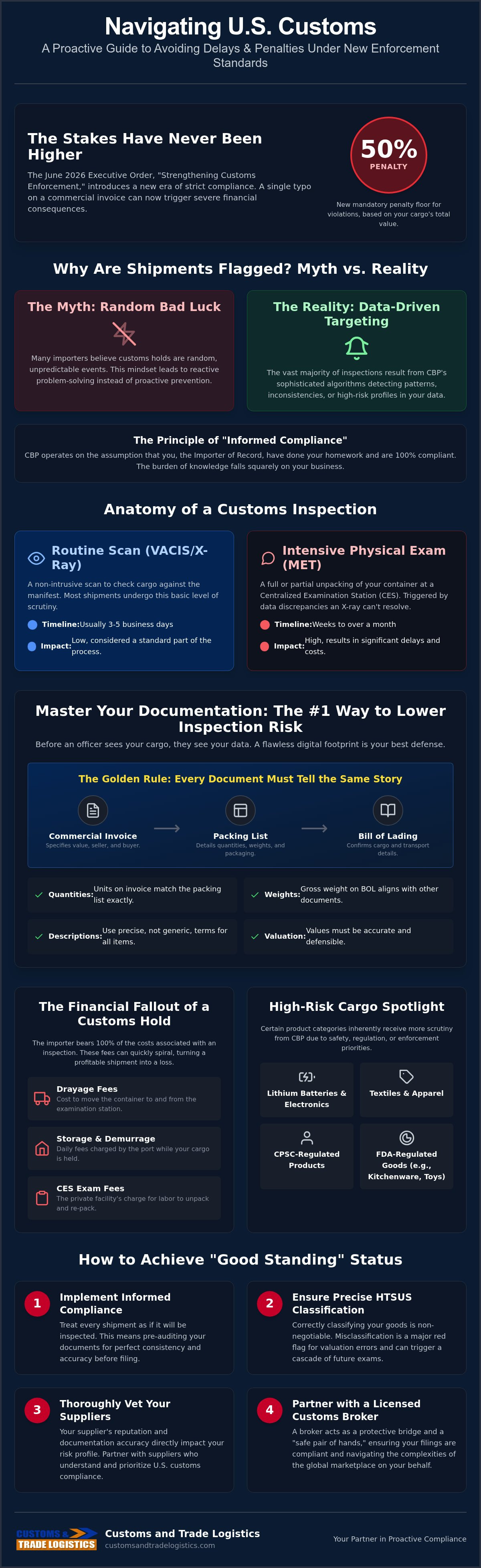
Many importers view a customs hold as a stroke of bad luck, like getting caught in a sudden rainstorm without an umbrella. However, the reality is far more systematic. The U.S. Customs and Border Protection (CBP) operates on a model known as "Informed Compliance." This principle shifts the burden of knowledge onto you, the Importer of Record. It assumes that if you're bringing goods into the country, you've done your homework and are 100% compliant with every regulation. When a shipment is flagged, it's often because the data provided doesn't align with the agency's expectations of a "good standing" importer.
To understand how to reduce the risk of a customs inspection, you first have to recognize the different levels of scrutiny. Most shipments undergo a basic VACIS (X-ray) or CET scan, which are non-intrusive and usually completed within 3 to 5 business days. These are often routine. The real trouble begins with an Intensive Physical Exam, or MET (Manual Exam). This involves a full or partial unpacking of your container. These exams aren't just time-consuming; they're a signal that the CBP's targeting algorithms found a discrepancy that an X-ray couldn't resolve.
The Myth of Random Selection vs. Data Targeting
While some inspections are truly random, the vast majority are the result of sophisticated algorithmic targeting. CBP monitors patterns in your shipment history, your supplier's reputation, and the accuracy of your data. Certain categories are naturally "high-risk" and receive more scrutiny, including:
- Lithium batteries and electronics
- Textiles and apparel
- FDA-regulated goods like kitchenware or toys
- Products subject to the July 2026 mandatory eFiling requirements
The danger of a single mistake is the "tail" it creates. If your shipment is flagged for a valuation error or a misclassified HS code, your business profile earns a red flag. This can lead to a string of future inspections as the agency verifies that you've corrected your internal processes. Consistency is your best defense.
The Financial Impact of a Customs Hold
The financial burden of an inspection falls entirely on the importer. The government doesn't pay for the time it takes to prove your cargo is legal. You'll be responsible for drayage (the cost of moving the container), storage fees at the port, and the exam fee itself. These goods are typically moved to a Centralized Examination Station (CES), which is a private facility authorized by CBP to unpack and inspect cargo. Under the June 2026 Executive Order, the stakes are even higher, as the new penalty floor for violations is set at 50% of the cargo value. Proactive compliance isn't just about speed; it's about protecting your bottom line from these avoidable costs.
While customs brokers handle the paperwork, specialized domestic logistics are often required for the final delivery of heavy or high-value items. Professional services like Clear Lake Movers, Inc. can be invaluable when your commercial relocation involves sensitive equipment that requires expert handling after it leaves the port.
Master Your Documentation: The #1 Way to Lower Inspection Risk
Before an officer ever touches your container, they "see" your shipment through the data you transmit. This digital footprint is the most powerful tool you have when learning how to reduce the risk of a customs inspection. If the data is sloppy, a physical inspection is almost guaranteed. The Golden Rule of importing is simple: every document in your set must tell the exact same story. Discrepancies between the Commercial Invoice and the Packing List are low-hanging fruit for targeting algorithms that look for inconsistencies.
Most filing now happens through the Automated Commercial Environment (ACE). This system cross-references your data against millions of other entries in real-time. When you use generic terms like "Gift" or "Daily Necessities," you aren't being clever. You're signaling that you either don't know what's in your boxes or you're trying to hide something. Proactive preparation for strict customs inspections begins with a rigorous internal audit of these digital filings before they ever reach the port.
The Essential Triple-Check: Invoice, Packing List, and BOL
A successful entry requires a perfect match between your three core documents. Any deviation in weight, piece count, or value creates a "data mismatch" flag. Ensure your audit covers these specific points:
- Quantities: Do the number of units on the invoice match the packing list exactly?
- Weights: Does the gross weight on the Bill of Lading (BOL) align with the packing list total?
- Parties: Are the "Sold To" and "Ship To" addresses consistent and clearly identified across all forms?
CBP needs to know exactly where the goods were made. If the "Manufacturer of Origin" on your paperwork doesn't match the "Made in..." markings on the physical product, you've created an identity flag. Getting these details right is why many sellers rely on our customs clearance services to act as a final safety check before submission.
Avoiding Vague Product Descriptions
Vague descriptions are an invitation for an exam. A detailed description allows an official to rule out prohibited or high-risk items without ever opening the box. Contrast a "bad" description like "Plastic Parts" with a "good" one such as "Injection-molded PVC pipe fittings for residential plumbing." The latter tells the officer exactly what the item is, what it's made of, and how it's used. This level of detail builds trust in your "Informed Compliance" profile. Additionally, your Commercial Invoice must be in English or accompanied by a precise translation to prevent any misinterpretation that could lead to a costly hold.
Strategic Classification and Valuation: Avoiding Red Flags
Every item entering the U.S. must be translated into a specific number that the government understands. This is the Harmonized Tariff Schedule of the United States (HTSUS). If you're looking for how to reduce the risk of a customs inspection, you must treat classification as a precise science rather than a guessing game. CBP's Automated Commercial Environment (ACE) is designed to flag "tariff engineering," which is the practice of choosing a code solely to pay lower duties rather than accurately describing the product's function and material.
Choosing the Right HTSUS Code
The HTSUS code is a ten-digit string that serves as the DNA of your shipment. The first six digits are global standards, but the final four are specific to U.S. statistical and duty requirements. Why does this matter? Using a code that is "almost right" can trigger an audit if the duty rate for your chosen code is significantly lower than the industry standard for that product type. If your product is innovative or doesn't fit neatly into existing categories, we recommend obtaining a Binding Ruling from CBP. This formal letter provides legal certainty and acts as a shield against future misclassification claims. For a deeper dive into how these filings work, see our Customs Clearance Services guide.
Valuation and Anti-Dumping Duties
How much did you actually pay for your cargo? CBP uses the "Transaction Value" method as its primary standard, which is the price actually paid or payable for the goods when sold for export to the U.S. Under-valuation is a major red flag that targeting algorithms catch by comparing your declared value to similar shipments from the same region. With the 2026 enforcement overhaul setting a minimum penalty floor of 50% for violations, the risk of "shaving" a few dollars off your invoice simply isn't worth the potential loss of your entire shipment's profit margin.
You must also account for "Assists" in your financial data. If you provide your manufacturer with molds, tools, or even specific engineering plans for free or at a reduced cost, the value of those items must be legally added to the declared price of the goods. Additionally, be extremely cautious with products subject to Anti-Dumping or Countervailing Duties (AD/CVD). These items are under a constant microscope because they often involve trade disputes. If your goods are even remotely related to a category currently under an AD/CVD order, expect a much higher frequency of inspections and document requests.
Finally, if you buy from a foreign factory you own or have a financial interest in, you're involved in a "Related Party" transaction. CBP scrutinizes these closely to ensure the price hasn't been artificially lowered to reduce duty payments. Maintaining an "arm's length" pricing strategy and keeping detailed records of how your costs are determined is the only way to protect your "good standing" status. This level of transparency is essential when you're deciding how to reduce the risk of a customs inspection over the long term.
Proactive Risk Management: Vetting Suppliers and Logistics
Your choice of supplier is often the first data point that U.S. Customs evaluates. If you're wondering how to reduce the risk of a customs inspection, you must look closely at who you're doing business with. Under the June 2026 Executive Order "Strengthening Customs Enforcement," the agency has significantly narrowed the path for foreign entities. Foreign Importers of Record (IORs) are now required to use a CTPAT-validated U.S. customs broker or achieve CTPAT validation themselves. This shift highlights a clear reality: CBP values transparency and verified partnerships above all else.
Physical security at the point of origin is equally vital. Ensuring your cargo is loaded into a container with high-security seals and documented correctly is a basic but essential step. You should also view your Customs Bond as a strategic tool rather than just a mandatory fee. Starting in late November 2026, all IORs face heightened minimum bond coverages and must prove minimum levels of domestic assets. Maintaining a robust bond and a clean compliance history signals to the authorities that you're a serious, low-risk partner who values the rules of the road.
Vetting Your Foreign Suppliers
Before you wire a deposit, you must verify that your supplier isn't on a government "Blocked Persons" or "Entity List." Importing from a blacklisted manufacturer can lead to the immediate seizure of your goods and a permanent red flag on your business profile. Additionally, every single unit must have an accurate "Country of Origin" marking that's permanent and legible. Failure to mark goods correctly is one of the fastest ways to trigger a "Tail Gate" inspection. For a detailed look at managing these foreign relationships, read our Import From China Logistics guide.
Special Considerations for Amazon FBA Sellers
Amazon sellers face a unique set of challenges because they often operate without a physical domestic office. CBP frequently targets FBA shipments for "Ultimate Consignee" errors. This happens when an importer incorrectly lists Amazon as the owner of the goods on the entry paperwork. Remember, you're the owner; Amazon is merely the destination. Correct labeling is also critical to avoid "Intellectual Property Rights" (IPR) seizures, which are common if your branding or packaging is even slightly confusing to trademark officials.
If a shipment is flagged, having a domestic partner to handle delivery and redistribution services is a lifesaver. This allows you to reroute goods for labeling corrections or secondary sorting without losing your entire FBA delivery window or facing massive storage fees. For more tailored advice, check our Amazon Seller Import Help guide.
How a Licensed Customs Broker Protects Your Supply Chain
What if the only thing standing between your cargo and a massive storage bill is a single phone call? While many purely digital platforms promise speed through automation, they often lack the human advocacy required when a shipment is actually on hold. A licensed customs broker acts as your professional "safe pair of hands" in an environment where the rules change almost weekly. If you're serious about learning how to reduce the risk of a customs inspection, you need a partner who understands the nuances behind the data, not just someone who pushes buttons on a screen.
A traditional, family-owned broker provides a level of protective care that algorithms can't replicate. When U.S. Customs and Border Protection (CBP) issues a "Request for Information" (CBP Form 28) or a "Notice of Action" (CBP Form 29), the clock starts ticking immediately. These documents are formal inquiries into your classification, valuation, or country of origin. Having a seasoned mentor to draft a precise, legally sound response can be the difference between a quick resolution and a permanent red flag on your importer profile.
Beyond Filing: The Broker as an Advocate
What happens when a shipment is flagged at the port? This is where your broker's relationship with port officials becomes invaluable. We don't just wait for the status to change; we communicate directly with the port to understand the nature of the hold and provide the necessary documentation to clear it. At Customs and Trade Logistics, we manage the end-to-end logistics chain to ensure your data remains consistent from the factory floor to the final delivery point.
We believe in "Pre-Entry" audits. This means we catch potential mistakes, such as vague descriptions or HTSUS mismatches, before your shipment ever leaves the foreign port. By scrubbing your data early, we align your business with the "good standing" requirements mandated by the 2026 enforcement overhaul. This proactive oversight is a fundamental part of how to reduce the risk of a customs inspection over the long term.
Investing in Compliance to Save on Logistics
It's helpful to reframe custom brokerage service fees as an insurance policy for your supply chain. When you consider that a single intensive exam can easily cost $5,000 or more in drayage and storage fees, the cost of professional oversight is remarkably low. You aren't just paying for a filing; you're paying for the peace of mind that comes with 35 years of "seen-it-all" experience.
Navigating global trade doesn't have to be a source of constant anxiety. With the right advocate, you can replace unpredictability with a steady, reliable flow of goods. Don't let complex regulations stall your growth. Contact Customs and Trade Logistics for a Compliance Review today and let our family-owned team secure your path to the U.S. market.
Securing Your Supply Chain for 2026 and Beyond
Navigating the 2026 U.S. trade landscape requires more than just crossing your fingers at the port. By prioritizing document consistency and mastering precise HTSUS classification, you've already taken the biggest steps toward a smoother entry. Remember that your digital footprint in the ACE system is your first impression with CBP. Ensuring every weight, count, and description matches perfectly across your invoice and packing list is the most effective way to demonstrate "Informed Compliance."
Whether you're an Amazon FBA seller or a growing small business, you don't have to carry the burden of these complex regulations alone. Our family-owned team brings 35+ years of industry expertise to provide comprehensive end-to-end management from the factory floor to your doorstep. We specialize in demystifying trade laws and acting as a protective bridge for our partners. If you're ready to master how to reduce the risk of a customs inspection and stabilize your delivery timelines, we're here to help.
Let our 35 years of expertise protect your next shipment; Contact Customs and Trade Logistics today.
Your growth in the global marketplace is within reach, and with a reliable partner by your side, you can import with total confidence and peace of mind.
Frequently Asked Questions
How long does a typical U.S. Customs inspection take in 2026?
The timeline for an inspection depends largely on the type of exam performed. A basic VACIS scan usually finishes within 3 to 5 business days after the container is available at the terminal. A targeted CET scan is often faster, completing within 24 to 48 hours of vessel berthing. However, if your cargo moves to a full manual exam at a Centralized Examination Station, you should prepare for delays of a week or more.
Can I refuse a customs inspection if I think it is unfair?
You cannot legally refuse a customs inspection. U.S. Customs and Border Protection has the absolute authority to examine any cargo entering the country to ensure safety and compliance. Refusing to cooperate or denying access to your goods will lead to the immediate seizure of your shipment and potential legal penalties. Instead of resisting, focus on proactive compliance to learn how to reduce the risk of a customs inspection before your goods arrive.
What is the most common reason for a shipment to be flagged by CBP?
Data discrepancies are the most frequent trigger for an inspection today. When the information on your Commercial Invoice doesn't match your Packing List or Bill of Lading, the agency's targeting algorithms flag the entry for review. Common mismatches include differing piece counts, weights, or vague product descriptions. Maintaining perfect consistency across your entire document set is the most effective way to keep your shipments moving without human intervention.
Does having a Customs Bond reduce the risk of an inspection?
A Customs Bond is a mandatory requirement for formal entries, so having one doesn't automatically grant you a "pass." However, maintaining a continuous bond and a clean compliance history contributes to your "good standing" as an importer. Under the 2026 regulations, a robust bond paired with a history of accurate filings signals to CBP that you are a low-risk partner, which can lower your overall frequency of exams over time.
How much do customs inspection fees usually cost for a single container?
Inspection costs vary significantly depending on the port and the intensity of the exam. You are responsible for drayage to move the container to an exam site, storage fees while it sits, and the labor costs for the facility to unpack and repack your goods. While these are industry fees rather than government taxes, a full physical exam can easily reach several thousand dollars. This is why professional oversight is a smart investment.
What happens if Customs finds an error in my HTSUS classification?
If CBP finds a classification error, you will likely face an adjustment in duties and potential penalties. Under the June 2026 Executive Order, violations can trigger a minimum penalty floor of 50% of the cargo value. Beyond the immediate cost, a misclassification creates a red flag on your importer profile. This often leads to a "tail" of future inspections as the agency monitors your business for continued compliance.
Can an Amazon FBA seller act as their own Importer of Record?
Amazon FBA sellers can and must act as their own Importer of Record. Amazon explicitly refuses to act as the IOR for third-party shipments. You must ensure your business is correctly identified on all entry paperwork. A common mistake is listing Amazon as the "Ultimate Consignee" incorrectly, which is a frequent trigger for holds. Having a domestic partner can help you manage these specific regulatory requirements with total confidence.
Is it possible to "pre-clear" a shipment before it arrives at a U.S. port?
You can technically file for clearance before the vessel arrives. By submitting your data through the Automated Commercial Environment (ACE) while the goods are still in transit, you allow CBP to review your entry early. This doesn't guarantee you'll skip an inspection, but it does mean any "paperwork" holds can be resolved before the container hits the dock. This early filing is a core component of how to reduce the risk of a customs inspection.


