
You've tracked your shipment across the Pacific for weeks, only to see it stall at the port with a status update you didn't plan for: "Held for Exam." It's a frustrating moment that often feels like losing control of your own supply chain, especially when you're worried about the impact on your bottom line. We understand that the fear of hidden fees from a Centralized Examination Station (CES) can turn a successful import into a logistical headache.
It's true that CBP inspections are harder to predict in 2026, but they don't have to be a total mystery. This guide provides a clear breakdown of the different types of customs exams and their costs, from the quick $150 VACIS scan to the more involved $1,000+ Intensive physical inspections. We'll walk you through the typical timelines for each exam and show you exactly how fees like drayage and storage are calculated. By the end of this article, you'll have a practical strategy to minimize your inspection frequency and keep your cargo moving toward its final destination with total peace of mind.
Key Takeaways
- Understand how U.S. Customs uses a "Targeting Score" to flag cargo and why keeping your documentation 100% accurate is your best defense.
- Gain a detailed breakdown of the four main types of customs exams and their costs, so you can budget for everything from a quick VACIS scan to a full physical inspection.
- Learn to identify the indirect fees that often surprise importers, such as drayage costs to the exam site and labor charges from the Centralized Examination Station.
- Discover how a consistent, compliant importing history helps you build a "trust profile" with CBP to reduce the frequency of future inspections.
- See how partnering with a veteran broker provides a "safe pair of hands" to manage the entire exam process and advocate for your shipment's quick release.
Understanding the US Customs Examination Process
A customs exam is a formal review conducted by U.S. Customs and Border Protection (CBP) to verify that your goods match your paperwork and comply with safety regulations. While these inspections serve a vital security role, they represent a significant variable in your supply chain. CBP uses a sophisticated targeting system that assigns a score to every shipment based on data like the manufacturer's history and the specific tariff codes used. If your score hits a certain threshold, your container is automatically flagged for review.
One detail often catches new businesses off guard: the government doesn't cover the bill for these inspections. As the importer of record, you're responsible for every cent. This includes the labor to unload your goods, the equipment used, and the transportation to a specialized facility. Understanding the different types of customs exams and their costs is the first step in protecting your profit margins. When you know what to expect, you can build a buffer into your landed cost calculations rather than being blindsided by a bill at the port.
Why Your Shipment Was Selected
Why was your container pulled while others passed through? Sometimes it’s just the "luck of the draw" through random selection. Other times, it's targeted because of the country of origin, the type of commodity, or a discrepancy in your ISF filing. First-time importers are also under a microscope. CBP wants to verify that you're a compliant partner before they grant you a smoother path. If you're just beginning your journey, our guide on import logistics for startups can help you set up the right foundation to handle these initial hurdles.
The Role of the Centralized Examination Station (CES)
When CBP decides on a physical inspection, your container doesn't stay at the pier. It moves to a Centralized Examination Station (CES). A CES is a private facility authorized by Customs to unload and inspect cargo. Because these are private businesses, they set their own rates for labor, equipment, and storage. Your broker acts as the bridge here, coordinating with the CES and CBP to ensure the process moves as quickly as possible. Knowing the various types of customs exams and their costs helps you anticipate these private-sector fees before your shipment even arrives. Having a veteran advocate in your corner ensures that your goods aren't sitting idle longer than necessary, as daily storage fees can quickly spiral out of control.
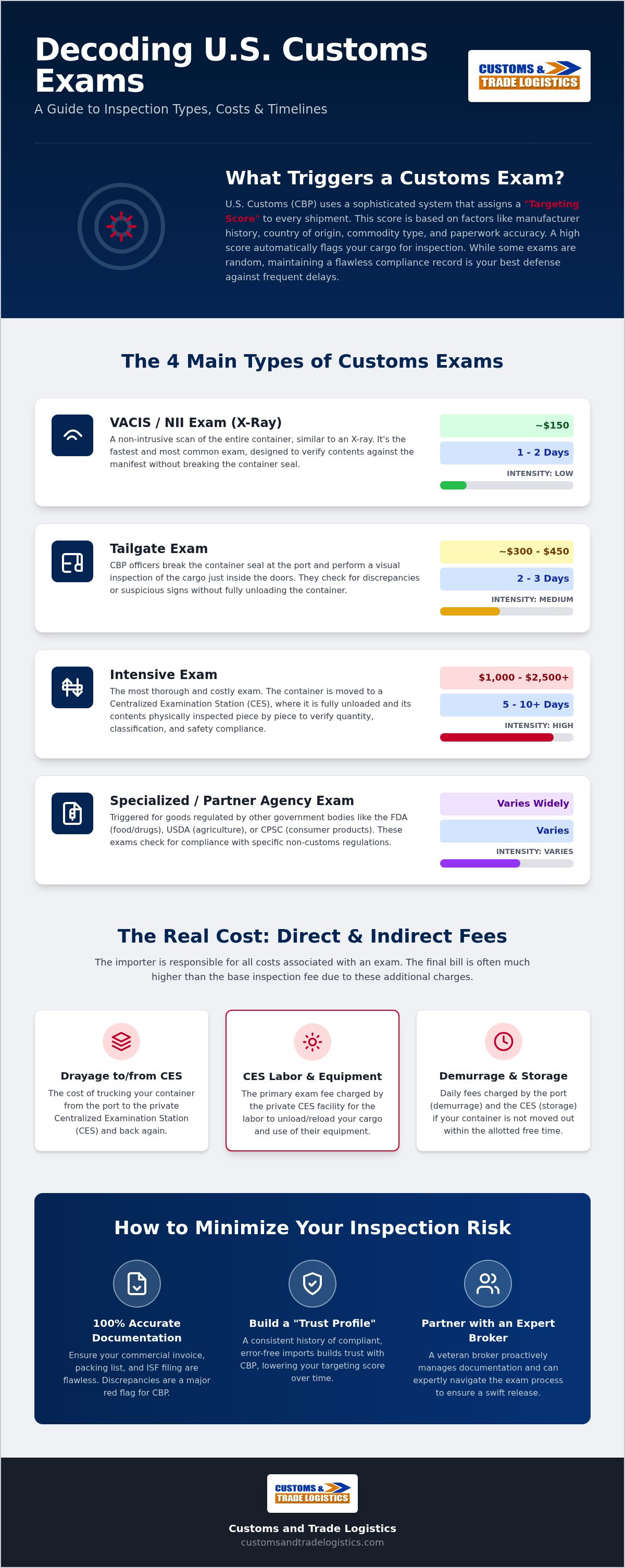
The 4 Main Types of Customs Exams and Their Timelines
Customs examinations aren't a one-size-fits-all event. They operate on a clear hierarchy where the level of scrutiny directly dictates the impact on your schedule and budget. Understanding the specific types of customs exams and their costs is essential for any importer who wants to maintain a predictable supply chain. In 2026, high volumes at major ports mean that even a "quick" inspection can be delayed by several days simply because your container is waiting in a queue at the examination station.
The intensity of the exam also influences the risk of cargo damage. While a simple X-ray is harmless, a full physical inspection involves multiple hands touching your goods. Knowing which exam your shipment is facing helps you set realistic expectations for your customers and your warehouse team. Let's look at the four primary ways CBP might inspect your cargo.
Non-Intrusive Inspections: VACIS and Tailgate Exams
The most common starting point is a Non-Intrusive Inspection (NII), frequently referred to as a VACIS exam. This is essentially a giant X-ray or Gamma Ray scan of your container. It's the least disruptive option, typically completed within 24 to 48 hours. If the scan matches your manifest, your cargo is released without a single box being moved.
A Tailgate exam is slightly more involved. In this scenario, CBP officers open the container doors at the pier to look for anything obvious or to verify the loading pattern. They don't actually unload the goods, but this visual check can take 2 to 3 days for ocean freight. If an officer spots a discrepancy or smells something unusual, they'll likely escalate the shipment to a more intensive search facility. Quick communication during this stage is vital, and having an expert customs clearance service can help you stay informed the moment a status change occurs.
Intensive and Specialized Exams (MET and CET)
An Intensive Exam, or a Manifest Examination Team (MET) inspection, is the most rigorous process. Your container is trucked to a Centralized Examination Station (CES), where it's fully unloaded. Every pallet is inspected, and boxes may be opened for physical counting. Because of the labor involved and the need for a bonded facility, these exams often cause delays of 7 to 14 days.
Specialized exams like the Contraband Enforcement Team (CET) focus on high-risk issues like narcotics or intellectual property rights. These usually take 2 to 5 days. During these inspections, CBP might take a "sample," meaning they remove a portion of your goods for laboratory testing. Navigating the various types of customs exams and their costs becomes much easier when you have a seasoned partner who understands these procedural nuances and can advocate for the safety of your cargo throughout the process.
Calculating the Real Cost: Direct and Indirect Fees
When you're budgeting for a shipment, it's easy to focus on the freight rate and duties. However, a customs hold triggers a domino effect of expenses that can quickly eclipse the initial shipping cost. To truly understand the types of customs exams and their costs, you have to look beyond the inspection itself. You aren't just paying for an officer's time; you're paying for a logistical event that involves specialized trucking, warehouse labor, and equipment usage at a private facility.
In 2026, these costs are more than just line items; they're potential threats to your cash flow. If your container is pulled for an exam, you'll face direct fees from the Centralized Examination Station (CES) and indirect penalties from the terminal. Because the CES is a private business, they charge for every touch, from moving the container with a reach stacker to the manual labor of devanning your pallets.
Direct CES Fee Estimates for 2026
The price you pay depends heavily on the intensity of the search. For non-intrusive inspections like the VACIS scan, you can expect to pay between $150 and $400. Tailgate exams, where the container is opened but not fully unloaded, typically fall in a similar $150 to $400 range. These are the "best-case" scenarios for an importer's budget.
The financial impact shifts dramatically with an Intensive Exam. Because these require a full unloading of the cargo, labor costs frequently exceed $1,000 per container. You also have to factor in drayage. Moving your container from the pier to the CES facility usually costs between $300 and $600 per trip. If you're importing Less than Container Load (LCL) cargo, your costs are generally lower than Full Container Load (FCL) shipments, but you're still responsible for your proportional share of the facility's handling fees.
The Hidden Cost of Delays: Demurrage and Detention
The real "budget killers" aren't always the exam fees themselves, but the penalties that accrue while your goods are sitting still. Most ocean carriers offer 3 to 5 days of "free time" at the port. Crucially, the clock doesn't stop just because CBP has placed a hold on your cargo. If an intensive exam takes 14 days, you could face over a week of demurrage charges, which currently range from $150 to $350 per day at major US ports.
Storage fees at the examination site add another layer of expense, with 2026 rates averaging $0.35 to $0.55 per cubic foot. These compounding costs make it vital to have a clear view of your total liabilities. Understanding how these expenses interact with your overall custom brokerage service fees helps you build a more resilient financial plan. We always tell our clients that being prepared for these "hidden" costs is what separates a sustainable import business from one that's constantly put on its heels by port authorities.
Strategies to Minimize Examination Risks and Delays
You can't stop a random inspection, but you can certainly lower the odds of your cargo being flagged. CBP uses a data-driven approach to select shipments, and your goal is to look as "low-risk" as possible on paper. Consistency is your greatest ally here. Every successful, clean entry you file builds your "trust profile" with port authorities. Over time, this history of compliance acts as a shield, potentially reducing the frequency of the more intrusive types of customs exams and their costs that often catch unorganized importers by surprise.
A continuous Customs Bond is another practical tool for speed. While a single-entry bond is fine for a one-off shipment, a continuous bond signals to CBP that you're a long-term, committed importer. It streamlines the paperwork process and ensures your cargo isn't held up simply because of a bonding technicality. If you want to ensure your entries are handled with this level of care, our team provides the customs clearance services you need to keep your profile clean.
Paperwork Precision: Avoiding the Red Flag
HTS classification errors are one of the most common triggers for a Trade or CET exam. If your Commercial Invoice says "metal brackets" but your Packing List and HTS code suggest "automotive parts," the discrepancy will trigger an alert. CBP expects these documents to match perfectly. A seasoned broker acts as a second pair of eyes, catching these small errors before they reach the terminal. We often see "silly" mistakes, like a missing manufacturer’s address or a vague product description, turn into a week-long hold at a CES facility. Proper labeling on your boxes also helps. If an officer can easily see what’s inside during a Tailgate exam, they're less likely to order a full unloading.
Special Considerations for Amazon FBA Sellers
For Amazon sellers, a customs delay is more than a fee. It's a risk to your inventory health and your Buy Box status. Because FBA windows are so tight, you must build a 10-day buffer into your factory-to-warehouse timeline. This protects you from the compounding types of customs exams and their costs like storage and demurrage. When choosing FBA freight forwarding services, ensure your partner understands the specific labeling requirements of both CBP and Amazon. If a hold occurs, communicate with Amazon immediately. Providing them with the exam notice can sometimes help mitigate penalties for late inventory arrival, though it's always better to have that time buffer in place from day one.
Navigating the Exam Process with an Expert Broker
Facing a customs hold can feel like you're standing alone against a massive bureaucracy. It’s in these moments that the value of a dedicated advocate becomes clear. At Customs and Trade Logistics, we bring over 35 years of industry experience to every shipment we handle. We don't just view an inspection as a status on a screen; we see it as a logistical event that requires active management. Our long-standing relationships with port authorities and Centralized Examination Stations across the country allow us to act as your "safe pair of hands," ensuring your cargo is treated with care and prioritized for release.
Being a family-owned firm means our support is personal. When a crisis hits, you aren't stuck in a phone tree; you're talking to a mentor who understands how a delay impacts your specific business. We’ve seen every variation of the types of customs exams and their costs, and we use that history to anticipate problems before they happen. Our goal is to replace your anxiety with a sense of security, providing the oversight needed to navigate even the most complex CBP requirements.
Proactive Communication and Oversight
Our work begins long before your container touches the pier. We monitor your shipment's status in real-time, allowing us to react instantly the moment a hold is placed. If an inspection is ordered, we immediately coordinate the drayage to the CES to minimize idle time at the terminal. This speed is crucial because, as we've discussed, the demurrage clock never stops. Once the exam is complete, we meticulously review every line item on the CES invoice. We ensure you aren't being overcharged for labor or equipment, protecting your budget from the common "hidden" fees that often accompany different types of customs exams and their costs.
Your Partner in Long-Term Compliance
A successful release is just the first step. We help you move beyond the immediate crisis by building a robust customs clearance services us strategy that focuses on long-term compliance. By consulting on your import from China logistics, we can help you improve your targeting score and reduce the likelihood of future flags. We believe that global trade should be accessible and manageable for every business, regardless of size. If you're ready for a stress-free clearance experience with a partner who truly cares about your growth, contact Customs and Trade Logistics today. We're here to bridge the gap between your business and the global marketplace.
Take Control of Your 2026 Import Strategy
Understanding the various types of customs exams and their costs is the first step toward a more stable supply chain. While you can't always avoid a random check, you can certainly prepare for the financial and logistical impact. By prioritizing document accuracy and building a consistent trust profile with CBP, you turn an unpredictable hurdle into a manageable part of your business operations. Knowledge is your best tool for protecting your margins from the "domino effect" of port fees and delays.
You don't have to navigate these complexities alone. As a family-owned firm with 35+ years of experience, we specialize in helping small businesses and Amazon FBA sellers clear their goods at all US ports. We act as your advocate at the exam station, ensuring your cargo stays moving and your interests are protected. Let us handle your customs clearance and minimize your exam stress today. With a safe pair of hands managing your logistics, you can focus on growing your business with total peace of mind. We're ready to help you succeed in the global marketplace.
Frequently Asked Questions
How much does a typical customs exam cost in 2026?
A typical customs exam costs anywhere from $150 for a basic X-ray scan to over $1,000 for a full physical inspection. These figures represent the direct labor and equipment fees charged by the examination station. However, you must also budget for drayage trucking and potential port storage penalties. Understanding the different types of customs exams and their costs helps you prepare for these varied financial scenarios before your cargo arrives.
How long does a US Customs exam usually take?
The duration of an inspection depends on its complexity. A VACIS scan is usually finished within 24 to 48 hours, while a Tailgate exam might take 2 to 3 days. If your shipment is flagged for an Intensive Exam, expect a delay of 7 to 14 days. These timelines can stretch even further if the port is experiencing high congestion or if the examination facility has a significant backlog of containers.
Can I choose which CES facility my cargo goes to?
You cannot choose the Centralized Examination Station (CES) for your cargo. U.S. Customs and Border Protection designates specific facilities to handle inspections for each port of entry. Your shipment'll be directed to the facility that has the contract for that particular type of exam. While you don't have a choice in the location, your broker works directly with the assigned facility to ensure your goods are processed as efficiently as possible.
Why was my shipment selected for an intensive exam if I have a bond?
Having a customs bond is a legal requirement for importing, but it doesn't exempt you from inspections. CBP uses a scoring system to flag shipments based on risk factors like origin, commodity type, or manufacturer history. Even with a continuous bond, your cargo might be selected for an intensive exam if the automated system identifies a discrepancy or if the agency is conducting a random compliance check on your specific industry.
What happens if CBP damages my goods during an inspection?
It's a tough reality, but the government is typically not held liable for damage that occurs during a lawful inspection. If your goods are damaged at the CES, the responsibility usually falls on the importer. This is why proper packing and clear labeling are so critical. We always recommend that you carry comprehensive cargo insurance to protect your investment against the physical risks associated with the more intrusive types of customs exams and their costs. You can read more about protecting your global logistics operations with specialized coverage.
Will a customs exam happen on every shipment I import?
Customs exams don't happen on every shipment. Most cargo passes through the port without a physical hold. However, if you're a new importer or if you're bringing in high-risk commodities, your frequency of inspection will likely be higher. As you build a consistent history of accurate filings and compliance, your "trust profile" improves, which can lead to fewer flags from the CBP automated targeting system over time.
How do I pay the fees associated with a customs hold?
You pay these fees directly to the private entities involved, such as the CES facility and the trucking company. These are not government taxes. Most importers have their customs broker handle these payments on their behalf to prevent further delays. Your broker'll then invoice you for the total amount, including the examination labor, drayage, and any storage charges that accrued while the shipment was under a hold.
Can my customs broker speed up the examination process?
While a broker can't dictate the CBP schedule, they play a vital role in speeding up the surrounding logistics. We ensure that all requested documents are submitted instantly and coordinate the immediate transport of your container to and from the CES. By staying in constant contact with the facility, we make sure your shipment doesn't sit idle once the officers have completed their review, saving you precious days of storage fees.


