

Self-clearing your ocean freight might feel like an easy way to trim expenses, but it often becomes the most costly gamble an expanding business can take. With marine terminal demurrage and detention fees costing U.S. importers over $5 billion annually, a single documentation discrepancy or classification error can quickly wipe out your profit margins. Learning the warning signs you need to hire a customs broker is the turning point between stressful port delays and a steady, predictable supply chain.
If you feel exhausted juggling strict Importer Security Filing deadlines, tangled tariff codes, and the threat of surprise customs exams, you aren't alone. Managing border regulations while running daily operations is a heavy burden for any growing team. This diagnostic guide helps you evaluate your actual import risk, protect your bottom line from regulatory penalties, and establish reliable cargo release across every national port of entry. Here is how to determine when your operations have outgrown self-filing and require a trusted compliance partner to step in.
Key Takeaways
- Learn the operational signs you need to hire a customs broker when your commercial volume shifts from small courier parcels into mandatory formal cargo entries.
- Discover how multi-material products and strict Partner Government Agency requirements can trigger costly border inspections without precise tariff classification.
- Identify the early procedural warnings that lead to spiraling terminal demurrage fees and missed Importer Security Filing deadlines.
- Understand how meeting rigid retail and Amazon FBA fulfillment standards requires proactive clearance coordination before freight ever leaves the supplier dock.
- Use our decision checklist to vet customs professionals based on nationwide clearance authority, deep trade lane experience, and dedicated compliance support.
Operational Volume Signs: When Shipment Scale Forces Professional Customs Clearance
Every growing business reaches an inflection point where informal shipping workarounds simply collapse under their own weight. What worked smoothly for a few small sample boxes quickly turns into a compliance bottleneck once you begin moving palletized freight or full shipping containers. Recognizing the physical operational signs you need to hire a customs broker lets you protect your margins before your cargo arrives at a congested terminal without clearance.
The Shift from Informal to Formal Commercial Entries
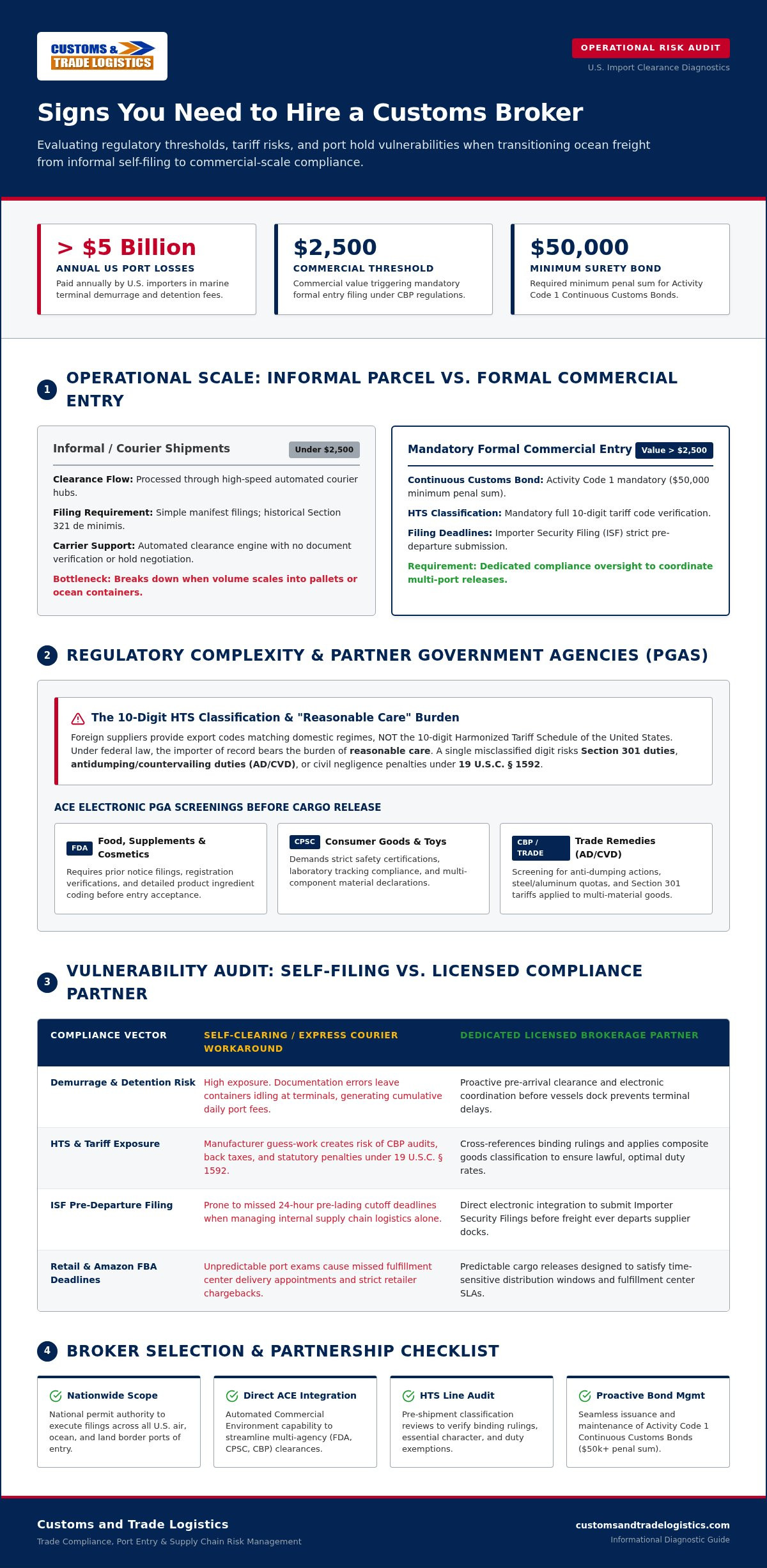
U.S. Customs and Border Protection (CBP) draws a strict line between casual importing and commercial business operations. Shipments with an entered commercial value exceeding $2,500 legally require formal entry filings. While micro-shipments historically slid by under Section 321 de minimis exemptions, ongoing regulatory suspensions mean all commercial imports now face full customs review and 10-digit tariff classification.
Crossing that $2,500 threshold triggers mandatory legal requirements, including obtaining an Activity Code 1 continuous customs bond with a minimum penal sum of $50,000. Filing these entries manually while trying to coordinate container arrivals across multiple domestic ports creates unnecessary exposure. If you find yourself spending hours inputting commercial invoices, managing entry summaries, and verifying surety bonds, your administrative capacity has reached its limit.
Transitioning from Express Couriers to Freight Forwarding
Integrated express carriers handle routine parcel deliveries reasonably well, but their automated clearance engines offer zero support when you scale to larger cargo volumes. Express carriers process volume through high-speed automated hubs. They won't challenge inaccurate duty assessments, provide pre-departure document reviews, or negotiate port holds on your behalf.
Partnering with a licensed customs broker bridges the gap between factory floor pickup and domestic delivery. As we explore in our comprehensive breakdown of import logistics for startups, moving ocean containers or consolidated air freight demands proactive oversight. When your supply chain graduates from individual cartons to full container loads, losing visibility or relying on courier call centers are decisive signs you need to hire a customs broker to manage your national trade lanes.
Regulatory Complexity Signs: Navigating HTS Classifications and PGA Oversight
Importing simple single-material items is straightforward, but product lines rarely stay simple as your business expands. Adding components, coatings, or accessories creates immediate tariff classification puzzles. If you find yourself guessing which ten-digit code matches your new SKU, you are facing one of the most serious regulatory signs you need to hire a customs broker.
Harmonized Tariff Schedule (HTS) Ambiguity and Duty Exposure
Relying on the tariff code provided by your overseas manufacturer is a dangerous shortcut. Foreign suppliers use their local export nomenclature, which rarely aligns perfectly with the 10-digit Harmonized Tariff Schedule of the United States. Under federal law, the legal burden of reasonable care falls entirely on you as the importer of record.
A single misclassified digit can trigger significant Section 301 additional duties, antidumping or countervailing duties (AD/CVD), or severe CBP negligence penalties under 19 U.S.C. § 1592. Licensed customs brokers evaluate the essential character of composite merchandise. They cross-reference binding classification rulings, ensuring you pay the lawful rate without risking retroactive audits or surprise bills years down the road.
Partner Government Agency (PGA) Compliance Traps
Customs clearance is no longer just about paying duties to CBP. The Automated Commercial Environment (ACE) now integrates dozens of Partner Government Agencies that screen cargo before container release. Red flags multiply quickly if you bring in goods subject to specialized oversight:
- Food, Supplements, and Cosmetics: Require FDA prior notice, registration verification, and product ingredient coding.
- Consumer Goods and Toys: Mandate Consumer Product Safety Commission (CPSC) certificates and lab compliance testing.
- Chemicals and Electronics: Demand EPA Toxic Substances Control Act (TSCA) positive or negative certifications.
Missing a single electronic PGA message set causes instant port holds. For comprehensive guidance on structuring these complex entries correctly, explore our guide to customs clearance services us. According to U.S. Customs and Border Protection broker guidelines, licensed professionals must execute filings with exact regulatory precision. If ambiguous product regulations are delaying your shipments, partnering with a knowledgeable specialist through Customs and Trade Logistics helps you clear complex agency checks safely and consistently.
Financial Warning Signs: Mounting Demurrage, Examination Holds, and Penalties
Unexpected port invoices drain cash reserves faster than almost any other supply chain surprise. When cargo gets stuck at the terminal, the charges accumulate daily without mercy. Unplanned port fees and non-compliance fines represent urgent financial signs you need to hire a customs broker who can safeguard your cash flow before goods leave foreign docks.
Demurrage, Detention, and Storage Fee Escalation
Marine terminals grant a brief window of free time, typically three to five business days after a container is discharged from the vessel. Once that window shuts, daily demurrage kicks in immediately. These charges escalate rapidly: terminal storage often starts around $150 to $225 per day, climbing past $500 per day after the tenth day on the dock. In fact, a ten-day overrun on a single 40-foot ocean container averages roughly $2,900 in terminal demurrage alone, completely separate from equipment detention and chassis fees.
Clerical omissions trigger the vast majority of these holds. For example, failing to submit your Importer Security Filing (ISF 10+2) at least 24 hours prior to loading at the foreign port prompts CBP liquidated damages of $5,000 per violation. When shipments get flagged for a Centralized Examination Station (CES) intensive inspection, devanning, drayage, and exam facility handling routinely tack on another $1,000 to $2,500. A dedicated broker reviews every document proactively before departure, ensuring direct terminal release the moment the vessel berths.
The Hidden Costs: DIY Clearing vs. Professional Brokerage
Self-filing often seems like a thrifty route until an unexpected audit or document hold upends your balance sheet. Consider the practical differences between self-filing and partnering with a licensed professional:
- Filing Accuracy: Researching thousands of product codes using the official Harmonized Tariff Schedule search tool requires deep technical expertise. A licensed broker assigns verified 10-digit codes that eliminate valuation errors and stave off Section 1592 negligence penalties.
- Surety Management: Purchasing individual single transaction bonds for every ocean shipment drains working capital. A broker structures an annual continuous customs bond, which typically breaks even after just four formal entries per year.
- CBP Inquiry Resolution: Receiving a CBP Form 28 (Request for Information) or Form 29 (Notice of Action) creates immediate panic for self-filers. Experienced brokers craft substantiated, compliant legal responses to protect your importing privileges.
Transparent operational costs are always far cheaper than emergency crisis management. Understanding the predictable structure of custom brokerage service fees provides total budget certainty. If you are constantly battling surprise terminal storage charges or audit notices, treat those expenses as unmistakable signs you need to hire a customs broker immediately.
Supply Chain Channel Signs: Meeting Strict Amazon FBA and Retail Delivery Deadlines
Expanding into major retail channels and marketplace fulfillment networks changes the operational stakes. When freight arrives late, you don't just pay terminal storage; you risk depleted buy boxes, cancelled retail purchase orders, and severe vendor chargebacks. Struggling to meet rigid warehouse receiving windows is one of the clearest signs you need to hire a customs broker who understands integrated freight movement.
Amazon FBA Inbound Compliance and Strict Delivery Deadlines
Amazon enforces unforgiving inbound compliance standards for marketplace sellers. Crucially, Amazon explicitly refuses to act as the Importer of Record or declarant on customs entries. If an ocean container or air shipment arrives at an Amazon fulfillment center without completed customs clearance, or lists Amazon as the importing party, facility managers will reject the delivery on the spot. You bear every dollar of return freight, re-routing, and terminal detention charges.
Even minor border holds cause missed dock appointments, which rapidly drag down your seller performance metrics. Overcoming this hurdle requires tightly synchronized cargo release, prompt container drayage, and de-vanning before cargo enters the fulfillment network. Explore our dedicated analysis of FBA freight forwarding services to see how proactive entry filing protects inventory schedules.
Complex Sourcing Routes from Chinese Manufacturing Hubs
Managing high-volume trans-Pacific supply chains out of industrial hubs like Ningbo, Shenzhen, or Shanghai introduces distinct operational hurdles. Overseas suppliers often issue commercial invoices and packing lists that fail to match actual container manifests or bills of lading. Without early intervention, those discrepancies sit dormant until U.S. Customs flags the shipment upon arrival.
Catching paperwork mismatches at origin before vessels depart prevents expensive terminal holds down the line. As covered in our strategic guide to import from China logistics, coordinating origin documentation directly with manufacturers ensures smooth entry processing across every national port of entry. If managing overseas trade lanes while coordinating domestic cargo redistribution is consuming your working hours, these bottlenecks are obvious signs you need to hire a customs broker.
Stop risking stockouts and costly supply line delays. Partner with Customs and Trade Logistics to secure dependable international freight logistics, China import consulting, and delivery redistribution tailored to your business needs.
Checklist for Action: How to Select and Partner with the Right Customs Broker
Once you recognize the operational bottlenecks in your supply chain, taking decisive action is essential. Finding the right partner isn't merely about checking a box; it's about securing an experienced advocate who treats your cargo with dedicated care. When evaluating potential compliance partners, use this vetting checklist to ensure your business receives the strategic protection it deserves.
Key Vetting Criteria for Your Broker Partnership
Avoid impersonal software platforms that treat entries like automated tickets. If unexpected inspection holds or complex paperwork queries arise, automated portals leave you stranded in anonymous customer service queues. Instead, evaluate brokers using these proven criteria:
- National Filing Authority: Following customs modernization, individual district permits are obsolete. Verify that your broker maintains national permit authority to process air, ocean, rail, and truck entries through every domestic port.
- Lane and Commodity Expertise: Deep familiarity with your sourcing corridors matters. Prioritize teams with decades of hands-on experience managing trans-Pacific ocean freight, air shipments, and factory coordination.
- End-to-End Service Integration: Smooth logistics requires unified movement. Look for providers that pair customs clearance with integrated freight forwarding and domestic delivery redistribution so your containers move directly off the pier.
Onboarding Your Broker: Required Documentation and Setup
Transitioning to professional oversight is a straightforward, methodical process designed to give you immediate peace of mind. Getting started requires just a few foundational compliance steps:
Under 19 CFR § 111.36, federal rules mandate that licensed brokers execute a direct Customs Power of Attorney (POA) with the importer of record. This legal document authorizes your broker to transact customs business, classify items, and remit duties on your behalf. Next, your broker files CBP Form 5106 to establish or update your verified legal identity within the Automated Commercial Environment. Finally, they help secure an annual continuous customs bond, ensuring your upcoming shipments clear without transactional bond surcharges.
Navigating commercial trade regulations shouldn't drain your daily focus. If mounting compliance demands are revealing the signs you need to hire a customs broker, team up with a seasoned mentor who can carry the administrative weight. Take control of your imports and protect your bottom line with over 35 years of family-owned experience at Customs and Trade Logistics.
Transform Your Import Compliance into a Competitive Advantage
Self-clearing cargo may feel manageable in the early days, but expanding shipment volumes, tricky tariff classifications, and unforgiving retail delivery windows quickly demand seasoned oversight. Spotting the signs you need to hire a customs broker is about much more than avoiding sudden dock charges. It's about establishing an orderly, predictable foundation so your business can scale without border friction or administrative exhaustion.
You don't have to shoulder the complicated demands of global trade by yourself. Backed by over 35 years of hands-on, family-owned leadership, we provide nationwide customs clearance across all U.S. commercial entry ports. Whether you need specialized consulting for container shipments from China, ocean freight management, or precise Amazon FBA inventory coordination, our dedicated team is here to act as your safe pair of hands. When you are ready to streamline your supply chain and protect your bottom line, partner with Customs and Trade Logistics for reliable national customs clearance and experience true peace of mind.
Frequently Asked Questions
Is hiring a licensed customs broker legally required for all US imports?
No, U.S. Customs and Border Protection doesn't legally require you to hire a licensed customs broker. Importers have the legal right to clear merchandise themselves. Doing so means you personally accept full legal liability for valuation, classification accuracy, and compliance under federal reasonable care statutes. For growing businesses, self-clearing becomes practically unmanageable, making administrative strain one of the prime signs you need to hire a customs broker.
At what dollar amount does an imported commercial shipment require a customs broker?
While not legally mandatory at a specific dollar threshold, commercial shipments exceeding $2,500 legally require formal customs entry. At this value, CBP requires formal entry documentation, an active customs bond, and full 10-digit tariff schedules. Because navigating formal entries without specialized electronic software is extremely complex, crossing the $2,500 mark is the standard volume threshold where businesses transition from DIY imports to hiring professional brokerage representation.
Can my international freight forwarder clear customs without a licensed broker?
No, freight forwarders cannot legally clear customs unless they employ licensed customs brokers in-house and hold a direct Power of Attorney signed by you. Forwarders handle physical cargo movement and booking. Under 19 CFR Part 111, only a licensed individual or corporate broker can file entry summaries, calculate duties, and communicate with CBP on your behalf. Always verify that your transportation partner maintains licensed brokerage authority.
What is the financial danger of misclassifying goods on customs paperwork?
Misclassifying merchandise triggers severe financial liabilities under 19 U.S.C. § 1592. If CBP discovers inaccurate Harmonized Tariff Schedule codes, your business faces back-due duties, accrued interest, and civil negligence penalties reaching up to twice the lost revenue. Misclassification can also trigger retroactive antidumping assessments or unexpected Section 301 tariffs. These sudden audit assessments can easily devastate cash reserves and jeopardize your importing privileges.
How far in advance should I hire a customs broker before shipping goods?
You should onboard a customs broker several weeks before your factory finishes production. Setting up a direct Power of Attorney, establishing your CBP Form 5106 importer identity, and securing a continuous customs bond takes time. For ocean cargo, your broker must electronically file the Importer Security Filing at least 24 hours before the container loads onto the vessel overseas to avoid $5,000 CBP late penalties.
Will a customs broker help me resolve unexpected customs holds or examinations?
Yes, managing port inspections is one of the most valuable services a licensed customs broker provides. When CBP flags a container for document verification or intensive physical inspection at a Centralized Examination Station, your broker communicates directly with port officers. They supply missing technical data, answer CBP inquiries, and work with terminal operators to expedite release, helping minimize accumulating daily demurrage fees.
Does Amazon act as the Importer of Record for my overseas FBA shipments?
No, Amazon strictly refuses to act as the Importer of Record for any seller shipment. If you list Amazon as the importer on customs paperwork or send uncleared freight to an Amazon fulfillment center, the facility will reject your delivery immediately. Experiencing inbound delivery delays or inventory appointment rejections are definite signs you need to hire a customs broker to ensure proper clearance before cargo arrives at domestic docks.


