

Did you know that de minimis import volumes surged to over 1.36 billion shipments before the recent federal crackdown? This explosion in parcel volume changed everything for online sellers, making import logistics for e-commerce businesses one of the most complex hurdles to scaling a brand in 2026. If you've felt the sting of a surprise customs hold or the frustration of unpredictable lead times, you know that the old way of shipping just doesn't work anymore.
We agree that the administrative burden of coordinating between Chinese suppliers and US warehouses can feel overwhelming, especially with the strict new advance filing deadlines. This guide promises to demystify those complexities, providing you with a clear roadmap from customs compliance to final delivery. We'll explore how to manage your Importer of Record liabilities, navigate the latest Merchandise Processing Fee rates, and establish a seamless factory-to-door workflow that keeps your inventory moving without the hidden fees.
Key Takeaways
- Understand how 2026 regulations have shifted the landscape from simple parcel shipping to a compliance-first strategy that prevents costly border delays.
- Discover how to optimize import logistics for e-commerce businesses by identifying the legal roles of customs brokers and the specific responsibilities of an Importer of Record.
- Learn the critical differences between automated digital platforms and traditional specialized partners to find the most reliable "safe pair of hands" for your brand.
- Master the factory-to-door workflow with a phased roadmap that covers everything from pre-shipment coordination in China to final US redistribution.
- Identify the hidden costs of automated logistics and see how expert oversight provides a competitive advantage during federal audits.
Navigating the E-commerce Import Landscape in 2026
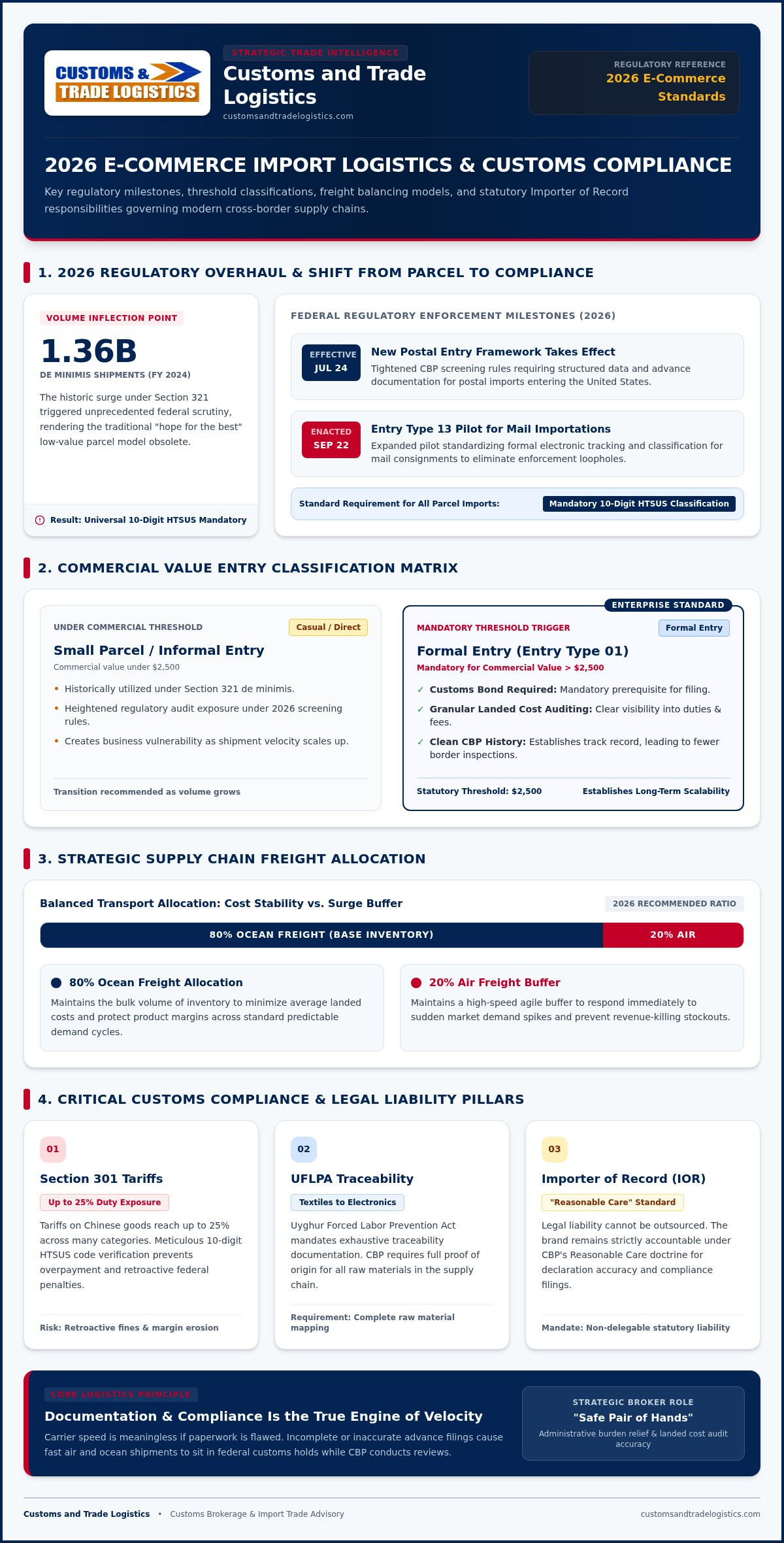
The way we move goods across borders has reached a turning point. For years, digital brands relied on high-volume, low-value shipping under the Section 321 de minimis exemption. However, the surge to 1.36 billion shipments in FY 2024 triggered a massive regulatory overhaul. In 2026, the "hope for the best" approach to international shipping is no longer a viable strategy. Modern import logistics for e-commerce businesses now requires a compliance-first mindset to avoid the gridlock caused by new federal screening rules.
Customs and Border Protection (CBP) has tightened the reins. As of July 24, 2026, a new postal entry framework took effect, followed by the Entry Type 13 pilot for mail importations on September 22. These changes mean that even small shipments now face 10-digit HTSUS classification requirements. If you want to scale, you need a licensed customs broker who can navigate these technical hurdles while you focus on marketing and sales.
From Small Parcel to Formal Entry
Many brands start by shipping individual parcels directly from China to US customers. While this avoids some upfront costs, it creates a massive business risk as you grow. Once your shipments exceed a commercial value of $2,500, they mandate a Formal Entry (Entry Type 01). This transition is a critical milestone for any brand. Formal entries require a customs bond and provide the granular data you need to audit your landed costs accurately.
If you're just beginning this journey, understanding import logistics for startups is essential. It helps you move from casual importing to a professional operation. By establishing a formal entry process early, you build a clean record with CBP. This history often leads to fewer inspections and more predictable lead times as your volume increases. Think of it as laying a solid foundation for your future supply chain.
2026 Supply Chain Expectations
Today’s consumers expect lightning-fast delivery, but speed is now tied directly to transparency. You can't have one without the other. Proactive data sharing is the new standard. This includes maintaining traceability documentation for the Uyghur Forced Labor Prevention Act (UFLPA). This law now covers everything from textiles to electronics, and CBP expects you to know exactly where your raw materials originated.
Successful brands are balancing their transport modes more strategically. They might use ocean freight for 80% of their inventory to keep costs low; meanwhile, they maintain a 20% air freight buffer to respond to sudden spikes in demand. This balanced approach ensures you don't run out of stock while keeping your average landed cost manageable. In this environment, expert oversight is your greatest asset.
The Core of Import Logistics: US Customs and Compliance
Many sellers mistakenly believe that their choice of carrier is the biggest factor in shipping speed. While a fast vessel helps, the real engine of speed is your paperwork. If your data is incomplete or inaccurate, even the fastest air freight will sit idle in a warehouse while U.S. Customs and Border Protection (CBP) reviews your entry. Mastering import logistics for e-commerce businesses means recognizing that compliance is a strategic advantage, not just a box to check.
A customs broker acts as your seasoned advocate, translating complex trade laws into actionable steps for your business. However, you can't outsource your legal liability. As the Importer of Record (IOR), you're legally bound by the "Reasonable Care" standard. This means you're responsible for the accuracy of every declaration made in your name. Following the U.S. Customs and Border Protection e-commerce guidance is vital for maintaining your brand’s integrity. We focus on providing a "safe pair of hands" to manage these filings, lifting the administrative weight so you can focus on growth.
HTS Classification and Duty Management
Selecting the right HTS code is one of the most technical parts of the import process. In 2026, with Section 301 tariffs on Chinese goods reaching up to 25% for many categories, a classification error can lead to massive retroactive fines. You should view custom brokerage service fees as a critical insurance policy for your margins. An expert broker verifies your supplier’s descriptions against the 10-digit HTSUS schedule to ensure you don't overpay or invite a costly federal audit.
The Customs Brokerage Process
The process starts long before your goods hit the water. Your broker must submit the Importer Security Filing (ISF 10+2) at least 24 hours before the cargo is loaded onto an ocean vessel. Failure to meet this window can result in fines up to $5,000 per violation. Once the goods arrive, your broker coordinates with Partner Government Agencies (PGAs) like the FDA or CPSC to ensure all safety certifications are digitally integrated into the ACE system. Using a partner with national coverage across all ports ensures your inventory stays mobile, regardless of which gateway you choose. If you're feeling the pressure of these deadlines, a conversation with a dedicated logistics specialist can help simplify your next shipment.
Comparing E-commerce Logistics Models: Which Fits Your Brand?
Deciding how to structure your supply chain is one of the most impactful choices you'll make as a business owner. Many scaling brands find themselves stuck between the convenience of a faceless digital platform and the precision of a dedicated partner. While all-in-one apps promise simplicity, they often struggle when a shipment hits a regulatory snag. In 2026, the ideal model for import logistics for e-commerce businesses is one that prioritizes oversight over automation.
As you evaluate your options, you must look at how your international commercial terms (Incoterms) dictate your responsibilities. If you're buying FOB (Free On Board), you gain control over the US-side logistics, but you also take on the burden of selecting a reliable broker. This is where the choice between a generalist and a specialist becomes critical. A "safe pair of hands" doesn't just move your cargo; they protect your business from the hidden costs of non-compliance.
The Freight Forwarder vs. Customs Broker Debate
It's a common misconception that freight forwarders and customs brokers do the same job. Simply put, a forwarder moves the box, while a broker moves the paperwork. While many large forwarders offer "in-house" brokerage, these services are often high-volume and low-touch. They might miss the nuances of your specific product category, leading to incorrect HTS classifications and potential audits.
Using specialized customs clearance services us providers ensures that your legal filings get the attention they deserve. A dedicated broker acts as a mentor, helping you navigate the shift from casual parcel shipping to formal freight. This expertise is especially valuable during a federal audit, where a digital platform's "automated" support often falls short of what a human expert can provide.
Logistics for Amazon FBA Sellers
Shipping directly from a factory to an Amazon fulfillment center requires a level of precision that most general logistics models can't handle. Amazon is notoriously strict about delivery windows and labeling. If your paperwork isn't perfect or your carrier misses their appointment, you face the "refused shipment" nightmare. This doesn't just cost you in extra freight fees; it kills your sales velocity and tanks your IPI score.
Integrating professional FBA freight forwarding services into your workflow removes this anxiety. A specialized partner understands the specific routing requirements for FBA redistribution and ensures your goods are pre-cleared before they even reach the port. This seamless factory-to-FBA transition is the secret to maintaining a healthy inventory level without the administrative headaches.
A Step-by-Step Roadmap for E-commerce Importing
Success in global trade isn't about luck; it's about a methodical sequence of events that starts months before a customer clicks "buy." When you formalize your import logistics for e-commerce businesses, you replace chaos with a predictable workflow. This roadmap ensures that your capital isn't tied up in customs holds or unexpected storage fees at the port.
Phase 1: Pre-shipment Coordination. This is where you verify HTS codes and ensure your supplier’s commercial invoice matches your purchase order exactly. Phase 2: Transit Management. At least 24 hours before your goods are laden onto an ocean vessel, your broker must file the Importer Security Filing (ISF). Missing this window invites a $5,000 fine from CBP. Phase 3: Arrival and Clearance. As the vessel nears the US, your broker submits the formal entry. If your data is clean, you'll receive a release message before the container even touches the dock. Phase 4: Redistribution. Once cleared, the container moves to a facility for devanning and palletization before the final mile delivery to your warehouse or an FBA center.
Mastering the China-to-US Pipeline
Do you know if your supplier’s paperwork meets the 2026 UFLPA traceability standards? The specific challenges of import from China logistics often center on document accuracy. We've seen many brands face delays because a factory listed a generic product description that triggered a manual inspection. You must vet your supplier’s packing lists and certificates of compliance before the cargo leaves the dock. Proactive vetting is the only way to maintain a steady flow of inventory across the Pacific.
Redistribution and Final Mile
Clearing customs is a major milestone, but the journey doesn't end at the port. You need a seamless handoff between your customs broker and your domestic carrier. This stage involves coordinating container devanning, where bulk goods are unloaded and sorted into pallets. If communication breaks down here, you'll face detention and demurrage charges that eat into your margins. Clear, real-time coordination ensures your inventory hits the shelves on time, keeping your customers happy and your sales velocity high. If you're ready to streamline this journey, request a personalized logistics roadmap from our expert team today.
Why Expertise is the Ultimate E-commerce Competitive Advantage
Why do so many brands think a software dashboard is enough to manage global trade? While digital platforms offer slick interfaces, they often lack the critical human oversight needed when a shipment is flagged for a manual inspection. Real-world import logistics for e-commerce businesses requires more than just code; it demands the intuition and relationships that only come from decades on the front lines. If an automated system misclassifies your goods, the software won't stand by you during a federal audit. You need a partner who treats your business with the same protective care as their own.
The hidden costs of "automated" logistics usually surface at the worst possible time. A faceless platform might process thousands of entries, but they won't notice if a supplier's paperwork subtly shifts in a way that triggers UFLPA scrutiny. Choosing a family-owned partner provides a layer of security that digital-only competitors can't match. We act as a stabilizing force, lifting the administrative weight from your shoulders so you can focus on scaling your brand without the constant anxiety of a customs hold.
The Value of 35 Years in the Industry
Relationships still matter in our digital world. Having 35+ years of experience means we've seen every major shift in global trade, from the rise of e-commerce to the strict regulatory environment of 2026. We've built long-standing connections with customs officials at ports across the nation. These relationships don't grant shortcuts, but they do provide the clarity needed to resolve issues quickly when they arise. We take a mentor approach, helping you grow from a small startup to a national enterprise by sharing the lessons we've learned over nearly four decades.
Securing Your Supply Chain for the Future
Developing a proactive import strategy is the only way to weather future tariff fluctuations and supply chain volatility. Does your current logistics chain have the flexibility to pivot if a specific port becomes congested or a new trade policy is enacted? By auditing your current workflow now, you can identify vulnerabilities before they become expensive mistakes. Having a dedicated logistics advocate gives you the peace of mind that your "safe pair of hands" is always looking three steps ahead.
Your brand’s reputation is tied to your ability to deliver. Don't let a compliance error or a preventable delay stall your growth. If you’re ready to move beyond the "hope for the best" strategy and implement a professional, end-to-end workflow, we are here to guide you. Contact Customs and Trade Logistics today for a consultation and see how 35 years of expertise can become your brand’s greatest competitive advantage.
Future-Proofing Your Supply Chain for 2026 and Beyond
Mastering the technical side of global trade is the only way to protect your brand's long-term growth. We've explored how a compliance-first strategy ensures your goods move quickly through customs without the hidden costs of audits or unexpected delays. By shifting your focus from simple shipping to a comprehensive model for import logistics for e-commerce businesses, you build a resilient factory-to-door workflow that supports sustainable scaling.
You don't have to navigate these complex federal regulations alone. With 35+ years of customs brokerage expertise, our family-owned and operated team acts as your dedicated advocate at every US port of entry. We provide the personalized oversight and national coverage that faceless digital platforms simply can't offer. This professional partnership turns a heavy administrative burden into a streamlined competitive advantage. Ready to secure your margins and simplify your international operations? Streamline your e-commerce imports with a partner who cares, contact Customs and Trade Logistics today. We're here to ensure your journey from factory floor to customer door is smooth, secure, and successful.
Frequently Asked Questions
What is the difference between a freight forwarder and a customs broker for e-commerce?
A freight forwarder is responsible for the physical movement of your goods, while a customs broker manages the legal entry and clearance with US Customs. Think of the forwarder as the driver and the broker as the legal advocate. For import logistics for e-commerce businesses, having both roles clearly defined is essential. While some firms offer both, a specialized broker ensures your paperwork meets strict 2026 standards, protecting you from audits that general forwarders might overlook.
How much should I expect to pay in import logistics fees for my e-commerce business?
Your total costs depend on several variables, including the transaction value, freight mode, and applicable duties. You'll typically encounter service fees for customs brokerage and freight management, alongside government-mandated charges like the Merchandise Processing Fee (MPF) or Harbor Maintenance Fee (HMF). While we don't provide fixed quotes here, remember that duties on Chinese goods often reach 25%. Investing in expert oversight helps you avoid the hidden costs of fines and port storage fees.
Do I need a customs broker if I am only importing small quantities from China?
Yes, you generally need a broker because even small shipments now face intense scrutiny under 2026 regulations. The days of shipping small parcels duty-free without formal data are largely over. Whether you're importing a single pallet or a full container from China, you're responsible for accurate HTS classification and valuation. A broker acts as a "safe pair of hands," ensuring your small-scale operations don't get sidelined by unexpected customs holds or documentation errors.
What are the most common paperwork mistakes that cause customs delays?
The most frequent errors involve vague product descriptions and incorrect HTSUS classifications. If your invoice simply says "samples" or "toys" without the required 10-digit code, CBP will likely flag it for inspection. Other common issues include missing Certificates of Compliance for regulated goods or failing to declare the correct transaction value. These mistakes lead to port gridlock and storage charges that quickly eat into your profit margins. Proactive document verification is your best defense.
How does the Section 321 de minimis rule affect my e-commerce imports in 2026?
In 2026, the Section 321 de minimis rule has been significantly curtailed. Low-value shipments that were once duty-free now require electronic entry filings and precise HTS classification. CBP now uses Entry Type 13 and other electronic pilots to monitor small parcels more closely. This shift means e-commerce brands can no longer rely on "de minimis arbitrage." You must ensure every parcel is fully compliant with current tariff screening and data requirements to avoid seizures.
Can a customs broker help with shipments going directly to Amazon FBA?
Absolutely. A customs broker is vital for Amazon FBA sellers because they ensure goods are pre-cleared before reaching the port. Amazon has strict delivery windows and will refuse shipments with incomplete paperwork. We specialize in coordinating the transition from the vessel to final redistribution centers. By handling the customs entry and the subsequent delivery handoff, a broker ensures your inventory hits the FBA shelves on time without incurring expensive detention fees at the dock.
How long does the customs clearance process typically take for freight shipments?
For most freight shipments, the customs clearance process takes between 24 and 48 hours, provided your paperwork is submitted correctly and in advance. However, shipments subject to Partner Government Agencies (PGAs) like the FDA or CPSC may take longer if a physical inspection is required. Proactive filing is the key to speed. When your broker submits data before the vessel arrives, you often receive a release message while the cargo is still at sea.
What is an ISF filing and why is it critical for my ocean freight?
The Importer Security Filing (ISF), also known as 10+2, is a mandatory submission for ocean imports that must be filed at least 24 hours before cargo is loaded onto a vessel. It consists of ten data elements from the importer and two from the carrier. This filing is critical because CBP uses it for high-level security screening. Failing to file on time or providing inaccurate data can result in liquidated damages of $5,000 per shipment.


