

You just received a notification that your shipment is arriving, but your stomach drops as you realize the Importer Security Filing (ISF) was never submitted. It's a terrifying moment that many importers fear. You're likely wondering what happens if I file ISF late and if that dreaded $5,000 fine is now an absolute certainty. The anxiety of having your cargo held at the port while staring at confusing terms like "liquidated damages" can feel overwhelming, especially when your business growth depends on these goods.
At Customs and Trade Logistics, we've spent over 35 years acting as a steady hand for businesses facing these exact hurdles. We understand that a late filing feels like a disaster; however, it's actually a manageable crisis if you take the right steps immediately. In this guide, you'll discover the exact financial penalties enforced in 2026 and the professional strategies used to mitigate damages and release held cargo. We'll walk through the immediate actions you need to take right now, the likelihood of reducing your fines through CBP petitions, and a foolproof plan to ensure your documentation remains compliant for every future shipment.
Key Takeaways
- Learn the strict 24-hour deadline for ISF filings and why "before loading" is the only timeline that matters to CBP in 2026.
- Understand exactly what happens if I file ISF late, including how the $5,000 liquidated damages penalty is calculated for each violation.
- Discover the step-by-step process for filing a petition for relief to potentially reduce or mitigate financial penalties after a late filing.
- Explore how establishing a proactive 72-hour internal deadline and partnering with a seasoned broker can prevent future port holds and cargo delays.
What is ISF and the 24-Hour Rule?
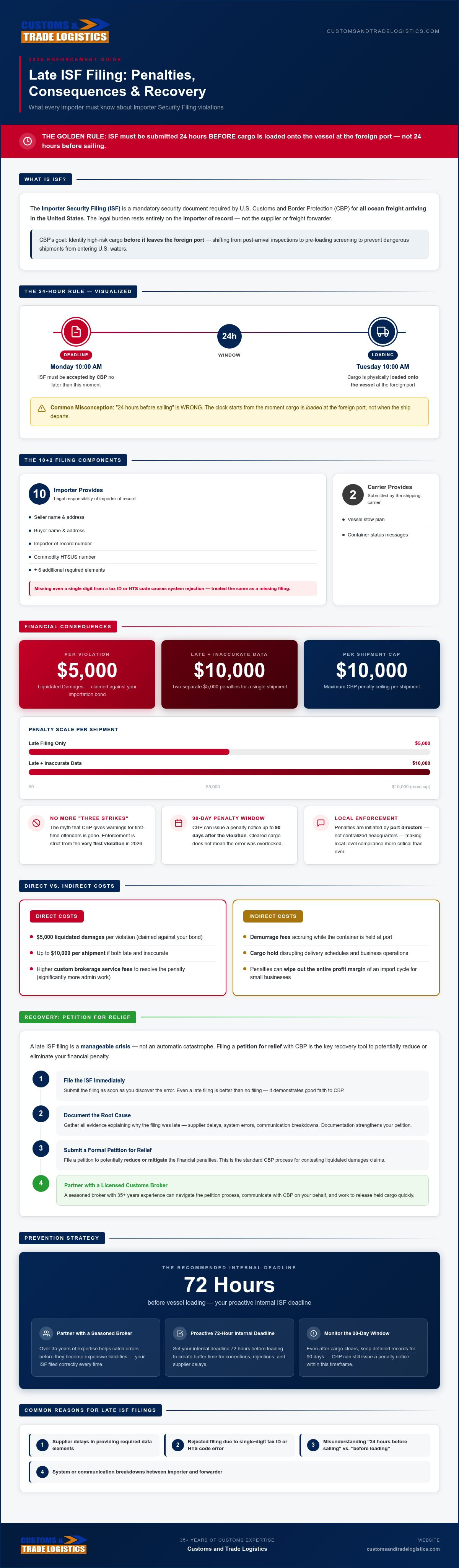
At Customs and Trade Logistics, we've spent 35 years acting as the "safe pair of hands" for importers navigating the complexities of global trade. We understand that the paperwork can feel like a mountain of jargon; however, the most important document to master is the Importer Security Filing. ISF is a mandatory security document required by CBP for all ocean freight arriving in the US. While your supplier in China or your freight forwarder might help gather the data, the legal burden rests entirely on you, the importer of record. If the submission isn't handled correctly, you'll quickly find out what happens if I file ISF late when your goods finally reach the port.
The most critical factor in this process is the 24-hour rule. This doesn't mean 24 hours before the ship sails away from the dock. It means 24 hours before the cargo is physically loaded onto the vessel at the foreign port. In the high-speed environment of 2026 logistics, this distinction is vital. If your container is lifted onto the ship at 10:00 AM on a Tuesday, your ISF must be accepted by CBP systems no later than 10:00 AM on Monday. Failure to meet this window can lead to immediate holds and significant financial stress.
The 10+2 Components Explained
The "10+2" name comes from the specific data elements required by the government. The importer is responsible for providing 10 pieces of information, including the seller and buyer names, the importer of record number, and the commodity HTSUS number. The carrier provides the final 2 elements: the vessel stow plan and container status messages. Missing even a single digit from a tax ID or an HTS code can cause the system to reject the filing. This rejection often leads importers to ask what happens if I file ISF late, as a rejected filing is treated the same as a missing one by customs officials.
Why the 24-Hour Rule Exists
CBP's primary mission is to identify high-risk cargo before it ever leaves a foreign port. By shifting from post-arrival inspections to pre-loading screening, the government can prevent dangerous shipments from entering U.S. waters. This proactive approach is a cornerstone of modern customs clearance services us. It ensures that by the time your goods reach a domestic port, the security risk has already been assessed. This allows for a much smoother transition from the ship to your warehouse, provided your paperwork was filed on time.
The Financial Fallout: Liquidated Damages and Fines
Understanding the financial consequences is the first step toward managing the risk of a missed deadline. When you ask what happens if I file ISF late, the most immediate answer is a $5,000 penalty. This fine is officially categorized as "liquidated damages" rather than a standard ticket. It's a claim against your basic importation bond, which means your surety company is notified immediately. In the current 2026 enforcement landscape, these penalties are initiated directly by the port directors rather than a centralized headquarters, making local compliance more critical than ever.
It's a common misconception that CBP allows a few mistakes before issuing a fine. The "Three Strikes" myth, which suggested ports were required to give warnings for first-time offenders, is no longer applicable. Today, enforcement is strict from the first violation. Additionally, these fines are cumulative. If your filing is both late and contains inaccurate data elements, you can be hit with two separate $5,000 penalties for a single shipment, totaling $10,000. According to the U.S. Customs and Border Protection ISF requirements, there is a $10,000 cap per shipment, but for a small business, that amount is often enough to wipe out the entire profit margin of an import cycle.
Patience doesn't mean you're in the clear. CBP has a 90-day window to issue a penalty notice. You might successfully clear your cargo, sell your goods, and believe the error was overlooked, only to receive a formal demand for $5,000 three months later. Keeping a close eye on your records is vital during this period. If you're feeling overwhelmed by these potential costs, partnering with a dedicated consultant for International Freight Logistics can provide the oversight needed to catch errors before they become expensive liabilities.
Direct vs. Indirect Costs of Late Filing
The $5,000 fine is only the beginning of the "Direct" costs. You must also account for how these complications impact your custom brokerage service fees, as resolving a penalty requires significantly more administrative work than a standard entry. "Indirect" costs often hurt more. While your container is held for an ISF issue, you'll rack up demurrage fees at the port and pier storage charges. These daily costs can quickly exceed the value of the fine itself if the hold lasts more than a few days.
Cargo Holds and Non-Intrusive Inspections (NII)
What happens if I file ISF late often starts with a "Do Not Load" (DNL) message sent to the carrier at the origin port. If the cargo is already on the water, CBP will likely flag the container for a mandatory exam upon arrival. Late filers are statistically more likely to face Non-Intrusive Inspections (NII), where your container is X-rayed. If the X-ray is inconclusive, a full physical devanning might be ordered. These inspections cause a massive ripple effect, delaying your supply chain and forcing you to break promises to your customers.
Common Reasons for Late ISF Filings
While understanding the penalties is vital, it's just as important to identify why these delays occur. Most importers don't set out to be non-compliant; instead, they get caught in the friction of international trade. If you're currently asking what happens if I file ISF late, you might find the answer lies in a simple communication breakdown or a technical oversight that could have been avoided with better oversight.
Delayed data from overseas suppliers remains the leading cause of late filings, particularly for those sourcing from China. Factories often focus on production and quality control, sometimes treating the "10+2" data elements as an afterthought. You can't file without the manufacturer's information, and if they wait until the container is already at the pier to send it, you've already missed your window. Similarly, missing or incorrect Bill of Lading (BOL) numbers from the carrier can stall the process. Without a valid BOL, your filing won't match the carrier's manifest, leading to a rejection that CBP treats as a late submission.
Time zone confusion also plays a major role in these errors. A 24-hour lead time in the U.S. is not the same as 24 hours in Shanghai or Ningbo. If you wait until Monday morning in New York to process a filing for a ship loading Tuesday morning in China, you're actually already late. These requirements were established in the federal ISF rulemaking and liquidated damages regulations to ensure security, and they don't account for the administrative lag of vessel changes or clerical errors. Forgetting to update an ISF when a carrier switches vessels at the last minute is another common trap that triggers a "late" status in the eyes of the port.
The China Import Challenge
Bridging the gap between U.S. importers and Chinese factories requires more than just email. Successful import from China logistics depends on a proactive strategy where ISF data is requested weeks before the cargo is ready. Last-minute shipping schedule changes are common, and having a seasoned partner to monitor these shifts can prevent a manageable crisis from becoming a $5,000 fine. It's about creating a rhythm of communication that keeps your supplier accountable for the paperwork as much as the product.
Amazon FBA and E-commerce Pitfalls
High-volume sellers often face unique hurdles. The danger of relying on automated platforms without human oversight is that one glitch can result in dozens of missed filings. Integrating ISF into your FBA freight forwarding services workflow ensures that as your business scales, your compliance doesn't fall behind. Personal oversight remains the best defense against the "set it and forget it" mentality that leads to port holds and unexpected liquidated damages claims.
How to Mitigate ISF Penalties: A Recovery Guide
Realizing you missed a filing deadline is a high-stress moment; however, your next move determines whether you pay the full $5,000 or a fraction of it. The "Immediate Action" rule is your best defense. If you discover an error while the cargo is still at sea, file the ISF immediately. CBP systems track the time between the loading event and your submission. By filing as soon as you spot the mistake, you demonstrate a good-faith effort to comply. This proactive step is the most significant factor when you later ask what happens if I file ISF late and seek to reduce your penalties.
Once a formal penalty notice arrives, you have the right to file a petition for relief. CBP isn't looking to put small businesses out of operation; they want to ensure future compliance. First-time offenders can often have fines reduced to $1,000–$2,500 through a formal petition. The agency considers several factors during this review, including your history of violations, how quickly you corrected the error, and the specific remedial actions you've implemented to prevent a recurrence. If you need assistance navigating this complex legal process, our team at Customs and Trade Logistics can act as your advocate to secure the best possible outcome.
The Petition Process Step-by-Step
Success in mitigation depends on the quality of your documentation. You must start by collecting all relevant evidence, such as email chains with suppliers or carrier logs that explain why the data was delayed. Your goal is to build a narrative for the Fines, Penalties, and Forfeitures (FP&F) office that shows the delay was an isolated incident rather than a systemic failure. You typically only have 30 to 60 days to respond to a CBP notice. Missing this window can result in the automatic forfeiture of your right to petition, leaving you responsible for the full liquidated damages amount.
The Role of a Customs Bond
It's helpful to remember that ISF fines are technically claims against your importation bond. If you have a Continuous Bond, it covers these liquidated damages up to its face value. However, your surety company will get involved if you don't address the fine promptly. They may require additional collateral or increase your premiums if they perceive you as a high-risk importer. Protecting your "Importer Record" is about more than just one shipment; it's about maintaining a clean status that avoids future scrutiny and keeps your supply chain moving smoothly.
Partnering for Compliance: Preventing Future Delays
How do you move from the constant stress of port holds to a smooth, predictable supply chain? The answer lies in shifting your mindset from reactive firefighting to proactive management. While we've discussed what happens if I file ISF late in terms of fines and mitigation, the ultimate goal is to ensure those questions never need to be asked. Establishing a strict "72-hour" internal deadline is the most effective way to protect your business. By requiring all ISF data elements three days before the cargo is even scheduled to arrive at the origin port, you build a vital safety buffer. This buffer accounts for time zone differences, supplier delays, and clerical errors that often occur at the last minute. Standardizing this flow ensures that filing is always the first step of your journey, not an afterthought.
Why a Seasoned Broker is Your Best Defense
Expert consulting is particularly vital for import logistics for startups. New businesses need to build a clean compliance history with CBP from day one to avoid being flagged for frequent inspections. A family-owned broker offers a level of personal oversight that digital algorithms simply cannot match. With 35+ years of experience navigating the specific nuances of every U.S. port, we understand the human element of logistics. We act as a seasoned mentor for growing businesses, catching missing Bill of Lading numbers or incorrect tax IDs before they ever trigger a penalty notice. This "safe pair of hands" approach replaces the anxiety of international trade with the security of a long-term, reliable partnership.
Next Steps for At-Risk Importers
If you've struggled with compliance in the past, your next step should be a thorough review of your recent shipments. Conducting a compliance audit helps identify exactly where the communication gaps with your suppliers are occurring. Are they failing to provide the manufacturer's address on time? Or are they sending incorrect HTS codes? Once you identify the root cause, you can set up automated alerts for ISF deadlines within your internal systems to ensure nothing slips through the cracks. Don't wait for a $5,000 liquidated damages notice to arrive in your mailbox before you take action. Contact Customs and Trade Logistics today for a professional review of your ISF process. We're here to help you move forward with confidence and total peace of mind.
Secure Your Supply Chain for 2026 and Beyond
While the threat of a $5,000 liquidated damages claim is intimidating, it doesn't have to define your import experience. You now understand that the 24-hour rule is a non-negotiable security requirement and that mitigation is a viable path for those who act quickly. By establishing a 72-hour internal deadline and keeping your documentation flow standardized, you can eliminate the uncertainty that leads to port holds and costly inspections. These proactive steps turn a complex regulatory burden into a predictable part of your business operations.
Knowing exactly what happens if I file ISF late is the first step toward building a more resilient and compliant business. With 35+ years of customs brokerage experience, our family-owned team specializes in managing the complex details of China-to-US import logistics. We act as your dedicated advocate, ensuring every filing is accurate, accepted, and on time. Let our experts manage your ISF compliance today and lift the administrative burden from your shoulders. Your growth depends on a steady flow of goods, and we're here to make sure nothing stands in your way.
Frequently Asked Questions
Is there a 'grace period' for late ISF filings in 2026?
No, there isn't a formal grace period for late ISF filings in 2026. While CBP originally focused on education, they've shifted to full enforcement. Ports now have the authority to issue penalties for a first-time offense without any prior warning. If your filing isn't accepted at least 24 hours before the cargo is loaded onto the vessel, it's considered late. You should prioritize filing as early as possible to avoid these automatic triggers.
Can I file my ISF after the ship has already departed?
Yes, you can still file your ISF after the ship has departed, and you should do so immediately. Filing late is significantly better than waiting until the cargo arrives or failing to file entirely. A late submission allows CBP to begin their security screening process while the goods are in transit. This action demonstrates a good-faith effort to comply, which is a critical factor when discussing what happens if I file ISF late during the penalty mitigation process.
What is the difference between an ISF fine and liquidated damages?
Technically, CBP refers to ISF penalties as liquidated damages rather than standard fines. A fine is typically a penalty for a criminal or regulatory violation. Liquidated damages represent a pre-determined debt claimed against your importation bond for failing to meet specific filing conditions. Because these are bond claims, your surety company is notified immediately. This distinction is important because it directly impacts your bond's standing and your future premiums with the insurance provider.
Will a late ISF filing affect my ability to import in the future?
Yes, a history of late filings can negatively impact your future importing operations. CBP maintains a compliance profile for every importer of record. If your record shows frequent delays or errors, your shipments are statistically more likely to be flagged for mandatory exams or X-ray inspections. Maintaining a clean record is essential for ensuring your cargo moves through the port quickly without the added costs of storage or devanning fees for secondary inspections.
How much does it cost to have a broker file an ISF for me?
Customs brokerage service fees for ISF filing vary depending on the complexity of your shipment and the level of personal oversight required. Most firms charge a flat fee for the professional preparation and submission of the mandatory data elements. While specific pricing depends on individual business needs, these fees are a minor administrative cost compared to the $5,000 liquidated damages penalty. Investing in professional filing ensures your documentation is handled by a seasoned partner who understands port-specific nuances.
What happens if my supplier provides incorrect data for the ISF?
The importer of record remains legally responsible for the accuracy of the filing, even if the error originated with a foreign supplier. If a factory provides an incorrect tax ID or commodity code, CBP will still hold you liable for the inaccurate submission. This is why many importers choose to partner with a consultant for import from China consulting. Having a "safe pair of hands" to verify supplier data before submission is the best way to prevent unexpected penalties.
Do Amazon FBA sellers have different ISF requirements?
No, Amazon FBA sellers must follow the same ISF regulations as any other commercial importer. Every ocean freight shipment entering the United States requires a timely 10+2 filing. E-commerce sellers often face higher risks because they manage high-volume shipments from various suppliers. To stay compliant, it's vital to integrate ISF filing into your broader logistics workflow. This ensures that every container is tracked and documented properly before it ever reaches the origin port for loading.
Can I get a late ISF penalty waived entirely?
Getting a late ISF penalty waived entirely is extremely rare and usually requires proof of a CBP system error or an act of God. However, you can often successfully petition to have the penalty reduced. CBP typically considers your past compliance history and the remedial steps you've taken to fix the issue. When you're facing the stress of what happens if I file ISF late, focus on filing a thorough petition for relief to minimize the financial impact on your business.


