

Since the indefinite suspension of the $800 de minimis exemption in June 2026, every commercial shipment entering the U.S. now requires a full 10-digit classification. This massive shift means that guessing is no longer an option; it's a liability that can lead to civil penalties starting at $5,000 per shipment. If you feel overwhelmed by the complexity of the 2026 HTS revisions, you aren't alone. Our harmonized tariff schedule lookup guide is designed to help you navigate this high-stakes environment without the fear of a surprise audit or a Customs Form 28 landing on your desk.
We promise to show you how to accurately classify your imports to ensure total compliance and protect your bottom line. By the time you finish reading, you'll understand the 10-digit code structure, the crucial differences between HTS and Schedule B, and the specific rules that help you secure the lowest possible duty rates. We've simplified the process so you can move your goods through any U.S. port with total confidence and the peace of mind that comes from having a seasoned partner in your corner.
Key Takeaways
- Understand how the 10-digit HTS structure determines duty rates and trade agreement eligibility to protect your profit margins.
- Follow our step-by-step harmonized tariff schedule lookup guide to navigate the official USITC tool using precise product descriptions.
- Learn why relying on foreign supplier codes or skipping the General Rules of Interpretation (GRIs) can lead to costly Customs penalties.
- Master the anatomy of the 10-digit code string to ensure your declarations are legally sound and compliant with U.S. Customs.
- Identify when complex classifications or highly regulated goods require the expertise of a professional customs broker to ensure seamless clearance.
What is the Harmonized Tariff Schedule (HTS) and Why Does It Matter?
Think of the HTS as the universal dictionary for international trade. This harmonized tariff schedule lookup guide begins with a clear reality: every physical item crossing the U.S. border must have a 10-digit home. The Harmonized Tariff Schedule of the United States is the official nomenclature used to classify these goods. It's more than just a list of numbers. These codes determine the duty rates you pay, whether your shipment is subject to quotas, and if you qualify for preferential treatment under various trade agreements. Most importantly, when you provide a code, you're making a legal declaration to U.S. Customs and Border Protection (CBP). Mistakes aren't just paperwork errors; they're potential compliance violations.
The Financial Impact of Accurate Classification
Accuracy is the primary shield for your profit margins. If you choose a code that's even slightly off, you might overpay duties, draining your company’s cash flow. On the other hand, underpaying can lead to unexpected "anti-dumping" fees or countervailing duties that often reach double or triple the original cost of the goods. Since the 2026 suspension of the Section 321 de minimis exemption, CBP’s scrutiny has intensified across all shipment values. "Close enough" classification can result in seized shipments, liquidated damages, and a permanent red flag on your importer record. Federal compliance requires precision, not guesswork.
HTS vs. Schedule B: Understanding the Difference
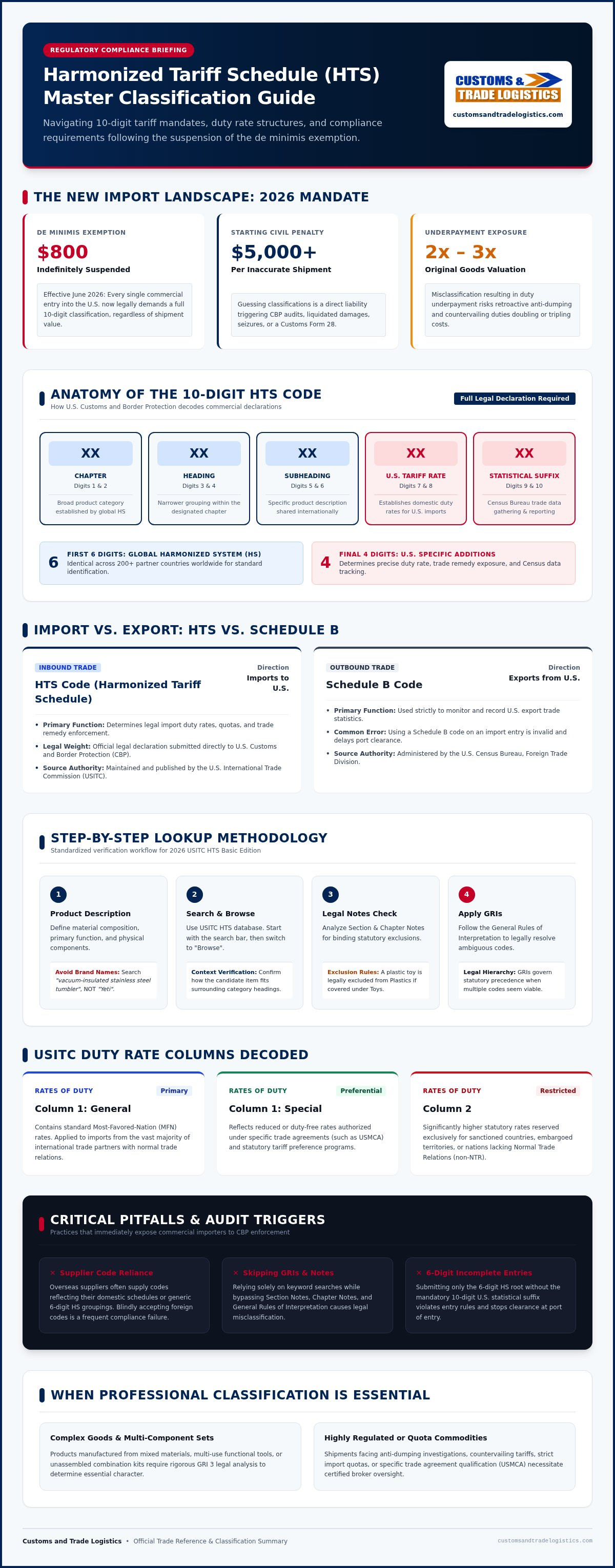
Confusion often arises between HTS codes and Schedule B codes, but the distinction is straightforward. Use HTS codes for imports coming into the U.S. and Schedule B codes for exports leaving the country. Both systems share the same first six digits, which are part of the global Harmonized System (HS). This global harmony ensures that the basic description of a product remains consistent across 200 countries. However, the final four digits are unique to the U.S. and provide the granular detail needed for domestic tariff rates and statistical reporting. Using a Schedule B code for an import entry is a frequent error that can delay your clearance and complicate your relationship with Customs.
Step-by-Step: How to Perform an HTS Code Lookup Like a Pro
Successful classification doesn't start at a computer; it starts with your product. You need a granular physical description that includes the material composition, primary function, and individual components. For instance, searching for a brand name won't yield results. Instead, you must search for the generic identity. A "Yeti" is a vacuum-insulated stainless steel tumbler. This harmonized tariff schedule lookup guide emphasizes using these descriptive terms to navigate the system effectively. Without a clear understanding of what your product is made of and how it works, you're likely to choose a code that leads to a Customs audit.
Once you have your description, navigate to the USITC HTS Search database. This is the official source for the 2026 HTS Basic Edition. While the search bar is intuitive, the results often provide multiple options that seem correct at first glance. You must verify these against the General Rules of Interpretation (GRIs). These rules provide the legal hierarchy for choosing one code over another when a product could technically fit into two different categories. If the process feels overwhelming, our Customs Clearance Services can provide the professional oversight needed to finalize your declaration with confidence.
Navigating the USITC Search Interface
The 2026 database offers both "Search" and "Browse" functions. Use the search bar for initial discovery, but use the browse function to see how your product fits into the surrounding categories. When you find a potential code, look at the "Rates of Duty" columns. Column 1 General contains the Most-Favored-Nation rates. Column 1 Special shows reduced rates for trade agreements like USMCA. Column 2 applies to sanctioned or non-NTR countries. Remember that your final code must be 10 digits long. This includes the statistical suffixes used for Census Bureau data reporting.
Analyzing Chapter and Section Notes
Chapter and Section Notes are the legal backbone of the tariff schedule. They often contain "Exclusionary Notes" that explicitly state a product is not covered by that specific section, even if the heading description seems to fit. For example, a plastic toy might be excluded from the "Plastics" chapter because it legally belongs in the "Toys" chapter. Always prioritize the legal text of these notes over the simple titles of the headings. These notes are the most common place where DIY importers make mistakes that lead to heavy fines.
The Anatomy of an HTS Code: Decoding the 10-Digit String
A 10-digit HTS code might look like a confusing string of numbers, but it's actually a highly structured map of your product. This harmonized tariff schedule lookup guide helps you peel back the layers of this hierarchy to understand how Customs identifies your goods. Each pair of digits adds a new level of specificity, moving from broad industry categories to the exact material and use of your item. Understanding this anatomy is the first step toward moving from guesswork to certainty in your declarations.
- The Chapter (Digits 1-2): These digits represent the broad category of the good, such as "Footwear" or "Electrical Machinery." There are 99 chapters in total.
- The Heading (Digits 3-4): This segment provides a more specific identification within the chapter, narrowing down the type of product.
- The Subheading (Digits 5-6): This is the last level of global consistency, where the international Harmonized System (HS) concludes.
- The U.S. Subheadings (Digits 7-10): These final digits are unique to the United States and are used to establish duty rates and gather trade statistics for the Census Bureau.
The "Harmonized" System: Global Consistency
Why does your supplier in China provide a code that only partially matches your U.S. declaration? It's because the system is only harmonized at the six-digit level. According to the International Trade Administration's HS code guide, the World Customs Organization (WCO) maintains this global foundation to ensure that a basic product description is recognized in every participating country. While you can use your supplier's first six digits as a helpful starting point for your lookup, you must never assume the full code is identical. National governments add their own unique digits to meet domestic policy and revenue needs.
The Final Four: US Specificity
The last four digits are where the financial impact of classification becomes clear. Digits seven and eight are the legal "rate lines" that determine the actual duty percentage you'll pay on your shipment. If you stop at the eighth digit, your entry will be rejected because U.S. Customs requires the full 10-digit string for formal entries. Digits nine and ten serve as statistical suffixes, allowing the government to monitor trade volumes and market trends for specific goods. Providing a complete 10-digit code is mandatory for securing customs clearance services us and ensuring your cargo moves through the port without administrative delays.
Common HTS Lookup Mistakes and How to Avoid Them
Even with a detailed harmonized tariff schedule lookup guide, classification errors happen. These mistakes are rarely intentional, but U.S. Customs treats them with a high level of scrutiny. Since the 2026 HTS Revision 18 and Revision 19 are now active, staying current is essential for every importer. You must look beyond the surface level of the text to ensure your 10-digit code stands up to federal review. Falling into common traps can lead to delayed shipments or baseline civil penalties that range from $5,000 to over $10,000 per shipment for gross negligence.
- Relying on foreign supplier codes: Suppliers prioritize their own country's export rules, which don't always align with U.S. import requirements.
- Ignoring the General Rules of Interpretation (GRIs): Skipping the hierarchical sequence of GRIs is a fast track to a misclassification error.
- Overlooking tariff engineering: Many businesses miss out on lower duty rates because they don't know how to legally optimize their product design.
- Using outdated codes: The USITC updates the schedule frequently; using a code from 2025 could result in an immediate rejection in 2026.
The Supplier Trap: Why You Can’t Just Copy the Invoice
It's tempting to look at your supplier's commercial invoice and copy the code they've provided. However, this is one of the most dangerous shortcuts an importer can take. Suppliers often use codes optimized for their own country’s export incentives or tax structures. Under the Customs Modernization Act, the legal burden of "Reasonable Care" falls squarely on you, the U.S. Importer of Record. If the code is wrong, Customs won't penalize the factory; they'll penalize your business. Always use the supplier's code as a starting point for the first six digits, but verify the final four digits against U.S. specific requirements.
Understanding Tariff Engineering
Tariff engineering is the practice of designing or modifying a product specifically to qualify for a heading with a lower duty rate. It's a completely legal strategy that has been upheld by U.S. courts for decades. For example, adjusting the material composition of a textile or the assembly method of a machine can significantly shift your tax liability. The line between legal optimization and illegal evasion is thin, so professional custom brokerage services are essential for this strategy. If you want to ensure your classification is both profitable and compliant, our Import From China Consulting team can provide the expert oversight you need.
When to Consult a Professional Customs Broker
Are you feeling uncertain about a product that doesn't seem to fit a single category? While this harmonized tariff schedule lookup guide provides a framework for DIY research, some items fall into a complex grey area known as "Essential Character" ambiguity. Under General Rule of Interpretation 3 (GRI 3), if a product consists of multiple materials or serves several functions, choosing the wrong heading can trigger an immediate audit. This risk increases significantly if you're importing highly regulated goods overseen by the FDA or EPA. In these cases, a classification error doesn't just mean a fine; it can result in a total refusal of entry at the port.
Consulting a broker is also vital when your business reaches a certain scale. High-volume Amazon FBA seller operations now face a massive administrative burden due to the 2026 suspension of the $800 de minimis exemption. Every single shipment now requires a formal or informal entry with a 10-digit code. Trying to manage this volume manually often leads to burnout and expensive clerical errors. A professional partner ensures your data is transmitted accurately to CBP, allowing you to focus on growing your brand rather than decoding tariff lines.
The Value of a Binding Ruling
How can you guarantee that U.S. Customs will accept your chosen duty rate? If you want absolute certainty, we can help you obtain a "Binding Ruling" from CBP. This process involves a formal submission where Customs provides a written, legally binding decision on your product's classification. We begin by conducting a CROSS (Customs Rulings Online Search System) lookup to find existing precedents for similar goods. A formal ruling provides a "safe harbor," protecting your business against future audits and liquidated damages as long as your product specifications remain the same. It is the ultimate tool for long-term import budgeting.
A Partner in Your Growth
Customs and Trade Logistics acts as a "safe pair of hands" for your import from China logistics. We understand that for small to medium businesses, every dollar of duty saved is a dollar reinvested in growth. As a family-owned consultancy with 35+ years of industry experience, we offer the personal connection and dedicated oversight that large-scale brokerages often lack. We don't just file paperwork; we act as a knowledgeable bridge between your operations and the global marketplace. Contact our expert team today for a classification review and ensure your shipments clear all U.S. ports with total confidence.
Secure Your Imports with Confident Classification
Mastering the 10-digit nomenclature is no longer just a best practice; it's a fundamental requirement for protecting your business's bottom line in 2026. This harmonized tariff schedule lookup guide has highlighted how precise descriptions and a deep understanding of the General Rules of Interpretation can prevent costly penalties. Whether you're navigating the new de minimis landscape or looking for tariff engineering opportunities, the right classification strategy ensures your cargo moves seamlessly through every U.S. port without administrative delays.
Don't let the complexity of the 2026 revisions slow your growth. With over 35 years of industry experience, our family-owned team specializes in helping Amazon FBA sellers and SMB importers manage their compliance with ease. We act as your safe pair of hands, providing the expert oversight needed to avoid audits and optimize your duty rates across all national ports. Get a Professional HTS Classification Review from Customs and Trade Logistics today to safeguard your supply chain. We're here to help you turn regulatory hurdles into a clear competitive advantage.
Frequently Asked Questions
Is the HTS code the same as a Schedule B number?
No, these codes serve different purposes. Use HTS codes for goods entering the U.S. and Schedule B numbers for shipments leaving the country. While both systems share the same first six digits based on the global Harmonized System, the final four digits differ to meet specific U.S. import duty or export statistical needs. Using a Schedule B number for an import entry is a common mistake that leads to immediate Customs rejections.
How often is the Harmonized Tariff Schedule updated?
The USITC updates the schedule throughout the year to reflect trade agreement changes and legislative shifts. For example, the 2026 HTS Basic Edition is currently operating under Revision 18 and Revision 19 as of September 2026. This harmonized tariff schedule lookup guide recommends checking the official database before every shipment to ensure you aren't using an expired code that could trigger a compliance audit or lead to unexpected duty costs.
What happens if I use the wrong HTS code on my customs entry?
Using the wrong code violates the "Reasonable Care" standard under 19 U.S.C. § 1484. This can result in civil penalties ranging from $5,000 to over $10,000 per shipment for gross negligence. Beyond fines, you face shipment seizures, liquidated damages, and the risk of a Customs Form 28 (Request for Information). These administrative hurdles can permanently damage your importer record and lead to increased inspections at all U.S. ports.
Can I look up HTS codes for free?
Yes, you can access the official 10-digit codes for free through the USITC HTS Online Reference Tool. This database provides the legal text, duty rates, and statistical suffixes needed for your declaration. While the tool is free, interpreting the complex legal notes and General Rules of Interpretation often requires professional expertise to ensure you aren't overpaying duties or missing "anti-dumping" fee requirements that apply to your specific product category.
Does the HTS code determine the sales tax on my import?
No, HTS codes determine federal import duties, the Merchandise Processing Fee (MPF), and any applicable trade remedies like Section 301 tariffs. They don't dictate state-level sales tax. For FY 2027, starting October 1, 2026, the minimum MPF for formal entries increases to $34.58. While the code impacts your total landed cost, sales tax is managed separately through state regulations or marketplace facilitator programs for Amazon sellers.
Where can I find the 2026 HTS revision online?
You can find the current 2026 HTS Revision 18 and Revision 19 online at the official United States International Trade Commission (USITC) website. The "New HTS Online" platform is the authoritative source for the 10-digit nomenclature. Always verify the revision number on the homepage, as the USITC frequently releases updates to account for new trade actions or corrections to the statutory legal framework throughout the calendar year.
What is a "General Rule of Interpretation" (GRI)?
General Rules of Interpretation (GRIs) are the six legal rules used to determine the correct classification of goods. You must follow them in sequential order, starting with GRI 1, which classifies goods according to the terms of the headings and relative section or chapter notes. These rules provide a strict hierarchy. If GRI 1 doesn't solve the classification, you move to GRI 2 and so on until a legal match is found.
How do I classify a product that is made of multiple materials?
Multi-material products are classified using GRI 3, which offers three methods for resolution. First, you look for the most specific description. If that fails, you identify the "essential character" of the item; the material or component that gives the product its primary function. If the essential character remains ambiguous, the rules dictate using the heading that occurs last in numerical order among those which equally merit consideration in the tariff schedule.


