

What if the quote you just received for your 2026 shipment is only half of what you'll actually pay by the time that container reaches your warehouse? It's a common frustration for many small business owners who feel overwhelmed by the scale of international shipping. You see a competitive rate for the ocean leg, but then the hidden fees start rolling in. Between fluctuating peak season surcharges and those confusing calculations for volumetric weight, it's easy to feel like you're guessing rather than budgeting.
We're here to lift that administrative burden and give you back your sense of security. This guide will show you exactly how to calculate ocean freight costs for importing from China, covering everything from base rates to the often-overlooked US Customs and port charges. We'll break down the math step-by-step, helping you move from a place of uncertainty to a position of total control over your 2026 logistics. By the end of this article, you'll have the confidence to review any freight forwarder quote with a seasoned, expert eye.
Key Takeaways
- Learn to identify the core components of your shipping quote, such as base rates and mandatory fuel surcharges, so you aren't caught off guard by extra fees.
- Master how to calculate ocean freight costs for importing from China by understanding the specific math behind both full container loads and smaller, volume-based shipments.
- Discover the "weight or measurement" rule to accurately figure out your shipment's volume and ensure you only pay for the space you actually use.
- Account for US Customs duties and destination port charges early in the process to create a reliable and stress-free shipping budget for 2026.
- Explore smart optimization strategies, like freight consolidation and route planning, that can help lower your overall costs without sacrificing reliability.
The Anatomy of Ocean Freight Pricing from China
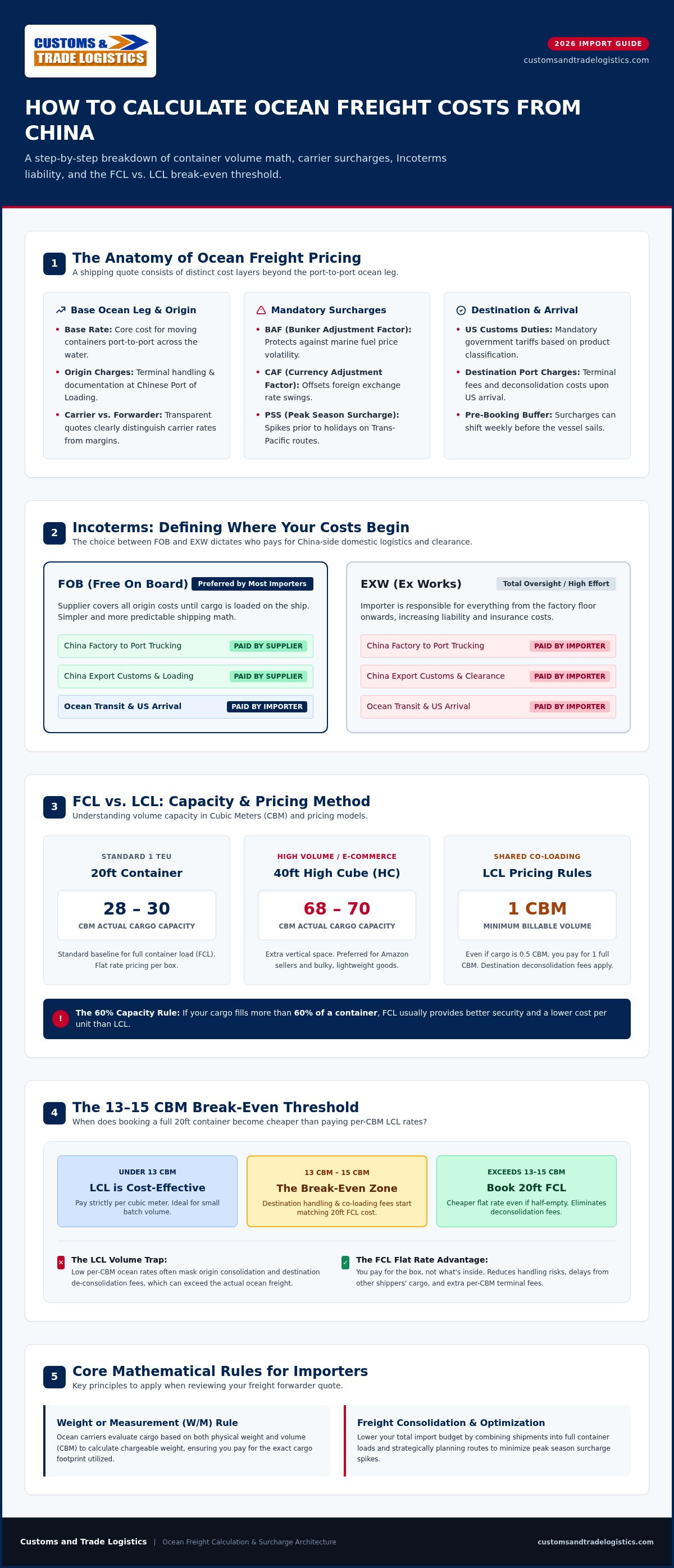
The foundation of any shipping quote is the base rate, often called the "ocean leg." This is the price for moving your container from port to port. However, understanding how to calculate ocean freight costs for importing from China requires looking past this single number. In 2026, carriers continue to apply mandatory surcharges that can shift weekly. The Bunker Adjustment Factor (BAF) accounts for fuel price volatility, while the Currency Adjustment Factor (CAF) protects against exchange rate swings. You should also prepare for the Peak Season Surcharge (PSS). On Trans-Pacific routes, these surcharges often spike during the months leading up to the holidays; making it vital to budget for these fluctuations well in advance. Having a seasoned partner helps you anticipate these shifts before they impact your bottom line.
Ocean Leg vs. Local Charges
Your total cost includes more than just the time spent on the water. While ocean freight transport is the primary expense, origin charges in China can add up quickly. These include terminal handling fees and documentation costs at the Port of Loading. It's helpful to distinguish between carrier-imposed fees and the margins added by a freight forwarder. A transparent quote should clearly separate these so you know exactly where your money goes. Don't be surprised if your final bill differs slightly from your initial booking. Space constraints or sudden fuel price shifts can trigger adjustments before the vessel even sails, but a reliable logistics provider will keep you informed of these changes in real-time.
The Role of Incoterms in Your Math
Which part of the journey are you actually paying for? This depends on your chosen Incoterms. When you are learning how to calculate ocean freight costs for importing from China, the choice between FOB (Free On Board) and EXW (Ex Works) is often the most critical decision you'll make. Most importers we work with prefer FOB. Under FOB, your supplier handles the costs of getting the goods to the Chinese port; you only start paying once the cargo is on the ship. If you choose EXW, you're responsible for everything from the factory floor onwards. This means you must calculate "hidden" costs like trucking across China and export clearance. While EXW gives you total oversight, it also increases your liability and insurance premiums. Choosing the right term is a balancing act between cost control and administrative effort. We often suggest FOB for those who want a simpler, more predictable math equation for their shipping budget.
FCL vs. LCL: Choosing the Right Calculation Method
Choosing between Full Container Load (FCL) and Less than Container Load (LCL) is the most significant fork in the road for your shipping budget. If you're trying to figure out how to calculate ocean freight costs for importing from China, you'll find that FCL offers a predictable flat rate per container. You pay for the box, not what's inside. Conversely, LCL is priced by volume, measured in Cubic Meters (CBM). While LCL seems like the obvious choice for smaller shipments, the math gets complicated once you factor in destination handling fees. It's about finding the balance between the space you need and the fees you can avoid.
Container Capacity and Flat Rates
For 2026, the standard 20ft container (1 TEU) remains the baseline, but 40ft High Cube (HC) containers are the preferred choice for Amazon sellers and high-volume importers. An HC container offers extra vertical space, which is perfect for lightweight but bulky goods. When calculating your costs, remember that a 20ft container typically holds about 28 to 30 CBM of actual cargo, while a 40ft HC can fit roughly 68 to 70 CBM. If you can fill more than 60% of a container, FCL usually provides better security and a lower cost per unit. It's a cleaner way to manage your budget without worrying about how other people's cargo might impact your shipment.
The LCL Volume Trap
LCL is often where new importers run into trouble. You might see a low "per CBM" rate and think you're saving money. However, LCL shipments require consolidation at the origin and de-consolidation at the destination. This "co-loading" process adds time and extra "handling" fees that don't apply to FCL. Most carriers have a minimum billable volume of 1 CBM. If your shipment is only 0.5 CBM, you're still paying for a full meter. These destination charges can sometimes exceed the actual ocean freight cost, which is a frustrating surprise for many small businesses.
The "break-even" point is where the math shifts in favor of a full container. Generally, if your shipment exceeds 13 to 15 CBM, it's often more cost-effective to book a 20ft FCL even if you don't fill it completely. This avoids the high-per-CBM destination fees and reduces the risk of delays during the de-consolidation phase. If you're feeling overwhelmed by these variables, our team at Customs and Trade Logistics can help you run the numbers to find the most efficient path for your specific cargo. Taking a moment to analyze these volume thresholds ensures you aren't paying for empty space or hidden handling costs.
How to Calculate Chargeable Weight and Volume
While digital calculators are convenient, relying on them blindly can leave you vulnerable to errors on your factory's packing list. Understanding the manual logic behind how to calculate ocean freight costs for importing from China is the only way to ensure you aren't being overcharged. The industry operates on a "weight or measurement" (w/m) rule. Carriers calculate both the physical space your cargo occupies and its actual weight; they then bill you for whichever number is higher. Chargeable weight is defined as the greater of these two values to ensure carrier profitability.
To master this calculation, follow these three steps. First, calculate the Cubic Meters (CBM) of your shipment. Second, determine the actual weight of the cargo in kilograms. Third, compare the two using the standard ocean freight ratio where 1,000kg equals 1 CBM. If your shipment is 2 CBM but weighs 2,500kg, the carrier will bill you for 2.5 units because the weight exceeds the volumetric equivalent. This simple comparison keeps your budget predictable and prevents surprises when the final invoice arrives.
The CBM Calculation Formula
To find your CBM, multiply the length, width, and height of your cartons in meters, then multiply that by the total number of cartons. If your supplier provides dimensions in inches, divide each measurement by 39.37 to convert to meters before you start your math. We often see importers make the mistake of measuring only the product boxes while forgetting the pallet. If your goods are palletized, the carrier measures the entire footprint, including the height of the pallet itself. Spotting these small discrepancies on a packing list before the ship leaves China can save you hundreds of dollars in unexpected volume adjustments.
Chargeable Weight for Heavy Goods
In the world of how to calculate ocean freight costs for importing from China, volume usually dictates the price. However, weight overrides volume when you are moving dense materials like machinery, stone, or liquids. Because ships have massive weight capacities, the "volumetric weight" penalty is much more forgiving than in air freight. You have more room to breathe with heavy items, but the 1,000kg per CBM threshold remains the line in the sand. If you're importing dense cargo, always double check your weight totals in kilograms. This ensures you are prepared for the moment your shipment "weighs out" before it "spaces out" on the vessel.
Destination Charges and Customs Obligations
Once your goods arrive at a US port, the calculation shifts from the water to the warehouse. Many importers focus so much on the ocean leg that they forget the Destination Delivery Charge (DDC) and the complexities of US Customs. If you want to know how to calculate ocean freight costs for importing from China accurately, you must account for the Harmonized Tariff Schedule (HTS). Unlike freight rates, duties are calculated as a percentage of your cargo's total value. This is often the largest variable in your entire budget. Missing this step is why many "all-inclusive" digital quotes fall short of reality.
Beyond duties, you'll face mandatory filings like the Importer Security Filing (ISF), also known as "10+2." This must be filed before your ship leaves China. If it's missed or filed late, you could face significant fines that instantly erase your profit margins. For a deeper dive into these requirements, see our guide on Customs Clearance Services in the US: The Complete Importer’s Guide. Planning for these filings ensures your shipment doesn't get flagged for an inspection that could cost you thousands in extra labor and storage fees.
The Hidden Cost of Port Delays
Demurrage and detention fees are the silent killers of a shipping budget. Demurrage kicks in when your container sits at the port longer than the "free days" allowed, while detention is charged for holding the equipment too long after it leaves the terminal. In 2026, port congestion remains a factor, and these penalties can reach hundreds of dollars per day. A proactive customs broker acts as your advocate, ensuring your paperwork is cleared before the vessel even docks. You'll also need to decide between a Single Entry or Continuous Customs Bond. If you plan to import multiple times throughout the year, a continuous bond is almost always the more cost-effective and efficient choice.
Total Landed Cost: The Final Math
The "Freight Quote" you receive is usually only about 60% of your total import spend. To find your true "Total Landed Cost," you must add the ocean freight, duties, port fees, and the final "last mile" trucking to your warehouse. This comprehensive view is the only way to ensure your product pricing is actually profitable. For help navigating the specific costs of professional assistance, read our article on Understanding Custom Brokerage Service Fees.
Managing these moving parts requires constant oversight. Our team specializes in Customs Clearance Services that bridge the gap between ocean transport and domestic delivery, giving you the peace of mind that your budget will remain intact. By planning for these destination charges from day one, you transform a complex logistical puzzle into a predictable business expense.
Optimizing Your Import Strategy for 2026
Once you understand the math, the next step is finding ways to shave dollars off that total without compromising your supply chain's reliability. In 2026, savvy importers are moving beyond just reacting to quotes; they're actively shaping their logistics plans. One of the most effective ways to lower your expenses is through consolidation. If you frequently ship small batches, combining them into a single LCL shipment or even a 20ft FCL can drastically reduce the per-unit handling fees at US ports. You should also consider "slow steaming" routes. While these take a few days longer, the base ocean rate is often significantly lower, making it a perfect choice for inventory that isn't time-sensitive.
Auditing your factory packing lists is another area where a logistics consultant can save you a fortune. Small errors in carton dimensions can lead to massive overcharges when you are figuring out how to calculate ocean freight costs for importing from China. Having a "safe pair of hands" review these documents before they reach the carrier ensures your data is accurate and your budget remains protected. For a deeper look at managing these moving parts, explore our Import From China Logistics: The Comprehensive Guide.
Special Considerations for Amazon FBA Sellers
For those selling on Amazon, the "Final Mile" delivery to fulfillment centers is often where costs spiral out of control. Many sellers assume direct factory-to-FBA shipping is the most efficient path, but using domestic delivery and redistribution services can actually be cheaper. By shipping a full container to a US warehouse and then redistributing smaller batches to Amazon, you avoid high LCL fees and gain more control over your stock levels. It's a strategic move that helps you manage 2026's fluctuating storage fees while keeping your shipping math simple. You can find more specific tips in our Amazon Seller Import Help guide.
From Estimates to Execution
When you're ready to move from planning to action, always request a transparent quote. A truly professional forwarder won't hide surcharges or destination fees in the fine print. Instead, they'll provide a breakdown that matches the logic of how to calculate ocean freight costs for importing from China that we've covered today. With 35+ years of industry experience, we understand the nuances of US Customs and the ever-shifting Trans-Pacific routes. We act as your dedicated advocate, acting as a bridge between your business and the global marketplace.
Ready to simplify your China imports and get a predictable budget? Contact Customs and Trade Logistics for a detailed consultation today.
Master Your 2026 Shipping Budget
Demystifying the logistics chain is the first step toward a more profitable and predictable year. You now have the essential tools to look past basic ocean leg rates and account for the total landed cost that includes duties, surcharges, and port fees. Mastering how to calculate ocean freight costs for importing from China means you won't be caught off guard by the weight to volume ratio or unexpected destination charges at the terminal. This knowledge replaces anxiety with a sense of security, allowing you to focus on growing your business rather than managing heavy administrative burdens.
At Customs and Trade Logistics, we bring 35+ years of family owned expertise to every container we manage. Whether you're an Amazon seller navigating FBA requirements or a growing SMB, our team provides the seasoned mentorship you need with national coverage across all US ports. We pride ourselves on being a reliable partner that values personal connection as much as technical compliance. Ready to simplify your supply chain? Get a Professional Logistics Consultation for Your China Imports today. We look forward to helping your business thrive in the global marketplace.
Frequently Asked Questions
Is ocean freight calculated by weight or volume?
Ocean freight is typically calculated using the "weight or measurement" (w/m) rule, where the carrier bills you based on whichever value is higher. The industry standard ratio is 1,000 kilograms to 1 cubic meter (CBM). If your shipment is heavy but small, weight dictates the price. If it's light but bulky, volume becomes the primary factor. Understanding this balance is central to knowing how to calculate ocean freight costs for importing from China effectively.
What is the standard CBM for a 20ft container?
The standard 20ft container has an internal volume of approximately 33 cubic meters, but your actual usable capacity is usually between 28 and 30 CBM. This gap exists because cargo rarely fits perfectly like a puzzle; you lose space to packaging, pallets, and air gaps. When planning your 2026 imports, always use the 28 CBM estimate for your initial math to ensure you don't overbook space or face unexpected overflows at the factory.
How much does it cost to clear customs for a China import?
The cost to clear customs involves several variables, including professional brokerage service fees, the price of a customs bond, and the specific duties assigned to your product. Duties are calculated as a percentage of your cargo's total value based on the Harmonized Tariff Schedule (HTS). While fees vary by port and shipment complexity, budgeting for these costs early prevents delays. Having a seasoned partner ensures you don't miss mandatory filings that lead to penalties.
What are the most common hidden fees in ocean freight quotes?
Surprise fees often appear as Destination Delivery Charges (DDC), Terminal Handling Charges (THC), and fuel adjustment factors like BAF. Many digital quotes only cover the "ocean leg," leaving out the costs of unloading the container or moving it through the port. You might also encounter documentation fees or peak season surcharges during busy 2026 shipping windows. A transparent quote from a veteran consultant should break these down individually so your budget remains predictable.
Can I calculate my own customs duties before the shipment arrives?
You can estimate your duties by identifying your product's 10 digit HTS code and applying the corresponding percentage to your cargo's commercial invoice value. This is a vital step in learning how to calculate ocean freight costs for importing from China. However, remember that additional fees like the Merchandise Processing Fee (MPF) or Harbor Maintenance Fee (HMF) also apply. Verifying these codes with a customs broker before shipping helps avoid costly classification errors at the port.
What is the difference between a freight quote and a landed cost?
A freight quote typically only covers the transportation from one port to another, whereas the landed cost represents the total amount paid to get a product from the factory to your door. Your landed cost includes the freight quote plus customs duties, taxes, insurance, port fees, and domestic trucking. Calculating the landed cost is essential for accurate product pricing. It ensures you understand your true profit margins before the goods even leave the origin.
How does the ISF filing fee impact my total shipping cost?
The Importer Security Filing (ISF) fee is a mandatory administrative cost for all ocean shipments entering the United States. While the filing fee itself is relatively small, the impact of ignoring it is massive. Failure to file the "10+2" data at least 24 hours before your ship leaves China can result in fines of up to $5,000 per violation. Including this in your initial budget is a simple way to avoid catastrophic port delays.
Why is LCL more expensive per unit than FCL?
LCL shipments are more expensive per unit because they require extra labor for consolidation at the origin and de-consolidation at the destination. You aren't just paying for ship space; you're paying for the warehouse time and handling needed to sort multiple importers' goods. Additionally, LCL destination fees are often billed per CBM with high minimums. Once your shipment exceeds roughly 13 to 15 CBM, switching to a full 20ft container usually becomes more cost effective.


