

What if the few hundred dollars you saved by filing your own paperwork ended up costing your business thousands in port storage fees and weeks of lost sales? It's a question many US importers face as they weigh the costs of professional help against the complexity of federal regulations. You've likely felt that spike of anxiety while staring at an HTS code list, wondering if one wrong digit will lead to a seized shipment. We understand that the pressure to keep overhead low is real, but knowing when is a customs broker required is about more than just checking a legal box. It's about protecting your bottom line from the unpredictable nature of international trade.
This 2026 guide clarifies the exact legal thresholds where a broker becomes mandatory and identifies the tipping points where hiring an expert is the only way to avoid costly penalties. You'll learn the difference between formal and informal entries, how to navigate the $2,500 threshold, and how to build a compliance strategy that keeps your goods moving. We provide a clear framework to help you decide when to handle paperwork yourself and when to hand the burden to a seasoned partner. Our goal is to ensure your imports remain compliant, giving you the peace of mind to focus on scaling your operations.
Key Takeaways
- Identify the specific $2,500 value threshold and the restricted commodity categories that trigger mandatory formal entry requirements for US imports.
- Discover exactly when is a customs broker required to protect your business from devastating anti-dumping duties and HTS code misclassifications.
- Learn why Amazon FBA sellers must act as their own Importer of Record and how to secure a broker to manage complex China-to-USA entry requirements.
- Clarify the distinct roles of freight forwarders and customs brokers to ensure your logistics chain is physically efficient and legally compliant.
- Gain a framework for evaluating when a professional partner’s expertise provides more value than the cost of potential port delays and federal fines.
The Legal Thresholds: When US Customs Mandates a Broker
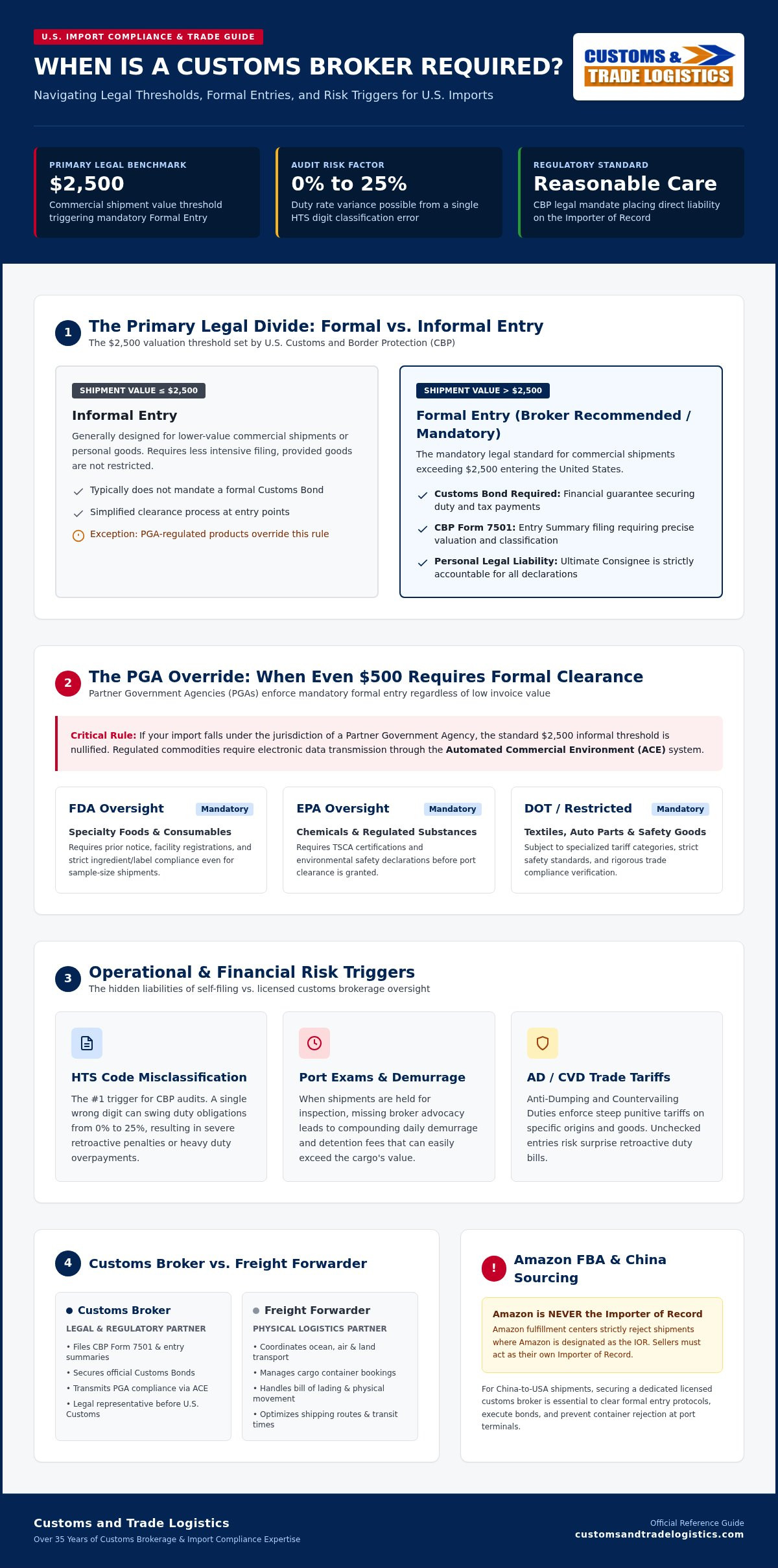
US Customs and Border Protection (CBP) doesn't just suggest using an expert; in many cases, they mandate a level of documentation that only a licensed professional can reliably provide. Deciding when is a customs broker required usually starts with the total value of your goods. If your commercial shipment exceeds $2,500, you're entering the territory of "formal entries," where the paperwork demands increase significantly. While it's technically possible to handle an entry yourself, the legal responsibilities of the Ultimate Consignee are heavy. You're personally liable for the accuracy of every declaration. CBP doesn't accept a lack of experience as an excuse for errors, making self-filing a high-stakes gamble for businesses without a dedicated compliance team.
Formal vs. Informal Entries
In 2026, the $2,500 threshold remains the primary dividing line for most commercial imports entering the United States. A Formal Entry is the legal standard for commercial shipments over $2,500. For these high-value shipments, CBP requires a Customs Bond. This bond acts as a financial guarantee that all duties and taxes will be paid to the government. A licensed customs broker is typically the partner who files CBP Form 7501, also known as the Entry Summary. This document is technically dense; it requires precise HTS codes and valuation methods that, if miscalculated, can lead to your goods being held at the port or subjected to expensive storage fees.
Government Agency Requirements (PGA)
Value isn't the only factor to consider. Sometimes, when is a customs broker required depends entirely on the nature of your goods rather than their price tag. If your products fall under the oversight of Partner Government Agencies (PGAs) like the FDA, EPA, or DOT, the complexity multiplies. Even a $500 shipment of specialty food, certain textiles, or chemicals often requires a formal entry due to safety regulations. These agencies require specific data transmissions through the Automated Commercial Environment (ACE) system. Managing these digital handshakes requires specialized software and the oversight we've provided for over 35 years. Without a "safe pair of hands" to manage these restricted commodities, you risk the total seizure of your inventory at the border.
The Risk Thresholds: When a Broker is Practically Essential
While the $2,500 legal limit is a clear marker, the real question of when is a customs broker required often centers on risk management. Even if your shipment is technically below the formal entry threshold, a single mistake in classification can trigger a chain reaction of financial losses. Are you prepared to handle the personal liability that comes with an audit? US Customs expects you to exercise "reasonable care," a standard that's difficult to meet without professional oversight. We've seen businesses face ruinous fines simply because they didn't realize their product was subject to specific trade enforcement actions.
Navigating the Harmonized Tariff Schedule
The Harmonized Tariff Schedule (HTS) is a massive, shifting document where a single digit change can swing your duty rate from 0% to 25%. HTS misclassification is the leading trigger for US Customs audits in 2026. If you're struggling to find the right code, our customs clearance services us guide provides deeper HTS navigation tips. A broker doesn't just guess; they use historical databases and expert knowledge to ensure your goods are classified correctly the first time. This accuracy prevents you from overpaying duties or, worse, underpaying and facing retroactive penalties years later.
Avoiding Costly Port Delays
What happens when your container is flagged for a port exam? Without a broker to act as a buffer, you're left to coordinate with port authorities and specialized carriers on your own. Port delays aren't just frustrating; they're expensive. Daily demurrage and detention fees can quickly exceed the value of the goods themselves. A broker manages the flow of information, ensuring that exam requirements are met quickly so your cargo can move. Following U.S. Customs and Border Protection broker regulations ensures that your representative has the legal standing to advocate for your shipment.
Beyond simple delays, there's the "tax surprise" of Anti-Dumping and Countervailing Duties (AD/CVD). These can reach 200% or more, often applied to goods you might not suspect, like wooden furniture or specific steel components. Determining when is a customs broker required becomes obvious when you consider these hidden costs. We provide a "safe pair of hands" to screen your imports for these high-risk categories before they ever leave the factory. If you want to secure your supply chain against these volatility spikes, reaching out to a team like Customs and Trade Logistics can turn an administrative nightmare into a manageable process.
Customs Broker vs. Freight Forwarder: Choosing Your Partner
Do you know the difference between the person moving your cargo and the person legally clearing it? Many new importers confuse these two roles, but they serve entirely different functions in your supply chain. A freight forwarder acts as a travel agent for your goods, coordinating the physical movement across oceans and borders. In contrast, a customs broker manages the legal compliance and financial transactions with U.S. Customs and Border Protection. Knowing when is a customs broker required versus when you simply need a logistics provider is the first step toward building a reliable import strategy.
Side-by-Side: Roles and Responsibilities
The distinction between these partners often comes down to licensing and documentation. Freight forwarders are typically regulated by the Federal Maritime Commission (FMC) and focus on the Bill of Lading, which tracks the physical journey of your container. However, only a professional licensed by the U.S. Treasury and CBP can legally represent your business in customs matters. This Customs Brokers and Freight Forwarders guide highlights how brokers handle the Entry Summary, while forwarders manage the transport. You need both for a successful shipment; one ensures your goods arrive, while the other ensures they're allowed to stay.
One common trap is relying on "Free Shipping" terms like CIF (Cost, Insurance, and Freight) or DAP (Delivered at Place). Under these terms, your overseas supplier might handle the ocean freight, but they rarely provide a designated U.S. broker. We've seen many shipments sit at the port because the importer didn't realize that when is a customs broker required applies even when the shipping is prepaid. Without a broker ready to file the entry, your "free" shipping can quickly turn into a nightmare of storage fees and administrative delays.
The Hybrid Advantage
Why should you consider a partner that manages both ends of the process? Using a combined logistics and brokerage firm creates a seamless experience where data flows directly from the shipping manifest to the customs entry. This coordination prevents paperwork from getting lost between the sea and the shore. As a family-owned firm with 35+ years of experience, we've found that managing both freight and clearance allows us to act as a "safe pair of hands" for our clients. It eliminates the finger-pointing that often happens when a forwarder and a broker are from different companies.
Choosing a hybrid partner also simplifies your budgeting. You can see how freight costs and custom brokerage service fees interact to form your total landed cost. This visibility is essential for maintaining your margins, especially when importing from complex markets like China. By integrating these services, you move away from a fragmented, high-anxiety process toward a steady, predictable flow of goods.
Critical Scenarios: Amazon FBA and China Sourcing
Are you an Amazon seller assuming the retail giant will handle your border paperwork? This is one of the most dangerous assumptions you can make in international trade. Amazon is never the Importer of Record (IOR) for your goods. They're a third-party warehouse, not a legal representative. If your shipment arrives at an Amazon fulfillment center with duties unpaid or customs uncleared, it will be rejected immediately. This leaves you responsible for the costs of returning the cargo or, in many cases, its destruction at the port. Understanding when is a customs broker required for FBA is simple: it's required for every single commercial shipment originating outside the US that you intend to sell on their platform.
The Amazon FBA Compliance Trap
Managing the legal side of FBA requires more than just a shipping label. You must designate a partner who can act as your agent through a Power of Attorney (POA). This is particularly complex for foreign-owned entities that don't have a physical US presence. A broker ensures that your company is correctly identified as the IOR, protecting your seller account from compliance strikes. For a deeper look at how to manage these specific requirements, our guide to FBA freight forwarding services provides a step-by-step compliance roadmap.
Importing from China in 2026
China remains the primary sourcing hub for US businesses, but it's also the most regulated. Importing from China requires navigating Section 301 duties, which can add a 25% tax or higher to your landed costs. Identifying when is a customs broker required in this context is about financial survival. A skilled consultant doesn't just file forms; they look for Section 301 exclusions and verify that your Chinese supplier has provided the correct paperwork to avoid "withhold release orders."
The "China-to-FBA" pipeline is a specialty we've refined over 35 years. It involves a tightly coordinated sequence:
- Factory pickup and export clearance in China
- Ocean freight management to US West or East Coast ports
- Immediate customs filing to prevent port storage fees
- Redistribution and delivery to specific Amazon fulfillment centers
Selecting a Reliable Partner for Your Import Logistics
Understanding when is a customs broker required is the first step, but finding the right partner is what actually ensures your peace of mind. You aren't just looking for a data entry clerk; you're looking for an advocate who treats your business like their own. In a volatile trade environment, 35+ years of industry experience isn't just a number. It represents thousands of cleared containers and a deep understanding of how to pivot when regulations change overnight. We position ourselves as a "safe pair of hands" to lift the administrative burden from your shoulders, allowing you to focus on growth instead of red tape.
Before you sign a Power of Attorney (POA), you should vet your potential partner thoroughly. Ask if they have expertise in all US Customs ports or if they specialize in specific regions like China. As a family-owned firm, we believe in providing the mentorship that startups and SMEs often miss with larger, impersonal agencies. We act as a knowledgeable bridge between your small-scale operations and the global marketplace, ensuring you don't feel overwhelmed by the scale of your own international expansion. Determining when is a customs broker required often comes down to realizing that your time is better spent on product development than on filing entry summaries.
The Value of Industry Expertise
Don't be fooled by "digital-only" brokers who lack deep-rooted port relationships. While software is essential, it often fails when a physical problem arises at the pier. When a container is flagged for an intensive exam, an automated app won't pick up the phone to coordinate with port authorities. You need a partner who knows the nuances of all US ports to navigate these hurdles. We bridge this gap by combining modern efficiency with veteran oversight, ensuring your goods stay moving regardless of logistical hiccups.
Next Steps for Your 2026 Import Strategy
Transitioning from DIY shipping to managed logistics is a major milestone for any growing brand. The onboarding process is simple, starting with a review of your current HTS classifications and sourcing goals. We help you move from a fragmented, high-anxiety process to a steady, predictable flow of inventory. If you're just beginning your journey, our guide to import logistics for startups offers a clear strategic roadmap for 2026. By handing off the compliance burden, you gain the security of knowing your shipments are in expert hands.
Securing Your 2026 Import Success
Determining exactly when is a customs broker required is the first step toward building a resilient international business. You now know the $2,500 legal threshold and the hidden risks of HTS misclassification. While self-filing is technically possible for small parcels, the personal liability and port delay risks make professional oversight essential for real commercial growth. Compliance isn't just a legal checkbox; it's a strategy to protect your profit margins and your brand's reputation.
At Customs and Trade Logistics, we bring 35+ years of trade expertise to every container we clear. We're specialists in China-to-US logistics and provide personalized support for Amazon FBA sellers who need a reliable Importer of Record. Don't let administrative burdens slow your progress. Let our family-owned team handle your customs clearance-Contact us today. We're ready to be your safe pair of hands, ensuring your 2026 imports stay compliant and move smoothly. Success in global trade starts with the right partner by your side.
Frequently Asked Questions
Can I clear customs myself without a broker?
You can technically clear your own customs as an individual, but it's a significant burden for commercial importers. US Customs requires you to meet the "reasonable care" standard, which means you're legally responsible for every HTS code and valuation detail. Most businesses find that the risk of seized cargo or heavy fines far outweighs the cost of professional help. Having a partner ensures your documentation is accurate and compliant from the start.
What is the minimum shipment value that requires a customs broker in 2026?
For most commercial goods, the legal threshold for a formal entry is $2,500. This is when is a customs broker required to manage the mandatory Customs Bond and Form 7501 filing. However, value isn't the only factor. If you're importing restricted items like textiles, food, or chemicals, you'll likely need a broker's oversight regardless of the shipment's total cost. These items fall under strict Partner Government Agency regulations that require expert handling.
How much do customs brokerage service fees typically cost?
Customs brokerage service fees aren't one-size-fits-all. They're structured as service charges for the professional preparation and submission of your federal documentation. The complexity of your shipment, the number of different products you're importing, and any additional agency requirements will influence the final cost. We focus on providing transparent management of these fees, helping you budget for your total landed cost without the worry of hidden administrative penalties.
Does a freight forwarder always include customs brokerage?
Not every logistics provider offers the same level of legal coverage. While some firms provide integrated services, many freight forwarders only manage the physical movement of your cargo. They might handle the Bill of Lading but leave the actual customs entry to you. It's vital to confirm if your partner has licensed brokers on staff who can legally represent your business before US Customs and Border Protection authorities.
What happens if I import goods without a customs broker?
Importing without professional help often leads to a port nightmare. Your goods might be held indefinitely, triggering daily storage and demurrage fees that quickly exceed the value of the inventory. If the paperwork contains errors, you could face federal audits, heavy fines, or the total seizure of your shipment. Using a broker acts as a protective shield, ensuring your business stays compliant and your goods move through the port without delay.
Is a customs broker required for personal items or just commercial goods?
Customs brokers are primarily used for commercial shipments intended for resale. While individuals importing personal effects or household moves can often handle their own declarations, high-value personal items or vehicles may still trigger formal entry requirements. If you're unsure about your specific situation, a quick consultation can clarify if your personal import needs a professional touch to avoid unexpected taxes or red tape at the border.
How do I choose between a traditional broker and a digital freight forwarder?
Digital forwarders often focus on automated tracking apps, but they can struggle when a physical problem occurs at a port. A traditional, family-owned broker provides the mentorship and deep-rooted port relationships that software simply can't replace. For businesses navigating complex China-to-US logistics or Amazon FBA requirements, having a safe pair of hands to manage the legal nuances is often more valuable than a digital-only dashboard.
What documents do I need to provide to my customs broker?
To get started, you'll need to provide several essential documents to your partner:
- Commercial Invoice and Packing List
- Bill of Lading from your carrier
- Signed Power of Attorney (POA)
- Specific PGA data such as FDA or EPA forms


