

What if a single digit on a shipping form could cost your business 40% of its total product value? Most importers feel a knot in their stomach when they first look at the Harmonized Tariff Schedule. It's perfectly normal to feel overwhelmed by technical jargon like GRIs and Schedule B codes. You're likely worried that an accidental error might invite a CBP audit or lead to unexpected duty costs that eat your profit margins. You've probably spent hours searching for how to classify my product for customs while hoping you don't get it wrong.
This guide will help you master the essentials of customs classification to ensure compliance, avoid penalties, and protect your bottom line. We'll walk through the 2026 HTS Revision 19 updates, explain the legal concept of "Reasonable Care," and show you exactly when it's time to stop the DIY approach and hire a professional. You'll gain the security of knowing your shipments are classified correctly, letting you focus on growing your business instead of deciphering regulatory fine print. We're here to act as your safe pair of hands in a complex global market.
Key Takeaways
- Understand why "Reasonable Care" is your legal responsibility as an importer and how it protects you from the five-year look-back period for duty errors.
- Learn exactly how to classify my product for customs using a methodical five-step process that moves from raw material data to the final 10-digit HTS code.
- Demystify the General Rules of Interpretation (GRIs) to correctly handle complex shipments like multi-piece sets or items with mixed materials.
- Discover the financial reality of misclassification, including how to avoid 2026 negligence penalties that can reach up to 40% of your product's value.
- Identify the specific business milestones that signal it is time to move from DIY filing to the protective care of a seasoned customs broker.
What is Customs Classification and Why Does It Matter?
Think of the Harmonized Tariff Schedule (HTS) as the genetic code for your merchandise. Every physical item entering the United States must be assigned a specific 10-digit number that tells Customs and Border Protection (CBP) exactly what it is, what it's made of, and how it will be used. This system is part of a global framework called the Harmonized Commodity Description and Coding System. It doesn't just identify your goods; it dictates the duty rates you'll pay and determines if you qualify for special trade agreements that could save your business thousands of dollars.
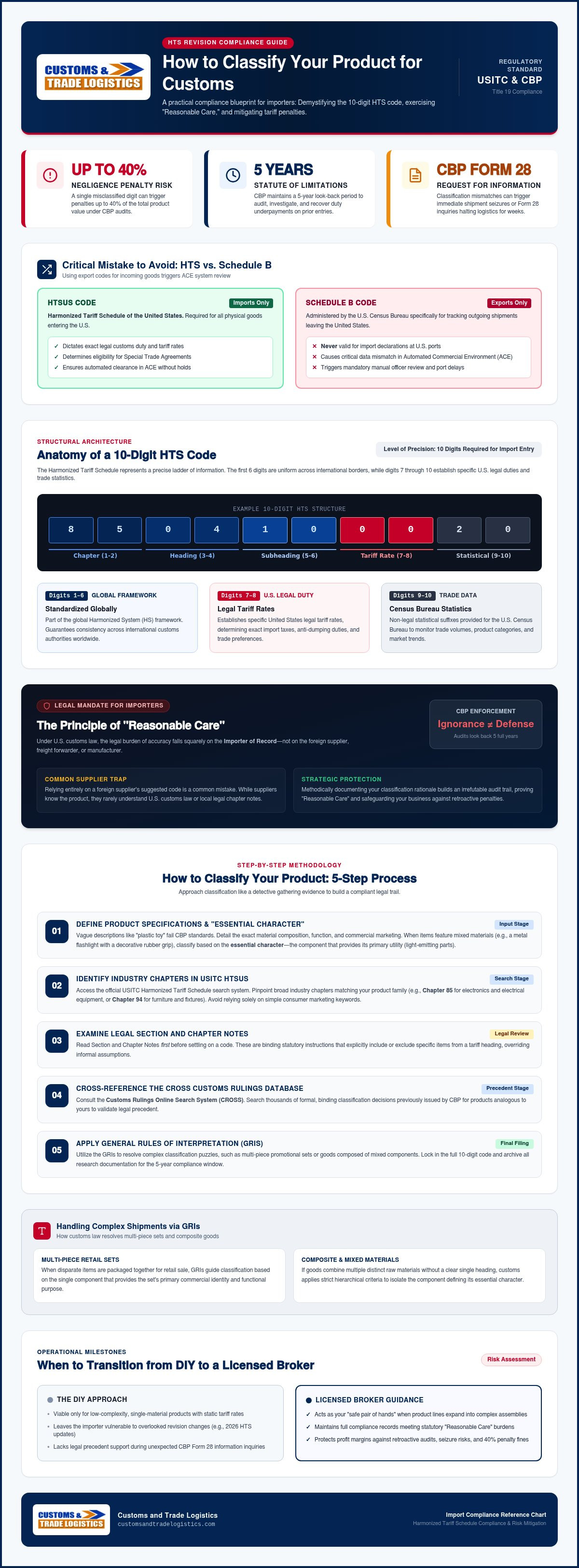
Many new importers confuse HTS codes with Schedule B numbers. It's a common mix-up. HTS codes are strictly for imports, while Schedule B codes are used for exports. If you're searching for how to classify my product for customs, you must ensure you're using the HTSUS (Harmonized Tariff Schedule of the United States) to avoid costly errors at the port of entry. Using the correct code is the difference between a seamless delivery and a logistical nightmare. For example, applying a Schedule B code to an import entry could lead to a mismatch in the Automated Commercial Environment (ACE) system, flagging your shipment for manual review.
Anatomy of a 10-Digit HTS Code
The US HTS code is a precise ladder of information. The first six digits are standardized globally, ensuring a basic level of consistency across borders. The next two digits (7 and 8) establish the specific US legal tariff rates. Finally, digits 9 and 10 provide statistical data for the Census Bureau. A single digit error might seem minor, but it can trigger a total shipment seizure or a request for information (CBP Form 28) that halts your operations for weeks. Accuracy at the 10-digit level is the only way to ensure your cargo moves through the port without friction.
Your Legal Responsibility as an Importer
A common mistake is relying entirely on a foreign supplier's suggested code. While they know the product, they often don't understand the nuances of US customs law. Under the legal principle of "Reasonable Care," the burden of accuracy falls squarely on the Importer of Record. This means you are legally responsible for every declaration made to CBP. If you're wondering how to classify my product for customs correctly, remember that ignorance isn't a defense against penalties. Proper classification acts as a stabilizer for your business growth, protecting you from the 5-year statute of limitations that CBP uses to investigate past entries. Taking ownership of this process transforms an administrative hurdle into a strategic advantage, ensuring you have a safe pair of hands guiding your global trade operations.
How to Classify Your Product: A 5-Step Practical Guide
Finding the correct code for your shipment doesn't have to be a guessing game. While the process is rigorous, following a methodical sequence helps you move from confusion to compliance. If you are wondering how to classify my product for customs, you should approach it like a detective gathering evidence. By documenting each step, you create a paper trail that proves you exercised "Reasonable Care" if a CBP officer ever questions your entry.
Step 1: Defining Your Product for Customs
Precision is your best friend here. A vague description like "plastic toy" is rarely enough for a successful filing. You need to know the material composition, the primary function, and how the item is marketed. If your product is made of multiple materials, such as a metal flashlight with a rubber grip, you must determine its "essential character." Ask yourself: what is the main reason a customer buys this? In the case of the flashlight, the light-emitting components usually define its classification, regardless of the decorative rubber casing.
Using the HTSUS Search Tools Effectively
Once you have your product data, you can head to the official USITC Harmonized Tariff Schedule to begin your search. Start by identifying the broad industry chapter that fits your goods. For example, electronics are generally found in Chapter 85, while furniture resides in Chapter 94. Don't rely solely on simple keywords. The HTSUS uses technical language that might differ from your marketing terms. It is vital to read the Section and Chapter Notes first; these are legal instructions that can specifically include or exclude certain items from a category.
After you find a potential heading, the next step is to consult the Customs Rulings Online Search System (CROSS). This database contains thousands of previous decisions made by CBP. Finding a ruling for a product nearly identical to yours provides a strong precedent for your choice. Finally, document your logic. Write down which headings you compared and why you chose one over the other. This documentation is your primary defense during a post-entry audit.
If this process feels like a heavy administrative burden, you don't have to carry it alone. Our team provides expert customs clearance services to help you navigate these technical requirements with confidence. We act as a safe pair of hands, ensuring your 2026 shipments are compliant from the moment they leave the supplier until they reach their final destination. Understanding how to classify my product for customs is a skill that protects your margins, and we are here to support your growth every step of the way.
Navigating Complex Rules: Sets, Parts, and Interpretations
Once you move beyond basic commodities, the process of finding a code becomes more nuanced. When you are determining how to classify my product for customs, you'll eventually encounter items that don't fit neatly into one category. This is where the General Rules of Interpretation (GRIs) come into play. These six rules act as the "rules of the road" for trade, ensuring that every importer follows the same logic. They are designed to eliminate ambiguity, but they require a steady hand to apply correctly.
The GRI Framework for Beginners
Most classifications are settled using GRI 1, which states that classification is determined by the literal terms of the headings and any relative section or chapter notes. If the heading says "Table lamps of base metal," and you have a brass lamp, your search ends there. However, complexity arises with composite goods or sets. GRI 3 provides a tie-breaker system for these situations. It asks you to identify the "essential character" of the item. For an e-commerce seller offering a yoga kit that includes a mat, a block, and a strap, you must decide which component gives the set its primary appeal. Usually, the mat is the essential character, and the entire set is classified under the mat's HTS code. For a deeper look at this hierarchy, the International Trade Administration guide to HS codes offers excellent foundational context on how these rules align with global standards.
Common Pitfalls in Classifying Parts
Classifying individual parts and accessories is one of the most common places where DIY importers trip up. The general rule is that a part should be classified under its own specific heading if one exists. If no specific heading exists, you then look at whether the part is "solely or principally used" with a particular machine. A major trap here is the "Parts of General Use" exception. Items like screws, bolts, and springs are almost always classified by their material (such as steel or aluminum) rather than the machine they are intended for. Misidentifying a simple bracket as a specialized aircraft part instead of a general base metal fitting can lead to duty rates that are 25% higher than necessary.
Understanding how to classify my product for customs when dealing with multi-component items requires looking past the marketing and into the legal definitions. If you find yourself stuck between two headings, don't guess. Guessing is what leads to the audits and penalties we discussed earlier. Instead, rely on the methodical application of the GRIs to find the most specific description possible. This level of diligence ensures your cargo stays moving and your profit margins remain protected from avoidable fees.
The High Cost of Misclassification: Risks and Penalties
Getting a code wrong might seem like a minor clerical error, but U.S. Customs and Border Protection (CBP) views it as a serious legal breach. Under 19 U.S.C. § 1592, importers are required to exercise "Reasonable Care" when declaring goods. If you fail this standard, the financial consequences are steep. For simple negligence, penalties can reach up to twice the actual loss of duties or 20% of the product's total value if no revenue was lost. If CBP determines the error was "gross negligence," those fines can double again. These aren't just one-time hits; the government has a five-year statute of limitations to investigate and assess retroactive duties on every shipment you've brought into the country.
The danger isn't just in the fines themselves. Once your business is flagged for a misclassification, the scrutiny on your future shipments intensifies. You may find yourself subject to frequent "intensive" exams, where every container is pulled aside for manual inspection. This creates a cycle of uncertainty that makes it nearly impossible to plan a predictable supply chain. If you are struggling with how to classify my product for customs, taking action now is the only way to prevent a single mistake from haunting your balance sheet for years to come.
Beyond the Fine: Operational Impacts
For e-commerce and Amazon FBA sellers, the operational damage often outweighs the legal fines. A customs hold triggered by a bad HTS code can leave your digital shelves empty for weeks. When you run out of stock, your "Best Seller" rank and search visibility can plummet, taking months of expensive marketing to recover. While your goods sit at the port, you'll also accumulate storage and demurrage fees that can easily reach hundreds of dollars per day. This is why reducing customs clearance delays starts with getting your classification right before the cargo even leaves the factory.
Mitigating Risk with Proactive Strategies
If you discover that you've been using the wrong code, don't wait for CBP to find it. A "Prior Disclosure" allows you to report the error and pay the underpaid duties before a formal investigation begins. This proactive step can significantly reduce or even eliminate monetary penalties. For new businesses, import logistics for startups must prioritize HTS accuracy to build a clean record with customs from the start. Creating a simple compliance manual that documents how to classify my product for customs ensures that your team follows the same rigorous logic for every SKU.
Protecting your business from these risks requires a partner who understands the high stakes of international trade. We offer professional customs clearance services designed to act as a safe pair of hands for your operations. By handling the technical details of classification, we help you avoid the pitfalls of misclassification and ensure your shipments move smoothly through the port. Let us help you stabilize your supply chain and protect your profit margins from avoidable penalties.
When to Professionalize: The Role of a Customs Broker
As your business scales, the stakes for every container increase. While you might have started by searching for how to classify my product for customs on your own, certain categories like textiles, chemicals, or intricate electronics demand a higher level of scrutiny. These items often carry layered tariffs, such as Section 301 duties on Chinese imports, where a single digit error doesn't just cause a delay; it fundamentally changes your tax liability. A seasoned broker brings the "safe pair of hands" needed to manage these complexities. With 35+ years of experience, a family-owned partner like CTL doesn't just file paperwork. We act as a protective bridge between your operations and the global marketplace, identifying duty-saving opportunities you might miss.
There is a significant difference between a transactional filing and a consultative partnership. An expert broker looks at your product's material composition and intended use through the lens of decades of precedent. This oversight is especially vital for Amazon sellers who can't afford the "Best Seller" rank destruction that comes with a customs hold. By moving beyond the guesswork, you replace anxiety with a sense of security, knowing that your administrative burden is being handled by professionals who treat your business growth as their own.
The Binding Ruling Process
If you're dealing with a truly unique product, a "Binding Ruling" is the ultimate tool for certainty. This is a formal, written decision from CBP that confirms your HTS code. Once issued, it's legally binding, meaning customs can't change their mind later and hit you with retroactive fines. In 2026, electronic ruling requests typically see a 30-day turnaround, while more complex cases sent to CBP Headquarters can take up to 90 days. For high-volume import from China logistics, this investment is often the best way to stabilize your margins and eliminate the fear of unexpected costs.
Partnering for Long-Term Compliance
Moving from a DIY approach to a managed customs clearance service is a milestone in any importer's journey. It allows you to shift your focus from technical HTS codes to core business growth. At CTL, we act as your dedicated advocate at every U.S. port, ensuring your documentation is airtight before it reaches a customs officer's desk. We've spent decades helping SMBs and Amazon sellers move beyond the basic question of how to classify my product for customs and into a state of total operational peace of mind. As a final step for your 2026 strategy, consider requesting a full classification review of your current product line to ensure your compliance program is as robust as your sales goals.
Secure Your Global Trade Future with Expert Classification
We've explored the 2026 HTS updates, the legal weight of "Reasonable Care," and the practical steps needed to identify the right 10-digit code. Mastering these procedural details protects your profit margins and ensures your shipments move through U.S. ports without the threat of retroactive audits or inventory-killing holds. You now have a clear framework for how to classify my product for customs, but you don't have to carry this technical burden by yourself.
As a family-owned brokerage with 35+ years of customs expertise, we act as a dedicated mentor for your business. We provide specialized support for Amazon Sellers and offer the personalized attention you need to navigate complex trade regulations with total confidence. Our team is here to simplify the intimidating world of global logistics so you can focus on scaling your brand. Let our family-owned team handle your customs classification and clearance today. Your international growth is within reach, and we're ready to be the safe pair of hands your supply chain deserves.
Frequently Asked Questions
Can I use the HTS code my supplier provided me?
You shouldn't rely on it blindly. While the supplier knows the product's physical specs, the Importer of Record is legally responsible for "Reasonable Care." Foreign suppliers often use the international 6-digit HS code or a code specific to their own country's tariff schedule. These might not align with the 10-digit HTSUS requirements. Always verify the code against the current USITC schedule to ensure it's valid for U.S. entry.
What is the difference between a 6-digit and a 10-digit code?
The first six digits are part of the international Harmonized System used by over 200 countries for global consistency. The remaining four digits are specific to the United States. Digits seven and eight determine the legal tariff rates, while digits nine and ten are used for statistical gathering by the Census Bureau. You must use the full 10-digit code on your customs entry forms to be compliant with 2026 regulations.
What happens if I accidentally use the wrong HTS code?
Using the wrong code can lead to significant financial penalties under Section 1592, ranging from interest on unpaid duties to fines of 20% or 40% of the product's value. Beyond the money, you'll likely face shipment holds, increased audit frequency, and storage fees. If you're unsure about how to classify my product for customs, it's better to seek professional help early rather than risk a five-year look-back from CBP.
How often does the HTSUS get updated?
The U.S. International Trade Commission typically releases a basic edition at the start of the year and several revisions throughout the year. As of September 2026, we are operating under Revision 19. Changes can happen due to new trade agreements, legislative updates, or shifts in technical specifications. Staying current is vital because an HTS code that was valid last year might be retired or re-assigned today.
Do I need a different code for every color of the same product?
Usually, color doesn't change the HTS classification unless the material composition varies significantly. For most consumer goods, a red t-shirt and a blue t-shirt share the same code. However, you should check the statistical suffixes in the last two digits. Sometimes these suffixes require separate reporting for specific colors or patterns for trade tracking purposes. Always read the chapter notes to see if color is a defining legal characteristic.
What is the CROSS system and how do I use it?
CROSS stands for the Customs Rulings Online Search System. It's a public database where you can search for official rulings previously issued by CBP. By entering keywords related to your product, you can see how customs classified similar items in the past. This serves as persuasive guidance when you're figuring out how to classify my product for customs, though only a ruling issued directly to you provides full legal protection.
Is there a difference between classification for Amazon FBA and traditional retail?
The legal HTS code is the same regardless of your sales channel. However, the operational stakes are higher for Amazon FBA sellers. Amazon requires strict adherence to customs laws to maintain your account health. A shipment delay caused by misclassification can lead to "out of stock" status, which destroys your search ranking. While the code doesn't change, the need for precision is amplified by Amazon's fast-paced logistics requirements.
Can a customs broker help me find a lower duty rate legally?
Yes, a broker can identify duty-saving opportunities through trade agreement eligibility or specific Chapter 98 provisions. By analyzing your product's materials and function, we can determine if it qualifies for lower rates under programs like USMCA. This isn't about cutting corners; it's about using 35+ years of expertise to ensure you aren't overpaying. A professional review often reveals legal ways to reduce your total landed cost.


