
The "easiest" shipping term your supplier offers is often the one that costs your business the most in hidden fees and lost control. You might think letting the factory handle the logistics saves you a headache, but that convenience frequently vanishes the moment your goods hit a US port and unexpected invoices start rolling in. It is a common struggle for many importers who feel caught between high costs and the confusing jargon of international trade.
We understand that feeling of uncertainty when you are unsure where your responsibility ends and the supplier's begins. Selecting the right Incoterm for your shipment can stop the drain on your bottom line and protect your business from hidden liabilities. This 2026 strategic guide is designed to move you from confusion to total confidence. Customs and Trade Logistics will provide a clear framework for choosing trade terms that minimize risk and ensure your documentation meets every US Customs requirement. You will learn how to gain full transparency over your international shipping chain so you can focus on growing your business instead of worrying about port delays.
Key Takeaways
- Learn how Incoterms serve as the universal language for your contracts, clearly defining who manages freight, insurance, and duty payments.
- Discover why FOB is frequently the "sweet spot" for importers compared to EXW or DDP when you want to balance costs and operational control.
- Gain a clear strategy for choosing the right incoterm for my shipment to eliminate surprise fees and regain transparency in your supply chain.
- Use our five-step framework to evaluate your supplier’s experience and decide exactly how much of the logistics process you should manage yourself.
- Understand how the guidance of an expert customs broker protects your business from hidden liabilities and ensures smooth clearance at any US port.
What are Incoterms and Why Do They Matter for Your Business?
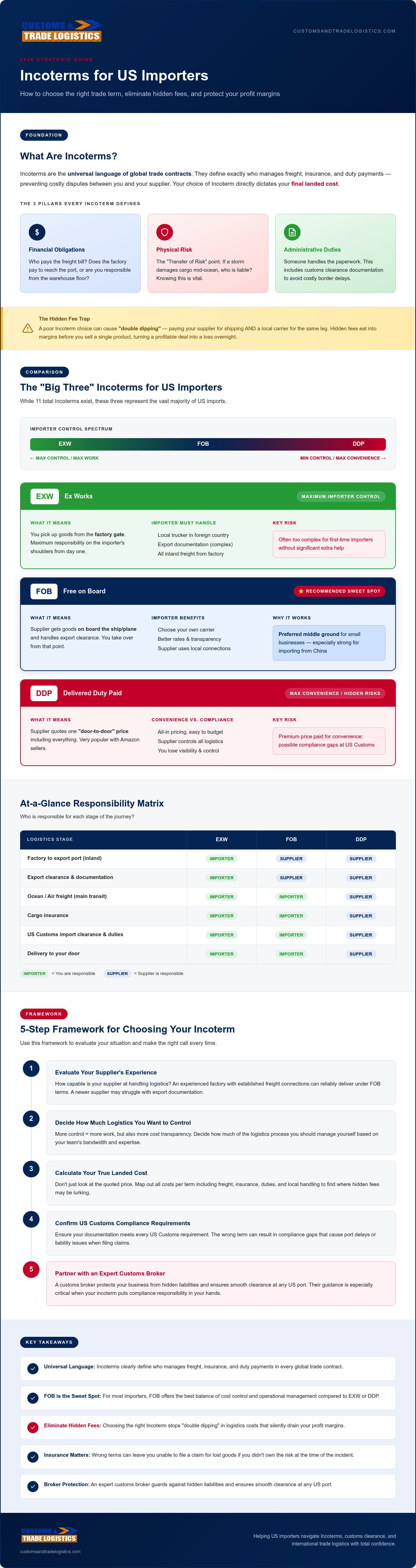
Think of Incoterms as the universal language of global trade contracts. They aren't just three-letter acronyms on a purchase order; they're the rules that prevent expensive misunderstandings between you and your supplier. When you're busy growing your business, the last thing you need is a dispute over who pays for a shipping container sitting at a port. Choosing the right incoterm for my shipment ensures everyone knows exactly where their job starts and ends. Your choice of Incoterm directly dictates your final landed cost by determining which party absorbs specific transportation and regulatory expenses.
The Three Pillars: Cost, Risk, and Responsibility
Logistics involves much more than just moving boxes from point A to point B. It's about managing three distinct areas of your business operations to ensure your goods arrive safely and legally. We break these down into three main pillars.
- Financial Obligations: This covers the actual freight bill. Does the factory pay to get the goods to the port, or are you responsible from the moment they leave the warehouse floor?
- Physical Risk: This is the "Transfer of Risk" point. If a storm damages your cargo mid-ocean, who is liable? Knowing exactly when responsibility shifts from the seller to you is vital for your peace of mind.
- Administrative Duties: Someone has to handle the paperwork. This includes filing documentation and managing the customs clearance services us importers depend on to avoid costly delays at the border.
Why the Wrong Choice Can Sink Your Profit Margins
A poor choice can lead to "double dipping" in your logistics costs. If you agree to terms without understanding the breakdown, you might pay your supplier for shipping while also paying a local carrier for the same leg of the journey. These hidden fees eat into your margins before you even sell a single product. It's a common trap that can turn a profitable deal into a loss overnight.
Insurance is another area where things get messy quickly. If you don't have the right terms, you might find yourself unable to file a claim for lost goods because you didn't technically "own" the risk at the time of the incident. Choosing the right incoterm for my shipment means you have the oversight needed to protect your investment. We've seen many small businesses struggle because they picked the "easiest" option instead of the one that offered the most protection. Taking a little time to understand these terms now saves a lot of stress later.
Comparing the Most Common Incoterms for US Importers
When you're looking at a proforma invoice, the "Big Three" terms you'll see are EXW, FOB, and DDP. While there are eleven total terms in the official rules, these three represent the vast majority of US imports. Finding the balance between saving money and saving time is the core of choosing the right incoterm for my shipment. Each term represents a different level of control over your supply chain. If you want to lower your costs, you usually have to take on more responsibility. If you want convenience, you'll likely pay a premium. Understanding these trade-offs is the first step toward protecting your margins and ensuring your goods don't get stuck at the port.
EXW (Ex Works) vs. FOB (Free on Board)
Ex Works (EXW) puts the maximum responsibility on your shoulders. You're essentially picking up the goods from the factory gate. This means you have to find a local trucker in a foreign country and manage export documentation you might not fully understand. It's often too much for first-time importers to handle without a lot of extra help.
Free on Board (FOB) is the preferred middle ground for many small businesses. Under this term, your supplier is responsible for getting the goods onto the ship or plane and handling the export clearance. This is a massive relief for import from China logistics, as it lets the factory use their local connections to handle the first leg of the journey. Once the cargo is "on board," you take over. This gives you the freedom to choose your own carrier for the main international transit, which usually leads to better rates and more transparency.
DDP (Delivered Duty Paid): The Convenience vs. Compliance Debate
Delivered Duty Paid (DDP) is incredibly popular with Amazon sellers because it feels like a "door-to-door" service. The supplier quotes one price that includes everything. While this is convenient, it's often where businesses lose the most money because suppliers rarely provide a transparent breakdown of freight, insurance, and duties. You're likely paying a significant markup for that convenience.
More importantly, DDP can create a compliance nightmare. Even though the supplier manages the shipment, US Customs views you as the Importer of Record. If the supplier's chosen carrier makes a mistake on the entry, you're the one facing the fines. Partnering with an experienced customs clearance agent usa allows you to maintain control over these filings. It's a safer way to manage your growth without leaving your legal standing in the hands of a third party. If you're currently choosing the right incoterm for my shipment, consulting with a logistics expert can help you transition to a more cost-effective strategy.
Control vs. Convenience: Finding Your Ideal Balance
Many business owners believe that choosing the right incoterm for my shipment simply means picking the easiest option. It's tempting to let your supplier handle everything so you can focus on sales, but this convenience often comes at a steep price. The fundamental trade-off in international trade is simple: more control usually leads to lower costs, while more convenience leads to higher fees and less transparency. When you take the reins, you eliminate the hidden markups that suppliers often add to "door-to-door" quotes.
Taking control doesn't mean you have to be a logistics expert yourself. By managing your own international freight shipping through a trusted broker, you gain the benefits of lower rates without the administrative headache. You might feel like you don't have the time to manage logistics, but a seasoned partner acts as your advocate. This partnership allows you to enjoy the cost savings of professional oversight while someone else handles the granular details of the managing international shipping chain for you.
Why Control Over Freight Means Control Over Visibility
When you let a supplier choose the carrier, you're often left in the dark. You might not know where your container is or which ship it's on until it finally arrives at the port. This lack of visibility makes it impossible to plan your inventory or update your customers accurately. By choosing the right incoterm for my shipment, such as FOB, you decide which forwarder handles your goods. This ensures you have a direct line of communication and can avoid surprise "destination charges" from unknown agents. Working with a family-owned logistics mentor gives you a "safe pair of hands" to guide you through these choices, ensuring you always know the status of your investment.
Compliance Risks You Can't Delegate
There's a dangerous misconception that using DDP terms removes your legal liability. In the eyes of US Customs, the owner of the goods is almost always the one responsible for the accuracy of the entry. If your supplier's agent misclassifies a product to save on duties, you are the one who will face the fines and penalties. Delegating shipping is not delegating legal liability. A professional broker protects your business by verifying every document before it reaches a US port. This oversight ensures you stay compliant with federal regulations, providing a sense of security that a distant supplier simply cannot offer.
A 5-Step Framework for Choosing Your Incoterm
Moving from a basic understanding of trade terms to a signed contract requires a methodical approach. Choosing the right incoterm for my shipment isn't just about picking an acronym; it's about building a sequence of decisions that protect your capital. We've developed this five-step framework to move you from uncertainty to a secure, transparent shipping chain.
- Step 1: Assess your supplier's export experience. Ask if they have their own export license or if they rely on a third-party agent. A factory that only sells locally may struggle with the requirements of an FOB agreement.
- Step 2: Determine your desired level of involvement. Decide if you have the bandwidth to oversee the international leg or if you need a partner to manage the end-to-end movement of your goods.
- Step 3: Compare quotes for FOB vs. EXW. Requesting both prices reveals the true cost of local transport in the origin country. If the price gap is massive, the supplier might be padding their inland freight margins.
- Step 4: Consult with a customs broker. Before you commit to a term, verify the custom brokerage service fees associated with your choice. This helps you build an accurate budget for your total landed cost.
- Step 5: Finalize the contract with precise points. Once you've settled on a term, ensure it's written into your sales agreement with a specific geographic location to avoid any ambiguity.
Evaluating Your Supplier's Capabilities
Is your factory a master of exports or a local-only manufacturer? This distinction is critical when choosing the right incoterm for my shipment. You'll often see the term "FOB Factory" on proforma invoices, but this is a dangerous misnomer. Since FOB stands for "Free On Board," the goods must technically be on a vessel. A factory is usually inland. If a supplier uses this phrase, they likely mean EXW or FCA. Misusing these terms leads to heated disputes over who pays for the truck if it breaks down between the warehouse and the port. Always match the term to the supplier's actual geographic ability to deliver.
The Crucial Step: Naming the Precise Place
Ambiguity in a contract is an open door for unexpected fees. Simply writing "FOB China" is not enough to protect your business. You need to specify a exact location, such as "FOB Shanghai Port" or "FOB Shenzhen." This level of detail is vital import logistics for startups because it prevents suppliers from choosing a distant port that's convenient for them but expensive for your ocean carrier. When you name the delivery point clearly, you lock in the trucking costs and ensure your logistics partner knows exactly where to collect the cargo. If you're feeling overwhelmed by these technical details, speaking with a logistics consultant can provide the clarity you need to sign your next contract with total confidence.
How a Customs Broker Optimizes Your Incoterm Strategy
A customs broker is more than just a documentation filer; we are the bridge between your overseas supplier and the complex requirements of US Customs. While choosing the right incoterm for my shipment sets the stage, a broker ensures the performance goes off without a hitch. With 35+ years of experience, we've seen every possible logistical pitfall. We act as your advocate, reviewing your contracts to spot "bad" terms that could lead to unexpected costs or legal liabilities before you commit your capital.
For e-commerce brands, the stakes are even higher. We specialize in simplifying FBA freight forwarding services, ensuring your goods move seamlessly from international factories to Amazon fulfillment centers. This end-to-end oversight means you don't have to worry about your shipment being rejected at the warehouse or stuck at a port due to a paperwork error. We position ourselves as a "safe pair of hands" for your business, taking the administrative weight off your shoulders so you can focus on scaling your brand.
Beyond Paperwork: Strategic Consulting for SMBs
Our role involves strategic consulting that helps you negotiate better terms with your overseas factories. We don't just tell you what a term means; we show you how it impacts your bottom line. By identifying hidden costs in your current shipping arrangements, we can often find ways to streamline your logistics and save you money. This level of oversight reduces the heavy administrative burden that often keeps small business owners awake at night. We help you understand the true cost of your goods, ensuring your profit margins remain protected throughout the entire journey.
Ready to Simplify Your Next Shipment?
Are you tired of surprise fees and confusing logistics jargon? Choosing the right incoterm for my shipment shouldn't be a source of anxiety. As a family-owned consultancy, we value your growth and treat your business with the care it deserves. We invite you to get a professional review of your logistics plan to ensure you're using the most cost-effective and compliant strategy possible. Getting started is simple. Reach out for a personalized logistics consultation today and experience the relief of having a dedicated partner manage your international freight logistics and customs clearance services.
Secure Your Supply Chain for 2026 and Beyond
Mastering international trade doesn't have to be an intimidating process. By moving away from the convenience trap of terms like DDP and embracing transparent options like FOB, you regain control over your costs and visibility. Every contract is a chance to protect your profit margins. Following a clear framework for choosing the right incoterm for my shipment ensures you aren't left holding the bill for unexpected port fees or compliance penalties.
You don't have to navigate these complex waters alone. With 35+ years of industry expertise, our family-owned team acts as a safe pair of hands for your business. We specialize in SMB and Amazon FBA logistics, providing the personalized support you need to thrive in the global marketplace. We're here to lift the administrative burden from your shoulders so you can focus on growth. Let our experts help you choose the right Incoterm for your next shipment and move forward with total peace of mind.
Frequently Asked Questions
Can I change the Incoterm after the shipment has already left the port?
You cannot officially change an Incoterm once the goods are in transit because the contract of sale is already executed. Any change would require a formal amendment to the commercial invoice and agreement from both parties. This often causes significant delays with US Customs and ocean carriers. It's much safer to focus on choosing the right incoterm for my shipment during the negotiation phase before any cargo moves.
Which Incoterm is best for Amazon FBA sellers importing from China?
FOB (Free on Board) is widely considered the best choice for Amazon FBA sellers. It allows you to use your factory's local expertise for export while giving you control over the international freight and US customs entry. While DDP seems easier, it often hides inflated shipping costs and puts your Importer of Record status at risk. Managing your own logistics ensures your goods reach warehouses without unexpected compliance hurdles.
Does the Incoterm I choose affect the amount of customs duty I pay?
Yes, your choice can impact the final duty amount. US Customs duties are generally calculated based on the transaction value of the goods. If you use a term like CIF, which includes insurance and freight, you must ensure those costs are clearly broken out on the invoice. If they aren't, you might accidentally pay duty on the shipping costs instead of just the product value. This is a common mistake for new importers.
What happens if my cargo is damaged and I chose EXW?
If you chose EXW (Ex Works), you are fully responsible for the cargo from the moment it leaves the supplier's door. This means if the truck flips on the way to the port or the container is damaged during loading, the loss is entirely yours. You must arrange your own insurance and handle all claims yourself. This high level of risk is why many businesses prefer terms that transfer responsibility later in the journey.
Is DDP always the most expensive option for small businesses?
DDP is frequently the most expensive option because suppliers often add a significant buffer to cover potential fluctuations in freight and duties. You lose the ability to shop around for better shipping rates or verify the accuracy of the duty payments. While the door to door convenience is tempting, choosing the right incoterm for my shipment like FOB usually results in lower total landed costs and much better financial transparency for your business.
What is the difference between FOB and FCA for air freight?
The primary difference is the mode of transport. FOB is strictly reserved for sea and inland waterway transport. For air freight or courier shipments, you should use FCA (Free Carrier). Under FCA, the supplier's responsibility ends when they deliver the goods to the carrier at a named place. Using the correct terminology prevents legal confusion if a dispute arises regarding where the risk actually transferred during the international journey.
Who is responsible for the ISF filing under different Incoterms?
The importer is legally responsible for ensuring the Importer Security Filing (ISF) is submitted to US Customs at least 24 hours before the ship leaves the origin port. Even if you use DDP or CIF, you are the party liable for the 5,000 dollar fine for late or inaccurate filings. Working with a professional broker ensures your ISF is filed correctly and on time, regardless of which shipping term you negotiated with your supplier.
How do Incoterms 2020 differ from the older 2010 rules?
The 2020 rules introduced a few key updates to improve clarity for global traders. The term DAT (Delivered at Terminal) was replaced by DPU (Delivered at Place Unloaded) to show that delivery can happen anywhere, not just at a terminal. Also, FCA was updated to allow buyers and sellers to agree on a Bill of Lading with an on-board notation. These changes reflect the evolving needs of modern trade and provide better protection for all parties involved.


