

What if the $800 duty-free threshold you relied on for years simply vanished? With the 2025 suspension of the de minimis exemption still in full effect, every commercial shipment from China now faces formal entry and full duty payments. It's a daunting shift that has left many importers feeling exposed to unexpected "bill shocks" and complex paperwork. If you're struggling to figure out how to calculate import duties from china to usa in this new landscape, you aren't alone. We know how heavy that administrative burden feels when you're just trying to grow your business.
You deserve to move your goods with confidence, not fear of HTS misclassification penalties. We agree that the current "Trade War" climate, including the 12.5% Section 301 tariffs for forced labor practices, makes the math feel like a moving target. This guide promises to demystify those complexities by providing a clear formula for your landed costs. We'll walk through the 0.3464% Merchandise Processing Fee, the Harbor Maintenance Fee, and specific HTS selection strategies. By the end, you'll know exactly what you owe and when a seasoned partner can help you protect your margins.
Key Takeaways
- Understand why "Dutiable Value" is the foundation of your costs and how the Transaction Value method determines what you actually owe.
- Get a clear, step-by-step breakdown on how to calculate import duties from china to usa using the latest 2026 HTS rates and processing fees.
- Identify how Section 301 tariffs and the suspension of the de minimis rule impact your specific product categories and bottom line.
- Learn to spot hidden costs like Antidumping and Countervailing Duties (AD/CVD) before they lead to unexpected border penalties.
- See how partnering with a family-oriented logistics mentor can transform complex HTS classification from a source of stress into a strategic advantage.
Understanding the Components of US Import Duties
Many importers start their journey by looking at their factory invoice and assuming that's the only number U.S. Customs and Border Protection (CBP) uses for taxes. It's rarely that simple. To learn how to calculate import duties from china to usa, you must first understand the concept of "Dutiable Value." This is the total value of your goods as defined by federal standards. If you get this number wrong, your entire calculation will be off before you even begin.
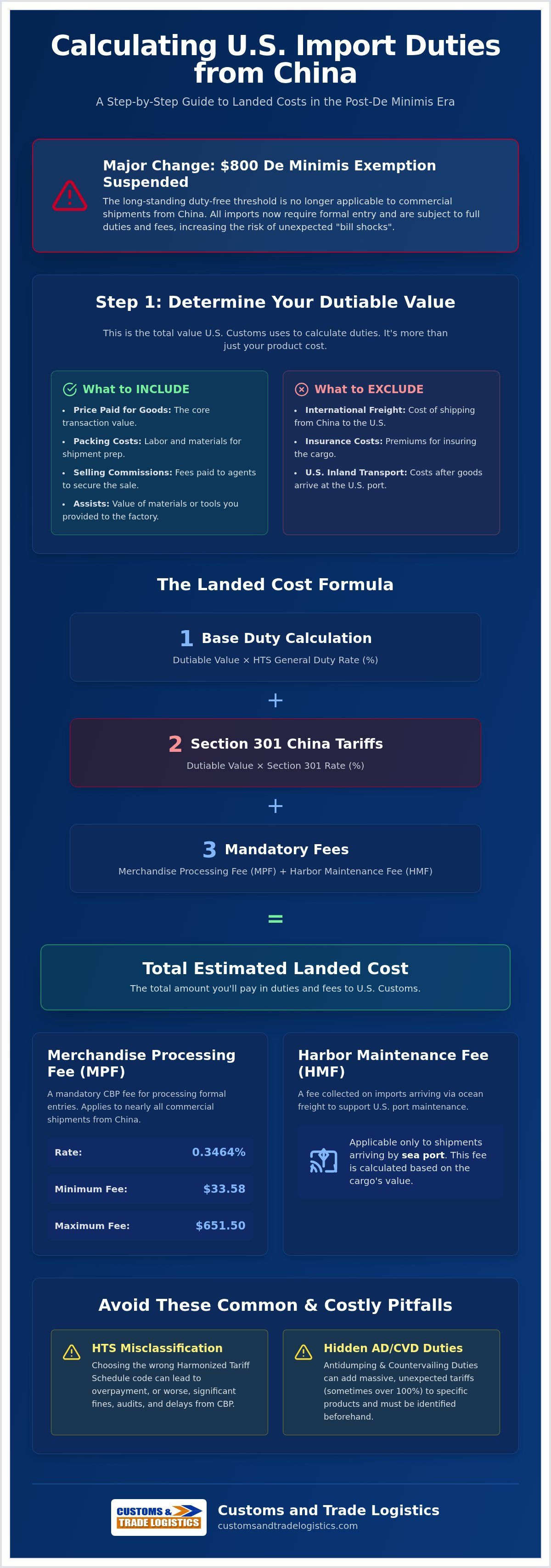
CBP primarily uses the "Transaction Value" method to determine cost. This is essentially the price actually paid or payable for the merchandise when sold for exportation to the United States. However, your dutiable value often includes more than just the unit price. You must also include:
- Packing costs: Any labor or materials used to get the goods ready for shipment.
- Assists: The value of any materials, components, or tools you provided to the manufacturer for free or at a reduced cost to help produce the goods.
- Selling commissions: Fees paid to an agent to secure the sale.
There is some relief for your budget, though. You can typically exclude international freight charges, insurance, and any inland transport costs within the U.S. from your dutiable value. Keeping these costs separate on your commercial invoice is a smart way to ensure you aren't paying duties on the shipping itself. This distinction is a key part of how to calculate import duties from china to usa without overpaying.
The Role of the HTS Code
Think of the Harmonized Tariff Schedule (HTS) as the DNA of your shipment. It's the foundation of all duty math. The first six digits of an HTS code are part of a global system, but the final four digits are unique to the U.S. These last four digits determine your specific tax rate. Precise classification is vital. If you choose a code that's too broad, you might over-comply and pay more than necessary. If you choose one that's incorrect, you risk penalties and delays. Having a mentor guide you through this selection process provides a "safe pair of hands" for your business growth.
Duty Rates: Ad Valorem vs. Specific
Once you have your value and your code, you'll encounter different types of rates. For a broad U.S. Customs Duties Overview, it's helpful to know that most imports from China fall under Ad Valorem duties. This is a simple percentage of the dutiable value. For example, if your goods are worth $10,000 and the rate is 3%, you owe $300.
Some commodities use Specific duties, which are based on weight or quantity, such as cents per kilogram. Occasionally, you'll see Compound duties that combine both methods. Knowing which one applies is essential for forecasting your landed costs accurately.
The Step-by-Step Formula for Calculating Import Duty
Calculating your total landed cost doesn't have to feel like a guessing game. While simple online calculators often miss the nuances, a methodical approach ensures your business stays profitable. Here is the foundational process for how to calculate import duties from china to usa in the current regulatory environment.
First, you need your HTS code and the General Rate of Duty. As we discussed, this code dictates the percentage CBP will apply to your dutiable value. Once you have that percentage, multiply it by the value of your goods. For instance, if you're importing $50,000 worth of electronics with a 2% base duty, your initial calculation is $1,000. However, this is just the starting point. You must also account for the Section 301 Tariffs on Chinese Goods, which often add a significant layer to the final bill. These additional tariffs are calculated on the same dutiable value as your general duty.
Calculating Merchandise Processing Fee (MPF)
The MPF is a mandatory administrative fee that many new importers overlook. Since the $800 de minimis exemption was suspended in 2025, virtually all commercial shipments are now considered formal entries. For fiscal year 2026, the MPF rate is 0.3464% of your cargo's value. However, there are strict limits to keep in mind. The minimum fee you'll pay is $33.58, and the maximum is capped at $651.50 per entry. If you're moving multiple shipments, these small fees can add up quickly, making precise budgeting essential.
Calculating Harbor Maintenance Fee (HMF)
If your goods arrive via ocean freight, you'll also see a Harbor Maintenance Fee on your bill. Unlike the MPF, this fee does not have a maximum cap. It's a fixed rate of 0.125% applied to the cargo value. HMF is a fee used to maintain US ports and waterways. It's important to remember that this only applies to sea shipments. If you're using air freight to speed up your supply chain, you can skip this specific line item entirely.
Putting it all together, your formula looks like this: (Dutiable Value x Duty Rate) + MPF + HMF + Section 301 Tariffs. This comprehensive view is what separates successful importers from those surprised by "bill shock" at the border. If these steps feel overwhelming, our team provides Customs Clearance Services to handle the heavy lifting for you. We act as a seasoned mentor, ensuring every decimal point is in the right place so you can focus on your customers.
The China Factor: Navigating Section 301 Tariffs
When you look at how to calculate import duties from china to usa, the "China Factor" is usually the biggest variable in your equation. Section 301 tariffs are additional duties imposed on goods of Chinese origin following investigations into trade practices. These aren't just small administrative fees; they can often double or triple your total tax bill. Unlike general duties that apply to many countries, these are targeted specifically at China to address ongoing trade imbalances and labor concerns.
Customs organizes these tariffs into a "Four Lists" system. Depending on which list your product falls under, you could face an additional 7.5%, 25%, or even the new 12.5% tariff related to forced labor practices that took effect on July 24, 2026. It's vital to remember that these duties are cumulative. They are added on top of the General Rate of Duty found in the HTS. For example, if your item has a 5% general duty and falls under a 25% Section 301 list, your total duty is 30%. This makes your initial HTS classification more critical than ever.
Finding Your Product on the Section 301 Lists
How do you know which list applies to you? You'll need to consult the USTR (US Trade Representative) database to verify your HTS code against the active lists. One common point of confusion is the difference between "Country of Origin" and "Exporting Country." Even if you ship goods from a third-party warehouse in a different country, if the "Origin" is China, Section 301 still applies. Because the database is dense and technical, many businesses find that a China to USA import consultant is the best way to avoid expensive classification mistakes. We act as a "safe pair of hands" to ensure you aren't paying a "China Tax" that doesn't actually apply to your specific goods.
Checking for Tariff Exclusions
Tariff exclusions can offer a much-needed financial breather. These are specific HTS codes or product descriptions that the USTR has temporarily exempted from Section 301 duties. However, these exclusions are not permanent. As we move through 2026, many previous exclusions have expired or are under review. Utilizing a mentor who tracks these shifts ensures you don't pay 25% on a product that could have entered for much less. The process of applying for or utilizing existing exclusions requires meticulous documentation, but the savings for your bottom line can be substantial.
Common Calculation Pitfalls and How to Avoid Them
Even with a solid formula in hand, the path to a perfect landing is often blocked by small, avoidable errors. Many importers struggle with how to calculate import duties from china to usa because they rely on the "Commercial Invoice" as the final word on value. As we've discussed, your dutiable value might need to include assists or packing costs that aren't on that invoice. Conversely, you shouldn't pay duty on international freight or insurance if those costs are bundled into your invoice price. Separating these line items is your first step toward financial accuracy.
Another "silent killer" of profit margins is overlooking Antidumping and Countervailing Duties (AD/CVD). These are additional taxes applied to specific goods, such as certain steel or aluminum products, that CBP believes are being sold below fair market value. These rates can sometimes exceed 100%, turning a profitable shipment into a massive loss. You must also account for currency conversion. CBP uses the exchange rate active on the specific date of export from China, not the date your goods arrive at a U.S. port. Using an outdated HTS code provided by your supplier is equally risky; their code is for Chinese export, but you must use the current 2026 U.S. schedule for your entry.
The Danger of Under-Valuation
Are you tempted to "low-ball" your invoice value to save on taxes? This is a trap that leads to seizures, heavy fines, and a permanent red flag on your business profile. CBP is diligent about auditing historical entries, often looking back five years to find discrepancies. This scrutiny also applies to samples or "free of charge" items. In the eyes of Customs, everything has a value. You must declare a fair market value for these items in your calculations to remain compliant and avoid unnecessary delays.
Strategic HTS Classification
Classification isn't just about finding a label; it's about applying the General Rules of Interpretation (GRI) to your specific product. How your product is made often dictates its tax rate. For example, a slight change in material, like moving from a plastic component to a metal one, can shift your product into a completely different HTS category with a lower duty rate. This is where strategic classification becomes a tool for legal duty mitigation. For a deeper look at staying compliant, see our Pillar Guide on Customs Clearance Services.
Don't let these pitfalls derail your supply chain. If you want a "safe pair of hands" to review your classification and valuation before you ship, contact our experts for Import From China Consulting today.
Why Professional Customs Brokerage is the Ultimate Cost-Saver
While learning how to calculate import duties from china to usa is a vital skill for any business owner, manual spreadsheets eventually become a liability. Small errors in valuation or HTS codes don't just result in wrong math. They lead to real-world penalties. Moving to professional custom brokerage services replaces administrative anxiety with a sense of security. As a family-owned mentor, we know that for a small business, every dollar counts. We don't just provide a formula. We act as your dedicated advocate.
A professional broker handles the granular details of filing and payment to CBP on your behalf. This oversight ensures that your paperwork is audit-ready from day one. By ensuring accurate preparation before your cargo even leaves China, you significantly reduce the risk of costly delays. These delays often lead to "demurrage" charges, which are daily fees for cargo sitting at the port. Avoiding just one week of demurrage can often save more than the cost of the brokerage service itself. It's a pragmatic investment in your bottom line.
Tailored Support for Amazon Sellers and E-commerce
Amazon FBA imports from China present unique logistical hurdles. You aren't just moving goods; you're managing a door-to-door chain from a factory to a specific warehouse. We specialize in demystifying this process for e-commerce entrepreneurs. Having a "safe pair of hands" to manage your compliance means you can focus on marketing and sales while we handle the technical density of customs entry. It's about providing the relief you need to scale without fear of a border seizure. We manage the movement so you can manage the growth.
The Long-Term Value of Logistics Consulting
Effective logistics goes beyond a single entry. It's about building a scalable import strategy that can withstand 2026 trade volatility. With 35+ years of industry experience, we've seen every shift in policy and tariff list. We use that history to help you forecast landed costs with precision. If you're ready to simplify your journey and stop worrying about how to calculate import duties from china to usa on your own, Contact Customs and Trade Logistics today. We're here to lift the administrative burden and help your business thrive.
Secure Your Supply Chain for 2026
Success in international trade depends on more than just high-quality products; it requires a deep understanding of your landed costs. As we've explored, getting your HTS classification right and navigating the latest Section 301 tariffs are essential steps to avoid "bill shocks" at the border. Mastering how to calculate import duties from china to usa gives you the power to forecast profits with precision and stay ahead of the competition.
You don't have to carry this administrative weight alone. With 35+ years of customs expertise, our family-owned team acts as a "safe pair of hands" for your business. Whether you need specialized support for Amazon FBA or end-to-end logistics management, we're here to demystify the process and protect your margins. Let our family-owned team manage your China imports so you can focus on what you do best. Your growth is our priority, and we're ready to help you navigate the complexities of global trade with total peace of mind.
Frequently Asked Questions
Is the duty calculated on the total cost including shipping?
Duties are calculated on the "dutiable value," which typically excludes international shipping and insurance costs. When learning how to calculate import duties from china to usa, it's important to use the Transaction Value method. This focuses on the price paid for the merchandise itself. If your invoice bundles freight and cargo costs together, you might pay taxes on the shipping. Ask your supplier to list these charges separately to ensure you only pay what's legally required.
What is the current Section 301 tariff rate for China imports in 2026?
Section 301 rates depend on which of the "Four Lists" your product falls under. While many goods face 7.5% or 25% additional duties, a new 12.5% tariff related to forced labor practices went into effect on July 24, 2026. These tariffs are cumulative; they're added on top of the general duty rate found in the HTS. Staying updated on these shifting percentages is vital for maintaining your profit margins in a volatile trade environment.
Can I avoid import duties if my shipment value is low?
In 2026, you can't avoid duties based on low shipment value. The $800 de minimis exemption, which allowed duty-free entry for small packages, was suspended in 2025 and remains inactive. Every commercial shipment now requires a formal customs entry and full duty payment. This change has increased the administrative burden for e-commerce and Amazon sellers, making it even more important to have a clear strategy for your landed cost calculations before shipping your goods.
How do I find the correct HTS code for my Chinese product?
You can find the correct code by consulting the 2026 Harmonized Tariff Schedule of the United States (HTS). It's a complex document where the first six digits are part of a global system and the last four are specific to U.S. requirements. Because a slight material change can shift your duty rate, many importers rely on a mentor with 35+ years of experience to ensure they select the most accurate and cost-effective classification for their products.
What happens if I calculate the import duty incorrectly?
Incorrect calculations often result in "bill shocks" at the border or severe legal penalties. If you underpay, U.S. Customs and Border Protection (CBP) can seize your goods or issue heavy fines during an audit. If you overpay due to misclassification, you lose valuable profit. Beyond the immediate costs, repeated errors can lead to your business being flagged for increased scrutiny, causing delays for every future shipment you attempt to bring into the country.
Does the US have a free trade agreement with China?
No, the United States doesn't have a free trade agreement with China. Most imports are subject to "Column 1 General" duty rates. On top of these base rates, goods from China are currently subject to additional Section 301 tariffs. Understanding how to calculate import duties from china to usa requires looking at both the standard HTS rate and these specific China-only surcharges to get an accurate picture of your total tax obligation.
Are there extra fees for ocean freight vs. air freight from China?
Yes, ocean freight shipments incur a Harbor Maintenance Fee (HMF) of 0.125% of the cargo value, which is used to maintain U.S. ports. Air freight is exempt from this fee. Both modes are subject to the Merchandise Processing Fee (MPF). For 2026, the MPF for formal entries is 0.3464%, with a minimum of $33.58 and a maximum of $651.50. Choosing between air and sea requires balancing these extra fees against your shipping deadlines.
How do I pay the duties once they are calculated?
Duties are typically paid electronically through the Automated Commercial Environment (ACE) system. Most businesses hire a licensed customs broker to manage these payments on their behalf. The broker ensures the funds reach CBP accurately and on time, preventing delays at the port. This partnership provides a "safe pair of hands" for your financial compliance, allowing you to focus on your core operations while a seasoned professional handles the complex administrative filing and payment requirements.


