

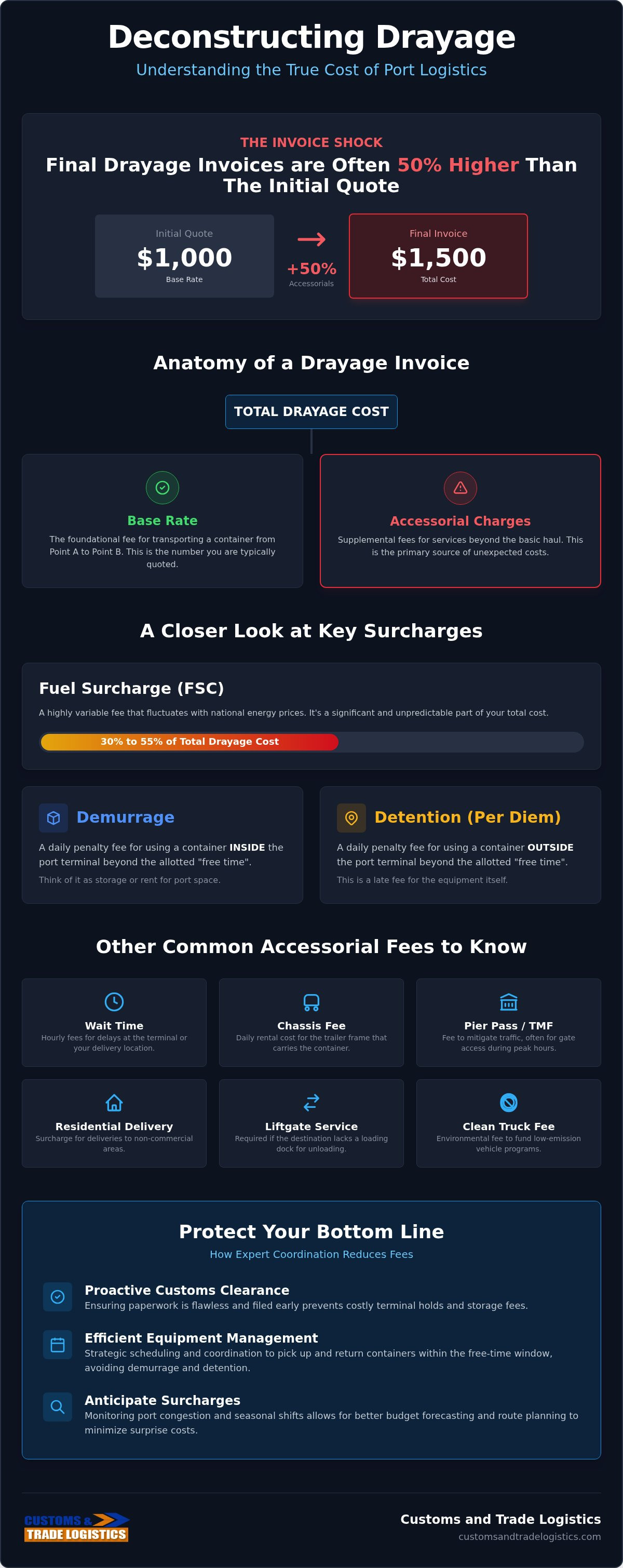
Did you know that the final invoice for moving a container from the pier is often 50% higher than the initial quote? It's a common and frustrating reality for importers who find themselves blindsided by "accessorial" charges they didn't see coming. Truly understanding drayage fees at US ports requires looking past the simple base rate to the complex stack of fuel surcharges, chassis rentals, and terminal fees that actually dictate your bottom line.
We understand how unsettling it feels to see your margins eroded by confusing line items like Pier Pass fees or unexpected per diem charges. You shouldn't have to guess what your logistics costs will be. This guide promises to help you master these complexities so you can identify, manage, and reduce the hidden fees impacting your business. We'll walk through the 2026 rate landscape, clarify the difference between demurrage and detention, and share veteran strategies to avoid late fees and chassis splits. By the end, you'll have the clarity and confidence to manage your port operations like a seasoned pro.
Key Takeaways
- Gain a clear perspective on understanding drayage fees at US ports by breaking down the complex journey between the ocean terminal and your warehouse.
- Master the anatomy of your invoice to distinguish between basic hauling rates and the supplemental "accessorial" charges that often hide in the fine print.
- Protect your bottom line by learning exactly how to avoid demurrage and detention penalties through better equipment management and timing.
- See how proactive customs clearance and expert coordination act as a "safe pair of hands" to prevent the terminal holds that drive up storage costs.
- Learn to anticipate seasonal shifts and congestion surcharges so your shipping budget remains predictable even during the busiest times of the year.
The Fundamentals of Port Drayage and Fee Structures
Drayage is the specialized short-haul transport of freight from an ocean terminal to a nearby warehouse, rail yard, or distribution center. It's often called the "first mile" of domestic transport. Drayage serves as the critical link in the intermodal chain, connecting massive container ships to the trucks and trains that move goods across the country. Without this bridge, your cargo stays stuck at the pier, regardless of how fast the ocean transit was.
Understanding drayage fees at US ports starts with recognizing that these costs aren't structured like standard long-haul trucking. In the US, ports are governed by a complex web of terminal operators, equipment providers, and regulatory bodies. Unlike many international ports where fees are more centralized, US ports utilize a modular fee structure where the base rate is only a fraction of the total cost. You'll typically choose between two service levels: port-to-door, which delivers the container directly to your facility, or port-to-ramp, which transfers it to a rail terminal for inland movement.
Why Drayage Costs Vary Across US Ports
Why does a move at one port cost significantly more than a similar distance at another? Congestion is the primary driver. If a terminal is inefficient, drivers spend hours in queues. This idling time isn't free; it's passed on through wait time surcharges. Beyond congestion, environmental regulations play a massive role. Many major hubs have implemented Clean Truck initiatives, adding environmental fees to every gate entry to fund low-emission vehicle programs. Local labor agreements also create regional price differences, as union-managed terminals often have different operating hours and cost structures than non-union facilities.
Drayage vs. Cartage: Clearing the Confusion
It's easy to use these terms interchangeably, but they serve different roles in your supply chain. Cartage refers to short-distance hauling of broken-down freight within a specific area, such as moving pallets between two local warehouses. Drayage is much more specialized. It requires port-authorized equipment, such as heavy-duty chassis, and drivers must hold specific credentials like TWIC cards to enter secure zones. If your goods are still inside an ocean container, you need a drayage provider. Check your Bill of Lading to confirm the delivery terms; if the destination is a maritime terminal, drayage is your required service.
The Anatomy of a Drayage Invoice: Base Rates vs. Accessorials
Have you ever opened a shipping invoice and felt a jolt of surprise at the final total? You aren't alone. For many business owners, understanding drayage fees at US ports is a lesson learned through unexpected surcharges. The "Base Rate" you see on an initial quote represents the core transport fee for moving a container from point A to point B, but it's rarely the final number you'll pay. Think of the base rate as the foundation of a building; it's essential, but it doesn't include the plumbing, wiring, or finishes that make the structure functional.
Accessorial charges are supplemental fees for services that fall outside that basic haul. They're the primary source of "invoice shock" because they often depend on real-time port conditions or specific delivery requirements. One of the largest variables is the Fuel Surcharge (FSC). This fee fluctuates with national energy prices and, according to recent 2026 data, can account for 30% to 55% of your total drayage cost. Because these percentages change weekly, a quote from last month might not match today's reality.
Common Accessorial Charges You Should Know
While every shipment is unique, certain fees appear more frequently than others. If you're delivering to a home or a small office rather than a commercial warehouse with a loading dock, you'll likely see a Residential Delivery Fee. These areas are harder for large trucks to navigate and require more time. Similarly, if your destination lacks a dock, you'll need Liftgate Services, which involves specialized equipment to lower the cargo to the ground. Perhaps most frustrating is Wait Time. Drivers typically provide a small window of free time for loading or unloading, but if they're delayed at your facility or the terminal, hourly fees apply. You can find more official guidance on how these delays impact costs through the Federal Maritime Commission's resources on Detention and Demurrage.
The Chassis Fee: A Vital but Often Overlooked Cost
A chassis is the specialized trailer used to carry ocean containers over the road. Years ago, ocean carriers provided these for free as part of the shipping bundle, but those days are gone. Today, you'll see a daily rental fee, typically ranging from $35 to $50 per day in 2026. Understanding drayage fees at US ports also means preparing for "chassis splits." This occurs when a driver arrives at a terminal only to find no chassis available, forcing them to drive to a separate depot to find equipment. This extra trip adds a specific surcharge to your bill and consumes valuable driver hours.
Managing these variables requires a proactive approach and a clear line of sight into your logistics chain. Working with a veteran international freight logistics partner can help you anticipate these costs before they hit your ledger, ensuring your budget remains as stable as possible.
Critical Surcharges: Demurrage, Detention, and Storage
Once your container touches the dock, an invisible clock starts ticking. This is the "free time" window, and in 2026, it's tighter than ever. At major terminals, free time has been reduced to as little as 2 to 4 days. If you exceed this window, you face two of the most expensive penalties in the shipping industry: demurrage and detention. Truly understanding drayage fees at US ports requires a firm grasp of these timelines, as they can quickly compound until the fees actually exceed the value of your cargo.
Demurrage is the penalty you pay to the terminal for leaving your container on the pier past the free time limit. Detention, often called per diem, is the fee you pay to the ocean carrier for keeping their equipment outside the port for too long. These aren't just administrative nuisances; they're significant financial drains that demand total oversight and protective care from your logistics team.
The "Per Day" Trap: How Penalties Escalate
Penalties don't stay flat; they climb. A typical demurrage rate might start at $150 per day for the first four days but jump to $300 or more for every day thereafter. It's a common misconception that the clock stops on weekends or holidays. In reality, terminals usually count every calendar day once free time expires. This is why the Federal Maritime Commission recently issued the Final Rule on Detention and Demurrage Billing to ensure more transparent and fair invoicing practices. To keep it simple, remember that demurrage is a port fee for using terminal space, while detention is an equipment fee for using the physical container.
Pre-Pull and Yard Storage Solutions
What happens if your warehouse is full but your container's free time at the port is running out? This is where a "pre-pull" becomes a lifesaver. A pre-pull involves your drayage driver picking up the container from the terminal and storing it at the carrier’s secure yard instead. While you'll still pay a yard storage fee and a pre-pull surcharge, these costs are often hundreds of dollars less than terminal demurrage rates, which can reach $350 per day. Strategically using a pre-pull allows you to stop the terminal's expensive clock while giving your warehouse team the time they need to prepare for offloading. It's a protective move that veteran importers use to maintain control over their logistics budget and ensure a steady rhythm in their supply chain.
Variable Factors Influencing National Drayage Costs
National drayage costs don't exist in a vacuum. They're heavily influenced by the seasonal rhythm of global trade. If you're importing goods during the 2026 peak season, which typically spans the third and fourth quarters, you'll likely face tighter capacity and higher congestion surcharges. This is particularly true for Amazon FBA sellers preparing for Prime Day or the winter holidays. During these windows, the sheer volume of containers hitting the docks can lead to appointment scarcity and premium pricing.
The dynamics change depending on which coast your cargo arrives at. When managing import from China logistics, many businesses choose West Coast ports for speed, but this often comes with a different set of fees compared to Savannah or Houston. Understanding drayage fees at US ports means recognizing that a standard move in one region might incur specific infrastructure or environmental penalties in another.
Infrastructure Fees and Modern Port Initiatives
At high-volume terminals, you'll often encounter Pier Pass or Traffic Mitigation Fees (TMF). These were designed to encourage night and weekend moves to reduce daytime traffic, but they're now a staple of daytime operations at many ports. You might also see Clean Truck Fund (CTF) fees. These support the transition to zero-emission port equipment. These infrastructure fees are non-negotiable and passed directly from the terminal to the importer. They aren't markups from your carrier; they're the cost of doing business at a modern, high-volume gateway.
Hazardous Materials and Overweight Surcharges
Gaining a deeper perspective on understanding drayage fees at US ports also requires looking at the specific cargo types you're moving. Does your cargo require special handling? If you're moving hazardous materials, expect to pay more for the specialized licensing and insurance required for HazMat drayage. Weight is another critical factor. If your container is too heavy for a standard chassis, you'll need an overweight permit and likely a tri-axle chassis. These specialized trailers distribute the weight more evenly to comply with road safety laws, but they come with their own daily rental surcharges.
Managing these variables across multiple ports can feel like a full-time job. If you're looking for a partner to handle these complexities, our team can provide the end-to-end logistics coordination you need to keep your supply chain moving smoothly.
Strategic Cost Management: How Expert Coordination Reduces Fees
Efficiency in drayage isn't just about how fast a driver moves; it's about how well your paperwork is prepared before the ship even arrives. There's a direct, unbreakable link between customs clearance services us and drayage efficiency. If your customs entry is filed late or contains errors, the terminal will place a hold on your container. Every hour that hold remains is an hour closer to expensive demurrage penalties. When you work with a broker who manages the end-to-end logistics chain, they anticipate these hurdles to keep your cargo moving without interruption.
In a world of automated digital forwarders, many importers feel like just another number in an algorithm. However, understanding drayage fees at US ports requires more than just software; it requires human expertise and a "safe pair of hands" to navigate the nuances of terminal operations. Family-owned firms with decades of experience offer a level of protective care that automated platforms simply can't match. We act as a knowledgeable bridge, ensuring that every stage of your container's journey is synchronized to avoid the communication gaps that lead to "invoice shock."
Proactive Paperwork: The Best Defense Against Fees
The best way to reduce costs is to ensure your Bill of Lading and Commercial Invoice are perfect before the vessel docks. Even a small typo can trigger a secondary inspection or a documentation hold. Beyond just clearing the goods, understanding custom brokerage service fees helps you budget for your total landed cost with precision. A veteran customs consultant doesn't just file papers; they act as your advocate, reviewing terminal invoices and disputing unfair charges when the port's own inefficiencies cause delays.
Choosing the Right Partner for National Logistics
For small businesses and growing brands, the stakes are high. This is why many SMBs benefit from a partner who specializes in import logistics for startups. You need a provider who has deep terminal access and a reliable supply of equipment, even during the peak seasons we discussed earlier. Evaluating a drayage partner should go beyond the base rate; you must look at their ability to secure appointments and their track record of avoiding equipment splits. Ready to streamline your port operations and protect your margins? Contact Customs and Trade Logistics for a personalized consultation to see how we can stabilize your shipping budget.
Master Your Logistics Budget and Protect Your Bottom Line
Mastering your shipping budget requires looking beyond the base rate to the specific surcharges that define the 2026 landscape. You've learned how to distinguish between port-level demurrage and equipment-based detention, and why proactive customs filing is your best defense against shrinking free time windows. By truly understanding drayage fees at US ports, you shift from simply reacting to invoices to strategically managing every dollar in your supply chain.
You don't have to navigate these complexities alone. With 35+ years of customs brokerage expertise, our family-owned team acts as a safe pair of hands for your business. We specialize in the unique demands of Amazon FBA and imports from China, providing personalized support with a national reach. We're dedicated to helping you replace logistics anxiety with professional assurance. Ready to stabilize your shipping costs and ensure your goods move smoothly? Get a Professional Logistics Consultation today. Your growth is our priority, and we're here to ensure your margins remain protected at every terminal.
Frequently Asked Questions
What is the average drayage fee at a US port in 2026?
In 2026, the national average for a local 40-foot container move typically falls between $475 and $900 after all surcharges are included. While base rates often range from $300 to $500, fuel and chassis fees quickly add up. Understanding drayage fees at US ports requires looking at the total landed cost rather than just the initial line haul quote. This perspective helps you budget more accurately for the entire journey from pier to warehouse.
How is demurrage different from detention in drayage?
Demurrage is a penalty charged by the terminal for leaving a container at the port past its free time. Detention, on the other hand, is an equipment fee charged by the ocean carrier for keeping the container too long outside the port. Think of demurrage as a parking ticket for the port's space and detention as a late fee for the carrier's physical equipment. Both can escalate daily if they aren't managed closely.
Can I avoid chassis fees by providing my own equipment?
While it is technically possible to provide your own chassis, most small to medium-sized importers find the maintenance and storage costs prohibitive. Instead, most businesses rely on their drayage provider’s fleet or a chassis pool. A more effective way to manage these costs is to work with a logistics partner who has established relationships with equipment providers. This ensures you have the right gear available even when port volumes are at their highest.
Why did I get a "chassis split" fee on my invoice?
A chassis split fee occurs when a driver arrives at a terminal but finds no available chassis to carry your container. The driver must then travel to a separate equipment depot to secure the trailer before returning to the port. This extra trip consumes fuel and driver hours, resulting in a surcharge that is passed on to the importer. It's a common operational reality that highlights the importance of working with well-equipped drayage partners.
How much "free time" do I typically get at the port?
The amount of free time has significantly decreased at major terminals recently. In 2026, many ports, particularly Los Angeles and Long Beach, have reduced free time to just 2 to 4 days. This narrow window makes it essential to have your warehouse and drayage team synchronized. If you don't pick up the container immediately after it is discharged from the vessel, you'll quickly face the expensive storage penalties we've discussed in this guide.
What happens if my container is put on a customs hold?
If US Customs places a hold on your container, it can't be picked up from the terminal until the hold is released. Unfortunately, the port’s demurrage clock continues to tick during this time. This is why working with a veteran customs broker is vital. They ensure your paperwork is perfect to minimize the risk of holds. Their protective oversight helps you avoid these expensive storage penalties that occur when cargo is stuck at the pier.
Are drayage fees negotiable for small businesses?
While terminal fees and fuel surcharges are non-negotiable, you can often find savings through better coordination. For small businesses, the best negotiation is working with a partner who can optimize your schedule to avoid late fees. Understanding drayage fees at US ports involves recognizing that the lowest base rate isn't always the best deal. If the provider lacks the equipment to avoid split fees, those hidden costs will quickly erode any initial savings.
Does Amazon FBA have specific drayage requirements?
Amazon FBA requires strict adherence to delivery appointment windows and specific labeling standards. If your drayage provider misses a scheduled window at an Amazon fulfillment center, you'll face additional re-delivery fees or even rejection of the shipment. It's important to use a carrier that understands these requirements. They ensure your containers are moved from the port and delivered to Amazon centers according to their precise logistical protocols to avoid costly delays.


