

Did you know that as of July 2026, the $800 de minimis exemption that once protected small shipments from duties has been completely suspended? For many, finding a reliable landed cost calculator for Amazon FBA sellers isn't just about convenience anymore; it's a vital tool for survival in a market where every cent is scrutinized by new regulations. You've likely felt the anxiety of unexpected fees appearing at the port or felt overwhelmed by shifting HTS codes and duty rates. It's exhausting to see your profit projections fall apart because of a 3.5% fuel surcharge or a miscalculated tariff layer.
We want to replace that uncertainty with the security of a seasoned partner. This guide will help you master the math behind your Amazon margins by revealing every component of your true landed cost, from the factory floor to the warehouse shelf. We'll walk through the exact 2026 formula for landed cost, explain how the new Section 301 tariff rates impact your bottom line, and show you how to maintain predictable margins despite rising fulfillment fees. By the end, you'll have the confidence to manage customs compliance and protect your business growth.
Key Takeaways
- Stop relying on factory unit prices; learn how to factor in every logistical expense so you can see your real profit.
- Use our framework for a landed cost calculator for Amazon FBA sellers to stay ahead of 2026 tariff changes and fluctuating fuel surcharges.
- Don't get caught off guard by hidden invoices; learn to manage demurrage, detention, and the unpredictable costs of customs exams.
- Simplify the math by identifying your specific Incoterms and aggregating insurance and freight costs into a predictable formula.
- Gain peace of mind by understanding how expert customs brokerage acts as a protective shield for your business margins.
What is Landed Cost and Why Does it Matter for FBA Sellers?
When you're sourcing a new product from overseas, the first number you usually see is the unit price from the factory. While that number looks attractive on a spreadsheet, it's a dangerous metric to use for your actual profitability. To truly understand your margins, you need to determine What is Landed Cost? in its entirety. Simply put, landed cost is the total price of a product once it's physically arrived and been checked into the FBA warehouse. It includes the manufacturing price, but it also piles on international freight, customs duties, insurance, and local trucking.
Relying on a landed cost calculator for Amazon FBA sellers is the only way to avoid the "out of cash" trap. We've seen many growing brands struggle because they priced their products based on the factory invoice, only to realize later that shipping and duties ate another 30% of their revenue. If your math is off, you aren't just losing profit; you're losing the capital needed to fund your next inventory order. Accurate calculations allow you to set competitive prices that actually keep your business bank account healthy.
The Difference Between COGS and Landed Cost
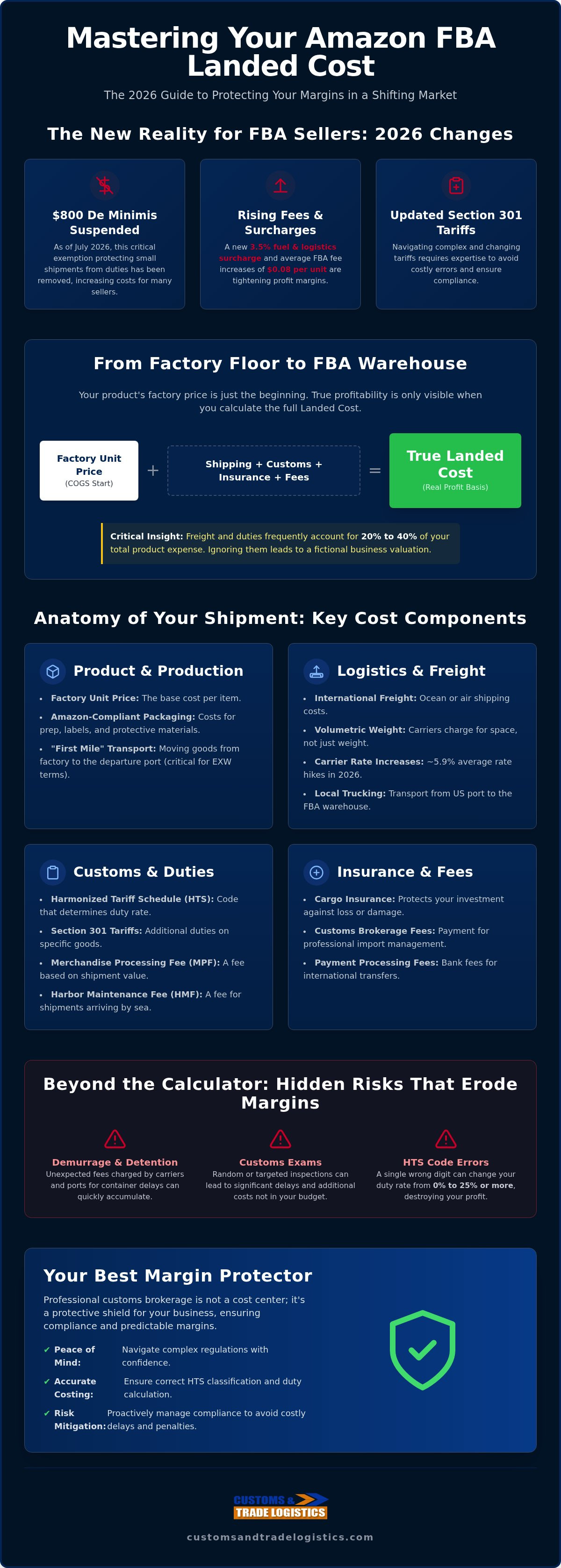
Many sellers confuse Cost of Goods Sold (COGS) with their total landed cost. Think of COGS as your starting point, not the finish line. In the world of international trade, freight and duties frequently account for 20% to 40% of your total expense. If you ignore these, your business valuation and tax filings will be based on a fiction. Landed cost provides the ground truth. It ensures your accounting reflects the movement of every dollar, from the moment the cargo leaves the factory to the second it hits the Amazon shelf.
The 2026 Amazon Landscape: Why Margins are Tightening
The environment for sellers has shifted significantly this year. With FBA fulfillment fees increasing by an average of $0.08 per unit and a new 3.5% fuel and logistics surcharge taking effect in April 2026, the room for error has vanished. Precision is no longer optional. You need expert Amazon seller import help to navigate these layers. Between the suspension of the $800 de minimis rule and the updated Section 301 tariffs, guesstimating your costs is a recipe for failure. A reliable landed cost calculator for Amazon FBA sellers helps you account for these 2026 realities so you can scale with total peace of mind.
The Anatomy of an FBA Shipment: Breaking Down Cost Components
Building an accurate landed cost calculator for Amazon FBA sellers starts with looking past the surface. A shipment is a complex collection of moving parts, each with its own price tag. Your manufacturing costs are the foundation, but they go beyond the simple unit price. You must account for Amazon-compliant packaging and the cost of moving goods from the factory floor to the departure port. If you're buying on EXW terms, that "first mile" transport is entirely your responsibility and can significantly shift your margins before the goods even leave the country.
International freight is the next major hurdle. Whether you choose ocean or air, you'll encounter the impact of volumetric weight, where carriers charge you based on how much space your boxes take up, not just how much they weigh. In 2026, this has become even more critical as major carriers implemented rate increases of approximately 5.9%. Additionally, a 3.5% fuel and logistics surcharge now applies to FBA fulfillment fees. To stay profitable, you should consult an official government guide to calculating landed cost to ensure your baseline math is sound.
US Customs duties often represent the largest "hidden" expense. Between the Merchandise Processing Fee (MPF), Harbor Maintenance Fee (HMF), and the various Section 301 tariffs, the paperwork can be daunting. Navigating these requires a clear understanding of custom brokerage service fees, which cover the professional oversight needed to keep your shipment moving without legal delays. If you're feeling overwhelmed by these moving parts, our team at Customs and Trade Logistics can help simplify the process.
The Hidden Power of HTS Codes
A single digit in your Harmonized Tariff Schedule (HTS) code can change your duty rate from 0% to 25% or more. Many sellers make the mistake of relying on their factory to provide these codes, but Chinese suppliers often use codes that don't align with US Customs standards. This is where professional customs clearance services us become invaluable. Accurate classification isn't just about saving money; it's about avoiding the heavy fines that come with misdeclaration.
Importing from China: Special Considerations
In 2026, the landscape for China imports has tightened. The suspension of the $800 de minimis exemption means even low-value shipments now face formal entry procedures and duties. You also have to navigate the current Section 301 "Forced Labor" tariffs, which can add 10% to 12.5% on top of standard duties. Mastering import from China logistics requires a landed cost calculator for Amazon FBA sellers that specifically accounts for these stacking costs. Without this level of detail, your "profitable" product could quickly become a financial burden.
How to Calculate Your Landed Cost: A Step-by-Step Framework
Calculating your true expenses requires a methodical approach. You can't just look at a single invoice and assume you've found the answer. By following a structured framework, you ensure that no small fee slips through the cracks. This process turns your landed cost calculator for Amazon FBA sellers from a basic spreadsheet into a powerful strategic asset. Let's walk through the five essential steps to find your number.
- Step 1: Determine your Incoterms. You must know exactly where your responsibility starts. Are you paying for the truck to the port (EXW), or is your supplier handling the goods until they are on the ship (FOB)?
- Step 2: Aggregate all "First Leg" costs. This includes the international freight quote, cargo insurance, and any terminal handling charges at the port of origin.
- Step 3: Calculate duties and taxes. Use your HTS classification to determine the base duty rate. Don't forget to add the Section 301 tariffs and the suspension of the de minimis threshold we discussed earlier.
- Step 4: Add "Last Mile" costs. This covers the journey from the US port to the Amazon FBA center, including customs brokerage fees and domestic trucking.
- Step 5: Divide by total units. Take the sum of every expense above and divide it by the number of sellable units in the shipment.
Understanding these steps is vital because US Customs regulations are dense. For a deeper look at the legalities, refer to the Why Professional Customs Brokerage is Your Best Margin Protector guide provided by the government. It highlights why professional oversight is necessary to avoid costly errors during the calculation process.
The Landed Cost Formula for FBA
To visualize the math, use this simple equation: (Product + Freight + Insurance + Duties + Fees) / Units. The landed cost formula is the ultimate truth for FBA profitability. You must apply this formula per-SKU rather than per-shipment. If you're shipping a mix of heavy and light items, a per-shipment average will hide the fact that your heavier products might actually be losing money after shipping costs are applied.
Incoterms: How They Change Your Math
Your choice of Incoterms drastically changes what you need to input into your landed cost calculator for Amazon FBA sellers. FOB (Free on Board) is often the most calculator friendly for new sellers because the supplier covers costs until the goods are loaded. Beware of the "DDP Trap." While "Delivered Duty Paid" sounds easy, it often leads to compliance audits because you don't have visibility into how duties were actually filed. We usually recommend starting with FOB or EXW to maintain total control over your documentation and your margins.
Beyond the Calculator: Hidden Risks That Erode FBA Margins
A perfect spreadsheet is a great start, but real-world logistics rarely follow a straight line. Many sellers find that even with a robust landed cost calculator for Amazon FBA sellers, their actual bank balance doesn't match their projections. This discrepancy usually stems from hidden friction costs that occur between the factory and the FBA warehouse. If your cargo gets stuck at the port, you face demurrage and detention fees. These are essentially rent for the container and the space it occupies at the pier. Once your allotted free time expires, these daily charges can quickly erase a month's worth of profit.
Customs exams are another unpredictable hurdle. US Customs can pull any shipment for inspection without warning. While some are simple X-ray scans, others are intensive exams that involve offloading the entire container. These inspections don't just cause delays; they come with an invoice that can easily exceed $1,000. Since these fees are random, they are hard to budget for. However, maintaining strict compliance reduces your risk profile. Non-compliance is even more expensive, leading to heavy fines or the seizure of your inventory. In the worst cases, Amazon may even ban your seller account if your documentation doesn't meet their standards.
Currency fluctuations also play a role. If you're paying your supplier in a foreign currency, a sudden drop in the dollar's value mid-transit can increase your per-unit cost. This is why a landed cost calculator for Amazon FBA sellers must be a living document, not a one-time calculation. If you need help securing your supply chain against these variables, reach out to Customs and Trade Logistics for a professional review of your import strategy.
Managing Port Delays and Storage Fees
In 2026, speed is more than just a convenience; it's a critical cost-saving measure. Port congestion can happen overnight, turning a standard delivery into a logistical nightmare. You can protect your margins by reducing customs clearance delays through early documentation filing. When your paperwork is ready before the ship docks, you minimize the time your goods spend sitting in expensive storage zones. This proactive approach keeps your per-unit math predictable and your inventory moving.
The Reality of Customs Exams
Why do some shipments get flagged while others sail through? It often comes down to the quality of your data. You can improve your odds by focusing on import compliance for small business. A seasoned broker acts as your advocate, ensuring your HTS codes and valuations are bulletproof. While you can't eliminate the risk of an exam entirely, you should budget a contingency fund in your annual projections. This allows you to handle unexpected invoices without derailing your primary cash flow.
Why Professional Customs Brokerage is Your Best Margin Protector
While a landed cost calculator for Amazon FBA sellers is a vital starting point, it remains a static tool in a dynamic industry. A spreadsheet can't account for a sudden shift in port procedures or a nuanced argument with a customs official regarding a specific product's material composition. At Customs and Trade Logistics, we've spent more than 35 years acting as a "safe pair of hands" for importers. We understand that behind every SKU is a small business owner looking for security and growth. Our family-owned approach focuses on demystifying the complex web of US Customs regulations, turning an intimidating administrative burden into a manageable part of your strategy.
Transitioning from a "calculator user" to a "strategy-led importer" means looking at the bigger picture. It's about moving beyond simple data entry and into a partnership where your logistics are managed with protective care. When you have a veteran advocate in your corner, you stop reacting to the market and start anticipating it. This shift is what allows high-revenue sellers to maintain their 15% to 20% net profit margins even as global trade requirements tighten.
Personalized Oversight vs. Automated Shipping
In a world of automated bots and generic shipping software, personalized oversight is a significant competitive advantage. Software often misses the subtle HTS classification errors that lead to overpaid duties or, worse, compliance audits. We've seen cases where expert consulting on a single product's classification saved a seller thousands of dollars in Section 301 duties. Our team catches the discrepancies that a landed cost calculator for Amazon FBA sellers might overlook, ensuring that your declared values and codes are bulletproof before the entry is filed.
Taking the Next Step: From Spreadsheet to Strategy
Are you ready to replace your "estimated" calculations with a reality-based cost analysis? The peace of mind that comes with total compliance is the most valuable asset an FBA brand can have. By working with a dedicated broker, you gain access to precise quotes that account for the 2026 tariff landscape and current fuel surcharges. This clarity allows you to scale your business with the confidence that your margins are protected from the port to the warehouse. If you want to secure your supply chain and master your math, Contact our expert team today to start building your professional import strategy.
Securing Your Amazon Margins for 2026 and Beyond
The landscape for Amazon sellers is shifting quickly, but these changes don't have to be a source of anxiety. You've learned that a true landed cost calculator for Amazon FBA sellers must account for everything from the factory floor to the FBA warehouse shelf. This includes the recent suspension of the de minimis rule and the updated Section 301 tariffs that define 2026 logistics. By moving from simple estimates to a strategy-led approach, you protect your business from the hidden risks of port delays and customs exams.
Our family-owned team brings 35+ years of customs expertise to every shipment, providing national coverage across all US ports. We're here to act as your "safe pair of hands," ensuring your operations remain compliant and your profits stay predictable. If you're ready to stop guessing and start growing with confidence, Get a Professional Landed Cost Analysis from Our Experts.
You've built a remarkable brand. Let's make sure your math is strong enough to support your next big leap.
Frequently Asked Questions
What is the most accurate landed cost calculator for Amazon FBA?
The most accurate calculator is one that integrates real-time customs data and specific logistical fees rather than just Amazon referral fees. While basic tools provide estimates, a professional landed cost calculator for Amazon FBA sellers needs to include HTS-specific duties, the 2026 fuel surcharges, and port handling fees. For absolute precision, consulting with a licensed customs broker ensures your math reflects current US Customs regulations and actual freight invoices.
Does landed cost include Amazon referral and FBA storage fees?
Technically, landed cost is defined as the total price of a product once it arrives at the FBA warehouse; therefore, it usually excludes selling fees. However, for total margin protection, many sellers include these as post-landed costs. In 2026, standard-size storage fees range from $0.78 to $2.40 per cubic foot depending on the season. Accounting for these alongside your landed cost gives you a complete picture of your true net profitability.
How do I find the correct HTS code for my Amazon product?
You can search the Harmonized Tariff Schedule on the official USITC website, but professional verification is highly recommended. Misclassification is a primary cause of overpaid duties or customs delays. Since HTS codes are complex, our team uses 35 years of experience to help sellers identify the exact code for their specific goods. This ensures you pay the correct duty rate and remain compliant with US Customs at every port in the nation.
Can I avoid Section 301 duties when importing from China to the US?
Legally avoiding Section 301 duties is difficult as they apply to a vast range of Chinese goods. In 2026, a new Section 301 tariff of 10% to 12.5% is in effect, stacking on top of existing duties. Strategies like product exclusions may apply in rare cases, but most sellers must factor these into their landed cost calculator for Amazon FBA sellers to maintain accurate profit projections and avoid financial surprises.
What happens if my landed cost is higher than my Amazon sale price?
If your landed cost exceeds your sale price, your business is losing money on every unit sold. This negative margin situation requires immediate action, such as renegotiating supplier prices, switching from air to ocean freight, or increasing your retail price. It's often a sign that hidden costs, like the 3.5% fuel surcharge or miscalculated tariffs following the suspension of the de minimis exemption, weren't properly accounted for during sourcing.
Why did my actual shipping costs differ from my calculator estimate?
Discrepancies often occur because calculators use static rates while the shipping market is volatile. In 2026, major carriers implemented rate increases of about 5.9%, and fuel surcharges can fluctuate significantly mid-transit. Additionally, if your cargo is pulled for an intensive customs exam or faces port congestion, these unexpected invoices won't appear in a basic estimate. A professional broker helps you budget for these variables to minimize the gap.
Is DDP shipping the best way to manage landed costs for new sellers?
While Delivered Duty Paid seems simple, it often hides the true cost of duties and can lead to compliance audits. Under DDP, you don't always receive the official entry documents needed to prove you paid the correct tariffs to US Customs. We typically recommend FOB or EXW terms instead. This allows you to work with a dedicated broker who provides total transparency and ensures your brand is legally protected.
How often should I update my landed cost calculations?
You should update your calculations with every new inventory order or whenever a major regulatory change occurs. With the 2026 suspension of the $800 de minimis rule and fluctuating fulfillment fees, quarterly reviews are no longer enough. Monitoring your costs per shipment ensures you can adjust your pricing strategy in real-time. This proactive oversight is the best way to protect your margins in a maturing and competitive marketplace.


