

Could a single week of port congestion or a misunderstood customs code really wipe out the profit margin of your entire shipment? For many business owners, the "final" cost of importing goods feels like a moving target that creates constant cash flow interruptions and unnecessary stress. You likely already know the frustration of seeing unexpected storage fees or administrative charges eat away at your hard-earned revenue before your products even reach the warehouse.
Learning how to budget for unexpected import costs is the most effective way to replace that anxiety with professional certainty. This 2026 strategic guide will help you master the art of landed cost forecasting and build a resilient financial buffer against hidden fees. We will explore how to identify potential customs bottlenecks, simplify complex terminology, and create a predictable financial roadmap that keeps your business moving forward with confidence. By the end of this article, you will have the tools to protect your margins and ensure a smoother, more transparent clearance process for every container you bring across the border.
Key Takeaways
- Learn why your initial freight quote is only the beginning and how calculating Total Landed Cost protects your actual profit margins.
- Discover how to budget for unexpected import costs by implementing a 10-15% contingency buffer based on your specific shipment history.
- Identify the primary drivers of hidden fees, such as customs examinations and port storage, to stop them from becoming cash flow interruptions.
- Adopt proactive operational habits like early paperwork audits and pre-alerts to stay ahead of the clock and avoid costly delays at the port.
- Understand how a strategic partnership with a seasoned broker provides the oversight needed to turn unpredictable logistics into a stable financial roadmap.
Understanding Landed Costs: Why Your Freight Quote is Only the Beginning
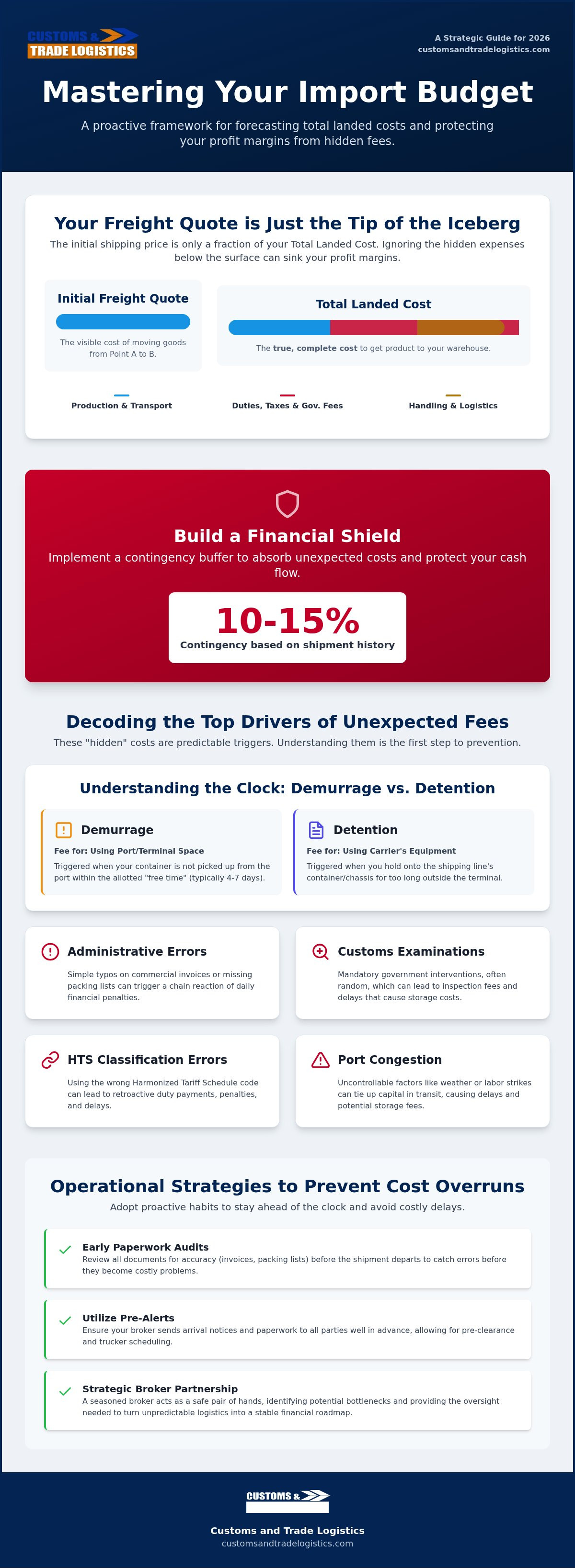
Many importers receive a freight quote and assume they've seen the finish line. In reality, that transport quote is just one piece of a much larger financial puzzle. To build a truly profitable business in 2026, you must look past the simple cost of moving a box from point A to point B. You need to focus on the Total Landed Cost. This represents the absolute sum of every penny spent to get a product from the factory floor to your warehouse shelf.
A solid foundation in understanding landed costs allows you to stop viewing shipping as a simple, isolated expense. Instead, it becomes a strategic inventory investment. When you account for every variable early, you protect your bottom line from the "sticker shock" that often follows a shipment's arrival at the port. If you're wondering how to budget for unexpected import costs, the answer begins with identifying the massive gaps that exist between your initial freight estimate and the final delivery invoice.
What is Included in a True Landed Cost Calculation?
A comprehensive budget must account for several layers of fees that aren't always visible on a standard carrier quote. These include:
- Production and Transport: The base manufacturing price plus the international ocean or air freight charges.
- Government Obligations: Customs duties, local taxes, and federal fees like the Merchandise Processing Fee (MPF) or Harbor Maintenance Fee (HMF).
- Logistics and Handling: Port terminal charges, chassis rentals, and the final-mile delivery to your door.
Missing just one of these categories can lead to a 20% or 30% discrepancy in your final margins. Successful importers treat these as fixed requirements rather than optional variables.
The Hidden Cost of 'Invisible' Delays
Administrative errors are the most common source of "invisible" costs. A simple typo on a Commercial Invoice or a missing packing list can trigger a chain reaction of daily financial penalties. When paperwork is incorrect, your cargo sits. While it sits, you're often charged for storage and equipment use. This is why first-time importers are specifically vulnerable to budget overruns; they haven't yet seen how quickly a minor delay can snowball into a major invoice.
Port congestion also plays a role by tying up your capital in transit for longer than expected. While you can't control the weather or labor strikes, you can control your preparedness. A seasoned customs broker acts as a safe pair of hands, identifying these potential bottlenecks before your ship even leaves the origin port. Their oversight ensures you aren't just reacting to fees, but actively preventing them from occurring in the first place.
Decoding the Top Drivers of 'Unexpected' Import Fees
Unexpected fees aren't random accidents. They are usually the result of specific logistical triggers or regulatory requirements that weren't accounted for during the initial planning phase. If you're trying to figure out how to budget for unexpected import costs, you must first understand the "parking tickets" and service fees that commonly appear on a final invoice. These costs typically stem from timing issues at the port or mandatory government interventions.
Classification errors also rank high among budget-killers. Using the wrong Harmonized Tariff Schedule (HTS) code can lead to retroactive duty payments and penalties. To avoid these traps, savvy importers consult an official U.S. tariff guide to ensure their product descriptions align with current federal standards. Even a minor mismatch in code can delay your shipment and trigger secondary storage fees at the warehouse.
Demurrage vs. Detention: Understanding the Clock
Demurrage and detention are two of the most frequent "hidden" costs in international trade. Demurrage occurs when your container stays inside the port terminal past the allotted "free time," which is usually between four and seven days. If your paperwork isn't ready or a trucker isn't available to pull the load, the port will charge you a daily rate that often increases the longer the container sits. Detention, on the other hand, applies to the equipment itself. It's a fee charged by the shipping line for holding onto their container or chassis outside the terminal for too long.
To estimate these for your contingency budget, look at the daily rates provided by your carrier. Common triggers for these clocks to start ticking include missing original bills of lading or delays in customs release. Keeping a close eye on these timelines is essential for protecting your profit margins.
The Reality of US Customs Exams
Every importer hopes for a "paperless" release, but U.S. Customs and Border Protection (CBP) reserves the right to examine any shipment. These exams range from non-intrusive X-ray scans (VACIS) to "Intensive" exams where the entire container is emptied and inspected. A common misconception is that the government pays for these inspections. In reality, the importer is responsible for all costs, including the transport to the Centralized Examination Station (CES), the labor to unload the goods, and the storage fees accumulated during the delay.
Because these exams are random or based on risk profiles, they are difficult to predict. Partnering with experts who provide customs clearance services us helps you prepare the correct documentation to reduce your risk profile. If an exam does happen, having a mentor like Customs and Trade Logistics ensures the process moves as quickly as possible to minimize the financial impact.
A Framework for Building a Resilient Import Budget
Building a budget that withstands the pressures of global trade requires moving beyond best-case scenarios. If you're unsure how to budget for unexpected import costs, start by implementing a 10-15% contingency rule across your entire shipment value. This flat buffer acts as your primary defense against the variables we discussed earlier, such as port storage or sudden examination fees. By setting this capital aside from the beginning, you ensure that a single delay doesn't trigger a domino effect across your entire business operation.
Refining this buffer involves looking backward at your own historical data. Are your shipments from specific regions consistently delayed? Managing the volatility of the import from China logistics lane, for example, often requires a higher contingency than more predictable routes. We recommend maintaining a dedicated "Duty and Tax" reserve account. This separate fund keeps your essential operating capital protected while ensuring you always have the liquid cash needed to settle government invoices immediately upon arrival.
Calculating Your Logistics Buffer
Creating a predictable roadmap involves more than just picking a random number. Follow these three steps to tailor your buffer to your specific needs:
- Step 1: Identify high-risk variables. Are you working with a new supplier or importing a complex product for the first time? These factors increase the likelihood of a customs hold.
- Step 2: Assign a percentage based on HTS complexity. Products with complicated classifications often face more scrutiny from U.S. Customs and Border Protection. Add an extra 2-5% to your buffer for these items.
- Step 3: Add a 'Time Buffer.' Calculate the daily cost of your capital being tied up in transit. If a shipment is delayed by 10 days, how much interest or lost opportunity cost does that represent?
The Role of Customs Bonds in Financial Planning
A customs bond is a mandatory financial guarantee that ensures the government receives its duties and taxes. Choosing the right type of bond is a critical part of your long-term financial strategy. For most regular importers, a Continuous Bond is the most cost-effective choice. It covers all your entries for an entire year across any U.S. port, whereas a Single Entry bond is required for every individual shipment and can quickly become expensive as your volume grows.
Securing your bond early is a simple way to prevent "urgent" filing fees that brokers may charge for last-minute setups. Beyond the legal requirement, a bond acts as a signal of your reliability as an importer. It shows that you have the financial backing to meet your obligations, which can sometimes lead to a smoother clearance process. Think of the bond as your "entry ticket" to the marketplace; having it ready well in advance keeps your budget focused on growth rather than administrative penalties.
Operational Strategies to Prevent Cost Overruns
While a financial buffer provides security, the most effective way to protect your bottom line is to stop hidden fees from ever appearing. Shifting your focus from reactive payment to proactive prevention is the secret to a truly stable supply chain. If you want to know how to budget for unexpected import costs effectively, you must realize that operational excellence is your best cost-saving tool. By auditing your paperwork before the vessel even leaves the origin port, you eliminate the most common triggers for delays and penalties.
Maintaining a centralized product database with pre-verified HTS codes is another essential strategy. This database ensures consistency across all shipments, preventing the classification errors that lead to retroactive duties. For e-commerce businesses, the stakes are even higher due to strict warehouse deadlines. Leveraging specialized FBA freight forwarding services allows you to tap into logistics networks designed specifically for the high-speed requirements of online retail, providing a layer of oversight that general carriers often miss.
Mastering the Paperwork Trail
A clean Commercial Invoice is more than just a requirement; it's a shield against customs intervention. Every detail, from the currency used to the country of origin for each component, must be crystal clear. When your Packing List provides a granular level of detail, it significantly reduces the likelihood of an intensive exam. Customs officers are less likely to flag a container for a physical search if the documentation already provides a transparent view of the cargo. Investing in professional paperwork assistance isn't just an administrative fee. It's a strategic investment that prevents the thousands of dollars in storage costs associated with a single rejected filing.
Proactive Communication with Carriers
Staying ahead of the clock requires a constant flow of information from your logistics partners. You should always request "Pre-Alerts" and "Last Free Day" notifications from your trucker and broker. These alerts serve as an early warning system, giving you time to resolve issues before the port starts charging daily storage rates. Using a "Door-to-Door" logistics model can also simplify your budget by consolidating disparate fees into a single, manageable invoice.
If you anticipate a delay at your primary warehouse, you can use Delivery and Redistribution services to move your cargo to a secondary site. This prevents the shipment from sitting at the terminal where "parking tickets" are most expensive. Having a dedicated mentor like Customs and Trade Logistics ensures you have a safe pair of hands managing these transitions, keeping your shipments moving and your costs predictable.
How a Strategic Broker Partnership Stabilizes Your Bottom Line
The final piece in mastering how to budget for unexpected import costs isn't a spreadsheet formula, but a professional partnership. While many businesses try to handle the intricacies of global trade alone, the most successful importers rely on a seasoned customs broker to act as their eyes and ears at the port. A broker doesn't just file paperwork; they provide the oversight necessary to transition your business from reactive shipping to a managed, predictable international supply chain. With 35 years of experience, a family-owned firm like Customs and Trade Logistics understands that every day your cargo sits idle is a day your capital is at risk.
It's a common misconception that hiring a professional is an added burden on the budget. In reality, custom brokerage service fees represent a tiny fraction of the potential savings they generate. By catching a classification error or resolving a paperwork discrepancy before it reaches a customs officer, a broker prevents the heavy penalties and storage fees that often dwarf their own service costs. They act as a safe pair of hands, ensuring that your financial roadmap remains intact from the factory floor to the final delivery.
Demystifying the Broker's Role in Your Budget
A broker serves as the central hub of communication between your foreign suppliers, the ocean carriers, and U.S. government agencies. This oversight is vital for maintaining your budget because it eliminates the information gaps where "unexpected" costs usually hide. When you have a mentor managing the end-to-end process, you gain the peace of mind to focus on growing your sales rather than decoding complex federal regulations.
- Regulatory Oversight: Ensuring your shipments comply with the latest 2026 trade policies to avoid retroactive fines.
- Vendor Coordination: Facilitating clear communication with overseas partners to ensure documentation is accurate before the ship sails.
- Financial Protection: Identifying opportunities for duty drawbacks or more favorable HTS classifications that lower your total landed cost.
Scaling with Import Logistics for Startups
For growing businesses, the jump from "one-off" shipments to a sustainable logistics strategy can feel overwhelming. Building a foundation for growth requires more than just moving boxes; it requires a compliant and predictable framework. Our guide on import logistics for startups highlights how early intervention and mentorship prevent the rookie mistakes that often stall a new company's cash flow.
By moving away from a "pay-as-you-go" mentality and toward a managed strategy, you can forecast your expenses with much greater accuracy. Whether you're an Amazon seller or a growing SMB, having a dedicated advocate ensures that your logistics costs stay within the lines you've drawn. If you're ready to secure your profit margins and simplify your customs process, contact Customs and Trade Logistics today for a consultation. Let our three decades of expertise become the stabilizing force your bottom line deserves.
Securing Your 2026 Import Strategy
Mastering the complexities of global trade doesn't have to be an exercise in anxiety. By shifting your focus toward a total landed cost model and implementing a disciplined contingency buffer, you've already taken the most important steps toward financial stability. You now understand how to budget for unexpected import costs by identifying port-level triggers before they manifest as expensive invoices. Success in this industry is about moving from reactive crisis management to proactive oversight.
The key to long-term growth lies in combining these financial frameworks with operational excellence. Customs and Trade Logistics is here to be your "safe pair of hands" throughout this journey. With over 35 years of industry-leading experience and a family-owned approach to personalized mentorship, we specialize in navigating all US Customs ports to protect your profit margins. We invite you to Request a Logistics Consultation with Customs and Trade Logistics to turn your logistical challenges into a predictable roadmap. You have the tools to import with confidence; we're here to ensure you never have to do it alone.
Frequently Asked Questions
What is the most common unexpected cost when importing from China?
The most common unexpected costs often stem from terminal storage and demurrage fees. These occur when cargo sits at the port longer than the "free time" allowed by carriers. When importing from China, minor paperwork discrepancies or missing original bills of lading can trigger these daily penalties. Because these lanes are high volume, even a small delay in container pickup can result in significant surcharges that weren't in the initial freight quote.
How much should I budget for a US Customs exam?
You should set aside a contingency fund specifically for potential inspections, as the government doesn't cover these costs. While X-ray scans are less expensive, intensive exams require the container to be moved to a Centralized Examination Station and fully unloaded. Importers are responsible for the transport, labor, and storage fees accumulated during the process. Having a 10-15% buffer in your total budget is a smart way to handle these unpredictable events.
Can my freight forwarder guarantee there will be no extra fees?
No freight forwarder can honestly guarantee a total absence of extra fees because many variables are outside their direct control. Government inspections, port congestion, and sudden carrier surcharges are determined by third parties or federal agencies. However, a transparent logistics partner will help you understand how to budget for unexpected import costs by identifying high-risk factors early. They act as a safe pair of hands to minimize these risks through proactive paperwork audits.
What happens if I cannot pay the unexpected customs duties immediately?
If you can't settle your customs duties immediately, U.S. Customs and Border Protection won't release your goods. While the cargo sits at the port, you'll accumulate daily storage and demurrage fees that can quickly exceed the original duty amount. If the delay lasts too long, the shipment may be moved to a General Order warehouse or eventually seized. Maintaining a dedicated duty reserve account is essential to prevent these logistical and financial bottlenecks.
How do I calculate the 'Total Landed Cost' for an Amazon FBA shipment?
Calculating Total Landed Cost for FBA requires adding several layers beyond the manufacturing price. You must include international freight, customs duties, and federal fees like the Merchandise Processing Fee. Don't forget the costs for FBA-specific labeling, palletization, and the final-mile transport to the Amazon fulfillment center. Accounting for every step from the factory floor to the Amazon shelf ensures your profit margins remain protected against hidden administrative or handling charges.
Is it cheaper to pay for a Continuous Bond or a Single Entry Bond?
A Continuous Bond is generally more cost-effective if you plan to import more than a few times per year. While it requires a larger upfront annual payment, it covers all your entries at any U.S. port for twelve months. A Single Entry Bond is required for every individual shipment and often costs more per entry when you factor in the additional filing work. For growing businesses, the Continuous Bond provides better financial predictability and simplified administrative management.
What is the 'Last Free Day' and why does it matter for my budget?
The "Last Free Day" is the final date you can pick up your container from the port before daily storage fees begin. This date is critical for your budget because missing it by even 24 hours can trigger expensive demurrage penalties. Your logistics partner should track this date closely to ensure truckers are scheduled for pickup well in advance. Understanding this deadline helps you manage your cash flow and avoid unnecessary "parking tickets" at the terminal.
How can a customs broker help me avoid demurrage fees?
A customs broker helps you avoid demurrage by ensuring your entry is filed and released before the ship even arrives. With over 35 years of experience, our team at Customs and Trade Logistics audits your paperwork early to catch errors that cause delays. We coordinate between carriers and truckers to facilitate a smooth handoff. This proactive oversight ensures your container moves quickly through the port, keeping your how to budget for unexpected import costs strategy focused on growth.


