

Did you know that hidden fees in international shipping can constitute 20% to 40% of your total landed cost? It is a staggering figure that often turns a promising shipment into a sudden financial headache. You likely feel the sting of unpredictable profit margins every time an invoice arrives with "green surcharges" or port delays that were never mentioned in your original quote. It is frustrating to feel powerless against industry jargon like demurrage while watching your budget inflate without any clear explanation.
We understand that you need more than just a carrier; you need a partner who acts as a financial shield for your business. This guide will teach you how to identify, calculate, and eliminate the unexpected surcharges that threaten your bottom line. We will demystify the 2026 regulatory shifts, including the elimination of the US de minimis threshold and the latest Section 301 tariffs. You will gain the specific knowledge required to audit freight quotes for missing line items and finally achieve a transparent budget with no surprises. Let's replace that shipping anxiety with the security of a reliable, expert-led strategy.
Key Takeaways
- Understand the critical difference between a basic freight estimate and your actual landed cost to prevent budget spikes.
- Identify the most common hidden fees in international shipping, including fuel surcharges and port-side penalties like demurrage.
- Recognize the warning signs of "bargain" logistics providers whose missing documentation can trigger intensive, costly customs exams.
- Use our proactive five-question audit to catch clerical errors and verify HTS classifications before your shipment departs.
- Learn how professional oversight from a veteran broker acts as a financial shield against unpredictable regulatory and carrier surcharges.
The Reality of International Shipping Quotes: Why the "Final" Price Often Changes
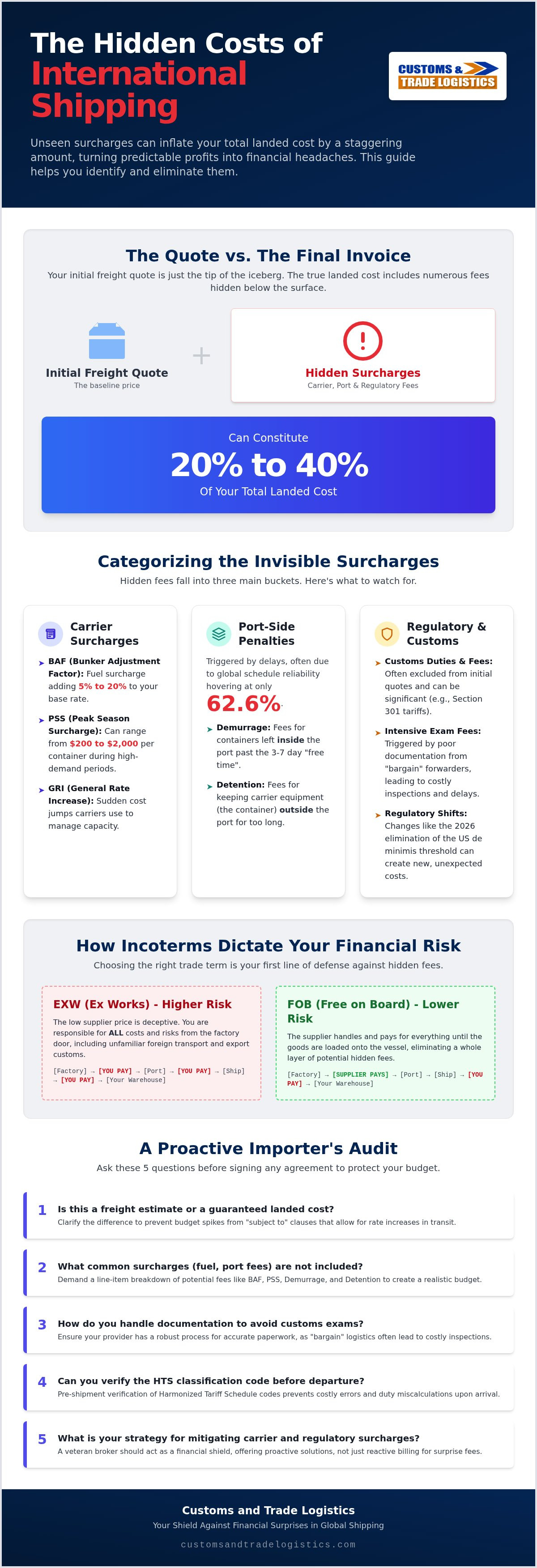
Why does that initial number rarely match the final bill? When you book a flight, the price you see is generally what you pay. In global logistics, the initial number is often just a baseline. Understanding how freight rates are determined reveals a complex web of variables that shift daily. With global schedule reliability for ocean freight hovering at 62.6% in mid-2026, delays are common. These delays trigger surcharges that no one can predict with total certainty at the start of a journey. This "estimate culture" can be jarring for businesses that need predictable margins to survive.
The "Quote vs. Invoice" Gap
Carriers and forwarders frequently use "subject to" clauses in their contracts. These small lines of text allow them to adjust for General Rate Increases (GRI) or unexpected fuel surcharges that occur while your cargo is in transit. Landed cost is the only metric that matters for business profitability. It encompasses every expense from the factory gate to your warehouse door. For many growing brands, the emotional toll of "invoice shock" creates a sense of powerlessness that stalls expansion. You cannot scale a business effectively when you don't know your true costs until the goods actually arrive.
How Incoterms Dictate Your Financial Responsibility
Who is responsible for the cargo when it's sitting on a truck in a foreign port? Your choice of Incoterms defines exactly where your liability begins. Many new importers choose Ex Works (EXW) because the supplier's price looks incredibly low. However, EXW leaves you vulnerable to more hidden fees in international shipping than Free on Board (FOB) terms. Under EXW, you must manage and pay for the inland transport and export customs in a foreign country. This often leads to surprise administrative fees and local handling charges that weren't in your original budget.
Choosing the wrong hand-off point is a common mistake that leads to paying for services you assumed were already covered. By shifting to FOB, you ensure the supplier covers the costs until the cargo is safely on the ship. This simple change can eliminate several layers of potential hidden fees in international shipping and provide a much clearer picture of your actual obligations. Always clarify the exact point where the financial burden shifts from the seller to you before signing any agreement. It's the first step toward regaining control over your logistics budget.
Categorizing the Invisible: Carrier, Port, and Regulatory Surcharges
While your initial quote might look clean, several layers of hidden fees in international shipping often wait beneath the surface. These costs fall into three main buckets: carrier-imposed surcharges, port-side penalties, and government compliance fees. In the high-volume trade lanes from China, these can escalate quickly. For example, 2026 has seen a 5% increase in global container demand, which frequently triggers Peak Season Surcharges (PSS) ranging from $200 to $2,000 per container. You may also encounter the Bunker Adjustment Factor (BAF), a fuel surcharge that typically adds 5% to 20% to your base rate depending on market volatility.
Carriers also use General Rate Increases (GRI) to manage capacity. If your cargo is caught in a GRI cycle, your costs could jump overnight. The U.S. Customs and Border Protection explicitly warns that purchase prices often exclude customs duties and processing fees, which can catch unprepared businesses off guard. This is where understanding custom brokerage service fees becomes vital for your long-term budgeting strategy.
Port-Side Penalties: Demurrage vs. Detention
Timing is everything at the terminal. Demurrage fees apply when your loaded container stays inside the port past its "free time," which is usually only three to seven days. In contrast, detention fees occur when you keep the equipment outside the port for too long. With global schedule reliability at 62.6% in 2026, even a minor rail delay or a shortage of truck chassis can trigger these fines. A single 24-hour delay can result in hundreds of dollars in daily penalties per container. This ripple effect often turns a minor logistical hiccup into a major financial burden.
The Hidden Costs of US Customs Compliance
Regulatory errors are perhaps the most expensive hidden fees in international shipping because they often come with mandatory fines. The Importer Security Filing (ISF), or "10+2" rule, requires specific data to be filed 24 hours before your goods leave a foreign port. Missing this deadline can lead to a $5,000 fine from U.S. Customs. You must also account for the Merchandise Processing Fee (MPF) and the Harbor Maintenance Fee (HMF), which are calculated based on the value of your goods. These are not optional "service fees" but federal requirements that every importer must satisfy. Partnering with a knowledgeable freight specialist ensures these filings are handled accurately and on time, protecting you from avoidable penalties.
The High Cost of Low-Cost Forwarding: How Bargain Logistics Leads to Penalties
Choosing the cheapest freight quote is often the quickest way to inflate your final bill. Many budget-focused forwarders offer "teaser rates" that intentionally omit essential line items or skip the detailed paperwork required for a smooth arrival. While the initial number looks attractive, these bargain services frequently lead to the most expensive hidden fees in international shipping. When a provider cuts corners on compliance to save on their own overhead, you are the one left paying the price for their clerical errors. This is especially true for Amazon sellers, whose strict FBA delivery windows leave no room for the delays caused by cut-rate logistics.
The "black hole" of automated customer service is another hidden cost of budget forwarding. If your container is flagged at the port, a generic email or an AI chatbot won't help you. You need a partner who can pick up the phone and speak with terminal managers or customs officials. Our 35+ years of industry experience has taught us that human relationships are the only thing that moves cargo when the system grinds to a halt. Reviewing an Import Tariffs & Fees Overview shows just how complex these costs can be, and why having a veteran advocate is your best defense against unexpected invoice spikes.
The Anatomy of a Customs Delay
A single vague word on a commercial invoice can trigger a "Customs Exam." If your paperwork says "parts" instead of a specific HTS code, U.S. Customs may pull your container for an intensive inspection. This triggers a cascade of costs, including drayage to an exam site, storage fees, and the inspection fee itself. A $200 broker fee can prevent a $2,000 exam fee. These inspections can last from a few days to several weeks, during which your demurrage costs continue to climb. Preventing these errors through diligent oversight is the most effective way to keep your profit margins intact.
Digital Platforms vs. Traditional Expertise
Algorithms are great for tracking packages, but they struggle with the nuance of complex import from China logistics. Automated software often misses trade-lane specific surcharges or fails to flag HTS classification risks before the cargo leaves the factory floor. A family-owned mentor provides a "safe pair of hands" that an algorithm simply cannot replicate. We act as a knowledgeable bridge, ensuring that every document is verified by a human expert who understands the unique pressures of the global marketplace. This proactive care eliminates the administrative gaps that lead to hidden fees in international shipping, giving you total peace of mind from port to porch.
A Proactive Importer’s Audit: 5 Questions to Ask Before Signing
How do you separate a reliable logistics partner from a risky gamble? Protecting your margins against hidden fees in international shipping starts with a rigorous audit of your paperwork before any cargo moves. Think of yourself as an investigator rather than just a customer. You aren't just looking for a price; you're looking for a guarantee of transparency. A quote that looks like a bargain today can quickly transform into a financial burden if it lacks specific line items for destination handling or ISF filing. Don't sign yet. Instead, use these five questions to flush out the gaps in any freight estimate.
- What exactly is in the "Exclusions" section? Most quotes have a list of what isn't covered. Read this with a magnifying glass to ensure port fees and terminal handling aren't tucked away here.
- Can you provide a Landed Cost estimate? A "Freight Quote" only covers the journey. A Landed Cost estimate includes duties, taxes, and delivery, giving you the only number that actually matters for your profit.
- Is this "All-In" or "Plus Surcharges"? Clarify if the rate includes current General Rate Increases (GRI) and fuel adjustments. If they say "plus surcharges," your bill will likely be higher than the quote.
- Who is my dedicated logistics coordinator? Test their responsiveness now. If they take 48 hours to answer a simple email today, they won't be there when your container is stuck at the port.
- Have you verified my HTS codes with the supplier? Misclassification is the fastest way to trigger a customs exam. Ensure your broker has audited these codes before the goods leave the factory.
Spotting the "Too Good to be True" Quote
Red flags are often easy to spot if you know where to look. If a quote is missing ISF filing fees or uses vague terms like "destination charges," it's a sign that the forwarder is hiding the true cost to win your business. Ask for itemized billing rather than a blanket "all-inclusive" fee that doesn't define its limits. Getting every detail in writing before the ship sails is your only protection against invoice spikes. If you want a partner who prioritizes this level of detail, you should connect with a veteran logistics consultant who values transparency over teaser rates.
Pre-Shipment Compliance Check
The 72-hour rule is a vital standard in global trade. Your paperwork must be perfect at least three days before the cargo is loaded to avoid late-filing penalties. You can use a customs clearance services us partner to audit your supplier’s commercial invoice and packing list. They will verify the "Country of Origin" and "Value" declarations to ensure they match U.S. Customs requirements. This proactive step prevents the administrative errors that lead to hidden fees in international shipping, ensuring your shipment arrives without a single surprise charge.
Eliminating Financial Surprises: How Customs and Trade Logistics Protects Your Bottom Line
Logistics shouldn't feel like a gamble. When you are managing a growing business, the last thing you need is an unexpected invoice that wipes out your quarterly profit. We built our "Safe Pair of Hands" philosophy on the belief that importers deserve total transparency and professional protection. With over 35 years of industry experience, we've seen every iteration of hidden fees in international shipping and developed the systems to prevent them before they reach your desk. We act as your financial shield, ensuring that the price you expect is the price you actually pay.
Our team provides end-to-end oversight that begins long before your cargo reaches the water. We coordinate directly with your suppliers on the factory floor in China to verify documentation and HTS classifications. This proactive care continues through every stage of the journey to final delivery at your warehouse. By managing the administrative burden for you, we eliminate the clerical gaps that lead to port-side penalties and customs delays. This level of detail is especially critical for those seeking Amazon seller import help, where even a small documentation error can disrupt an entire FBA inventory cycle.
The Benefit of a Family-Owned Mentorship
We operate as a family-owned consultancy because we value personal connection as much as technical compliance. You aren't just another account number in a database; you are a partner whose growth we treat as our own success. This means you get direct access to experts who understand the nuances of every US port and can explain complex costs in plain English. We take pride in demystifying the industry, replacing the anxiety of global trade with the steady confidence of a seasoned veteran. You can focus on scaling your brand while we handle the granular procedural details that keep your supply chain moving.
Your Next Steps to Stress-Free Shipping
Preparing your business for a successful 2026 import season requires more than just booking a container. It requires a comprehensive review of your current logistical gaps and a strategy to mitigate the rising "green surcharges" and GRI trends we're seeing in the market. We are ready to help you audit your current quotes and identify where you might be vulnerable to hidden fees in international shipping. Whether you are a startup making your first import or an established brand looking for a more reliable partner, we provide the stabilizing force your business needs. Schedule a consultation with our logistics experts today to secure your margins and gain total peace of mind for your next shipment.
Take Control of Your Import Budget Today
You don't have to accept unpredictable invoices as an unavoidable cost of doing business. By prioritizing accurate landed cost calculations and performing rigorous pre-shipment audits, you can protect your profit margins from the most common hidden fees in international shipping. It's clear that a "bargain" quote often hides administrative gaps that lead to expensive port penalties or customs exams. You deserve a logistics partner who acts as a dedicated financial shield, providing the specialized China-to-US support your brand needs to thrive in a volatile market.
With 35+ years of customs brokerage expertise, our family-owned team offers the personalized service and oversight required to navigate the 2026 trade landscape with ease. We're here to demystify the complex world of global trade and ensure your goods move smoothly through every U.S. port. It's time to replace logistical anxiety with the security of expert-led management. When you have a "safe pair of hands" watching over your cargo, you can focus on what you do best: growing your business.
Get a Transparent Import Quote from Our Experts
Your business growth is our ultimate success, and we're ready to help you ship with total confidence and peace of mind.
Frequently Asked Questions
What is the most common hidden fee in international shipping?
The most common hidden fees in international shipping are typically fuel surcharges, known as the Bunker Adjustment Factor (BAF), and General Rate Increases (GRI). These fees are often omitted from initial quotes to make a rate look more attractive. While a BAF covers fluctuating fuel costs, a GRI is a sudden price hike carriers implement to manage demand. Understanding these helps you avoid the shock of an invoice that doesn't match your original estimate.
Can I avoid demurrage fees if the port is congested?
You generally cannot avoid demurrage fees simply because a port is congested. Carriers and terminals typically hold the importer responsible for moving the container within the "free time" period, regardless of truck shortages or rail delays. Proactive planning is your best defense. Working with an experienced logistics partner ensures your paperwork is filed early and your trucker is scheduled well before the cargo arrives, significantly reducing the risk of these expensive daily penalties.
How much should I budget for "unexpected" shipping costs?
Industry data indicates that hidden fees in international shipping can constitute 20% to 40% of your total landed cost. To protect your profit margins, you should budget at least 25% above your initial freight quote for potential surcharges. This buffer covers regulatory fees, terminal handling, and unexpected fuel adjustments. A comprehensive landed cost calculation, rather than a simple freight estimate, provides a much safer financial baseline for your business operations and long-term growth.
What is an ISF filing fee and why is it mandatory?
An Importer Security Filing (ISF) fee covers the professional preparation of the "10+2" data required by U.S. Customs and Border Protection. This filing is mandatory for all ocean freight imports to ensure national security by identifying high-risk cargo before it reaches a U.S. port. It must be submitted at least 24 hours before the goods are loaded onto the ship. Failure to file accurately and on time can result in a mandatory $5,000 penalty.
Why did my shipping quote double after the cargo arrived?
Your quote likely doubled because the initial estimate only covered the "ocean freight" portion of the journey. Many bargain forwarders omit essential costs like customs duties, Merchandise Processing Fees (MPF), and terminal handling charges to win your business. When these regulatory and port-side costs are added upon arrival, the final invoice can be shocking. Always request a full landed cost estimate that includes every step from the factory floor to your warehouse door.
Does a customs broker help reduce hidden shipping fees?
Yes, a professional customs broker acts as a financial shield by preventing the administrative errors that lead to the most expensive penalties. By auditing your HTS classifications and verifying supplier paperwork before the cargo departs, a broker eliminates the risk of costly customs exams and late-filing fines. Their expertise ensures that all regulatory fees are calculated upfront, providing the transparent budget you need to maintain healthy profit margins and avoid sudden invoice spikes.
What happens if I refuse to pay a hidden surcharge?
If you refuse to pay a surcharge, the carrier or terminal will typically place a lien on your cargo and refuse to release it. This delay creates a cycle where demurrage and detention fees accumulate daily, often exceeding the value of the goods. If fees remain unpaid, the cargo may be considered abandoned and sold at auction. It is always better to resolve fee disputes through a knowledgeable advocate while the cargo is still in transit.
How do I know if my HTS code is correct?
Verifying your Harmonized Tariff Schedule (HTS) code requires a detailed analysis of your product's material, function, and use. You shouldn't rely solely on your supplier's suggestion, as they may not understand specific U.S. Customs nuances. A professional brokerage team can perform a pre-shipment audit of your goods to ensure the code is accurate. This step is vital because the wrong code can lead to overpaid duties or intensive, expensive customs inspections that delay your inventory arrival.


