

Could the cheapest customs entry quote on your desk actually be the most expensive mistake your business makes this year? It’s a question many small business owners forget to ask until they’re hit with a $5,000 penalty for a late ISF filing or unexpected arrival fees that weren't in the original estimate. We understand the anxiety that comes with international trade, especially when you're trying to distinguish between mandatory government duties and the actual cost of professional oversight. Having customs broker pricing models explained clearly is the first step toward moving your cargo with a sense of security rather than a sense of dread.
You deserve a partner who acts as a bridge to the global marketplace, not just a data entry clerk. In this 2026 guide, you'll learn how to master the complexities of brokerage fees and discover which pricing model best protects your bottom line. We provide a clear framework for comparing quotes and help you build a predictable import budget. From understanding the latest Merchandise Processing Fee updates to identifying the value of a dedicated advocate, you’ll gain the confidence to ensure you’re paying for true expertise that keeps your supply chain moving smoothly.
Key Takeaways
- Learn how to distinguish between mandatory government duties and broker service fees to avoid "hidden" costs on arrival.
- See customs broker pricing models explained so you can choose between flat-fee and percentage-based structures that suit your specific shipment volume.
- Understand the logic behind ancillary charges like ISF filings and customs bonds to create a more predictable import budget for 2026.
- Use our "Full Disclosure" framework to compare broker quotes and ensure you are paying for technical expertise rather than just data entry.
- Discover how an end-to-end logistics partnership provides more long-term value and protection than a low-cost, digital-only platform.
Understanding Customs Broker Pricing: Why the Model Matters for Your Bottom Line
When you look at a quote, do you know exactly what you're paying for? Many small business owners struggle to separate mandatory government duties from the actual service fees charged by their partner. To start, it's helpful to understand What is a Customs Broker? and why their role as an intermediary between you and U.S. Customs and Border Protection (CBP) is so vital. Having customs broker pricing models explained isn't just about finding the lowest number. It's about ensuring that the model you choose aligns with your long-term business growth and risk tolerance.
Think of your import costs through the lens of "Total Cost of Ownership." A broker who charges a rock-bottom fee might only be providing basic data entry. If they don't catch a classification error or miss an Importer Security Filing (ISF) deadline, the downstream costs can be devastating. A low sticker price often hides risks like shipment holds or unexpected storage fees. You want a pricing model that incentivizes your broker to act as a protective shield, catching problems before they reach the port.
The "Hidden Cost" of Poor Compliance
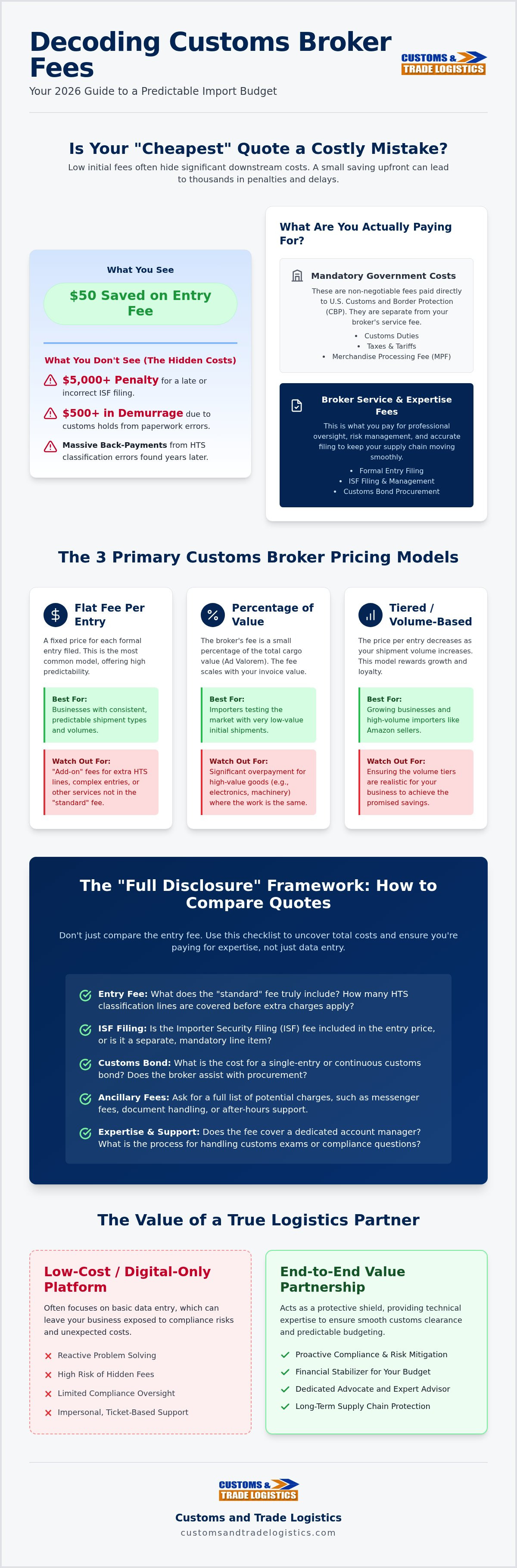
Errors in Harmonized Tariff Schedule (HTS) classification are a primary cause of retroactive fines. CBP can audit your entries years after the fact. If your broker isn't diligent, you could face massive back-payments and interest. Beyond fines, there is the immediate cost of delays. Saving $50 on an entry fee is a poor trade-off if it leads to $500 in demurrage charges because your paperwork wasn't ready. Customs compliance is a strategic financial safeguard that protects your cash flow from unpredictable regulatory shocks.
Setting Your Import Budget for 2026
As we look toward the next year of trade, understanding custom brokerage service fees becomes the foundation of your logistics planning. You need to allocate funds for duties, taxes, and specialized oversight. When customs broker pricing models explained are used correctly, your broker acts as a financial stabilizer. They help you predict costs accurately so you don't have to worry about "bill shock" when your goods arrive at the warehouse. This level of oversight ensures that your business stays profitable even as global trade regulations shift.
The 3 Primary Pricing Models Used by Modern Customs Brokers
How does your broker calculate their value? Choosing the right structure is about more than just the bottom line; it's about how your partner manages the official role of customs brokers on your behalf. When you have customs broker pricing models explained by a veteran mentor, you see that each model serves a different stage of your business lifecycle. The goal is to find a model that provides total management without surprise surcharges.
Flat Fee per Entry: Simple but Scalable?
The flat fee is the industry standard for most reputable customs clearance services us firms. You pay a fixed price for each formal entry filed with CBP. This model is excellent for predictability. If you ship ten containers a month, your budget stays steady. But there's a catch. Does your flat fee include the first five HTS lines or just one? If your shipments are complex, you might find yourself paying "add-on" fees for every extra product line on your commercial invoice. It's vital to ask what "standard" really means before you sign an agreement.
Percentage of Value: Pros and Cons
In an Ad Valorem model, the broker takes a small percentage of the total cargo value. This can be a double-edged sword. For a small business testing a new product with a low invoice value, this might be the most accessible way to get started. However, if you're importing high-value electronics or heavy machinery, you'll likely overpay. The technical work required to clear a $100,000 shipment is often identical to a $10,000 shipment. Why should your service fee skyrocket just because your cargo is more valuable?
Growing Amazon sellers often find success with a Tiered or Volume-based model. This structure rewards your growth. As you move from three shipments a month to thirty, the broker reduces the cost per entry. It's a partnership that scales alongside your success. Some firms also offer Hybrid models. These are perfect for complex entries that require extra consulting time for Partner Government Agency (PGA) compliance, such as the FDA or EPA. By combining a flat fee with a specialized service rate, you ensure you're paying for deep expertise rather than just simple data entry. If you're unsure which path fits your current volume, we can help you compare these structures to find your ideal balance.
Beyond the Entry Fee: Ancillary Charges and Hidden Logistics Costs
While the base entry fee is the most visible part of your quote, it's rarely the final price you'll pay. Understanding customs broker pricing models explained by a partner who values transparency means looking closely at the ancillary charges that keep your supply chain moving. Some of these are official customs broker fees and government-mandated costs, while others are pass-through logistics expenses. Knowing the difference helps you spot "junk fees" that don't add value to your compliance strategy.
One common charge that surprises newcomers is the "extra line" fee. Most brokers include a set number of Harmonized Tariff Schedule (HTS) lines in their standard entry price. However, if your commercial invoice contains dozens of different products, each requires its own classification and data entry. This complexity takes time and technical expertise to manage correctly. It's better to pay a fair rate for this oversight than to rush the process and risk an audit later on.
The Critical Role of ISF and Bonds
Are you filing your Importer Security Filing (ISF) on time? If you're managing import from China logistics, the "10+2" rule is your most time-sensitive requirement. This filing must be completed at least 24 hours before your vessel is loaded at the origin port. Failing to do so can result in a $5,000 penalty per violation from U.S. Customs. Most brokers charge a separate fee for this filing, but it's a small price to pay to avoid a massive fine that could wipe out your profit margins.
You also need to consider your customs bond. If you import more than three to five times a year, a continuous bond is almost always the better financial move. While a single-entry bond might seem cheaper for a one-off shipment, the costs add up quickly. A continuous bond covers all your entries for a full 12 months. This provides a sense of security and simplifies your administrative burden, acting as a stabilizing force for your import budget.
Logistics and Redistribution Surcharges
If you're an Amazon FBA seller, your journey doesn't end at the port. You'll likely encounter warehouse handling and redistribution fees as your goods are prepped for final delivery. There are also mandatory pass-through costs like Pier Pass or Clean Truck fees at major ports. These aren't markups from your broker; they're fees charged by terminal operators to manage congestion and environmental standards. A reliable partner will itemize these for you, ensuring you aren't paying for "document handling" or "messenger fees" that should be automated in today's digital world. Look for a broker who prioritizes end-to-end oversight to keep these ancillary costs predictable and under control.
How to Compare Broker Quotes: A Framework for Small Businesses
Comparing quotes from different providers often feels like trying to solve a puzzle with half the pieces missing. To make an informed decision for your business, you need customs broker pricing models explained in a way that reveals the true total cost of your shipment. It's not enough to look at a single number on a page. You must understand the level of oversight and protection included in that price. Use this four-step framework to ensure you're comparing apples to apples.
- Step 1: Request a "Full Disclosure" quote. Ask for an itemized list that includes every potential surcharge, from ISF filings to additional HTS line charges.
- Step 2: Verify category experience. Confirm the broker has handled your specific product type before, especially if it involves Partner Government Agencies like the FDA.
- Step 3: Analyze the communication model. Determine if you'll have a dedicated agent who knows your business or if you'll be redirected to an automated digital portal.
- Step 4: Check for "End-to-End" capabilities. A partner who manages the entire journey offers significantly more value than a firm that only handles the final entry filing.
Evaluating Experience Over Price
For many new ventures, import logistics for startups require more hands-on consulting than standard entries. You need a partner who understands the "factory to front door" journey. When you speak with a potential broker, ask about their history and values. A family-owned firm with 35 years of industry experience often prioritizes a mentorship approach. This type of advocate acts as a bridge between your small-scale operations and the global marketplace, providing a "safe pair of hands" that a digital-only platform simply cannot replicate.
Spotting the Red Flags in a Cheap Quote
A quote that seems too good to be true usually is. If a proposal fails to mention ISF requirements or leaves out bond costs entirely, you're likely dealing with a basic "filing service" rather than a comprehensive trade consultant. Watch out for vague "processing" fees that don't correspond to specific tasks. You deserve to know exactly where your money is going. The cheapest quote often leads to the most expensive delays when your cargo is held at the port due to avoidable clerical errors. If you want to move beyond guesswork and secure your supply chain, request a transparent quote comparison from our dedicated team today.
The Customs and Trade Logistics Approach: Value-Based Partnership
Why settle for a transactional relationship when you can have a dedicated advocate? At Customs and Trade Logistics, we believe that having customs broker pricing models explained should lead you to a solution that values oversight as much as entry filing. Our family-owned firm brings 35+ years of industry experience to the table, positioning us as a "safe pair of hands" for your growing business. We don't just file paperwork. We provide a stabilizing force that lifts the administrative burden from your shoulders, ensuring your shipments are managed with the care they deserve.
Our history of navigating all U.S. ports means we've seen every challenge imaginable. We specialize in China-to-U.S. trade and Amazon logistics, ensuring that your goods move through the system without the "bill shock" often associated with low-cost, digital-only platforms. When customs broker pricing models explained are rooted in actual logistical expertise, you gain predictable pricing and a partner who is deeply invested in your long-term success.
Tailored Solutions for Amazon FBA and Beyond
Many sellers struggle with the fragmented nature of global logistics. We offer customized FBA freight forwarding services that simplify the entire factory-to-warehouse path. Instead of juggling multiple vendors, you benefit from a single point of contact who manages everything from foreign supplier coordination to final delivery and redistribution. This end-to-end oversight allows you to focus on scaling your brand while a veteran advocate handles your U.S. Customs relationship with precision and protective care.
Ready to Simplify Your Import Costs?
Navigating the full importation process doesn't have to be a source of anxiety. Whether you're a startup or an established SMB, we're here to provide clear, declarative answers to your most pressing trade questions. Our goal is to replace confusion with a sense of security, ensuring your bottom line is protected at every stage of the journey. We move step-by-step through the logistical process to ensure no detail is overlooked, providing you with total resolution and peace of mind. Contact Customs and Trade Logistics for a personalized pricing walkthrough and discover how we can streamline your 2026 import strategy.
Secure Your Business Growth with Transparent Logistics
Choosing the right partner means looking beyond the base entry fee to find a relationship built on total management and protective care. You've seen the customs broker pricing models explained and now understand how to spot the "junk fees" that can derail your budget. Whether you're navigating complex China imports or scaling an Amazon FBA brand, the goal is always predictable costs and zero surprises at the port. This level of clarity is what transforms a simple shipment into a successful business milestone.
With 35+ years of family-owned logistics expertise, we act as your dedicated advocate across every US Customs port. We provide the mentorship and oversight small businesses need to thrive in a global marketplace, acting as a "safe pair of hands" for your cargo. Don't let hidden costs or compliance risks hold your business back. You deserve a partner who is as invested in your growth as you are.
Request a Transparent Customs Brokerage Quote Today to see how our veteran team can stabilize your supply chain. Your international trade journey is a path to growth, and with the right support, you can move forward with absolute confidence.
Frequently Asked Questions
How much does a customs broker typically charge per entry?
While industry averages exist for formal entries, your total cost depends on the complexity of your commodities and the number of HTS lines involved. Most providers use a flat-fee model for predictability, but high-compliance items requiring extra oversight may incur different rates. Having customs broker pricing models explained by a veteran mentor helps you see that you're paying for technical accuracy rather than just a simple data transmission.
What is the difference between an entry fee and an ISF filing fee?
The entry fee covers the formal declaration filed when your goods reach the US port, while the Importer Security Filing (ISF) fee is for the "10+2" data required before the vessel even leaves the origin. ISF is strictly time-sensitive and must be completed 24 hours before loading. These are two distinct steps in the compliance journey, each requiring its own set of professional oversight to avoid massive penalties.
Do I have to pay a customs broker if I am an Amazon FBA seller?
Amazon FBA sellers must use a licensed broker for any commercial shipment valued over $2,500. While Amazon handles the storefront, they don't act as your Importer of Record. A broker ensures your goods meet CBP requirements and coordinates the specialized delivery and redistribution services needed to get your inventory into the FBA network correctly. This partnership protects your seller account from delays and compliance-related holds.
Can I negotiate customs brokerage fees for high-volume shipping?
Negotiation is common for businesses with consistent, high-volume shipment schedules. Many firms offer tiered pricing structures where the cost per entry decreases as your monthly volume increases. This volume-based approach is often the best fit for growing brands that need a scalable solution. It allows you to maintain a high level of professional oversight while keeping your per-unit logistics costs predictable as you expand your operations.
What is a continuous customs bond and how does it affect my pricing?
A continuous customs bond is a 12-month guarantee that covers all your import entries at every US port. While it requires an annual premium, it's significantly more economical than purchasing single-entry bonds for each individual shipment if you import more than three times a year. This bond simplifies your administrative process and acts as a financial stabilizer, ensuring you don't face repetitive bonding costs throughout the fiscal year.
Are there extra fees for importing specific goods like food or chemicals?
Shipments involving food, medical devices, or chemicals require additional filings with Partner Government Agencies (PGAs) like the FDA or EPA. Because these commodities carry higher regulatory scrutiny, brokers typically charge additional fees for the technical work involved in ensuring compliance. Navigating these requirements is a core part of customs broker pricing models explained for specialized industries, as these filings demand much more expertise than a standard consumer goods entry.
What happens if my broker makes a mistake in the pricing or classification?
The Importer of Record is ultimately responsible for all duties and penalties, even if a broker makes the error. If a mistake occurs in classification or valuation, CBP may issue retroactive fines or initiate an audit of your previous entries. This is why choosing a "safe pair of hands" with decades of experience is vital. A veteran advocate focuses on meticulous oversight to prevent these costly clerical errors from reaching the government's desk.
How do digital freight forwarder fees compare to traditional customs brokers?
Digital platforms often prioritize automated data entry and may offer lower base fees for simple shipments. However, traditional brokers often provide a higher level of personalized consulting and advocacy that digital platforms lack. For complex China-to-US trade or Amazon logistics, the value of a dedicated agent who understands your business often outweighs the minor savings offered by a software-only solution. You're paying for a relationship, not just a portal.


