

The days of "duty-free" shipping are officially over for every Amazon seller importing from overseas. With the global suspension of the de minimis exemption and U.S. Customs and Border Protection now voiding inaccurate Importer of Record numbers as of September 2026, the margin for error has disappeared. You probably feel like the goalposts keep moving just as you're ready to scale. It's exhausting to worry about HTS codes or the fear that your ocean freight might be seized because of a missing CPSC certificate. We understand that behind every shipment is a business you've worked hard to build; you shouldn't have to be a legal expert just to stay in stock.
This guide will help you master customs clearance for Amazon FBA shipments so you can stop guessing and start growing. We'll show you exactly how to handle the latest 2026 regulations, from electronic filing requirements to managing Section 301 tariffs. You'll learn how to establish a seamless "door-to-FBA" logistics chain that keeps your costs predictable and your inventory safe. We're going to break down the complex paperwork and hidden costs into a clear roadmap for total compliance and peace of mind.
Key Takeaways
- Learn how to organize the hierarchy of essential paperwork, from Commercial Invoices to Bills of Lading, while ensuring accurate valuations to avoid costly audits.
- Understand why FBA sellers face unique regulatory scrutiny and how to navigate customs clearance for Amazon FBA shipments to prevent rejections at the warehouse door.
- Discover how to coordinate a seamless logistics chain from your Chinese supplier through the ocean leg to final US redistribution without losing oversight of your inventory.
- Identify the five most common documentation mistakes, such as incorrect Importer of Record data, that lead to unexpected penalties and delivery delays in the 2026 landscape.
- See how leveraging 35+ years of industry expertise can transform international shipping from a heavy administrative burden into a predictable, scalable engine for your business growth.
Understanding Customs Clearance for Amazon FBA Shipments
Success on Amazon depends on more than just a great product and an optimized listing. It relies on a stable, predictable supply chain that doesn't break down at the border. For many sellers, the process of customs clearance for Amazon FBA shipments feels like a black box. Our team at Customs and Trade Logistics brings 35+ years of industry experience to every entry, acting as a "safe pair of hands" for your growing brand. We help you move from factory to fulfillment without the administrative burden that usually slows down international operations.
Why are FBA sellers targeted for audits so often? It's because the high-speed nature of e-commerce often leads to shortcuts in documentation. Customs isn't a suggestion; it's the law. U.S. Customs and Border Protection (CBP) is increasingly vigilant about valuation and safety standards. Without professional oversight, you risk the ultimate seller nightmare: a shipment rejected by Amazon because it arrived without the proper duties paid or the correct legal standing.
Why Amazon Won’t Act as Your Importer of Record
A common misconception is that Amazon, as the ultimate destination, will handle the legalities of entry. This is a dangerous assumption. Amazon's policy is crystal clear: they will never act as the Importer of Record (IOR). The IOR is the party legally responsible for the accuracy of the data submitted and the payment of U.S. Customs Duties and taxes.
If you incorrectly list Amazon as the IOR on your shipping forms, your carrier will likely be turned away at the fulfillment center. You're left holding the bill for the return freight and the storage. You must have a designated IOR, which is typically your own business entity or a licensed agent, to ensure the goods are cleared before they ever reach an Amazon dock.
The High Cost of Customs Delays in 2026
In 2026, the logistics landscape is tighter than ever. If your cargo gets stuck in a customs exam, the costs spiral quickly. You'll face daily demurrage fees at the port, which can often exceed the value of the shipment itself if left unresolved. Beyond the direct fees, there's the damage to your business health. When your inventory doesn't arrive on time, your Best Seller Rank (BSR) plummets as you go out of stock.
A simple three-day delay at the border can easily cost thousands of dollars in lost revenue and recovery fees while your competitors snatch up your hard-earned search rankings. By investing in professional customs clearance for Amazon FBA shipments, you're buying insurance against these avoidable disasters. It's about moving from a state of constant administrative anxiety to the total resolution and peace of mind that comes with a seasoned partner.
Essential Documentation and Regulatory Requirements
Getting your paperwork right isn't just about avoiding a headache; it's about protecting your business from legal exposure. For customs clearance for Amazon FBA shipments, three documents form the backbone of every entry: the Commercial Invoice, the Packing List, and the Bill of Lading. Each must mirror the others perfectly. If your invoice lists 500 units but your packing list shows 510, you're inviting a manual inspection that could sideline your inventory for weeks. Our customs clearance services us provide the structured framework you need to ensure these details are flawless before your cargo ever leaves the factory floor.
Valuation is another area where many sellers stumble. Since the $800 de minimis exemption was suspended globally in August 2025, every single item now requires a formal entry and duty payment. As of June 2026, this suspension remains indefinite, meaning the era of duty-free imports for low-value goods is over. Under-declaring the value of your items to save a few dollars is a high-risk gamble that leads to heavy fines or seized inventory. We always recommend reviewing the CBP Tips for New Importers to understand your responsibility for reasonable care. It's much safer to have a professional broker handle your Power of Attorney (POA) and verify your data than to face an audit alone.
IOR vs. Ultimate Consignee: Clearing the Confusion
The Importer of Record (IOR) is the entity legally liable for the shipment, duty payments, and regulatory compliance. In contrast, the Ultimate Consignee is simply the party who will receive the goods at the end of the journey. For FBA sellers, Amazon is the Ultimate Consignee, but you are the IOR. You'll need a valid Tax ID or EIN to register. Keep in mind that as of September 18, 2026, CBP has begun voiding IOR numbers with inaccurate registration data, specifically targeting addresses that belong to agents or brokers rather than the actual importer. Ensuring your IOR data is current is a critical step in customs clearance for Amazon FBA shipments.
Mastering HTS Codes for Amazon Products
The Harmonized Tariff Schedule (HTS) is the 10-digit classification system used to determine your duty rates. Choosing the wrong code can mean overpaying by thousands or being flagged for fraud. With Section 301 tariffs still imposing 25% or 7.5% duties on many Chinese goods in 2026, precision is vital. A seasoned broker doesn't just file your paperwork; they act as a mentor to help you classify products correctly. If you're feeling overwhelmed by these requirements, you can partner with our family-owned brokerage to secure your supply chain today.
Logistics Strategy: From Chinese Suppliers to US FBA
Moving your goods from a factory floor in China to an Amazon dock in the U.S. requires more than just booking a container. It's a relay race where the handoff between your supplier and the carrier determines your success. For high-volume sellers, managing import from China logistics means choosing between Less than Container Load (LCL) and Full Container Load (FCL) based on both cost and speed. While LCL is great for smaller batches, FCL often moves through the port faster because it doesn't require the extra step of "de-consolidation" at a warehouse. Our team focuses on the "pre-clearance" advantage, where we file your paperwork five days before the ship hits the dock. This proactive oversight ensures that customs clearance for Amazon FBA shipments happens while your goods are still at sea, allowing them to bypass the congestion that traps unprepared sellers.
Managing Duties, Taxes, and Section 321 Entries
The 2026 tariff landscape has become significantly more restrictive for Amazon sellers. As of June 24, 2026, the suspension of the $800 de minimis exemption is indefinite. This means every shipment, regardless of its low value, now requires a formal entry and is subject to duties. You can't rely on "duty-free" shipping for small parcels anymore. Most products from China still face Section 301 tariffs of either 25% or 7.5%, which must be factored into your landed cost calculations. We recommend reviewing the latest Tips for New Importers and Exporters to stay ahead of these regulatory shifts. Understanding your total cost per unit before you ship is the only way to protect your profit margins from unexpected CBP bills.
Redistribution and Final Mile Delivery to FBA
Once your goods clear the port, the final leg of the journey begins. This stage is where many sellers face the "shipment rejected" nightmare because of Amazon’s strict prep requirements. Your cargo must transition from the port to a redistribution center where it's palletized and labeled to meet Amazon’s specific standards. Navigating the Carrier Appointment Request (CAR) system is a delicate dance; if your carrier misses their window, you face late-arrival penalties and potential storage fees. We manage this entire sequence to ensure your customs clearance for Amazon FBA shipments leads directly to a successful delivery. By handling the logistics from factory to warehouse, we act as a stabilizing force that removes the administrative burden from your shoulders and keeps your inventory moving.
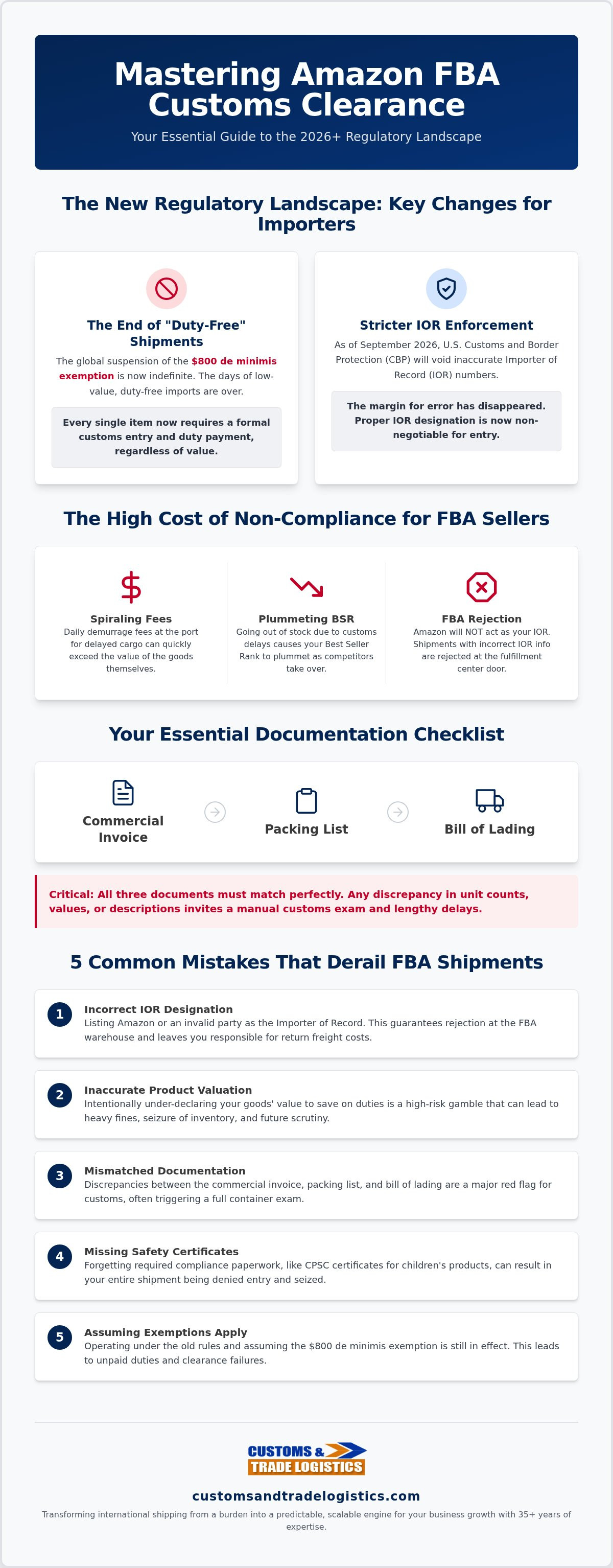
5 Common Mistakes That Derail Amazon FBA Shipments
Even the most experienced sellers can find their growth halted by a single administrative oversight. Precision isn't just a goal; it's a requirement for survival. We've seen many businesses lose thousands in revenue because they treated paperwork as an afterthought. Avoiding these common pitfalls ensures your inventory moves from the ocean leg to the fulfillment center without a hitch. When customs clearance for Amazon FBA shipments is handled correctly, your logistics chain stays invisible, allowing you to focus on selling.
- Inaccurate IOR Registration: As of September 18, 2026, CBP began voiding Importer of Record numbers that use a registered agent's address rather than the importer's actual physical location.
- Data Mismatches: If your Commercial Invoice and Packing List don't align perfectly, you're inviting a manual inspection that can sideline your goods for weeks.
- Bonding Oversights: Relying on single-entry bonds for frequent shipments is a costly mistake that slows down the entry process and increases per-shipment costs.
- PGA Neglect: Failing to account for agencies like the FDA or FCC can lead to immediate shipment seizures at the port of entry.
- Scheduling Gaps: Missing an Amazon delivery window because your carrier wasn't coordinated with your broker results in expensive storage fees and late-arrival penalties.
The Continuous Bond vs. Single Entry Bond
A customs bond acts as a financial guarantee to the U.S. government that all duties and taxes will be paid. For most Amazon sellers, a continuous bond is the only logical choice. It covers all your entries for a full year and simplifies customs clearance for Amazon FBA shipments by removing the need to secure a new bond for every container. In the 2026 fiscal year, with high Section 301 tariffs still in play, a continuous bond provides the predictability your budget needs. It's a one-time annual setup that replaces the administrative burden of per-shipment bonding.
PGA Compliance: Beyond Just Customs
Many products fall under the jurisdiction of Partner Government Agencies (PGAs). If you sell toys or children's products, you must comply with the CPSC eFiling requirements that went into effect on July 8, 2026. This requires electronically filing Certificates of Compliance at the exact time of entry. Whether it's FCC filings for electronics or FDA oversight for supplements, your broker must manage these layers of compliance simultaneously. You can secure your supply chain with our expert brokerage services to ensure every agency requirement is met before your cargo arrives.
How Professional Brokerage Simplifies Your Amazon Growth
Growing an e-commerce brand is a full-time job that requires your total focus. You shouldn't have to spend your nights worrying about whether your latest container will clear the port or get stuck in a red-tape nightmare. Choosing a partner with 35+ years of experience means you're putting your business in a "safe pair of hands." We specialize in customs clearance for Amazon FBA shipments because we know that for a small business, a single mistake isn't just a fee; it's a threat to your survival. By moving the heavy administrative burden of compliance onto our shoulders, you gain the peace of mind needed to focus on product development and marketing.
As your volume grows, your logistics needs change. Transitioning from small parcels to full containers requires more than just a software platform; it requires a tailored strategy. Our FBA freight forwarding services are designed to scale alongside you, providing the oversight needed to manage complex factory-to-warehouse movements across all US ports. For those just beginning their journey, we offer a mentor-style approach to import logistics for startups. We don't just file your entries; we help you understand the logic behind the regulations so you can build a resilient, long-term business.
The Benefits of a Family-Owned Logistics Partner
In an industry dominated by automated ticketing systems and faceless corporations, we choose a different path. Being family-owned and operated means you get personalized communication and direct access to seasoned trade consultants. We value the personal connection as much as the technical compliance. When you have a question about your customs clearance for Amazon FBA shipments, you won't get a generic auto-reply. You'll get a dedicated advocate who is deeply invested in your success as an SME and acts as a knowledgeable bridge to the global marketplace.
Streamlining Your Supply Chain for 2026
Efficiency is the key to maintaining your margins in the 2026 high-tariff environment. By managing your entries correctly from the start, we help you reduce overhead and avoid the hidden costs of port delays or shipment rejections. Understanding custom brokerage service fees is a vital part of your 2026 budgeting process. We provide transparent, predictable structures that allow you to plan your growth with confidence. Your next step toward a seamless logistics chain is simple. Reach out for a comprehensive quote today and let us handle the complexities of the border while you build your Amazon empire.
Secure Your Global Supply Chain for 2026
The complexities of international trade don't have to be a barrier to your success. By mastering the hierarchy of documentation and staying ahead of the latest tariff shifts, you can turn a potential administrative nightmare into a predictable, scalable logistics engine. Remember that accuracy in your Importer of Record data and HTS classifications is the only true shortcut to a seamless FBA delivery. Navigating customs clearance for Amazon FBA shipments requires precision, but it also requires a partner who understands the high stakes of your Best Seller Rank.
You don't have to manage these shifting regulations alone. Our family-owned team brings 35+ years of logistics expertise to every entry, acting as a "safe pair of hands" for your brand. We are specialists in China-to-US imports and provide comprehensive port coverage across the USA to ensure your inventory stays in stock. Let our family-owned team manage your Amazon FBA customs clearance today. Your business deserves the security of a veteran partner who values your growth as much as you do. Let's get your products moving.
Frequently Asked Questions
Does Amazon clear customs for my FBA shipments?
No, Amazon won't clear customs for you. They strictly refuse to act as the Importer of Record for any shipment. This means you are legally responsible for ensuring your goods comply with U.S. Customs and Border Protection regulations before they reach the warehouse. If your inventory arrives at an FBA center without prior clearance and duty payment, Amazon will reject the delivery. You'll then be responsible for all return shipping costs and storage fees.
What is an Importer of Record (IOR) and why do I need one?
An Importer of Record (IOR) is the entity legally responsible for the accuracy of a shipment's documentation and the payment of all duties and taxes. You need an IOR because U.S. Customs requires a designated party to be liable for compliance with federal regulations. As of September 18, 2026, your IOR registration must include your actual physical business address rather than a registered agent's office to remain valid and avoid shipment delays.
Can I use Amazon’s Tax ID for my customs entry?
No, you cannot use Amazon's Tax ID or EIN for your customs entry. Attempting to list Amazon as the Importer of Record or using their tax information is a direct violation of their seller policies. You must use your own business's federal Tax ID or social security number to register as the importer. Incorrectly identifying the IOR is one of the most common reasons for customs clearance for Amazon FBA shipments to be derailed or rejected.
How much are customs duties for products imported from China in 2026?
Duty rates vary based on your specific product's HTS classification. However, most goods imported from China in 2026 remain subject to Section 301 tariffs, which often add an additional 25% or 7.5% duty. It's also vital to remember that the $800 de minimis exemption was suspended in mid-2025 and remains suspended indefinitely as of June 2026. This means that every shipment, regardless of its low value, is now subject to formal entry and duty payments.
What happens if my shipment is held by US Customs?
If U.S. Customs holds your shipment, they will typically issue a detention notice requesting more information or a physical exam. This often happens due to paperwork inconsistencies or suspected under-valuation of goods. During this time, your cargo will sit in a bonded warehouse, accumulating daily storage fees. These delays can cause your Amazon listings to go out of stock, which negatively impacts your Best Seller Rank and overall business momentum.
Do I need a customs broker for small FBA shipments?
Yes, a customs broker is highly recommended for all FBA shipments in 2026. The suspension of de minimis exemptions means that even small, low-value parcels now require formal entry documentation that was previously unnecessary. A professional broker manages the complex electronic filings and ensures your paperwork meets the latest CBP standards. This oversight protects you from unexpected penalties and ensures that customs clearance for Amazon FBA shipments remains a smooth, predictable process.
How long does the customs clearance process take for FBA?
The standard clearance process typically takes between 24 and 48 hours if all paperwork is submitted electronically before the ship arrives. However, if your shipment is selected for a physical intensive exam, the timeline can extend by a week or more. We recommend a "pre-clearance" strategy where your broker files the entry data at least five days before the vessel hits the dock. This proactive approach helps bypass port congestion and keeps your inventory moving.
What is a Continuous Customs Bond and do I need one?
A Continuous Customs Bond is an annual guarantee that covers all your import entries at every U.S. port for a full 12 months. You need one if you plan to import multiple shipments per year, as it's significantly more efficient than purchasing a Single Entry Bond for every individual container. It streamlines the entry process and serves as a financial promise to CBP that all required duties and taxes will be paid on time.


