
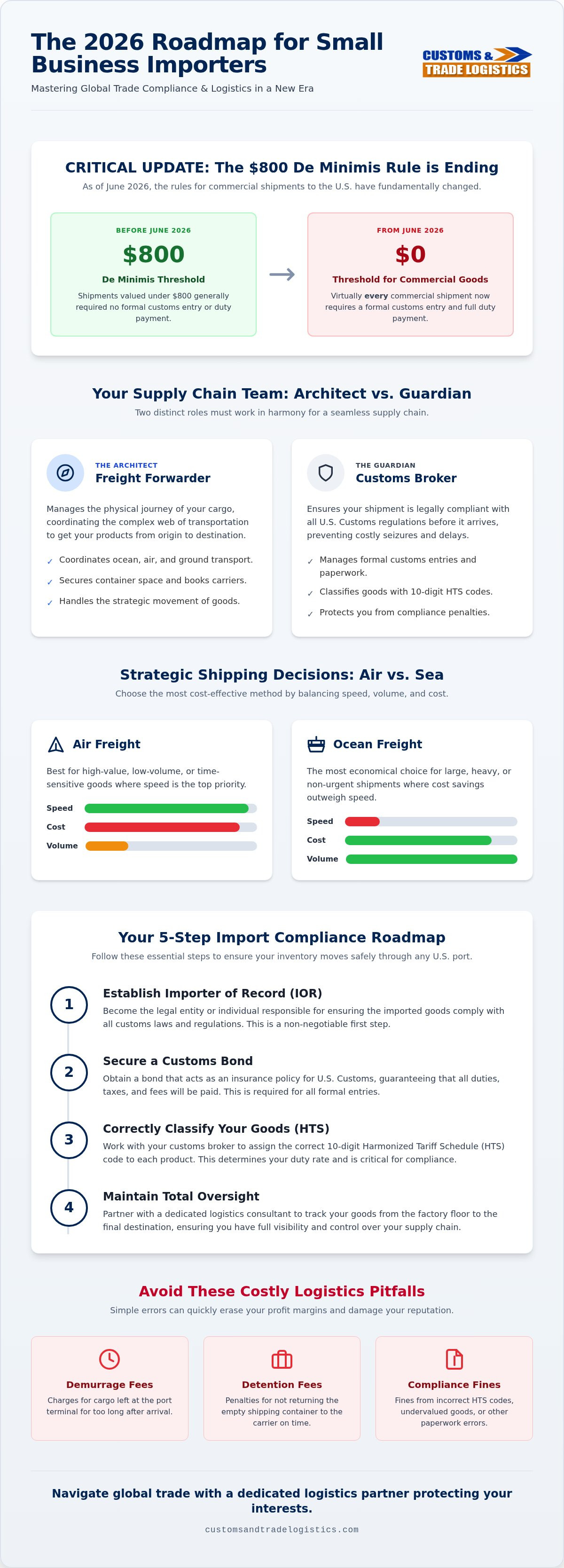
Did you know that as of June 2026, the $800 de minimis threshold is officially a thing of the past, meaning every commercial shipment now requires a formal customs entry and full duty payment? If you feel like the rules for international freight logistics for small business change faster than you can track them, you're certainly not alone. It's exhausting to worry about hidden shipping fees or the sudden fear of your inventory being seized at the border because of a minor paperwork error. You want a supply chain that just works, without the administrative stress or the constant threat of non-compliance with US Customs.
We've designed this 2026 roadmap to replace that anxiety with a sense of security and partnership. You'll learn how to master the complexities of global shipping and customs compliance through a strategic approach tailored specifically for small to medium-sized importers. We will walk through the latest Section 301 tariff updates, explain the 10-digit HTS classification process, and show you how to maintain total oversight of your goods from the factory floor to their final destination. By the end of this guide, you'll have the tools to build a resilient, compliant operation that supports your growth rather than slowing it down.
Key Takeaways
- Understand the critical 2026 changes to the de minimis threshold and how they impact your duty payments and paperwork requirements.
- Learn to coordinate the "architects" and "guardians" of your supply chain to streamline international freight logistics for small business without sacrificing compliance.
- Determine the most cost-effective shipping method for your goods by weighing the speed of air freight against the volume benefits of ocean containers.
- Follow our clear roadmap to obtain your Importer of Record status and choose the right customs bond to keep your inventory moving safely through any US port.
- Discover the value of a dedicated logistics mentor who provides the oversight and protective care needed to navigate global trade with total confidence.
Navigating the Complexity of International Freight Logistics for Small Business
The scale of global trade often feels overwhelming for first-time importers. It's not just about moving a box from Point A to Point B; it's about managing a web of regulations, carriers, and shifting deadlines. For many, the intimidation factor is real. Small businesses face higher risks in the shipping chain because they don't have the massive volume or deep pockets of corporate giants. When a shipment gets stuck, it isn't just a line item on a spreadsheet. It's your inventory, your capital, and your reputation on the line.
By 2026, the standard strategy has shifted. We've moved beyond the "just-in-time" model that left so many shelves empty during past disruptions. Today, successful growth requires a "just-in-case" mindset. This means building resilience into your supply chain by diversifying routes and maintaining better oversight. A seasoned logistics consultant acts as a stabilizing force here. They bridge the gap between your local operations and the global marketplace, acting as a knowledgeable mentor who protects your interests at every turn.
The True Cost of Logistics Errors
Errors in international freight logistics for small business are expensive. It isn't just the duty payment itself that catches people off guard. Hidden fees like demurrage, which are charges for cargo left at the port too long, and detention fees for late container returns can quickly erase your profit margins. These delays don't just drain your bank account; they erode customer trust. When you have professional oversight, that heavy administrative burden lifts. You gain the psychological relief of knowing a "safe pair of hands" is watching every port and checkpoint to prevent these costly surprises.
Scalability Through Outsourcing
Many entrepreneurs start with a DIY approach, but trying to handle every document yourself often limits your ability to scale. You might manage one or two occasional shipments, but building a consistent, predictable supply chain requires a different level of expertise. Transitioning to a managed service allows you to focus on selling while a professional freight forwarder coordinates the physical movement of your goods.
If you're just starting out, you might find our guide on import logistics for startups helpful for laying a solid foundation. Outsourcing doesn't mean losing control. It means gaining a partner who has spent 35 years navigating US Customs ports. This expertise ensures your business stays compliant while you focus on reaching new customers and growing your brand.
Breaking Down the Logistics Chain: Freight Forwarding vs. Customs Brokerage
Does the person moving your freight also handle the legal paperwork at the border? Not always. In the world of international freight logistics for small business, these are two distinct roles that must work in perfect harmony. While one focuses on the physical movement, the other focuses on legal compliance. Understanding how they differ will help you avoid common pitfalls that lead to delayed shipments and unexpected bills.
What a Freight Forwarder Actually Does
Think of the forwarder as the architect of your cargo's journey. They manage the complex web of ocean, air, and ground transportation to get your products where they need to go. They don't just book a ship; they manage carrier relationships and secure container space during peak seasons when capacity is tight. A freight forwarder is the strategic partner who handles the physical coordination and movement of your goods across international borders.
The Essential Role of the Customs Broker
If the forwarder is the architect, the customs broker is the guardian of compliance. Their job is to ensure your shipment meets all US Customs regulations before it ever touches the dock. This includes the precise classification of your goods using the 10-digit Harmonized Tariff Schedule (HTS). Just as you'd carefully complete a customs form for a personal package, a broker manages the much more complex formal entries required for commercial trade.
They ensure all filings are accurate and submitted on time to prevent costly delays. For a deeper look at this process, check out our resource on customs clearance services us. Brokers act as your advocate, communicating directly with government agencies to keep your goods moving without legal friction.
The Benefits of an Integrated Approach
Why should a small business look for an integrated service? Managing separate providers often leads to communication gaps that cause expensive errors. When you consolidate these roles, you gain a partner who understands the entire lifecycle of international freight logistics for small business. This creates a "safe pair of hands" that maintains total oversight from port to porch. This end-to-end management reduces your administrative stress and keeps your supply chain predictable. If you're ready to lift that burden, our customs and logistics consulting provides the seasoned advocacy your business needs to grow.
Strategic Shipping Decisions: Air, Sea, and Volume Optimization
How do you decide between the slow boat and the fast plane? Making the right call in international freight logistics for small business requires balancing three critical factors: weight, volume, and product value. In 2026, the transit landscape is more volatile than ever, with Panama Canal restrictions impacting East Coast routes and shifting fuel surcharges. Choosing the wrong mode doesn't just delay your goods; it can evaporate your entire profit margin before the inventory even arrives.
Choosing the Right Mode for Your Product
Ocean freight remains the backbone of global trade, especially for bulky or heavy items. You'll need to choose between Full Container Load (FCL) and Less than Container Load (LCL). If you have enough inventory to fill a 40ft container, FCL is often more secure and cost-effective, with 2026 rates from China to the US West Coast typically ranging between $2,000 and $3,800. For smaller batches, LCL allows you to share space, though it requires more handling at the port. If you're looking to expand your reach beyond imports, the SBA guide to exporting provides a great foundation for small firms entering the global stage.
Air freight is the "express lane," but it comes at a premium. With standard rates currently between $2.50 and $6.00 per kg, it's best reserved for high-value electronics, fashion, or urgent restocks. Navigating the "China Factor" is particularly complex due to product-specific Section 301 tariffs. Our specialized import from China logistics consulting helps you calculate the true ROI of these modes, ensuring you don't overpay for speed you don't actually need.
Redistribution and Final Delivery
The journey doesn't end when the ship docks. For e-commerce and Amazon sellers, the "last mile" is often the most stressful part of the chain. You need a seamless transition from the port to regional distribution centers or directly into the Amazon network. This requires precise coordination to meet strict delivery windows and labeling requirements.
Efficient redistribution ensures your capital isn't tied up in a port warehouse. By using dedicated FBA freight forwarding services, you can automate the movement of goods from the supplier to the fulfillment center. This end-to-end oversight means you can focus on marketing and sales while we handle the heavy lifting of getting your products onto the shelves and into your customers' hands.
The Small Business Roadmap to Import Compliance and Paperwork
How do you ensure your cargo doesn't just arrive at the port, but actually clears the gate? Compliance is the bedrock of successful international freight logistics for small business. It starts with your status as the Importer of Record (IOR). This means you're the party responsible for ensuring the goods are legally imported and all duties are paid. You'll also need a Customs Bond. For most growing businesses, a continuous bond is better than a single-entry bond because it covers all your shipments for a year, saving you administrative headaches. As of October 2026, new regulations require even informal postal entries to secure a bond, making this step more critical than ever.
Have you double-checked your 10-digit HTS codes lately? With the 2026 regulations, accuracy is mandatory. Every commercial shipment, regardless of value, now requires a formal entry. Mastering this classification process for your entire SKU list is a proactive step that prevents your inventory from getting stuck at the border. It's about moving from guesswork to certainty.
Essential Documentation Checklist
What does US Customs actually look for when your shipment arrives? Accuracy is the only way to avoid the dreaded inspection queue. Your documentation must be consistent across every form. We recommend keeping a digital folder for each shipment containing these essentials:
- Commercial Invoice: This must show the true purchase price, country of origin, and a detailed description of the goods.
- Packing Lists: These must match your invoice exactly. If the box count or weight is off, it triggers an audit.
- Certificates of Origin: These are vital for claiming lower duty rates under specific trade agreements.
- Bill of Lading: This is your contract of carriage and your title to the goods.
Avoiding Common Compliance Pitfalls
Why is misclassification so dangerous? It's the number one cause of small business fines and audits. You might think your broker handles everything, but here's a hard truth: the importer, not the broker, is legally responsible for data accuracy. If you provide the wrong information, you're the one who pays the penalty. In 2026, the Merchandise Processing Fee (MPF) is 0.3464% of your customs value, with a minimum of $32.71 per entry. If your paperwork is messy, these fees are just the beginning of your costs.
Proactive consulting is the best way to manage international freight logistics for small business without risking your bottom line. By the time the cargo arrives at the port, it's often too late to fix errors without a penalty. If you want to ensure your paperwork is bulletproof before the ship ever leaves the dock, our customs clearance services provide the seasoned advocacy you need to stay compliant and profitable.
Partnering for Growth: Why a Dedicated Logistics Consultant Matters
In an era of rapid automation, many importers are tempted by digital marketplaces that promise a "self-service" approach to global trade. While a login and a dashboard might look efficient, they often fail when your cargo hits a real-world snag at the port. Managing international freight logistics for small business isn't just about moving data; it's about having a seasoned advocate who knows exactly how to respond when a customs officer flags your shipment. A digital platform can't replicate 35 years of industry experience or the personal connection of a family-owned partner who treats your inventory as if it were their own.
Experience is something you simply can't code. Our team provides end-to-end oversight that spans from your foreign supplier's dock to the final redistribution center. This "safe pair of hands" approach ensures that no stage of the journey is overlooked. By acting as a knowledgeable bridge between your small-scale operation and the global marketplace, a consultant transforms a complex administrative burden into a stabilized, predictable supply chain. This dedicated management allows you to focus on your brand's growth while we handle the intricate details of movement and facilitation.
A Personalized Approach to Global Trade
Do you want to be a support ticket number or a valued partner? When exceptions occur, such as a random customs exam or a port delay, direct communication is your most valuable asset. A dedicated consultant provides instructional phrasing and clear answers rather than automated responses. We act as your advocate during customs exams, ensuring that government agencies have the precise data they need to release your goods. This protective care is especially vital for niche products that require nuanced HTS classification to avoid overpaying on duties.
Many business owners worry about the cost of professional help, but brokerage fees often pay for themselves through duty savings and the avoidance of fines. One classification error in 2026 can lead to penalties that far exceed the price of expert oversight. We help you identify the most efficient routes and compliance strategies, turning logistics from a "cost of doing business" into a strategic advantage.
Planning Your Next Move
As you look toward the rest of 2026, it's the perfect time to audit your current shipping process for efficiency. Are you overpaying for air freight when ocean containers would suffice? Is your SKU list fully compliant with the latest Section 301 updates? Understanding the custom brokerage service fees involved in your operation is the first step toward better budgeting and higher margins.
Don't let the scale of international operations overwhelm your team. You deserve a partner who is deeply invested in your success and capable of managing every granular procedural detail. Let Customs and Trade Logistics manage your global supply chain so you can get back to what you do best: growing your business.
Securing Your Supply Chain for 2026 and Beyond
You've now seen how the landscape of international freight logistics for small business is shifting. From the end of de minimis thresholds to the nuances of HTS classification, the complexity is real but manageable with the right roadmap. By integrating freight forwarding with professional customs brokerage and choosing the right shipping mode for your specific volume, you can turn a source of anxiety into a competitive advantage. It's about moving from a reactive stance to a proactive strategy that protects your margins and your reputation.
At Customs and Trade Logistics, we've spent over 35 years acting as a safe pair of hands for importers. Our family-owned firm specializes in China-to-US imports and provides comprehensive coverage across all US ports nationally. Ready to lift the administrative burden from your shoulders? Request a Consultation with Our Logistics Experts today. Your global growth is within reach, and with a dedicated partner by your side, you can navigate the path ahead with total confidence.
Frequently Asked Questions
What is the difference between a freight forwarder and a customs broker?
A freight forwarder manages the physical movement of your goods across borders, while a customs broker ensures your shipment complies with federal laws. Think of the forwarder as the travel agent for your cargo, booking space on ships or planes. The broker acts as your legal representative with US Customs, handling the complex 10-digit HTS classifications and duty payments. Using a partner who handles both roles provides a seamless experience for your supply chain.
Can a small business act as its own Importer of Record?
Yes, a small business can and often must act as its own Importer of Record (IOR). This status means your company is legally responsible for the accuracy of all documentation and the payment of duties and taxes. While you don't need a special license to be an IOR, you are liable for any errors or misclassifications. Most businesses partner with a consultant to manage these risks and ensure total compliance with US Customs regulations.
How much does international freight logistics typically cost for a small business?
Costs for international freight logistics for small business vary widely based on the weight of your cargo and the shipping mode you choose. You'll typically encounter ocean freight rates, air freight surcharges, and professional brokerage fees for filing entries. While these expenses are a necessary part of global trade, they often pay for themselves by preventing costly customs delays and fines. We help you calculate these landed costs early to protect your profit margins.
Do I need a continuous customs bond if I only import twice a year?
Even if you only import twice a year, a continuous customs bond is often the most strategic choice in 2026. New regulations have increased the requirements for customs entries, making single-entry bonds more administratively heavy and expensive over time. A continuous bond covers all your shipments for a full year and simplifies the clearance process at any US port. It provides the peace of mind that your business is always ready to move inventory.
What are the most common reasons for customs delays in 2026?
The most common reasons for delays in 2026 include incorrect 10-digit HTS classifications and missing data required by the new postal entry process. US Customs has increased its focus on data accuracy following the suspension of the de minimis threshold. If your commercial invoice doesn't match your packing list exactly, or if your bond information is outdated, your cargo will likely be flagged for an exam. Proactive oversight is the best way to avoid these bottlenecks.
How do I choose between air and ocean freight for my first shipment?
Choosing the right mode depends on your product's weight and how quickly you need it on the shelf. Air freight is ideal for high-value or lightweight items that need to arrive in days, though it carries a higher premium. Ocean freight is the standard for international freight logistics for small business, offering much lower costs for heavy or bulky inventory. We help you weigh these options to find the best balance for your cash flow.
Does Customs and Trade Logistics handle Amazon FBA shipments?
Yes, we provide specialized support for Amazon FBA and e-commerce sellers. Navigating the specific labeling and delivery requirements of Amazon warehouses can be intimidating, but our team manages the entire process from the foreign supplier to the final redistribution center. We ensure your inventory meets all compliance standards so it's accepted at the fulfillment center without delay. This end-to-end management allows you to focus on growing your sales while we handle the logistics.
What documentation do I need to import goods from China to the US?
To import goods from China, you'll need several essential documents to clear US Customs. These include a detailed commercial invoice showing the true purchase price, a precise packing list, and a bill of lading from the carrier. You may also need a certificate of origin to qualify for specific trade agreements or to manage Section 301 tariffs. Keeping these documents consistent and accurate is the key to a predictable and stress-free supply chain.


